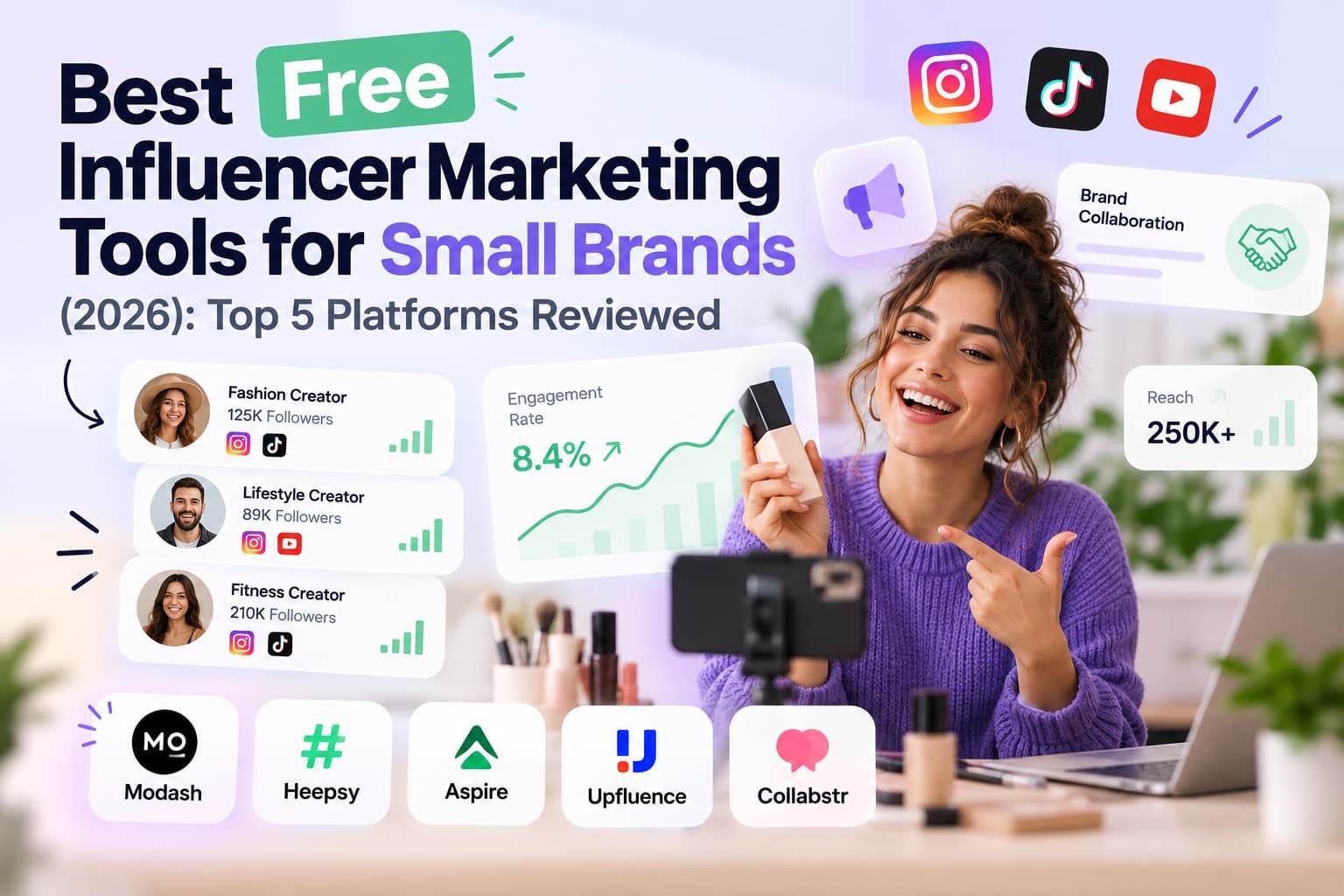
Small brands do not need enterprise software to start influencer marketing. The real question is simpler: which free influencer marketing platforms and low-cost tools actually let you find creators, run a campaign, and measure results without a monthly software bill that eats your entire budget?
This guide answers that question directly. Platforms were evaluated with a strict eligibility test: meaningful ongoing free access, or inexpensive self-service pricing suitable for small brands. A free demo or a short trial does not count. The focus is what you can realistically finish for $0, where the free plan stops, and when it makes sense to pay.
Quick answer
The strongest free influencer marketing platforms for small brands right now are:
- Afluencer — best overall free marketplace for posting campaigns and receiving creator applications.
- Ainfluencer — best truly free-forever option, with unlimited search, campaigns, messaging, and escrow.
- Shopify Collabs — best free option if you already sell on Shopify, covering affiliate links, gifting, and automatic payouts.
- Collabstr — best pay-as-you-go marketplace. Free to browse and hire; you pay a fee only when you book.
- Elev8or — best low-cost self-serve option, with a usable free credit tier and paid plans starting under $25 a month.
These tools are built for small brands, startups, and first influencer programs. They are not replacements for enterprise platforms. They close the gap that matters first: testing the channel without a software line item. If the goal is one or two campaigns this quarter, any of the top three can get you there.
What counts as free
Many lists mix free trials, thin freemium tiers, and genuine free access. This guide uses a stricter standard:
- Free forever. Ongoing access, no forced expiry, and no credit card.
- Meaningful freemium. Enough to complete at least one real campaign: discover, contact or receive applications, and manage a basic workflow.
- Transaction-based. Free to use the platform. You pay only when you hire or pay a creator.
- Low-cost. Self-serve plans under roughly $50 a month.
A trial that ends after 7–14 days and then forces a paid plan does not qualify. Independent roundups such as G2’s free influencer marketing platforms category show how rare a usable free tier is. The test here is narrower: what a brand can finish before it hits a hard wall.
What you actually get for $0
| Platform | Actually free? | Card required? | Discovery | Contact / applications | Run a campaign | Transaction fees | Major limitation | First paid upgrade | Best for |
| Afluencer | Yes, free plan | No | Directory search | Unlimited applicants, limited invites | Yes | None on free | Limited outbound invites | About $49/mo | Brands that want creators to apply |
| Ainfluencer | Yes, free forever | No | Full search | Unlimited messaging | Yes | Fee on creator payout | Marketplace model only | Optional paid plans | Zero-subscription campaigns |
| Shopify Collabs | Yes, for Shopify merchants | No | Network and invites | Applications and invites | Yes, affiliate | 2.9% on auto payouts | Shopify-only; thinner discovery | None | Shopify ecommerce brands |
| Collabstr | Yes, free plan | No | Browse marketplace | Direct hire | Yes | 10% on hires | Fees add up | About $249/mo | One-off or occasional hires |
| Elev8or | Yes, limited credits | No | Search and filters | Outreach | Limited | Platform fees on some campaigns | Credit limits on free | About $19–25/mo | Testing with light structure |
If a platform cannot support discovery, contact, and a basic campaign without payment, it does not belong in a free guide.
Afluencer: best free platform when you want creators to apply
Free-plan verdict: 4/5
Afluencer gives small brands a free plan strong enough to run real campaigns. You can post Collabs, search the creator directory, and receive unlimited applications. Outbound invites are limited. Inbound applications are not. That inbound model suits brands that do not yet have a creator list and do not want to spend hours cold-messaging.
What you can do for $0
- Post campaign briefs and let verified creators apply.
- Search the directory and review profiles.
- Message applicants and manage basic collaboration details.
- Start with no credit card.
Where the free plan stops
Outbound volume is restricted. Advanced search, higher invite limits, and priority features sit behind paid plans starting around $49 a month. Brands that want to reach dozens of creators a week will feel that limit quickly.
Hidden costs
None on the free tier itself. You still pay creators separately. Applicant quality depends on how clear the Collab brief is. Vague briefs attract weak applications.
Best small-brand use case
A first campaign with no existing creator list, when you would rather have creators come to you. Useful for product seeding or a simple sponsored post without building an outreach process.
When it is worth upgrading
When you need a higher daily invite volume, or several Collabs running at once. Many small brands stay on the free plan for months if inbound applications cover their volume.
Ainfluencer: best truly free-forever option
Free-plan verdict: 5/5
Ainfluencer does not cap the free tier the way most tools do. Brands get unlimited search, campaign posting, messaging, and escrow-protected payments. There is no monthly subscription. The platform takes a service fee from creator payouts, so the brand-side software cost stays at zero until a deal is completed.
What you can do for $0
- Search a verified creator database across Instagram, TikTok, and YouTube.
- Post campaigns and receive applications or replies.
- Message freely and run the collaboration workflow.
- Use escrow so neither side has to pay first.
Where the free plan stops
Platform use is free. The trade-off is the marketplace model and the fee on completed deals. Brands that want heavy outbound control, rather than inbound applications, may find the workflow less flexible than a CRM.
Best small-brand use case
A zero software budget, and a willingness to work in a marketplace where creators apply or respond to posted campaigns. A clean way to test whether paid creator content can drive sales before any software cost.
When it is worth upgrading
Only if you later need higher-volume tooling or managed services. Most small brands can run a real program on the free tier if the marketplace approach fits.
Shopify Collabs: best free option for Shopify brands
Free-plan verdict: 4/5 for Shopify users
Shopify Collabs is free to install for eligible Shopify merchants. It covers creator recruitment, product gifting, affiliate links and codes, sales tracking, and automatic commission payouts inside Shopify admin. The only platform cost is a 2.9% processing fee on automatic payouts. Attribution is cleaner than most third-party tools for a pure ecommerce brand. Shopify’s 2026 platform guide treats Collabs as that ecommerce workflow, not as a general discovery database.
What you can do for $0
- Create an application page or invite creators directly.
- Send product gifts tracked through Shopify.
- Generate affiliate links and discount codes.
- Track sales and pay commissions automatically.
Where the free plan stops
Discovery is thinner than a marketplace. Creator network access has eligibility rules, and the tool only works if you are already on Shopify.
Best small-brand use case
Any Shopify store that wants an affiliate-style creator program with almost no software cost. Strongest for brands that already gift products and want those relationships to become tracked affiliate sales.
When it is worth upgrading
Usually it is not. If you outgrow it, you move to a fuller platform rather than a paid tier of Collabs. The native integration is the reason to stay.
Collabstr: best free-to-browse marketplace
Free-plan verdict: 4/5
Collabstr lets brands browse creators, many of them focused on UGC and package-based work, view rates, and hire directly. The free plan has no monthly fee. You pay a 10% marketplace fee on completed hires. Higher tiers lower that fee. It fits a brand that wants to test one or two creators with no recurring cost. Afluencer’s 2026 marketplace guide describes the same browse-then-hire pattern.
What you can do for $0
- Search and filter creators.
- View packages and rates.
- Hire with escrow protection.
- Manage the transaction inside the platform.
Where the free plan stops
Advanced campaign posting, higher reporting limits, and lower fees require paid plans, around $249 a month and up. Frequent campaigns eventually make a lower transaction fee, or better reporting, worth paying for.
Best small-brand use case
Occasional hires when you want package pricing and no monthly commitment. Particularly useful for UGC, where you need finished assets rather than an ongoing social posting relationship.
Elev8or: best low-cost self-serve option
Free-plan verdict: 3.5/5 to 4/5
Elev8or offers a free plan with a limited number of credits and no credit card. Paid plans start around $19–25 a month on annual billing and stay self-serve, with no annual lock-in. It sits between a pure marketplace and mid-tier software. Elev8or’s free-platforms review makes the same point: a usable free tier is rare, and most “free” tools are trials.
What you can do for $0
- Discover creators and run basic analysis.
- Start limited campaigns or outreach.
- Test the workflow before paying.
Best small-brand use case
Teams that want more structure than a marketplace, but still need to stay under $50 a month.
Best free platform by use case
- Finding micro influencers: Ainfluencer or Afluencer.
- First campaign with zero budget: Afluencer or Ainfluencer.
- Marketplace and inbound applications: Afluencer or Collabstr.
- Product gifting plus affiliate: Shopify Collabs, if you are on Shopify.
- Instagram or TikTok: Ainfluencer, Afluencer, or the native creator marketplaces.
- Ecommerce on Shopify: Shopify Collabs first, then Afluencer or Ainfluencer.
- Zero monthly software budget: Ainfluencer or Collabstr.
A brand that needs three micro-influencers for a launch is not the same job as a Shopify store building an affiliate roster. Match the tool to the immediate job.
Free platforms versus paid software
Free and low-cost platforms are strong at discovery, basic campaign setup, and first partnerships. They fall short on deep CRM, multi-touch attribution, enterprise governance, rights management, and high-volume automation.
If you are managing dozens of ongoing creator relationships, need order-level Shopify attribution across many campaigns, or require brand-safety tooling at scale, you will outgrow these tools. Hootsuite’s 2026 tools guide and Dash Social’s platform roundup cover that next tier by use case. The switch is usually driven by operational pain. When spreadsheets and inbox threads cost more time than a $50–200 monthly tool, the upgrade is rational.
What free influencer platforms do not give you
- A deep creator CRM and relationship sequences.
- Multi-market governance and approvals.
- Enterprise-depth fraud and brand-safety modules.
- Complex BI connectors and custom reporting.
- High-volume automated outreach without limits.
Most free platforms also stop short of high-volume outreach. Turning a creator list into ongoing conversations still means manual messaging, or a separate tool, once you leave the marketplace workflow.
Disclosure rules still apply. Any paid, gifted, or discounted relationship is a material connection and needs a clear disclosure. The clearest official starting point is the FTC’s Disclosures 101 for Social Media Influencers, with the Endorsement Guides and the Endorsements, Influencers, and Reviews hub.
These gaps are intentional. Free tools optimize for access, not enterprise scale.
When a small brand should pay
Pay when:
- Monthly campaigns are hitting free-tier limits.
- You need clearer tracking of sales attributed to creators.
- Spreadsheets and inboxes have become the bottleneck.
- Transaction fees cost more than a flat monthly plan.
Until then, the free and low-cost options above are the better start. Buying mid-tier software before the channel is proven is a common waste.
How these platforms were evaluated
Priority went to:
- Real ongoing free or very low-cost access, not a trial.
- A full basic workflow for $0 or near $0.
- Transparent fees and limits.
- Fit for small brands and first programs.
- Publicly available information as of 2026.
Enterprise and mid-market platforms were left out so the guide stays on the free and low-cost job. Speed from signup to a live campaign, without a sales call, mattered more than theoretical feature depth. G2’s 2026 small-business test of free plans draws a similar line between a workable free plan and a demo that does not count.
Conclusion
Free and low-cost influencer platforms are mature enough in 2026 that a small brand can test, and sometimes run, a real program without enterprise software. Pick the platform that matches the way you want to work — inbound applications, direct hire, or Shopify-native — and pay only after the channel proves itself.
About the author
Aravindh Kumar is an ecommerce and Instagram growth expert with 8+ years of experience in online selling. He has worked with 500+ brands - including Forbes-listed companies - He has helped 200+ Instagram businesses grow their online presence.