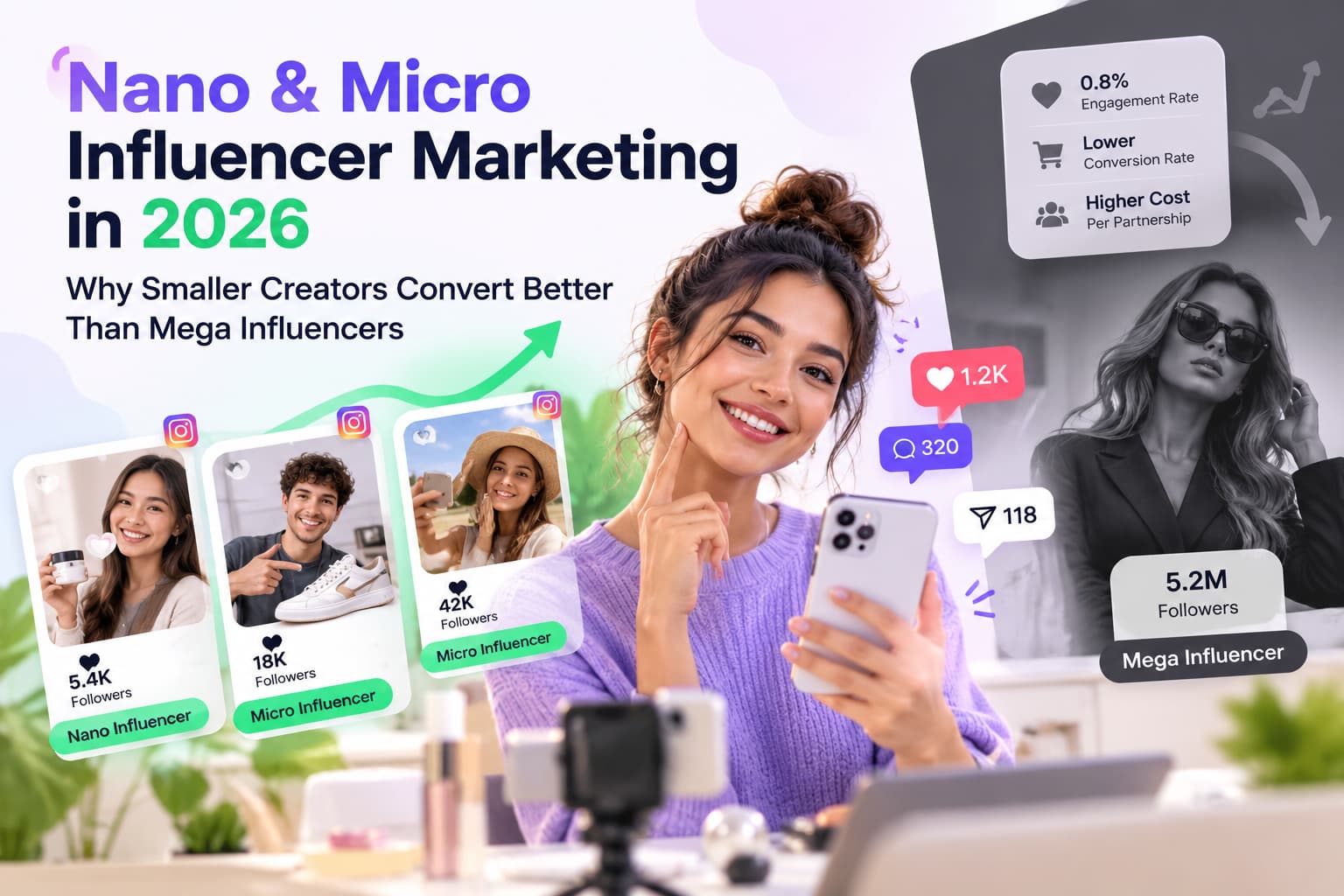
In 2026, nano and micro influencers outperform mega creators on engagement, trust, and conversion because their smaller, niche audiences treat recommendations like peer advice—not ads. Data shows nano engagement at 4–8% (vs. <1.5% for mega), with 75.9% of Instagram influencers now nano-tier. Brands win by treating them as a portfolio, not one-offs, and tracking real ROI. Mega still works for mass awareness, but for performance, smaller is smarter.
Quick Verdict Table
| Goal | Best Tier | Why |
| Highest conversion efficiency | Nano + Micro portfolio | Trust, relevance, cost efficiency |
| Balanced reach + conversion | Micro | Strong engagement with usable scale |
| Mass awareness / prestige | Mega or high Macro | Raw reach and cultural impact |
| Local / hyper-niche campaigns | Nano | Community density and authenticity |
| High-volume authentic UGC | Nano army | Low-cost, scalable content production |
What Are Nano and Micro Influencers?
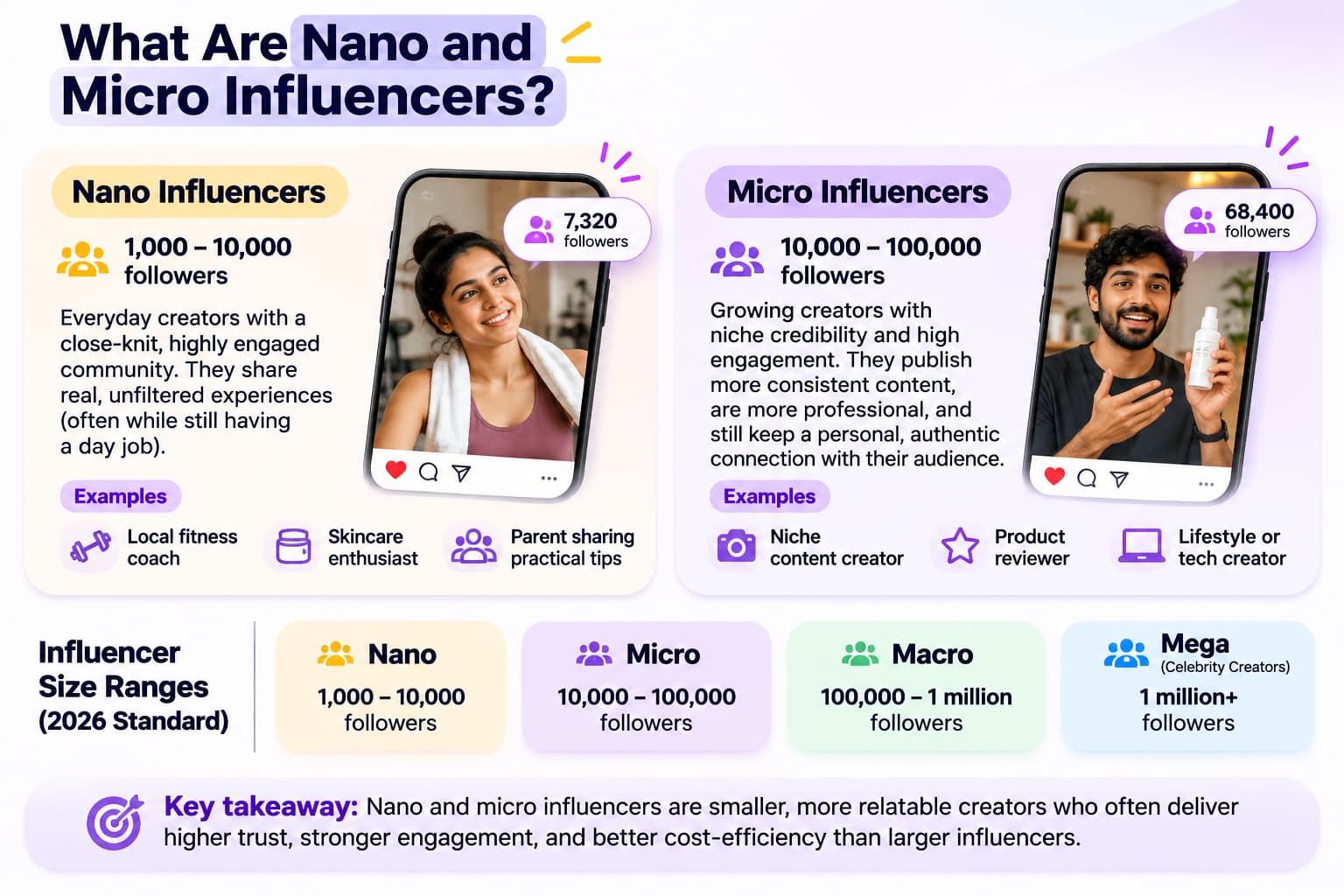
Nano influencers typically have between 1,000 and 10,000 followers. Most never set out to become professional influencers. They’re the local fitness coach posting real workouts, the skincare person documenting what actually works on their skin, or the parent sharing practical, unfiltered advice. Their audiences often feel more like a group of friends or a tight community than a traditional fan base. Many still have day jobs. Their content tends to feel closer to everyday life than polished brand work.
Micro influencers sit between 10,000 and 100,000 followers. They’ve grown past the pure community stage but still keep strong niche credibility and relatively high engagement. Many produce more consistent content than nanos while remaining far more accessible and authentic than larger creators. At this size they often start treating content creation more seriously, yet the relationship with their audience usually stays personal enough to drive real action.
For comparison:
- Macro influencers usually range from 100,000 to 1 million followers.
- Mega influencers (or celebrity creators) have 1 million or more.
These ranges are the widely accepted industry standard in 2026 as outlined in guides on what influencer marketing is. Exact cutoffs can shift slightly by platform and source, but the practical differences in trust, engagement, and cost remain consistent.
Why Do Nano and Micro Influencers Convert Better Than Mega Influencers?
The core reason is simple: trust density and relevance beat raw reach for most conversion goals.
Mega influencers can put a product in front of hundreds of thousands or millions of people in a single post. That reach still has value for awareness. But as follower counts climb, engagement rates drop, the relationship becomes more distant, and audiences get better at treating the content like an ad rather than a recommendation.
Nano and micro creators reverse that pattern. Their smaller audiences create higher trust density — a larger share of the people following them actually pay attention and act.
“Recommendations feel closer to advice from someone you know than a paid placement, and 3 in 5 consumers are more likely to engage or purchase when a favored creator recommends a brand.”
Several forces drive the conversion advantage:
Higher engagement rates signal stronger attention. Across 2025 and 2026 data from multiple platforms, engagement consistently falls as follower count rises, with nano engagement at 4–8% on Instagram and micro at 2–4%. Nano creators often land in the 4–8% range on Instagram and significantly higher on TikTok, with nano-influencers driving the highest engagement at 4.39%.”
Micro creators usually sit between 2–5%. Mega accounts frequently drop below 1–1.5%. Those percentages matter because engagement remains one of the better early indicators of purchase intent.
Authenticity still carries weight. Smaller creators respond to comments, answer DMs, and talk about products in a voice that matches their normal content. Their followers have watched them for months or years. When they recommend something, it doesn’t feel like a sudden shift into advertising mode. That continuity builds the kind of credibility that is hard to buy at larger scales.
Niche relevance pre-qualifies the audience. A nano creator focused on sustainable skincare or specialty coffee is already speaking to people interested in that category. A broad mega lifestyle creator inevitably reaches large numbers of people who have little interest in the product. The tighter the overlap between creator and product, the higher the chance that attention turns into action.
Cost efficiency compounds the results. The budget required for one high-profile mega post can often fund dozens of nano or micro partnerships. That creates more total engagement, more content assets, more testing opportunities, and usually better overall cost per acquisition when tracking is done properly. Brands that treat smaller creators as a portfolio rather than one-off experiments tend to see the strongest compounding effects over time.
Do Nano Influencers Actually Convert?
Yes. On a per-post and especially on a cost-per-result basis, nano influencers frequently convert better than larger creators.
This is one of the most common questions brands ask, and the data keeps pointing the same direction. In strong niches, nano and micro campaigns often show conversion rates in the 5–8% range on direct-response activity, compared with lower figures for many macro and mega campaigns. The traffic that comes through tends to be higher intent because the recommendation carries more personal weight.
The limitation is scale per creator. One nano post rarely moves the needle by itself. The advantage appears when brands work with portfolios of carefully chosen smaller creators and track results with unique codes, affiliate links, or post-purchase surveys. When those pieces are in place, the conversion efficiency of nano and micro creators becomes difficult to ignore.
Nano vs Micro vs Mega: Which Delivers Better ROI in 2026?
There is no universal winner. The best tier depends on the objective.
Quick verdict table:
| Goal | Best Primary Approach | Why | Secondary Option |
| Highest conversion efficiency | Nano + Micro portfolio | Trust + relevance + cost efficiency | Micro alone |
| Balanced reach + conversion | Micro | Strong engagement with usable scale | Nano portfolio |
| Mass awareness / cultural moment | Mega or high Macro | Raw reach and prestige | Hybrid with micros |
| Local or hyper-niche campaigns | Nano | Community density and authenticity | Micro |
| High volume of authentic UGC | Nano army | Content output at low cost | Micro |
For most performance-focused brands in 2026 — especially DTC, e-commerce, beauty, wellness, food, and niche services — a combination of nano and micro creators delivers stronger ROI than relying primarily on mega influencers. The key is matching the tier to the job rather than defaulting to the largest available names.
The Math: Why a Nano Army Often Beats One Mega Influencer
Consider a realistic $50,000 budget.
One solid mega or high-macro post can easily consume most or all of that spend. The same money can support 50 to 150 nano partnerships (many still work for product only or modest fees of $100–$300) plus a smaller group of micro creators.
Well-run campaigns using this approach typically generate more total engagement, coverage across multiple niche communities, a larger volume of usable content, and better opportunities to test messaging and creative. When tracking is in place, cost per acquisition often comes out meaningfully lower than the mega alternative.
This does not mean every nano program automatically wins. Poor creator selection, rigid briefs, or missing attribution will still produce weak results. The structural advantages only show up when the work is done carefully. Brands that treat the portfolio as a system rather than a collection of one-off deals see the clearest gains over time.
Why Brands Are Shifting to Nano and Micro Influencers in 2026
Several forces are accelerating the move.
Platform algorithms continue rewarding content that generates real interaction rather than passive views. Consumer skepticism toward polished commercial content keeps rising. Measurement tools have improved, making it easier to connect smaller creators to actual sales. Rates at the top of the market have climbed while performance has not always kept pace. And the supply of quality smaller creators is massive — nano accounts still make up the large majority of the creator base on Instagram and TikTok.
Together these changes make the old “bigger is better” model look increasingly inefficient for anything beyond pure awareness. Brands that adapt early are building more resilient and measurable creator programs.
When Mega Influencers Still Make Sense
Smaller creators are not the right answer for every situation.
Mega influencers still win when a brand needs massive reach in a short window, when prestige and cultural association matter, or when a major launch requires the kind of visibility only a big name can create. Some categories also benefit from the aspirational pull larger creators provide. Luxury positioning, broad cultural moments, and certain awareness-heavy launches remain stronger fits for the top tiers.
The smarter 2026 strategies are rarely pure. Many brands use mega or macro creators for specific high-visibility moments and then rely on nano and micro partnerships for conversion, community building, and ongoing content. Treating the tiers as complementary rather than competing options usually produces better overall results.
How to Build a Practical Nano and Micro Strategy in 2026
Here is what tends to work when brands move from theory into execution.
Start with clear goals. Decide whether the priority is direct conversions, content volume, local awareness, testing new messaging, or a mix. Then choose metrics that match those goals — engagement quality, click-through rates, conversion rates, cost per acquisition, and content usage rights matter more than raw impressions.
Focus on audience fit over follower count. Once you are inside the nano or micro range, size is one of the least useful filters. Look at whether the creator’s existing content and community actually overlap with the people you want to reach. Niche alignment consistently outperforms size.
Think in portfolios rather than single big bets. Spreading budget across multiple creators reduces risk and increases both content volume and learning speed. A single underperforming partnership hurts less when it is one of many.
Give creators room to sound like themselves. Overly rigid scripts are one of the fastest ways to kill the authenticity that makes smaller creators effective. Provide key messages and brand boundaries, then let them speak the way they normally talk to their audience. The best results usually come from content that feels native to the creator’s feed.
Set up tracking from the beginning. Unique discount codes, affiliate links, UTM parameters, and simple post-purchase questions make a large difference in understanding what is actually working. Without attribution, it becomes difficult to justify continued investment or to improve over time.
“Treat the strongest performers as longer-term partners. One-off posts can work, but the highest returns often come from ongoing relationships where the creator already knows and likes the product.”
Ambassadors who post repeatedly tend to drive stronger compounding results than rotating one-time collaborators.
Build systems once you scale. Manual outreach is fine for small tests. When you move to dozens or hundreds of creators, you need clearer processes for discovery, briefing, content review, payment, and performance tracking—often supported by Instagram DM automation tools to handle outreach and follow-ups at scale.
The operational side is where many brands underestimate the work. Rate cards, simple templates, and centralized tracking tools reduce friction and protect results as volume grows.
Common Mistakes That Quietly Kill Results
A few patterns show up repeatedly.
Choosing creators purely by follower count inside the nano or micro range. Treating smaller creators with the same heavy production expectations used for mega influencers. Skipping proper tracking and then wondering why ROI is hard to prove. Running everything as one-off transactions instead of building relationships. And underestimating how much coordination is required when the number of partnerships grows.
Avoiding these does not require perfection. It just requires treating the work with the same seriousness given to any other performance channel. The brands that get consistent results usually focus on fit, process, and measurement more than on finding the single “perfect” creator.
Filling the Gaps Most Competitors Still Miss
Several areas remain under-served in most existing content on this topic. Addressing them strengthens both practical value and citation potential.
Scaling operations is the biggest practical gap. Finding and managing 50–200 nano creators requires process, not just enthusiasm. Successful programs use clear rate cards, simple briefing templates, centralized tracking, and often platform tools that reduce manual work. Without systems, the volume advantage turns into chaos. Brands that treat nano programs like a media channel rather than a series of one-off favors tend to scale more cleanly.
Audience quality and fraud checks matter more at smaller sizes than many brands expect. Even nano accounts can have inflated engagement. Quick checks of comment quality, audience location, and posting consistency still save money and protect performance. Looking at whether comments feel human and relevant is often more useful than staring at the follower number alone.
Platform differences are real. TikTok often shows higher engagement rates for smaller creators than Instagram. YouTube Shorts and niche communities behave differently again. Treating every platform the same usually wastes budget. Matching the creator’s strongest platform to the campaign goal improves results.
When nano is the wrong call is rarely discussed clearly. Short-lead mass awareness launches, heavily regulated categories that need strict compliance language, and pure luxury positioning that relies on aspiration often work better with larger creators. Being honest about the limits of smaller creators builds more credible strategy than claiming they are always superior.
Concrete tracking and attribution remains weak in many guides. Unique codes, affiliate links, and post-purchase surveys are not optional if you want to prove results. Brands that skip this step often struggle to defend or improve their programs.
Looking Further into 2026 and Beyond
A few trends appear likely to matter even more. Algorithms will keep prioritizing meaningful interaction. The growing volume of AI-generated content is raising the relative value of real human voices that already have trust. Better attribution tools will continue making performance easier to measure. Brands that get good at managing portfolios of smaller creators will hold a durable efficiency and authenticity advantage.
The old model of chasing the biggest names and hoping reach turns into results is losing ground. The brands adapting fastest are treating nano and micro creators as a core part of their strategy rather than a side experiment, embracing the principle that ROI in 2026 is about alignment, not reach. Those that build systems for discovery, briefing, tracking, and long-term relationships will be better positioned as the channel continues to mature.
Final Verdict
In 2026, nano and micro influencer marketing is no longer just a cheaper alternative. For most conversion-focused and mid-funnel work, it is often the higher-performing approach.
Smaller creators convert better because they combine higher engagement, stronger trust, better audience relevance, and more efficient costs. Mega influencers still have a clear role for awareness and cultural impact. But the brands getting the strongest returns are building diversified groups of nano and micro voices and measuring what actually matters.
The data has been pointing this way for some time. The remaining question is how quickly each brand decides to act on it.
Sources & Further Reading
- Deloitte — Brand-creator collaborations
- Deloitte — The Creator Economy in 3D
- McKinsey — The real signals from Cannes Lions 2026
- McKinsey — What is influencer marketing?
- HubSpot — My Comprehensive Guide to Micro-Influencer Marketing
- Influencer Marketing Hub — The New Rules of Influencer Vetting in an AI World
- IAB — Creator Impact Report 2026