last Updated: 09 November 2026 Most small-business ad advice is written for teams with large testing budgets. It talks about brand studies and complex attribution. When you are spending $15 to $50 of your own money each day, that advice creates more waste than results.
Platforms are efficient at spending the budget you give them. Turning that spend into consistent revenue requires removing friction between the ad and a real conversation. Mobile users leave when pages load slowly, forms feel heavy, or replies arrive hours later.
The practical approach is to keep the first interaction inside the platform, qualify interest quickly, and follow up automatically.
Why Most Small Business Ad Campaigns Lose Money
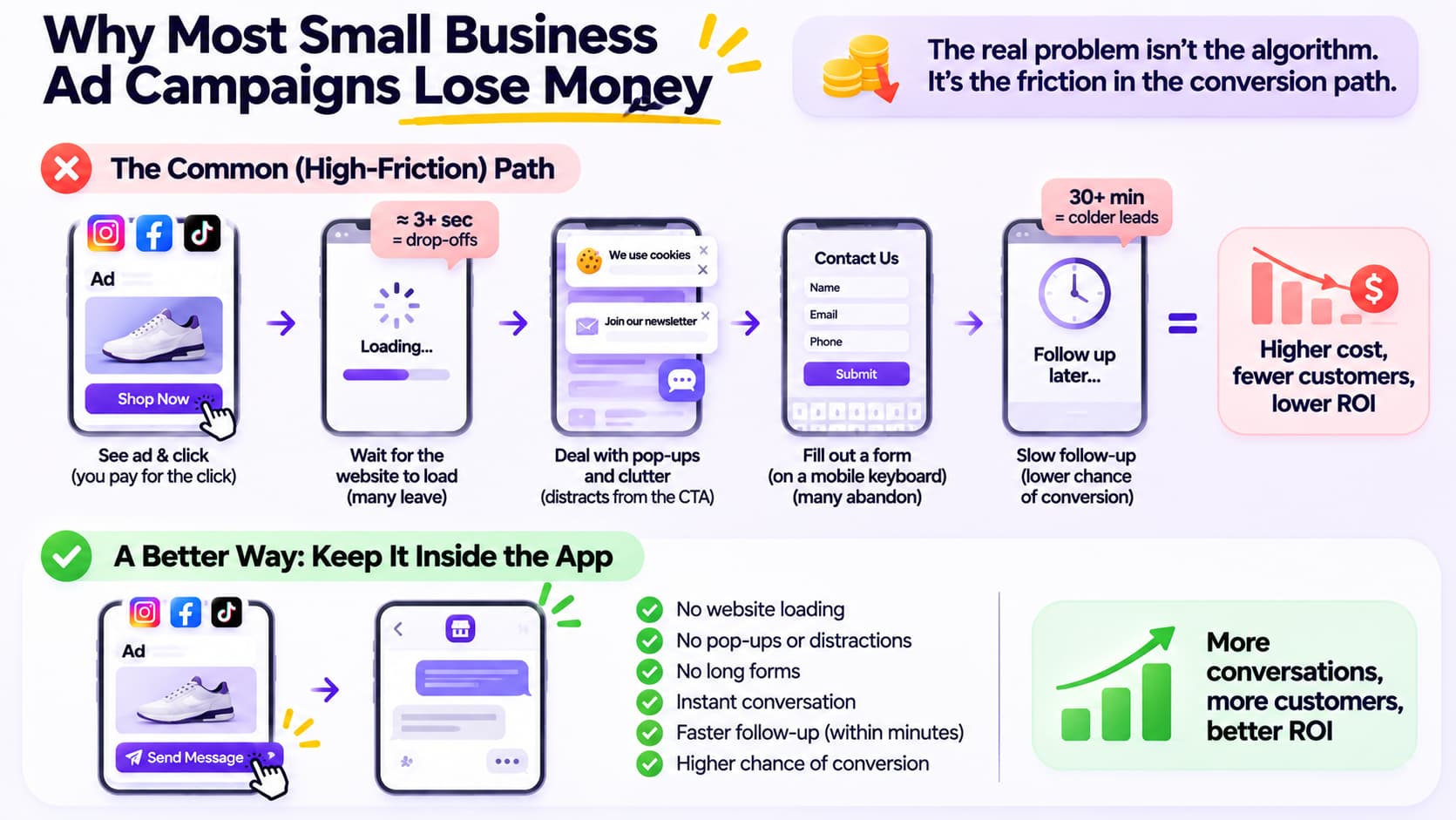
Most underperforming campaigns fail because of structural friction, not because the algorithm is broken. Each extra step between the ad and a conversation reduces the number of people who continue.
When a person taps an ad and lands on an external website, many leave before the page finishes loading. Mobile browsers inside social apps must resolve DNS, load tracking scripts, and download images. Anything over roughly three seconds produces significant abandonment. You pay for the click and receive little usable traffic.
Once on the site, desktop-designed layouts often feel crowded on a phone. Cookie notices, newsletter overlays, and chat widgets compete for attention and hide the main call to action. Filling out a standard web form on a mobile keyboard adds further friction. Many people abandon the form partway through.
Even when a form is submitted, slow follow-up creates another loss. Contacting an inquiry within the first five minutes produces far higher qualification rates than waiting thirty minutes or more. By the time many owners check email later in the day, the lead has cooled.
The practical fix is to remove the website from the earliest stage of the conversion path and keep the interaction inside the app the person is already using.
Choosing Where to Spend a Limited Budget
Spreading a modest monthly budget across several platforms usually leaves none of them with enough data to optimize. Select one primary channel, learn its mechanics, and expand only after you have a consistent cost per lead.
Meta (Instagram and Facebook)
For most small businesses, Meta is the strongest starting point. Its data is useful for identifying people who engage with messages, complete mobile checkouts, or interact with service businesses. Click-to-Instagram Direct, Click-to-Messenger, and native lead forms keep the entire flow inside the app and avoid browser and form friction. Meta’s own guidance on best practices for ads that click to message emphasizes clear creative and the right objective so the conversation starts immediately.
Google Search
Google Search works well when people already have high commercial intent and are searching for an immediate solution, such as emergency repair services. In competitive categories, cost per click can be high enough that a small daily budget produces very few clicks. It is usually better reserved for high-intent, high-margin services rather than general discovery.
TikTok and LinkedIn
TikTok can deliver low costs per thousand impressions, but ads typically fatigue within ten to fourteen days. Sustained performance requires a steady supply of new native video, which many small operators do not have the capacity to produce every week. LinkedIn is relevant mainly for higher-ticket B2B offers. For most local and service businesses, the volume and efficiency are higher on Meta.
Practical Daily Budget Allocations
You do not need a large monthly spend to begin testing. You do need to divide the daily budget across prospecting, conversion, and retargeting rather than putting everything into a single cold ad set.
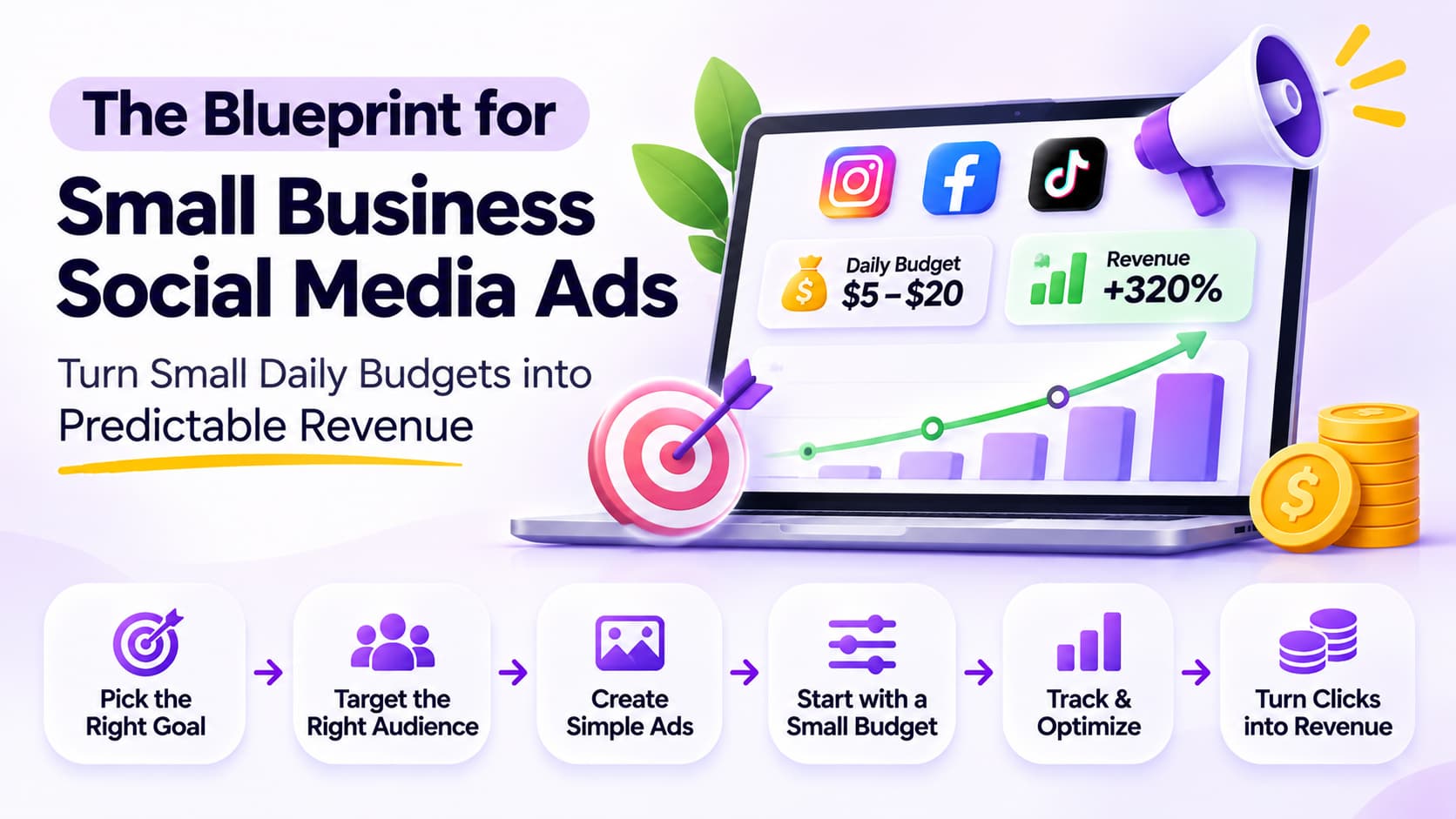
$15 per day
This level suits local service providers, clinics, and solo operators aiming for a small number of qualified conversations. Roughly 60 percent goes to top-of-funnel short-form video that addresses a specific problem. About 25 percent goes to click-to-message ads aimed at people who have already watched the top-of-funnel content. The remaining 15 percent retargets recent profile visitors and engagers with social proof or a direct offer.
$30 per day
This provides enough volume for the algorithm to move out of the learning phase more reliably. Allocate roughly half to broad prospecting with two creative angles, about 35 percent to dedicated click-to-message campaigns, and 15 percent to retargeting engaged audiences.
$50 per day
At this level you can test creative more frequently while keeping retargeting active. A typical split is 50 percent prospecting, 35 percent middle-funnel messaging, and 15 percent bottom-funnel retargeting. Watch hook rate and cost per message started at the top, qualification rate in the middle, and cost per closed customer at the bottom.
Recent industry data from LocaliQ’s 2026 Facebook advertising benchmarks shows average lead costs around $27 across industries, with wide variation by vertical. The same report and complementary WordStream Facebook Ads Benchmarks help set realistic expectations for what a small daily budget can actually produce.
Creative That Converts Without High Production Costs
High-production cinematic ads often underperform because they look like advertisements. The formats that work more consistently on mobile are straightforward, relevant, and resemble content people already watch.
Short Video Structure
A practical structure for a short video is:
- Open with a clear visual and a direct reference to the problem in the first three seconds. Hook rate (percentage of viewers who watch past three seconds) below roughly 25 percent usually means the creative is being skipped before the offer is heard.
- Spend the next several seconds explaining why the common approach is failing or creating extra work.
- Show the mechanism or result of your solution in plain language. Demonstrate rather than describe.
- End with a low-friction next step, such as tapping to send a message or commenting a specific word.
Avoid long introductions about the company. Lead with the problem the viewer recognizes. For local services, show the actual issue. For digital services, show a before-and-after screen or a simple process. For products, show the item solving a real task in the first frame.
For Reels specifically, the same low-friction principle applies. A detailed walkthrough of how to launch Instagram Reels ads that collect leads in DMs covers the Ads Manager setup, comment-keyword path, and first message that keeps the conversation inside the app.
Why In-App Flows Usually Beat External Landing Pages
When an ad sends someone into a direct message conversation or a native lead form, several common drop-off points disappear. There is no page load time. Data entry can use quick-reply buttons instead of typing on a keyboard. The experience stays inside an app the person already uses. Follow-up arrives as a push notification rather than an email that may be filtered.
Meta’s Click to Message Ads page notes that businesses using the format often see new customers and that multi-destination campaigns (Messenger, Instagram Direct, WhatsApp) can lower cost per message while raising conversion rates.
Automated Sequence with InstantDM
Pairing click-to-message ads with an automation tool such as InstantDM creates a short sequence:
- The person taps the ad or comments and receives a reply within a few seconds containing the promised resource or next step.
- A short series of questions using buttons gathers basic information (type of business, main obstacle, timeline).
- Contact details are requested after the person has already engaged, which typically produces higher completion rates than a cold web form.
- The lead is tagged and you receive a notification so high-value conversations can be handled personally.
This approach does not eliminate the need for a website later in the process. It simply removes it from the first conversion step where most small-budget campaigns lose people. Related formats such as Click to WhatsApp ads follow the same post-click logic, with their own setup and cost considerations.
Tracking and Reducing Customer Acquisition Cost
You need only a few numbers to know whether the spend is sustainable.
Customer acquisition cost is total ad spend plus related tool costs divided by the number of new paying customers. Cost per qualified lead is total ad spend divided by the number of leads who meet your buying criteria. Close rate is paying customers divided by qualified leads.
Where to Intervene When Costs Rise
When cost rises, the usual places to intervene are:
- Low hook rate or high CPM: revise the first three seconds of the video.
- High cost per message started: clarify the offer or reduce the number of steps.
- Poor lead quality: add clearer qualifying questions in the automated flow.
- Qualified leads not converting: shorten response time and tighten the sales conversation.
Four Tactics That Lower Cost
Four tactics that reliably lower cost:
Responding within the first minute keeps the person in the same context in which they saw the ad. Automated first replies make this possible even when you are unavailable.
Turning ad comments into private messages captures people who have already shown intent. When someone comments a keyword or asks a question, a public reply can confirm the comment while a private message continues the conversation. This does not require additional ad spend.
Offering a useful free resource (checklist, cost breakdown, short guide) instead of asking for an immediate call reduces resistance on higher-priced services. The automated sequence can deliver the resource and then move toward a consultation.
Retargeting people who watched at least half of a video is usually cheaper than cold prospecting. These viewers have already shown interest, so a follow-up ad focused on objections or proof tends to convert at lower cost.
Testing Creative Organically Before Spending
Launching cold ads on untested creative is one of the faster ways to waste budget. Post short videos and carousels on your organic feed first. Watch which ones produce higher watch time, saves, or comments relative to your normal baseline.
When one clearly outperforms, use its existing Post ID in the ad account rather than rebuilding the asset. Organic likes and comments remain visible, which gives the paid version social proof from the start. Attach the same automated message triggers so comments on the promoted post still generate private conversations.
Setting Up a Simple Meta Campaign
In Ads Manager:
- Choose the Leads or Engagement objective and set the conversion location to Messaging Apps (Instagram Direct and Messenger).
- Turn on Advantage Campaign Budget and set the daily amount at the campaign level so Meta can shift spend toward the better-performing creative.
- Keep location targeting to your service area (or broader if the offer is digital) and leave interests relatively open. Narrow interest stacks often raise costs without improving quality.
- Run at least three creative variations: a direct problem-focused video, an educational carousel, and a social-proof asset.
- Add quick-reply buttons in the message template that match the first questions your automated flow expects.
Let the campaign run for several days without changing budget or creative so the learning phase can complete. A practical setup guide for Facebook Messenger advertising and chat tools walks through objectives, message templates, and the $20–50 daily testing range many small businesses use.
Common Mistakes That Increase Cost
Changing the daily budget by more than about 20 percent forces the ad set back into learning. Set a number you can leave alone for at least a week.
Treating incoming messages as casual chat instead of structured inquiries leads to incomplete information and stalled threads. Automated sequences should collect the details you need and move toward a next step.
Over-narrowing local audiences creates high frequency and fatigue quickly. Broader geographic targeting with a clear hook in the creative usually performs better.
Building every ad as a dark post (never appearing on the public profile) forgoes the credibility that comes from visible comments and engagement.
Placing important text or logos near the edges of vertical video puts them under platform interface elements. Keep key information in the central portion of the frame.
Changing creative, targeting, and offer at the same time makes it impossible to know what improved or hurt results. Test one variable at a time.
Running ads overnight while only answering messages during business hours leaves late inquiries cold. Automated first responses and qualification keep the conversation moving until you can reply personally.
A Practical 30-Day Sequence
Week 1: Foundations
Confirm the Meta Business and Instagram connection. Set up the automated flows for click-to-message ads and comment triggers. Create one simple lead magnet.
Week 2: Creative Testing
Post three short videos and one carousel organically. Note which one produces the strongest engagement or watch time.
Week 3: Launch
Launch a campaign using the winning organic post (via Post ID) plus two additional variations. Set Advantage Campaign Budget between $15 and $30 per day. Leave it untouched for five to seven days.
Week 4: Optimize
Pause clear underperformers. Add a small retargeting ad set for recent engagers and video viewers. Review cost per qualified lead and adjust the automated questions based on what people are actually asking. Calculate acquisition cost from the month’s results before increasing spend.
A complementary guide to generating leads on Facebook in 2026 covers both paid and organic paths, including Instant Forms, chat leads, and a similar weekly cadence.
Closing Note
Paid social works as an amplifier of a clear offer and a low-friction way to start a conversation. When the path from ad to qualified lead depends on slow pages, long forms, and delayed replies, most of the budget is spent before anyone has a real discussion. Keeping the first steps inside the platform, using straightforward creative, and handling the initial reply automatically removes the largest sources of waste for most small businesses.