In early 2026, Instagram rolled out a feature that fundamentally changed how we think about digital identity, consent, and the boundaries of artificial intelligence. Called Muse Image AI, the tool allows anyone on the platform to generate hyper-realistic, AI-generated images by simply @ mentioning a public Instagram account. That means if your profile is public, a complete stranger can create a photorealistic depiction of you — in any scenario, setting, or context they choose — without your knowledge, without your consent, and without any notification sent to your account. The Verge covered the launch extensively, and the response from privacy advocates, parents, and digital rights organizations has been nothing short of alarming.
This is not a hypothetical concern or a speculative future scenario. This is happening right now, in 2026, on one of the largest social media platforms in the world with over two billion active users. Instagram, owned by Meta, positioned Muse Image AI as a creative tool — a way for users to "explore new forms of expression" and "collaborate with friends through AI-powered visuals." But the reality on the ground tells a very different story. Within weeks of its launch, reports began surfacing of AI-generated images being used for bullying, harassment, impersonation, and — most disturbingly — the targeting of minors.
If you use Instagram, if your children use Instagram, or if you have ever posted a photo on a public account, this issue directly affects you. And understanding the risks, the mechanisms, and the available protections is no longer optional — it's essential.
TL;DR: What You Need to Know Right Now
Instagram's Muse Image AI, launched in 2026, lets any user generate photorealistic AI images of any public Instagram account by simply @ mentioning them. No consent is required. No notification is sent to the person being depicted. The feature has been linked to deepfake creation, child targeting, bullying, and harassment. To protect yourself, you can make your Instagram account private and disable the "Content Reuse" setting in your privacy controls. This blog post covers the feature in depth, explains the risks, walks through protective steps, and answers common questions. If you manage social media accounts professionally, tools like InstantDM can help you stay on top of DM-based alerts and community management while you adjust your privacy posture.
What Exactly Is Instagram's Muse Image AI?
Muse Image AI is a generative artificial intelligence tool built directly into Instagram's interface. It was rolled out gradually through the first quarter of 2026 and became widely available to all users by April of that year. The tool leverages a proprietary Meta AI model trained on a massive dataset of publicly available images — including, critically, the billions of photos that Instagram users have uploaded over the years.
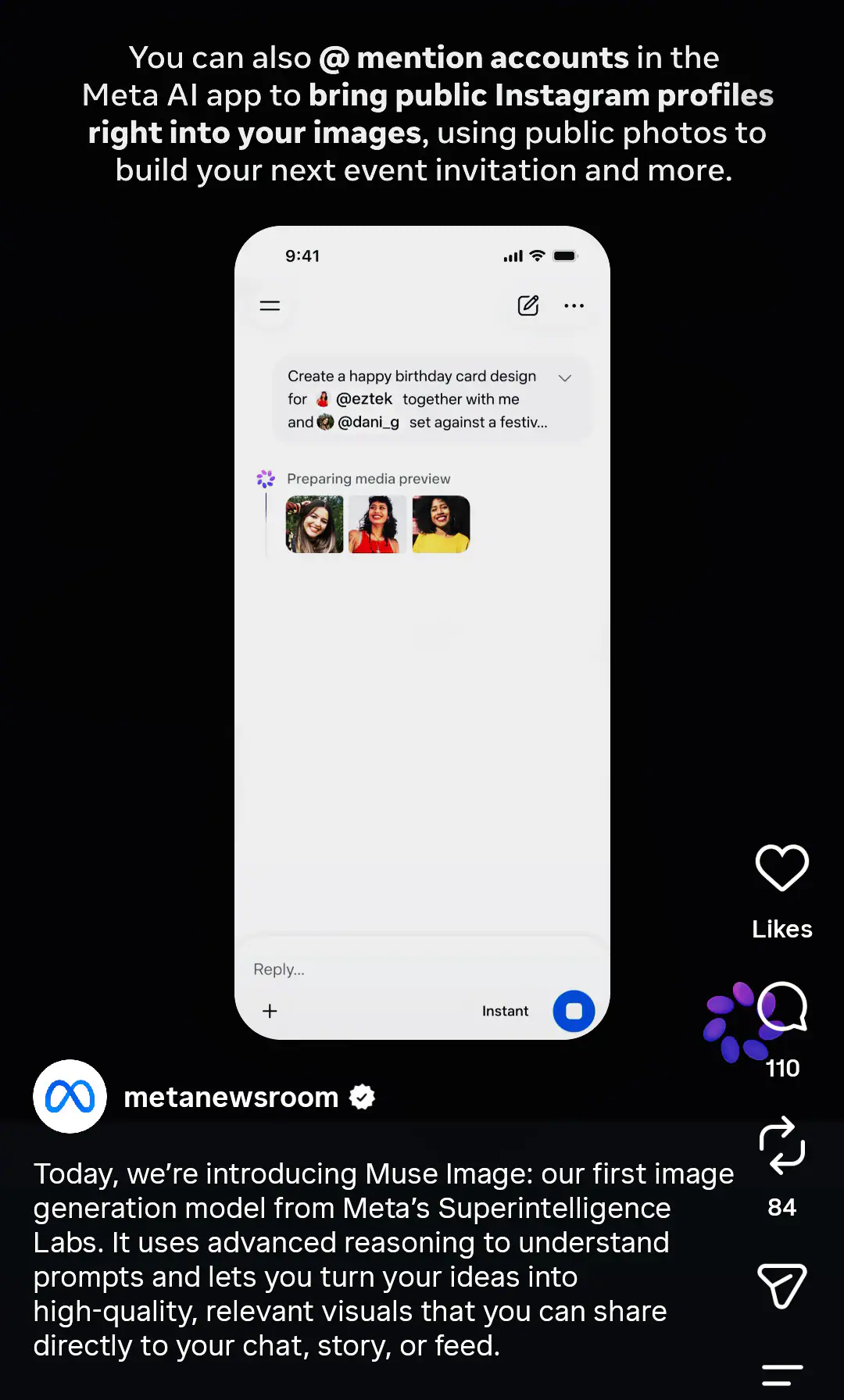
The core functionality is straightforward: a user types a prompt and @ mentions any public Instagram account. The AI then generates a photorealistic image that incorporates the visual likeness of the person associated with that account. The user can specify scenarios, locations, outfits, actions, companions, and virtually any other contextual detail. The generated images are high quality — often indistinguishable from actual photographs to the untrained eye.
Meta has described the tool as "a new creative canvas" and has emphasized that it includes "safety guardrails" to prevent the generation of explicitly harmful content. However, as multiple investigations have revealed, those guardrails are far more porous than Meta has publicly acknowledged.
How Does the Feature Work in Practice?
From a user's perspective, the process is remarkably simple. Open the Instagram app, navigate to the Muse AI section (accessible from the creation menu), type a text prompt describing the image you want to generate, and include an @ mention of any public account. The AI pulls visual reference data from that account's public photos, synthesizes a new image based on your prompt, and returns the result in seconds. You can then share it in DMs, Stories, or posts. The entire process requires no approval, no verification, and no interaction with the person being depicted.
Why Is Muse Image AI Such a Big Deal for Privacy?
The privacy implications of Muse Image AI are staggering, and they stem from a fundamental design choice: the feature operates without consent. Unlike traditional photo editing or even other AI image generators that require you to upload a reference photo of yourself, Muse Image AI bypasses this entirely by drawing from the public photo library of any Instagram user.
This means that every photo you have ever posted on a public Instagram account has become, in effect, training data for an AI system that allows strangers to generate new images of you. You did not agree to this. You were not asked. And until very recently, you were not even notified that it was happening.
Privacy researchers have compared this to someone taking your passport photo and using it to create fake identification documents. The visual likeness is yours, the context is fabricated, and the resulting images can be shared, saved, and distributed without any oversight. As BBC reported in their investigation of the feature, the lack of a consent mechanism represents "one of the most significant erosions of digital likeness rights in the history of social media."
Can Muse Image AI Be Used to Create Deepfakes?
Yes, and this is arguably the most dangerous aspect of the entire feature. Deepfakes — AI-generated images or videos that depict real people doing or saying things they never actually did — have been a growing concern for years. But until 2026, creating a convincing deepfake required technical skill, specialized software, and often a significant collection of source images. Muse Image AI has effectively removed every single one of those barriers.
Now, anyone with an Instagram account can create a photorealistic deepfake of any public figure, celebrity, influencer, or ordinary person in seconds. The images look real. They can be placed in compromising situations, fabricated scenarios, or misleading contexts. And because they are generated within Instagram's own ecosystem, they carry an implicit — though false — sense of authenticity.
Consider the implications: a political candidate in 2026 could have AI-generated images of themselves in fabricated compromising situations shared across Instagram within minutes. A business executive could be depicted engaging in unethical behavior. A private citizen could be portrayed in scenarios designed to humiliate, defame, or harass them. The potential for abuse is not theoretical — it is already happening.
Real-World Cases Already Emerging in 2026
Within the first month of Muse Image AI's full rollout, several high-profile cases emerged. In one instance, a teenager in California discovered that classmates had used the tool to generate images of her in explicit scenarios and distributed them through group chats. In another case, a small business owner in the UK found AI-generated images of himself appearing to engage in illegal activity, which were then used in a coordinated harassment campaign. These cases are not isolated — they represent a pattern that is accelerating as more users discover the tool's capabilities.
How Does Muse Image AI Target Children and Minors?
This is where the conversation becomes most urgent and most uncomfortable. Muse Image AI does not distinguish between adult and minor accounts when generating images. A public Instagram account belonging to a 13-year-old — the minimum age to use the platform — is just as accessible to the AI as an account belonging to a 30-year-old. The visual likeness of a child can be pulled, synthesized, and placed into any scenario the requesting user specifies.
Child safety organizations have sounded the alarm loudly in 2026. The National Center for Missing and Exploited Children (NCMEC) issued a formal statement calling Muse Image AI "an unprecedented tool for the creation of child exploitation material." While Meta has stated that the tool's safety filters block the generation of explicit content involving minors, independent testing by researchers has repeatedly demonstrated that these filters can be bypassed with relatively simple prompt engineering.
Even when the tool functions as intended and blocks explicit content, the ability to generate realistic images of children in non-explicit but still harmful contexts — fabricated bullying scenarios, false depictions of misbehavior, staged embarrassing situations — represents a serious child safety concern. A child's digital likeness is now, without their consent or their parents' consent, available for manipulation by anyone on the platform.
What Happened to the Idea of Notification and Consent?
One of the most criticized aspects of Muse Image AI is the absence of a notification system. When someone generates an AI image using your public account's likeness, you receive no alert, no email, no in-app notification. You have no way of knowing that your image has been generated unless someone shares it with you or you happen to stumble upon it.
This is a stark departure from how other platforms handle AI-generated content. Several competing services in 2026 require explicit opt-in consent before a user's likeness can be used in AI generation. Others at minimum send a notification when someone attempts to generate content using a user's visual data. Instagram's approach — no consent, no notification, no oversight — is the most permissive (and therefore the most privacy-invasive) of any major platform.
Meta has argued that because the images are generated from publicly available data, no additional consent is necessary. Privacy advocates strongly disagree. The fact that you posted a photo publicly does not mean you consented to that photo being used as training data for an AI system that can generate entirely new, fabricated images of you. Public posting and AI likeness generation are fundamentally different uses, and conflating them represents a dangerous precedent.
Is Instagram Doing Anything to Address These Concerns?
Meta has taken some steps, though critics argue they are woefully insufficient. In response to backlash, Instagram added a setting called "Content Reuse" in the privacy section of user accounts. When disabled, this setting theoretically prevents Muse Image AI from using your photos as source material for new generations. However, the setting is opt-out, not opt-in, meaning it is enabled by default and users must actively find and disable it to protect themselves.
Meta has also introduced "watermarking" on AI-generated images, embedding metadata that marks them as AI-created. While this is a positive step, it has significant limitations. Watermarks can be cropped out, metadata can be stripped, and most casual viewers do not check for AI indicators when viewing images in their feed. The watermark provides a forensic tool for investigators after the fact, but it does little to prevent the initial harm.
Additionally, Meta has expanded its content reporting categories to include "AI-generated likeness without consent," which allows users to report images created using Muse Image AI. But this is a reactive measure — the image has already been created and potentially shared by the time a report is filed. For many victims, the damage is already done.
How Can You Protect Your Account from Muse Image AI?
If you are concerned about your likeness being used by Muse Image AI — and you should be — there are concrete steps you can take right now in 2026 to reduce your risk. While no protection is perfect, these measures significantly limit your exposure.
Step 1: Make Your Instagram Account Private
The single most effective protection is to set your Instagram account to private. When your account is private, your photos are not part of the public dataset that Muse Image AI draws from. This means the AI cannot generate new images using your likeness. To make your account private, go to Settings → Privacy → Account Privacy and toggle the "Private Account" option. Instagram's official help documentation at help.instagram.com provides step-by-step instructions for this process.
Keep in mind that switching to private means that only your approved followers can see your posts, Stories, and Reels. For personal accounts, this is usually a worthwhile trade-off. For businesses, influencers, and public figures who rely on public visibility, the decision is more complicated.
Step 2: Disable Content Reuse in Settings
Even if you keep your account public, you should immediately disable the Content Reuse setting. Navigate to Settings → Privacy → Content Reuse and toggle it off. This tells Instagram that you do not consent to your content being used as source material for AI generation. While reports suggest this setting is not 100% effective — some users have found that previously cached data can still be used — it is an important layer of protection.
Step 3: Audit Your Existing Public Photos
Take the time to review your existing photo library. Consider removing or archiving photos that you would not want used as source material for AI generation. This is especially important for photos of children, which should never be posted on public accounts given the current risks.
Step 4: Enable Two-Factor Authentication and Monitor Your Account
While not directly related to Muse Image AI, enabling two-factor authentication helps protect your account from being compromised and used to generate or distribute AI content. Staying vigilant about your account security is always important, but it's especially critical in 2026.
What Role Do Social Media Managers Play in This Crisis?
For social media managers, brand strategists, and digital marketers, Muse Image AI presents a unique set of challenges. Public brand accounts and influencer profiles are prime targets for AI generation because they contain large libraries of high-quality, well-lit photos that the AI can use as source material. A brand's carefully curated visual identity can be co-opted and placed into fabricated contexts in seconds.
This is where having the right tools matters. Social media professionals who manage multiple accounts need to stay on top of DMs, mentions, and potential misuse across platforms. Tools like InstantDM can help streamline DM management and ensure that you catch potential issues — including unauthorized AI-generated content being shared with your brand — before they spiral out of control. In 2026, community management is no longer just about engagement; it's about protecting your digital likeness.
What Legal Protections Exist Against AI-Generated Deepfakes in 2026?
The legal landscape around AI-generated imagery is evolving rapidly, but as of 2026, protections remain fragmented and inconsistent across jurisdictions. In the United States, several states have enacted deepfake-specific legislation, particularly focused on non-consensual intimate imagery. Federal legislation has been proposed but has not yet been signed into law. The European Union's AI Act, which came into effect in 2025, includes provisions related to AI-generated content and transparency, but enforcement mechanisms are still being developed.
For individual users, the most practical legal avenues include:
- Right of Publicity Claims: In many jurisdictions, you have a legal right to control the commercial use of your likeness. AI-generated images that use your likeness without permission may violate this right.
- Defamation Claims: If an AI-generated image places you in a false and damaging context, you may have grounds for a defamation lawsuit.
- Harassment and Cyberbullying Statutes: Many states and countries have laws against online harassment that can be applied to AI-generated content used for bullying or intimidation.
- Child Protection Laws: AI-generated images of minors used for exploitation or harassment are subject to existing child protection legislation, which carries severe penalties.
However, pursuing legal action is expensive, time-consuming, and often inadequate as a first line of defense. Prevention — through privacy settings, account management, and platform advocacy — remains far more effective than after-the-fact legal remedies.
How Does Muse Image AI Compare to Other AI Image Generators?
It's worth noting that Instagram is not the only platform offering AI image generation in 2026. Tools like Midjourney, DALL-E, Stable Diffusion, and others have been available for years. However, Muse Image AI is fundamentally different from these tools in several critical ways.
- Integrated Source Data: Unlike standalone AI generators that require you to upload reference images, Muse Image AI is connected directly to Instagram's massive photo database. This makes it uniquely powerful — and uniquely dangerous.
- Zero Barrier to Entry: Other AI tools often require subscriptions, technical knowledge, or specific workflows. Muse Image AI is free, built into an app that billions of people already use, and requires nothing more than typing a text prompt.
- Social Distribution: Images generated by standalone tools exist in isolation. Images generated by Muse Image AI can be instantly shared within Instagram's social ecosystem — DMs, Stories, posts, and Reels — giving them immediate reach and social context.
- Implicit Authenticity: Because the images are generated within Instagram and depict real Instagram users, they carry an implicit sense of authenticity that externally generated AI images do not.
These differences mean that even if you have been unconcerned about AI image generation until now, Muse Image AI should change your calculus. The combination of integrated source data, zero barriers, social distribution, and implicit authenticity creates a risk profile that is qualitatively different from anything that has come before.
What Should Parents Do to Protect Their Children?
For parents, Muse Image AI represents an urgent safety concern that requires immediate action. If your child has an Instagram account — and many children aged 13 and older do — their photos may be accessible to the AI system. Here are the steps every parent should take in 2026.
- Switch your child's account to private immediately. This is non-negotiable. A public Instagram account for a minor is, in the current environment, an unacceptable risk.
- Disable Content Reuse on your child's account. Go into their privacy settings and ensure this option is turned off.
- Talk to your children about AI-generated images. Make sure they understand that anyone can create realistic-looking fake images of them, and that they should tell you immediately if they encounter such content.
- Monitor for AI-generated content. Periodically search for your child's name and check DM group chats where they are active. Early detection is critical.
- Report any harmful content immediately. Use Instagram's reporting tools and, if the content is exploitative, report it to NCMEC's CyberTipline.
- Consider whether your child needs a public account at all. In 2026, the risks of a public account for minors far outweigh any potential benefits.
The conversation about children and social media has been ongoing for over a decade, but Muse Image AI has raised the stakes dramatically. Parents who were previously comfortable with their children having public Instagram accounts should reconsider that decision in light of this new capability.
Is There a Way to Completely Remove Your Data from AI Training?
This is one of the most common questions people ask, and the honest answer is complicated. Disabling Content Reuse and switching to a private account are the most effective steps available within Instagram's own settings. However, if your account was public before you made these changes, there is no guarantee that your previously public photos were not already incorporated into the AI's training data.
Meta has stated that disabling Content Reuse will prevent future use of your photos but has been vague about whether previously processed data can be fully purged. Under regulations like the EU's GDPR and California's CCPA, you may have the right to request that your data be deleted from AI training datasets. However, enforcing these rights in practice remains challenging in 2026, and the process is often slow and opaque.
Privacy advocates recommend submitting a formal data deletion request to Meta through their privacy settings, documenting your request, and following up if you do not receive a response within the legally required timeframe. While this process is imperfect, it creates a record of your objection and may contribute to broader pressure on Meta to improve its data handling practices.
What Does This Mean for the Future of Digital Identity?
Muse Image AI is not an endpoint — it is a beginning. The technology will only improve, becoming more realistic, more accessible, and more deeply integrated into our digital lives. What Instagram has done in 2026 is establish a precedent: that a platform can use its users' public photos as source material for AI generation without consent, without notification, and without meaningful opt-out mechanisms.
If this precedent stands without significant pushback, other platforms will follow. The implications extend far beyond Instagram. Your LinkedIn photo could be used to generate fake professional credentials. Your Facebook vacation photos could be used to place you in locations you never visited. Your TikTok videos could be used to create fabricated footage of you saying things you never said.
The fight for digital identity rights in 2026 is, in many ways, the defining privacy battle of this era. It requires action from individuals (through privacy settings and advocacy), from platforms (through consent-based design and robust safety measures), from lawmakers (through comprehensive legislation), and from the broader technology community (through ethical standards and accountability mechanisms).