

last updated: October 2026
The best Sellfy alternatives in 2026 are Payhip (free + 5% — best overall for digital), Gumroad (10% — fastest setup), Lemon Squeezy (5% + $0.50 — Merchant of Record), Stan Store ($29/mo — Instagram and TikTok), ThriveCart ($495 lifetime — funnels), Fourthwall ($0/mo — merch), and Podia ($39/mo — courses and community). Creators leave Sellfy because Starter is $22/mo billed annually with no free plan and a $10,000/year sales cap (sellfy.com/pricing, October 2026). Shopify, Ko-fi, and Big Cartel show up on G2-style lists; they are a full store, a tip jar, and a starter merch shop — not 1:1 Sellfy swaps.
What are Best Sellfy Alternatives?
The best Sellfy alternatives in 2026 are Payhip, Gumroad, Lemon Squeezy, Stan Store, ThriveCart, Fourthwall, and Podia. Pick Payhip if you want a free store, Gumroad if you want a payment link in five minutes, Lemon Squeezy if you sell software across borders, Stan Store if the traffic is Instagram or TikTok, ThriveCart if you run funnels, Fourthwall if you sell merch, and Podia if you sell courses with a community.
Sellfy alternatives at a glance (verified October 2026)
Platform — Best for — Starts at — Platform fee
Payhip — Digital shop + coaching — Free — 5% (0% on Pro)
Gumroad — File delivery in minutes — Free — 10%
Lemon Squeezy — Software / global tax — Free — 5% + $0.50
Stan Store — Instagram / TikTok checkout — $29/mo — 0% + Stripe
ThriveCart — Funnels — $495 once — 0% + Stripe
Fourthwall — Merch + memberships — $0/mo — 0% on digital
Podia — Courses + community — $39/mo — 5% on Mover, 0% on Shaker
Sellfy (baseline) — All-in-one store — $22/mo — 0% + Stripe, sales caps
Shopify — Full ecommerce (not a 1:1 swap) — Paid plans — Shopify + card fees
Ko-fi — Cheapest / tips + simple shop — Free — 5% on shop sales

Sellfy started as a platform that lets creators build a simple, all-in-one shopfront to sell downloadable PDFs, video lessons, recurring memberships and basic print-on-demand merchandise, without any coding. For years, it was an affordable bridge between complex, developer-heavy ecommerce carts and basic file hosting.
But the creator economy has grown up a lot and Sellfy’s flat subscription-first pricing model adds unnecessary friction for today’s independent sellers. The Starter plan from Sellfy is $22/month when billed annually or $29 to $39/month on a month-to-month basis. If you are a new creator trying out your first digital download, building a first audience, or have seasonal drops in your sales, you have to pay a recurring SaaS subscription before you make a significant amount of revenue. Also, Sellfy caps sales on lower tiers (Starter is limited to $10k/year), pushing you to more expensive tiers ($49/mo to $99/mo) as your business expands.
Sellfy Pricing Model (Starter Tier)
- $0 in Sales: You still pay $22 to $29/mo (Guaranteed loss during launch phases)
- $12,000/yr in Sales: Business Plan forced upgrade (from $49 to $79/mo) due to revenue caps
And to make matters worse, creator commerce today has evolved into something much more than the static shopfronts where you post a link and hope visitors browse your catalogue. Today, the best monetisation for creators is happening inside social feeds, one-click checkout pages, automated DM conversations, and custom software delivery pipelines. If you want a free, pay-as-you-grow platform to handle all sales tax through a Merchant of Record, a high converting one-page checkout funnel or automated social selling, there are better platforms for each specific creator profile. For more details on payment for instagram selling check our guide Paypal vs Stripe for Instagram Selling.
Here’s the short answer
- Payhip is the best overall Sellfy alternative Payhip has a solid free-forever plan with a 5% transaction fee for complete digital shopfront and coaching features – without the risk of a monthly fee.
- For quick file delivery Gumroad is easiest, with no maintenance of a shopfront, totally free to start and a flat 10% fee per transaction.
- Lemon Squeezy is the clear leader in digital software and SaaS. They are a global Merchant of Record, handling sales tax and VAT all over the world at 5% + $0.50.
- Stan Store is the best dedicated link-in-bio platform for Instagram and TikTok creators and offers seamless on-page checkout for $29/month.
- ThriveCart is the ultimate power-tool for serious digital product funnels – to eliminate recurring monthly software fees with a $495 one-time lifetime license.
- Fourthwall is the #1 choice for creators building branded merchandise in tandem with digital downloads. It has 0% monthly fees and way more quality control than Sellfy’s built-in POD.
- Podia is the best all-in-one community and digital product platform — bring together online courses, digital files and email marketing in one clean ecosystem.
What About Pricing for Sellfy Alternatives?
Sellfy alternatives pricing in 2026: Payhip and Gumroad are free until you sell (5% and 10%), Lemon Squeezy is 5% + $0.50 with no monthly fee, Stan Store is $29/mo, Podia is $39/mo, Fourthwall is $0/mo, ThriveCart is $495 once, and Sellfy starts at $22/mo with no free plan (vendor pricing pages, October 2026). 0% platform fee is not cheaper if you still pay $22–$99/mo before the first sale.
Platform | Monthly Base Fee | Transaction / Platform Fee | Free Plan Available | Core Value Proposition |
Sellfy | $22/mo to $99/mo | 0% (Stripe/PayPal fees apply) | ❌ (14-day trial only) | All-in-one digital + print on demand store |
Payhip | Free / $29 / $99 | 5% / 2% / 0% | ✅ (Unlimited products) | Affordable digital shopfront & coaching |
Gumroad | Free | 10% flat fee | ✅ (Unlimited products) | 5-minute setup & audience discovery Frictionless |
Lemon Squeezy | Free | 5% + $0.50 per sale | ✅ (No subscription fee) | Merchant of Record for software, apps & global VAT |
Stan Store | $29/month to $99/month | 0% (Stripe fees apply) | ❌ (14-day trial only) | Native Instagram/TikTok link-in-bio checkout |
ThriveCart | $495 (One-time lifetime) | 0% (Stripe/PayPal fees apply) | ❌ (Lifetime investment) | High-converting upsell funnels & affiliate system |
Fourthwall | Free ($0/mo) | 0% on digital / Split on custom merch | ✅ (Full custom site) | Premium merchandising, digital goods & memberships |
Podia | $39/mo to $89/mo | 5% (Mover) / 0% (Shaker) | ❌ (30-day free trial) | All-in-one courses, downloads and community |
Verified October 2026 The data includes active merchant pricing schedules, standard payment gateway pass-throughs and public platform terms.
Don’t get hung up on pricing and whether a platform has “0% transaction fees”. If you are paying Sellfy $264-$468 a year and making less than twenty sales a year, 0% transaction fee doesn’t matter. But a 5% or 10% fee on Payhip or Gumroad lets a beginner seller run with zero fixed overhead, paying only when money actually lands in their account. As soon as you’re regularly pushing $1,000 in sales volume per month, switching to flat-rate platforms or lifetime tools like ThriveCart will instantly secure higher profit margins.
What you keep on a $10, $50, and $200 sale
Platform fee only (card fees extra unless noted). Sellfy’s $22/mo still hits even if you make one sale.
Sale — Payhip 5% — Gumroad 10% — Lemon Squeezy 5%+$0.50 — Sellfy $22/mo + 0%
$10 — you keep $9.50 — $9.00 — $9.00 — you are still down $22 that month
$50 — $47.50 — $45.00 — $47.00 — $22 already paid
$200 — $190.00 — $180.00 — $189.50 — $22 already paid
A beginner with ten $10 sales in a month pays $5 on Payhip or $10 on Gumroad, and $22 on Sellfy before Stripe. The 0% headline on Sellfy only wins after volume clears the monthly floor and the Starter sales cap.
Pros and Cons Overview
Platform | Benefits | Drawbacks |
Payhip | Free-forever plan, low 5% base fee, full shopfront customisation, built-in coaching scheduling, handles EU/UK VAT | 5% transaction fee on free tier adds up at scale; no native print-on-demand fulfilment; basic email marketing |
Gumroad | Zero monthly fees, fastest setup in the industry, built-in marketplace recommendations, native affiliate features | High 10% flat transaction fee, strict risk/payout reviews, limited visual shopfront customisation |
Lemon Squeezy | Full Merchant of Record (global sales tax & VAT compliance), true license key management for software, powered by Stripe | 5% + $0.50 fee can be high for low ticket ($5) items, payout processing fees, limited physical product support |
Stan Store | Seamless 1-tap checkout within mobile social browsers, integrated calendar bookings, digital downloads, courses | $29/mo fixed starting cost; no desktop-optimized full shopfront; no physical merchandise support |
ThriveCart | Pay once ($495) with no recurring monthly fees ever, industry-leading 1-click upsells, bump offers, and affiliate center | High upfront capital required; no multi-item browsing catalogue (strictly structured as individual sales funnels) |
Fourthwall | No monthly subscription fee, high-quality custom apparel/merchandise manufacturing, built-in member community, digital sales | Slow to set up your shop design; physical product margins depend on apparel production costs |
Podia | All-in-one interface with unlimited courses and digital downloads, built-in email broadcasts and community spaces | 5% fee on entry Mover tier; limited design customisation versus dedicated site builders |
Different creators have different business models. If you’re a software engineer selling developer licence keys, you’ll need an automated Merchant of Record to handle complex European VAT calculations. Fitness coach on Instagram wants a seamless, instant mobile checkout experience in an Instagram in-app browser, without putting customers through a 5-step shopping cart.
Knowing these trade-offs means you won’t pay for enterprise features you’ll never use, or restrict your audience behind clunky checkout experiences.
Why are creators seeking Sellfy alternatives in 2026?
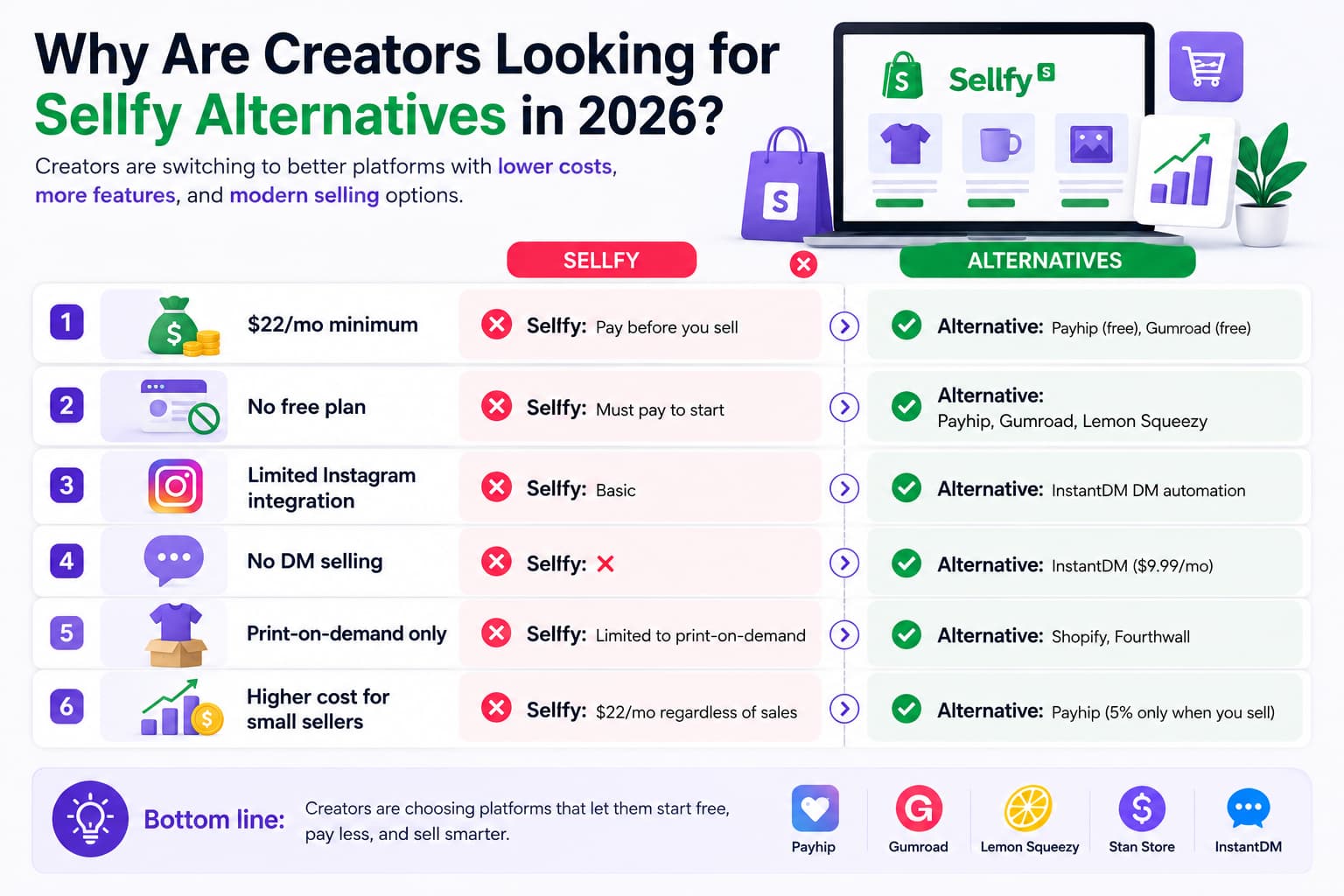
Creators look for Sellfy alternatives because there is no free plan, Starter costs $22/mo billed annually ($29–$39 month-to-month), and Starter caps sales at $10,000/year before a forced upgrade (sellfy.com/pricing, October 2026). Payhip, Gumroad, and Lemon Squeezy charge when you sell. Fourthwall starts at $0/mo for merch.
The Creator Conundrum of Sellfy 2026
[Pay $22-$39/mo upfront] to [Normal catalogue store creation] to [Share static link on social bio] to [Low 2-5% conversion]
Multi-Channel Strategy of Today
[Pay $0 Up Front] to [Frictionless 1-Click Mobile/DM Checkout] to [Automated Lead Capture] to [High 15-30% Conversion]
$22/mo minimum starting price
- Sellfy: You will need to subscribe to mandatory recurring monthly subscription ($22/mo billed annually, or up to $39/mo month-to-month) whether your store makes $10,000 revenue or $0 revenue. This is unfair to both newbies and seasonal sellers.
- Alternatively: You can launch your digital products for free on platforms like Payhip, Gumroad and Lemon Squeezy that only take a small percentage once a sale is made.
Sellfy charges $22-$99/mo with no free plan. You pay whether you make sales or not. Payhip and Gumroad let you start for free and only take a percentage when you sell.
Random sales caps on paid plans
- Sellfy: Has strict yearly revenue limits even on paid plans. The Starter plan limits you to $10,000 in annual sales. If you exceed that, Sellfy will automatically upgrade you to the $49/mo Business plan or the $99/mo Premium plan.
- Alternative: Payhip, Lemon Squeezy and ThriveCart have no revenue caps on your account, never punishing your business for success.
No free plan forever
- Sellfy: Only free trial is 14 days, then you have to upgrade to keep your store alive.
- Alternatively: Payhip and Fourthwall have solid, permanent free tiers that provide full product hosting, unlimited bandwidth and no expiration timers.
Does Sellfy really charge 0% transaction fees?
- Yes, Sellfy’s own plans list 0% platform commission. You still pay Stripe or PayPal, and you still pay $22–$99/mo. 0% is the platform cut, not “you keep 100%,” and it sits next to annual sales caps on cheaper tiers (sellfy.com/pricing, October 2026).
Is Sellfy a merchant of record?
No. You are the merchant. You register and remit sales tax/VAT unless you bolt on a third-party tool. Lemon Squeezy is the Merchant of Record (5% + $0.50). Payhip calculates UK/EU VAT on digital goods. That is the tax gap, not a feature Sellfy hides — it is a different legal setup.
Multi-step checkout for mobile traffic, clunky
- Sellfy: Takes buyers to a shopping cart that looks like a classic desktop style shopping cart and has several pages. The user needs to add products to the cart, see the cart, enter information on several screens and pay.
- Alternative: Stan Store and other mobile-first platforms instantly target impulse buyers with one-tap on-page checkouts.
Average print on demand margins and customisation
- Sellfy: Sellfy has its own print-on-demand, but the product catalogue is very basic, mockups are not flexible and the base production costs cut into apparel profit margins.
- Alternative: Fourthwall offers better quality apparel, custom branding tags, custom packaging inserts and better profit margins on creator merchandise.
1. Payhip – The Best Overall Sellfy Alternative
Price: There is a free plan available (payhip.com, July 2026) with a 5% transaction fee. Paid plans start at $29/mo (2% fee) and $99/mo (0% fee).
Payhip has gained a reputation for itself as the best all-in-one ecommerce platform for creators who want the full shopfront experience of Sellfy, but without the upfront cost. Payhip is a free, simple to use, high converting store builder for anything from digital ebooks, design presets, software, physical products and video courses to coaching sessions or recurring paid memberships.
Payhip vs Sellfy – What’s Better? What Payhip Does Better Than Sellfy
- No upfront risk: Payhip’s Free Forever plan gives you access to all the features of the platform, unlimited product listings, unmetered customer bandwidth for just 5% per transaction. You don’t pay anything until you earn money.
- Built-in coaching & appointment bookings: Sellfy needs third-party plugins to sell 1-to-1 calls. Payhip natively integrates with Calendly and Zoom so you can manage calendar availability, client intake forms, and paid video calls all in Payhip.
- Visual store builder with full functionality: Customise colours, layouts, typography, hero banners and product landing pages that look professional on mobile and desktop with a clean drag-and-drop builder.
- Automatic EU/UK VAT calculation: Selling digital files internationally can be a tax compliance nightmare. No more hours spent on admin headache, Payhip automatically calculates, applies and reports EU and UK VAT on digital goods at checkout.
- Native course hosting: Payhip offers an integrated learning management system (LMS) with video hosting, student progression tracking, lesson drip scheduling, and assignment uploads.
Payhip pricing
Plan | Monthly SaaS Fee | Transaction Fee | Core Inclusions |
Free Forever | $0/mo | 5% of sales | Unlimited products, full store builder, memberships, courses |
Plus Plan | $29/month | 2% per sale | All Free features, lower transaction fees |
Pro Plan | $99/month | 0% per sale | All Plus features and no platform transaction fees |
Payhip vs Sellfy fees: Comparison Breakdown
Monthly Store Revenue | Sellfy Starter ($22/mo) | Payhip Free (5% Fee) | Payhip Plus ($29/mo + 2%) | Payhip Pro ($99/mo + 0%) |
$0 / month | $22 (Net Loss) | $0 (Zero Overhead) | $29 | $99 |
$300 / month | $22 | $15 (Cheaper) | $35 | $99 |
$500 / month | $22 | $25 | $39 | $99 |
$1,000 / month | $22 | $50 | $49 | $99 |
$2,500 / month | $49 (Forced tier upgrade) | $125 | $79 (Best Value) | $99 |
$5,000 / month | $49-$99 | $250 | $129 | $99 (Capped Costs) |
Calculations show Payhip protects your capital during launch phases and gives you clean, predictable upgrade tiers as volume scales.
Pros and Cons of Payhip
- Pros: Free plan forever with no feature limits; visual shopfront builder is easy to use; built-in coaching and course hosting; automatic EU/UK VAT compliance; pay out immediately to PayPal and Stripe.
- Cons of Payhip: 5% fee on the free plan gets pricey for high-ticket items (500+ items); lack of a built-in print-on-demand fulfilment engine; rudimentary marketing automation features versus dedicated email platforms.
2. Gumroad – Best for Easy, Frictionless Selling
Price: Free plan (gumroad.com, July 2026) + flat 10% transaction fee Add-ons for custom domains (optional).
In the digital creator space, Gumroad is still the gold standard for ease of use. If designing hero images for hours, setting up multi-page shopfront menus, or creating complex DNS records doesn't sound like fun to you, Gumroad lets you publish a downloadable file and start accepting credit card payments in under five minutes.
What Gumroad does better than Sellfy
- Frictionless product publishing: Upload an ebook, notion workspace, audio preset pack or software zip file, set your price and generate a live payment link with zero technical friction.
- No monthly overhead: Gumroad doesn't have recurring SaaS subscription fees. When you are zero sales, you don’t get an invoice for months.
- Gumroad Discover marketplace: Sellfy lacks any organic discovery mechanism. Built-in Discover recommendation engine: Your products are actively recommended to millions of shoppers on the platform resulting in passive affiliate sales.
- Automated Software Licensing: Generate, validate and revoke software license keys for desktop applications, digital content and browser extensions easily without custom backend coding.
- Flexible “Pay What You Want” Pricing: Gumroad has been a leader in dynamic donations and tiered pricing, allowing your most loyal fans to pay more than your base price.
Example of a fee comparison
- Monthly Sales – $200 (10 sales @ $20 each)
- Sellfy Price: $22 flat fee/month (11% effective take rate)
- Gumroad Cost: $20 total fee (10% flat take rate) Gumroad is cheaper & risk-free
- Monthly Sales: $2000 (i.e. 100 sales x $20)
- Sellfy Cost: $22/month flat fee (1.1% effective take rate)
- Gumroad Cost : $200 total fee (10% flat take rate) : Sellfy is cheaper on pure volume
- If the job is replacing Gumroad, not Sellfy, use our Gumroad alternatives list.
Pros and Cons of Gumroad
- Pros of Gumroad: No monthly fees up front; super fast 5 minute set up; built in discovery marketplace; native affiliate management; flexible pricing and tipping options.
- Gumroad cons: 10% flat platform fee on all sales (high) Page layouts are rigid with very little room for branding Weekly payout schedules with strict reserve holdbacks for new accounts.
3. Lemon Squeezy - Best for software, SaaS and international tax compliance
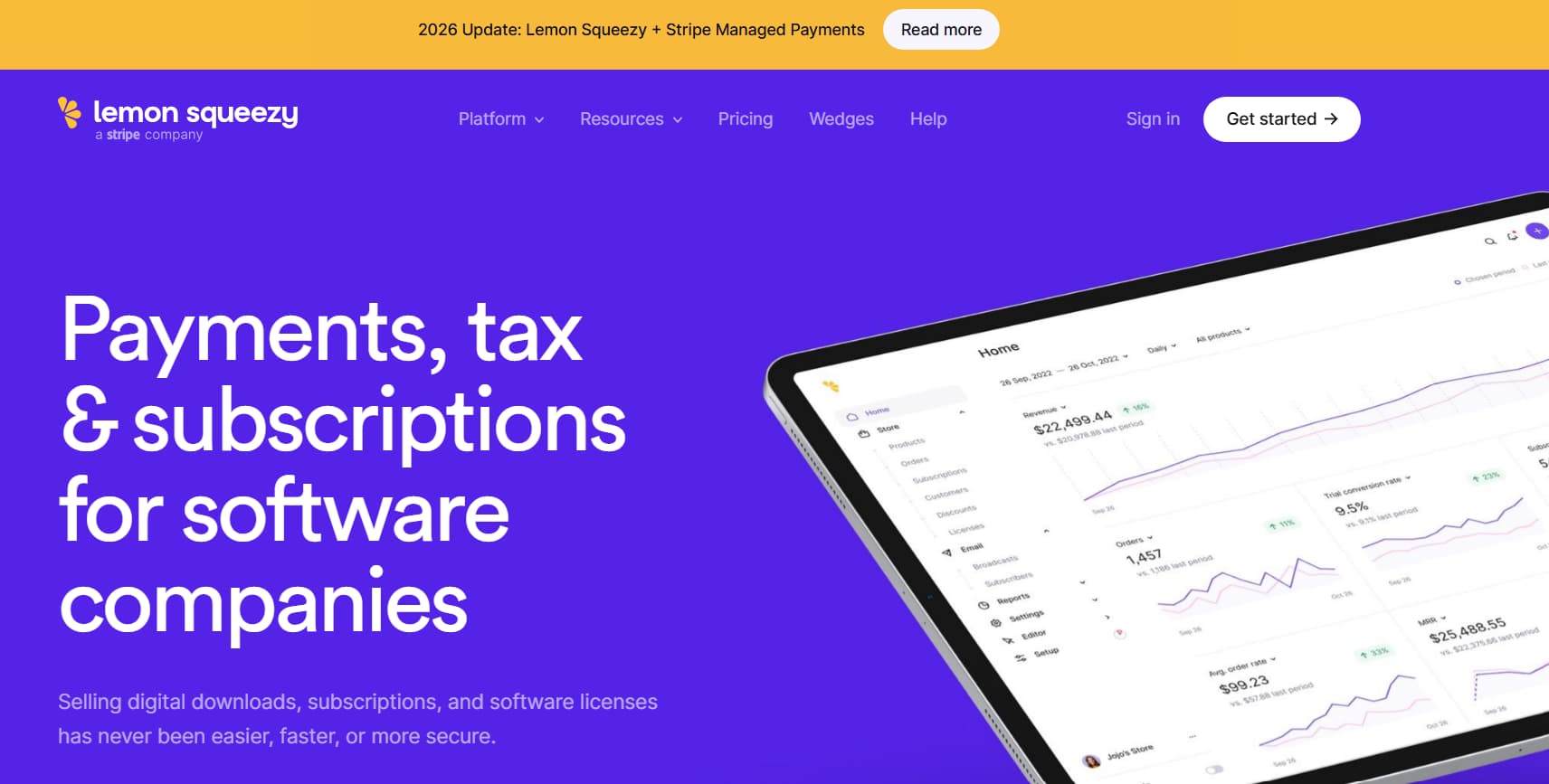
Price: Free plan (lemonsqueezy.com, July 2026) with a 5% + $0.50 per transaction fee. There is no monthly subscription fee.
Lemon Squeezy was created to address the massive legal and financial headaches of selling digital software, SaaS subscriptions, license keys and downloadable assets globally and was acquired by Stripe in 2024. With Lemon Squeezy you are the Merchant of Record (MoR) instead of the usual platforms where you have to file sales taxes in dozens of jurisdictions.
How Does Merchant of Record (MoR) Work
Buyer buys software: Lemon Squeezy (MoR) collects and remits global VAT/tax: You receive clean, compliant payout
What Lemon Squeezy does better than Sellfy
- Real Merchant of Record compliance: Lemon Squeezy is the legal merchant of record for your purchase, automatically calculating, collecting and remitting sales tax, GST and VAT in over 100 countries. You never have to register with international tax authorities or file complex quarterly returns.
- Enterprise-grade software license keys: Out-of-the-box create, activate, limit and manage recurring license keys for software apps, WordPress plugins, macOS tools and SaaS products.
- Advanced recurring billing & SaaS trials: Create sophisticated subscription levels with free trials, prorated billing, volume discounts and automated churn prevention sequences.
- Powered by Stripe infrastructure: Get high authorisation rates, multi-currency processing in 135+ local currencies and fraud detection directly from Stripe's global network.
Pricing: Lemon Squeezy
Plan | Monthly Fee | Transaction Fee | Core Inclusions |
All-in-One Account | $0/mo | 5% + $0.50/sale | Merchant of Record tax compliance, licence keys, subscriptions, hosted checkouts |
Pros and Cons of Lemon Squeezy
- Advantages of Lemon Squeezy: Fully automated global tax and VAT compliance; No monthly fees for the platform; Native software licence keys & API webhooks; Backed by Stripe; Modern hosted checkout overlays.
- Lemon Squeezy cons: 5% + $0.50 per transaction is pretty expensive for low-ticket ($3 to $5) digital downloads; extra international card fees (1.5%) for cross-border transactions; payout schedules run through Wise and PayPal, instead of instant bank payouts.
4. Stan Store — Best for Instagram and TikTok Creators

Price: Creator Plan $29/month, Creator Pro $99/month (stan.store, July 2026) 0% Transaction Fees (Regular Stripe Processing Fees Apply)
Stan Store changed the way creators make money by turning the static “link-in-bio” into an effortless one-page digital shopfront. Sellfy redirects mobile users from social apps to a multi-page site, while Stan Store embeds digital downloads, calendar bookings, paid newsletters and mini-courses directly into the mobile browser so followers can buy in seconds without ever leaving Instagram or TikTok.
Comparison of friction
- Traditional Shopfront: Social Bio Link Open External Browser Load Catalogue Add to Cart Checkout (High Dropoff)
- Stan Store: Social Bio Link : 1 Page Overlay : 1 Tap Apple Pay Checkout : Instant Access (High Converting)
Why Stan Store beats Sellfy
- Seamless on-page mobile checkout: Customers can pay with Apple Pay, Google Pay or credit card directly in the social media in-app browser without having to go through multiple web pages.
- Integrated 1-on-1 coaching & audits: Sell paid coaching slots, with native calendar sync, calendar availability limits, and custom client intake fields.
- Lead Magnet & Email Opt-ins: Grow your newsletter list with special lead magnet pop-ups before you pitch your paid products.
- Course and community delivery: Deliver simple video masterclasses and module lessons right to mobile devices without complex customer login screens.
Pricing Stan Store
Plan | Monthly fee | Platform fee | Core inclusions |
Creator Plan | $29/mo | 0% (Stripe fees apply) | Unlimited digital products, calendar bookings, lead magnets, 1-tap checkout |
Creator Pro | $99/mo | 0% (Stripe fees apply) | Full video course hosting, affiliate management, payment plans, order bumps |
Pros and Cons of Stan Store
- Stan Store Pros: Native Apple Pay / Google Pay integration. Built-in calendar appointments / lead capture. Best conversion rates on mobile for social traffic. Clean, aesthetic mobile UI.
- Stan Store cons: Fixed fee of $29/mo with no free tier. Limited layout options for desktop browsing. No support for physical merchandise or print-on-demand fulfilment.
- For a Stan-only comparison, see Stan Store alternatives for creators.
5. ThriveCart – Ideal for Sales Funnels with High Conversion (One-Time Payment)
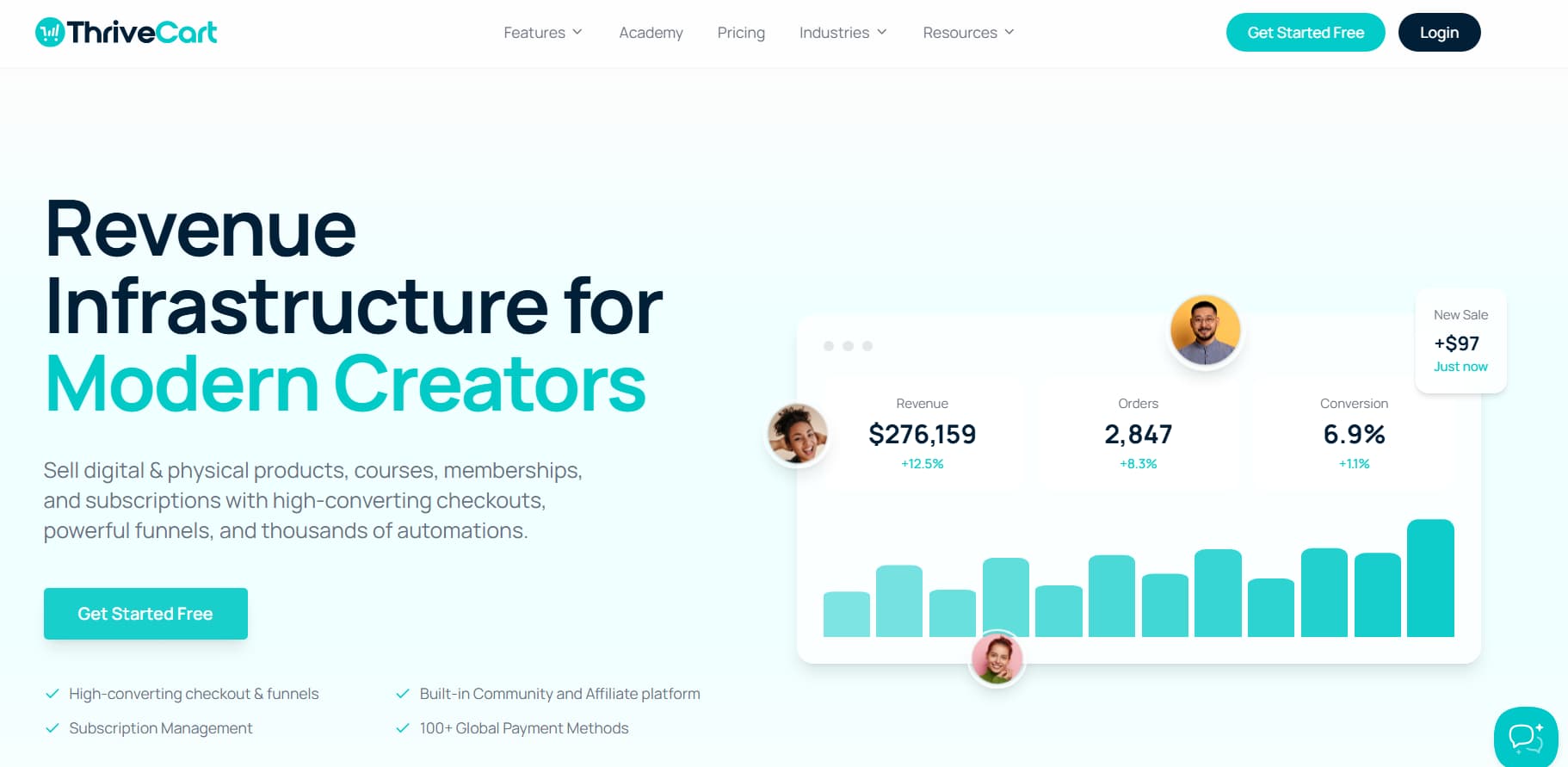
Cost: One-time lifetime license for Standard: $495; one-time lifetime license for Pro: $690 (thrivecart.com, July 2026). No monthly recurring charges.
ThriveCart is a great alternative to Sellfy if you’re already making consistent revenue and want to get away from recurring SaaS fees. ThriveCart isn't a catalogue of many things to browse, it's a dedicated checkout and sales funnel engine that maximises the average order value (AOV) of every customer that clicks your links.
ThriveCart Funnel Structure
Main Product ($47) : 1-Click Order Bump (+$19) : 1-Click Post-Purchase Upsell (+$97) : Total Order: $163 (3.4x Revenue)
Where Sellfy does not measure up to ThriveCart
- Zero monthly fees forever: Pay $495 once and get lifetime access to ThriveCart, never pay a monthly bill or a percentage of your sales, and get free updates for life.
- High-converting 1-click bump offers: Pre-checkout checkbox offers (like an audio version of an ebook for $9) that convert at 20-40% on standard checkout pages.
- Post-purchase 1-click upsells & downsells: sell high-ticket video courses or free resources immediately after payment without having the buyer re-enter their credit card info.
- Native course platform (ThriveCart Learn): Host unlimited courses, modules and student accounts with custom access tiers right within the platform at no additional cost.
- Advanced Affiliate Center: Build & control your own affiliate sales army, with custom commission plans, automated payouts & lead tracking.
ThriveCart vs Sellfy: The ROI in the Long Run
Year 1 Cost
- Sellfy Starter: $22/mo billed yearly ($264/yr)
- ThriveCart Standard: $495 one-time fee
Year 3 Total Cost
- Sellfy Starter / Business: $792-$1,764 total payment
- ThriveCart Standard: Still $495 total paid (Saves $300 to $1,200+)
Year 5 Cumulative Costs
- Sellfy Starter / Business: $1,320 - $2,940 one-time payment
- ThriveCart Standard: Still $495 paid in full (Massive lifetime savings)
Pros and Cons of ThriveCart
- ThriveCart Pros: One-time payment (no more monthly software subscriptions, ever); best-in-class order bumps & 1-click upsell funnels; built-in course platform (Learn); solid affiliate management; no platform fees.
- ThriveCart Cons: High upfront payment ($495); Built as single product sales funnels, not a multi-item shopfront catalogue.
6. Fourthwall - Great for high-end merchandise, physical goods & memberships
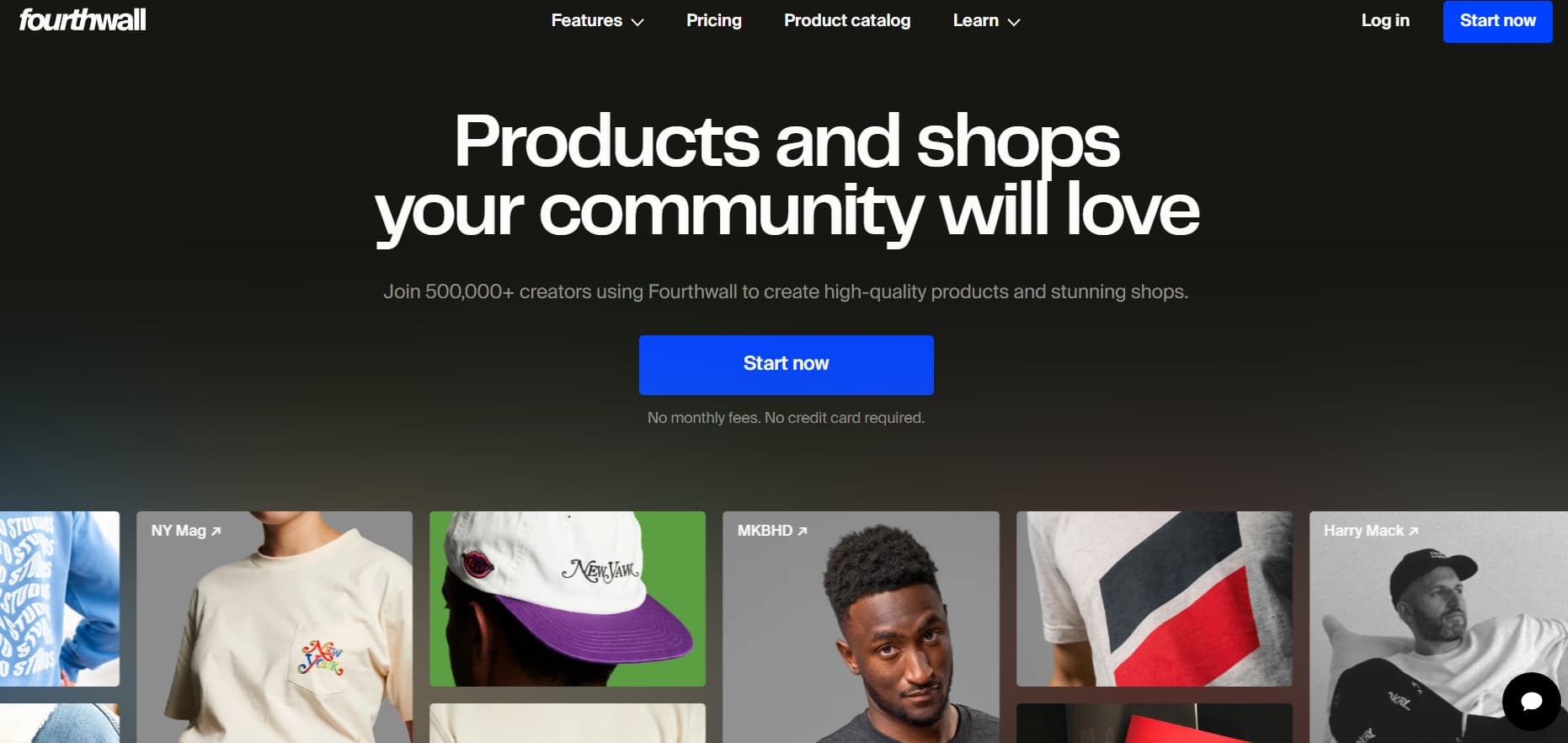
Price: Free plan available (100%) (fourthwall.com, July 2026). There are no monthly subscription fees for standard shopfronts.
Sellfy does have a basic print-on-demand add-on, but apparel is very much an afterthought with limited customisation, standard catalogue items and tight margins. Fourthwall is made for creators who want to launch custom apparel lines, one-of-a-kind merchandise, digital content, and paid fan memberships from one high-end branded site.
What Fourthwall does better than Sellfy
- Better quality and product selection: Premium heavyweight tees, custom cut and sew hoodies, embroidered headwear, custom moulded drinkware and packaging inserts from premium global suppliers.
- No monthly subscription fees: Build a fully branded standalone website, link custom domains and host unlimited digital files and products with no monthly platform subscriptions.
- Built-in creator memberships: Start private recurring tiers of membership (like Patreon) with members-only video posts, private RSS podcast feeds and exclusive discounts on merchandise right from your store.
- Live stream & YouTube shopping integration: Show your products live under YouTube videos, on Twitch overlays, and across TikTok Shop feeds natively with verified inventory sync.
Fourthwall pricing
Service | Monthly Fee | Production Cost / Platform Cut |
Digital Products | $0/mo | Flat 5% platform fee (or direct processing pass through) |
Physical Print-on-Demand | $0/mo | Base manufacturing costs are deducted from the retail price (You keep 100% of the profit margin) |
Memberships & Subscriptions | $0/mo | Flat 5% platform fee on recurring fan memberships |
Pros and Cons of Fourthwall
- Fourthwall pros: No monthly software fees; top-tier apparel and packaging customisation; integrated recurring memberships; seamless YouTube and Twitch shopping integrations.
- Cons: Fourthwall takes longer to design custom physical product mockups; not for pure software or license key distribution.
7. Podia — Best all-in-one for courses, downloads & community

Price: $39/mo (Mover, 5% fee) or $89/mo (Shaker, 0% fee) (podia.com, July 2026) Try it free for 30 days!
Podia is an all-in-one platform that creators love. It’s built for entrepreneurs who want to unify their website, digital downloads, video courses, coaching calls, email marketing and community spaces into one beautiful, easy to use dashboard. For need more information check our guide about platforms to sell courses without a website.
How Podia beats Sellfy
- Real community spaces: Build free or paid discussion communities (think Circle or Mighty Networks) that have threaded conversation, member directories and multimedia posts right next to your products.
- Clean, intuitive course builder: Build structured multi-module courses with video lessons, student quizzes, lesson drip schedules and completion certificates.
- Built-in email marketing: The platform offers email blast campaigns, automated email sequences and customer segmentation, without needing to pay for extra tools like Mailchimp.
- Unlimited Hosting: Paid plans include unlimited files, digital downloads, and students. No hidden fees for bandwidth or storage.
Podia pricing
Plan | Monthly Fee SaaS | Platform Transaction Fee | Core Inclusions |
Mover | $39/mo ($33/mo billed annually) | 5% of sales | Unlimited downloads, courses, coaching, community, website |
Shaker | $89/mo ($75/mo billed annually) | 0% per sale | All Mover features + 0% fees, affiliate marketing, third-party code embeds |
Pros and Cons of Podia
- Podia Pros: Fantastic all-in-one user experience; unlimited digital products & course hosting; built-in email blasts, community spaces; responsive customer support.
- Podia Cons: 5% transaction fee on the Entry Mover plan, no permanent free tier (just a 30-day trial), and standardised web design options compared to custom web builders.
How do you choose the right Sellfy alternative?
If you sell digital files and want $0/mo until a sale: Payhip. If you want a link in five minutes: Gumroad. If you sell software and need tax handled: Lemon Squeezy. If buyers are on Instagram or TikTok: Stan Store. If you live on order bumps: ThriveCart. If you sell apparel: Fourthwall. If you sell courses plus community: Podia. If you need a full custom store with apps and themes: Shopify — that is a different product than Sellfy. If you only need tips or a tiny shop: Ko-fi (free, 5% on shop sales). If you want a cheap merch-style storefront: Big Cartel. If you are still choosing a store type, not leaving Sellfy, see the top platforms to sell digital products.
Creator Profile | Best Recommended Platform | Selection Reasoning |
Beginner / Budget-Conscious Creator | Payhip (Free plan) | No monthly cost, full visual store builder, courses, coaching and handles EU VAT |
Fastest Digital Setup | Gumroad (Free plan) | Publish files in 5 minutes with no technical overhead and built-in marketplace reach |
Software, Apps & SaaS Developers | Lemon Squeezy (Free plan) | Merchant of Record in full, worldwide sales tax, VAT and licence keys |
Instagram / TikTok Mobile Sellers | Stan Store ($29/mo) | Seamless 1-tap mobile checkouts, calendar scheduling and lead magnets directly in social bios |
High-Volume Funnel Marketers | ThriveCart ($495 one-time) | No monthly fees with one-time payment; Industry-leading bump offers and 1-click upsells |
Custom Apparel & Merchandise Brands | Fourthwall ($0/mo) | Premium quality custom merchandise manufacturing, membership tiers and YouTube Shopping sync |
Courses, Community & All-in-One | Podia ($39/mo) | Bundles online courses, downloads, community spaces and email marketing into one neat hub |
ThriveCart costs $495 one-time. Sellfy costs $264-$1,188/year. After 12-18 months, ThriveCart pays for itself and you never pay monthly again.
How We Chose These Sellfy Alternatives
We ran seven platforms through the same practical filter to see which ones actually make sense for creators in 2026.
Here’s what we reviewed:
1. Pricing model We examined monthly fees, transaction fees, and whether a real free plan is available. Sellfy starts at $22–$99 per month with no free option. Payhip and Gumroad both let you get started for free.
2. Feature depth We looked at what each platform offers beyond a basic shopfront — course hosting, coaching bookings, print-on-demand, memberships, and email marketing.
3. Ease of migration We tested how simple it is to leave Sellfy. Every platform we reviewed accepts standard CSV exports for customers and products.
4. Creator fit We matched each tool to the type of seller it works best for: beginners, software developers, Instagram/TikTok sellers, funnel marketers, merchandise brands, or course creators.
5. Long-term cost We calculated total spend over 1, 3, and 5 years so you can clearly see which platforms stay cheaper once you start making consistent sales.
All pricing was verified directly on each platform’s website and reflects rates as of July 2026.
Last updated: October 2026.
Sellfy Alternatives Recommended by Redditors and Creators
In r/ecommerce, r/digitalnomad, and r/creators, there have been repeated mentions of moving away from rigid subscription shopfronts that impose revenue limits:
- On Payhip: Highly recommended as the best all round alternative for beginners. Another reason Reddit users often mention is that Payhip offers all features in the free tier with no arbitrary limits which makes it the most logical platform for launching new products.
- On Lemon Squeezy: The best choice for developers and indie hackers. Community conversations suggest that, while the 5% fee is a headache to register for VAT and sales tax in dozens of countries, Lemon Squeezy has the huge benefit of being a Merchant of Record.
- On ThriveCart: Trusted by digital course creators and proven sellers universally. One time lifetime license means you’ll never have to pay for the software monthly. Pays for itself in 12-18 months. 1-click bump gives a significant boost to total cart value.
- On Stan Store & DM Automation: Social media creators say attention is mobile-first. Commenters note that sending followers to traditional multi-page desktop stores results in high bounce rates, while mobile on-page checkouts (Stan Store) and sending direct payment links via DM automation convert much higher.
Start Smarter Selling Today
If you’re sick of shelling out Sellfy’s minimum fee of $22/month before you’re reliably making sales, moving to a modern alternative is the quickest way to boost your margins and simplify your business:
- No monthly fees upfront: Get your free store on Payhip (5% fee) or Gumroad (10% fee).
- Automate global sales tax and software licensing: Build on Lemon Squeezy (5% + $0.50).
- To maximise mobile conversion on social media: Go with Stan Store ($29/mo).
- To get rid of recurring software fees forever: Get ThriveCart ($495 one-time payment for life).
- Build on Fourthwall ($0/mo): Custom merchandise & fan memberships, scaled.
- Build on Podia ($39/mo): All your courses, downloads, and community in one hub.
- Checkout is the store. Getting the payment link into the conversation is a separate job. InstantDM can send a Payhip, Gumroad, or Stan link in Instagram DMs after a comment; it is not a Sellfy storefront.
About the Author
Aravindh Kumar is an ecommerce and Instagram growth expert with 8+ years of experience in online selling. He has worked with 500+ brands — including Forbes-listed companies - He has helped 200+ Instagram businesses grow their online presence.