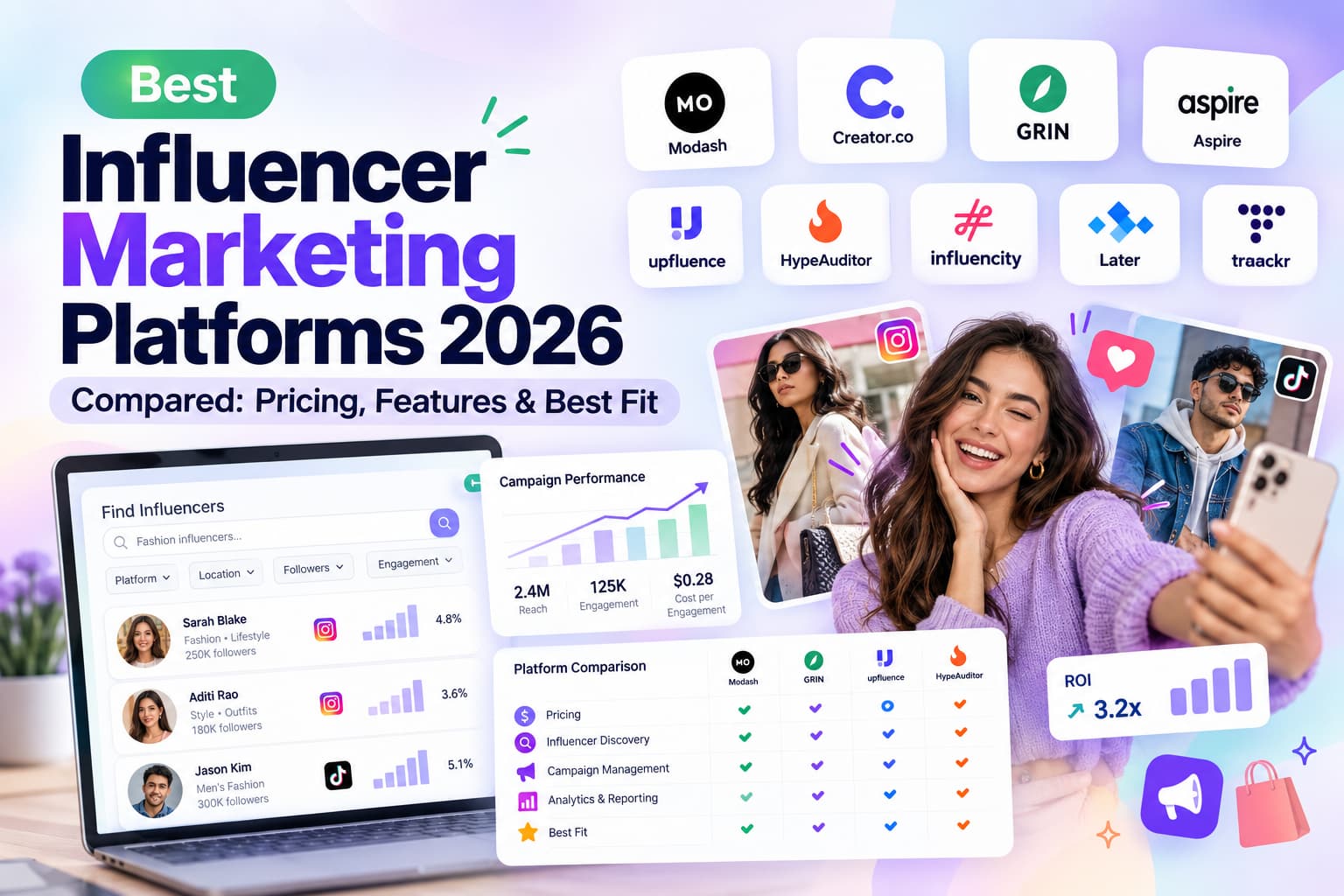
For most growing ecommerce brands and agencies, Modash is the default pick. The public Essentials plan is $299 a month, or $199 a month billed annually ($2,388 a year), and you can start a 14-day trial without a card. GRIN is the stronger pick once ambassador programs, creator payments, and Shopify workflows have to live in one place. Its paid plans start at $200 a month, month to month, and a free plan needs no card.
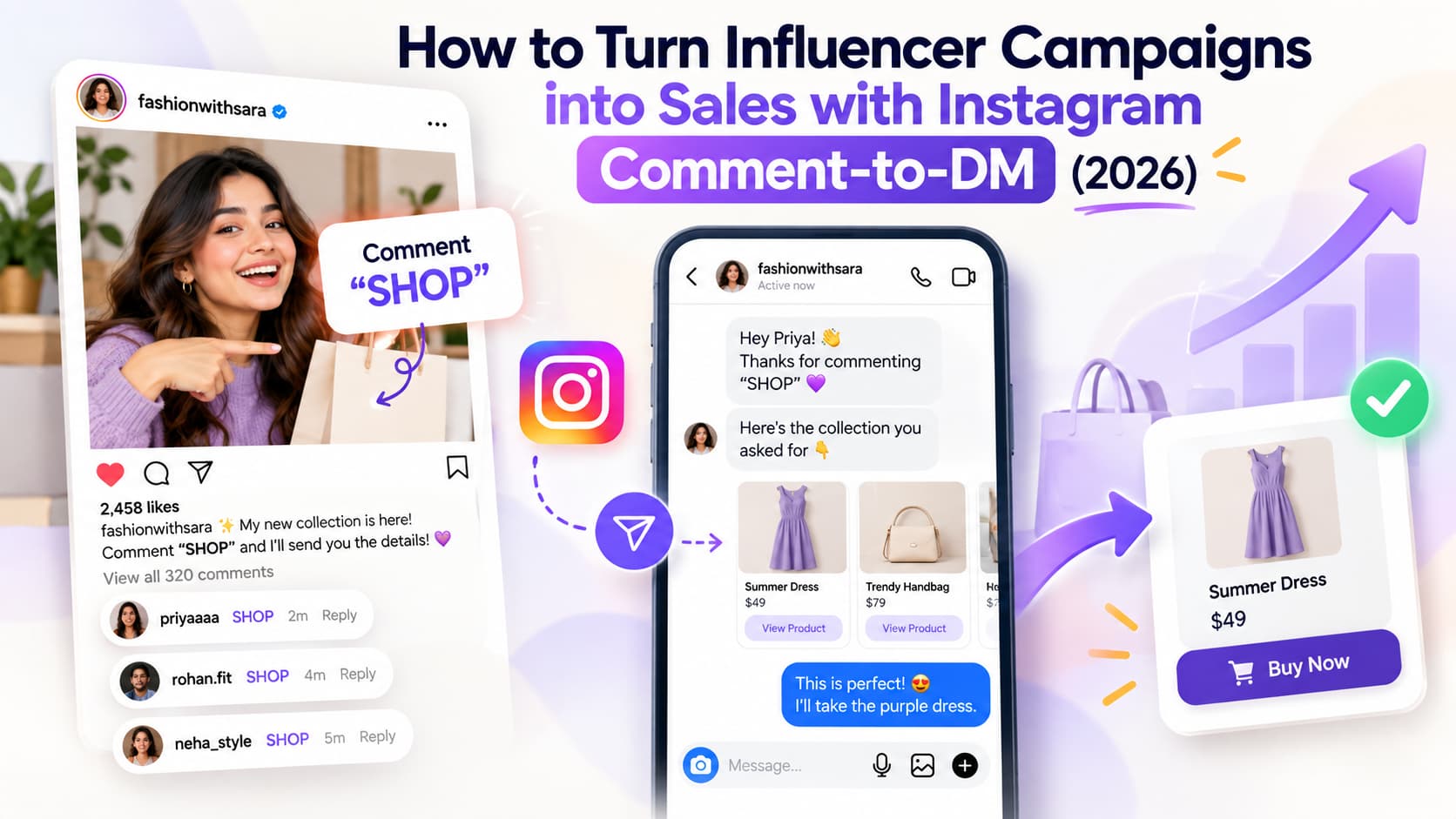
The platform finds and manages creators. Comment-to-DM automation and DM follow-up are what turn the campaign traffic into sales. Almost every comparison stops at discovery, CRM, and reporting. Accenture treats the creator economy as a platform opportunity, not a one-off campaign. The missing piece is narrower: the hour the audience talks back. Unlocking creator economy potential (Accenture)
Key takeaways
- Modash wins for self-serve discovery and a public price.
- GRIN wins for Shopify-centric ambassadors, payments, and ongoing creator programs.
- CreatorIQ is the enterprise governance choice. It does not publish a price.
- Aspire leads for product seeding and inbound applications. It does not publish a price.
- HypeAuditor remains the specialist for audience authenticity. Basic starts at $299 a month on an annual contract.
- Heepsy is the low-cost discovery option, from $69 a month on annual billing.
- None of these tools answer the comment after the post goes live. That is a separate layer.
- The subscription is not the program cost. Creator fees, product, staff time, and the unanswered comment usually cost more.
How we compared these platforms
Influencer marketing, as McKinsey defines it, is a collaboration between popular social-media users and brands to promote a product or service. The buying decision is narrower: which system finds the creator, runs the job, and pays them. What is influencer marketing? (McKinsey)
Six criteria:
- Discovery quality: database, filters, fake-follower signals, audience data
- Campaign operations: briefs, outreach, contracts, approvals, payments
- Ecommerce fit: Shopify or BigCommerce, affiliate tracking, product seeding
- Pricing transparency: public rate versus quote-only, and total cost
- Team size and scale: first campaign, mid-market, or enterprise governance
- Post-publish conversion: whether the tool answers comments, story replies, and DMs after the post is live
Deep profiles are limited to the tools teams actually shortlist. 19 Best Influencer Marketing Platforms for 2026 (Modash)
Prices as of 4 October 2026
Public price means the vendor shows a number without a sales call. Annual price means the monthly rate when billed yearly. Quote-only means no public rate card. Reported means a third-party figure, not a number on the vendor site.
| Platform | Price on 4 Oct 2026 | Self-serve | Creator payments | Shopify |
| Modash | Essentials $299/mo, or $199/mo annual ($2,388/yr). Performance $599/mo, or $499/mo annual ($5,988/yr). Enterprise $14,700/yr. 14-day trial, no card. | Yes. Enterprise is a sales plan. | Performance and Enterprise. 0% fee up to $10,000/yr on Performance, then 5%. Enterprise starts at 0% up to $100,000/yr. | Gifting and tracking. Not a full ambassador system. |
| GRIN | Free $0, 50 credits. Starter $200/mo, 2,000 credits. Growth $500/mo, 7,500 credits. Scale $1,000/mo, 20,000 credits. No Complete plan on the public page. | Yes. Free needs no card. Paid plans are month to month. New accounts get 30 days of Starter. | Yes. Links, codes, and commission payables. Creating a payable uses credits. | One-click Shopify on every plan, including Free. |
| HypeAuditor | Basic from $299/mo billed annually, per HypeAuditor’s pricing article. Lite $219/mo for companies under 5 years old with fewer than 25 employees. Pro and Enterprise are demo. | Partial. Lite can be subscribed. Core plans lean on a demo. | Not a creator-payout system. | Not a Shopify campaign system. |
| Heepsy | Free $0. Starter $69/mo annual ($89 month to month). Plus $149/mo annual. Advanced $229/mo annual ($299 month to month). | Yes | Creator payments on Plus and above. | Light tracking, not an ambassador OS. |
| Shopify Collabs | Free to install. Creator payouts carry a 2.9% processing fee, paid by the merchant. | Yes, inside Shopify | Yes | Native. Not available on Starter or Retail. |
| impact.com | No public rate card. 2026 directories report Starter around $30/mo, with higher tiers from about $500/mo. | Partial | Yes, on the partnership product | Ecommerce plugins, including Shopify |
| CreatorIQ | No public price. Reported contracts often start around $30,000/yr. | No | In vendor materials; scope is contractual | Not a Shopify-native default |
| Aspire | No public price page. Reported entry often from about $1,000/mo. | No | Contractual | Seeding workflows in vendor materials |
| Upfluence | Quote only. Demo required. No public plan price. | No | In the campaign product | Ecommerce data matching, including store data |
| TikTok One, Instagram Creator Marketplace | Free inside the native platform | Yes | Platform-dependent | Single channel |
Sources for the public rows: Modash pricing, GRIN pricing, HypeAuditor pricing. Heepsy figures are from heepsy.com/pricing. Shopify Collabs is free to install for eligible Shopify plans. A second read on how vendors package these prices is in Storika’s 2026 pricing guide.
Quick comparison
| Platform | Best for | Starting price | Self-serve | Skip if |
| Modash | Discovery for a growing ecommerce team | $199/mo annual | Yes | You need a full ambassador and payments system |
| GRIN | Shopify ambassadors and payments | Free; paid from $200/mo | Yes | You only need a one-off search |
| CreatorIQ | Enterprise reporting and governance | Quote, often ~$30k/yr | No | Budget is under about $30k a year |
| Aspire | Seeding and inbound applications | Quote, often ~$1k+/mo | No | You want a public monthly price |
| Upfluence | Matching creators already in your customer file | Quote | No | You want self-serve discovery today |
| HypeAuditor | Fake-follower and audience checks | $299/mo annual, or Lite at $219/mo | Partial | You need campaign operations and payouts |
| Heepsy | Low-budget discovery | $69/mo annual | Yes | You need payments and CRM at scale |
| Shopify Collabs | Shopify affiliate programs | Free with an eligible Shopify plan | Yes | You sell outside Shopify |
| impact.com | Affiliate and creator performance | Reported from ~$30/mo | Partial | The job is awareness only |
| TikTok One, Instagram Creator Marketplace | One channel | Free | Yes | The program runs on several platforms |
impact.com is a performance network, not an audience-quality tool. HypeAuditor vs impact.com
Best fit by situation
| Your situation | Start here | Why |
| You need creator research today | Modash | Public price, trial, no sales call |
| You run Shopify ambassador programs | GRIN | Payments, affiliate workflows, creator CRM, free start |
| You rely on product seeding and applications | Aspire | Marketplace and inbound model |
| You operate across markets and brands | CreatorIQ | Governance, permissions, executive reporting |
| You need audience-quality checks | HypeAuditor | Authenticity and fraud analysis |
| You are testing a first campaign | Shopify Collabs or a native marketplace | Low cost, low setup |
| You already have creator data in the store | Upfluence | Customer-to-creator matching |
| You need affiliate and creator performance tracking | impact.com | Performance measurement |
| You want cheap research and some outreach | Heepsy | Free plan, paid from $69/mo annual |
These tools do different jobs
- Discovery tools find and analyze creators. Modash, Heepsy, and HypeAuditor sit here. HypeAuditor vs Modash
- Campaign tools run briefs, outreach, approvals, and reporting.
- Affiliate and performance tools track links, commissions, and revenue.
- Marketplaces take applications instead of cold outreach.
- Audience-intelligence tools score authenticity and fraud.
- Native marketplaces work inside one social or ecommerce app.
HypeAuditor should not be scored as a campaign system. Upfluence should not be scored as a fraud tool. HypeAuditor vs Upfluence
How to read the price
Some vendors charge a flat subscription. Others meter credits, profile views, email unlocks, seats, or payout volume. The number on the pricing page is the platform fee, not the program.
Before buying, confirm seats, search or profile limits, active-creator limits, email or outreach credits, payout fees, affiliate fees, export rights, onboarding fees, annual lock-in, and whether content rights or Partnership Ads are included.
Total program cost = platform fee + creator fees + product and shipping + staff time + payment costs + content-rights fees + paid amplification.
A cheap discovery tool can cost more to run if outreach, payments, and reporting stay in spreadsheets.
What the plans include
Modash
Essentials is the self-serve discovery plan: $299 monthly or $199 a month on annual billing, with a 14-day trial and no card. The trial is capped at about 20 profiles, 6 emails, and 10 tracked creators. Performance at $599 monthly or $499 a month annual is where payments and affiliate management sit, with a 0% fee up to $10,000 a year combined and 5% after. Enterprise is listed at $14,700 a year and raises that payout allowance toward $100,000. Skip Modash if you need multi-currency creator payroll and a full ambassador desk.
GRIN
Free is $0, no card, no time limit, 50 credits, and every campaign type. Starter is $200 a month for 2,000 credits. Growth is $500 for 7,500. Scale is $1,000 for 20,000. Paid plans can buy more credits. Free cannot. Plans are month to month, with no annual contract. Shopify connects in one click on every plan, including Free. A new account also gets 30 days of Starter. GRIN compare
CreatorIQ
No public price and no public trial. Reported annual contracts often start around $30,000. It fits global brands that need brand safety, permissions, and executive reporting. It is the wrong buy for a small or mid-market team.
Aspire
No public pricing page. Reported entry points often start around $1,000 a month, sometimes higher per user. The product fit is seeding, ambassador programs, and creators applying to briefs. Skip it if you need a price you can read before a demo.
Upfluence
Quote only, after a demo. The useful job is finding creators who are already customers, then running the campaign in the same system. Skip it if the only need is a self-serve search box.
HypeAuditor
Basic starts at $299 a month on an annual contract. Lite is $219 a month, limited to companies under five years old with fewer than 25 employees, and includes discovery, 10 demographic reports, and 200 email unlocks a month. Pro and Enterprise are sold through a conversation. Use it to vet an audience before you spend. Do not use it as the system of record for payouts.
Heepsy
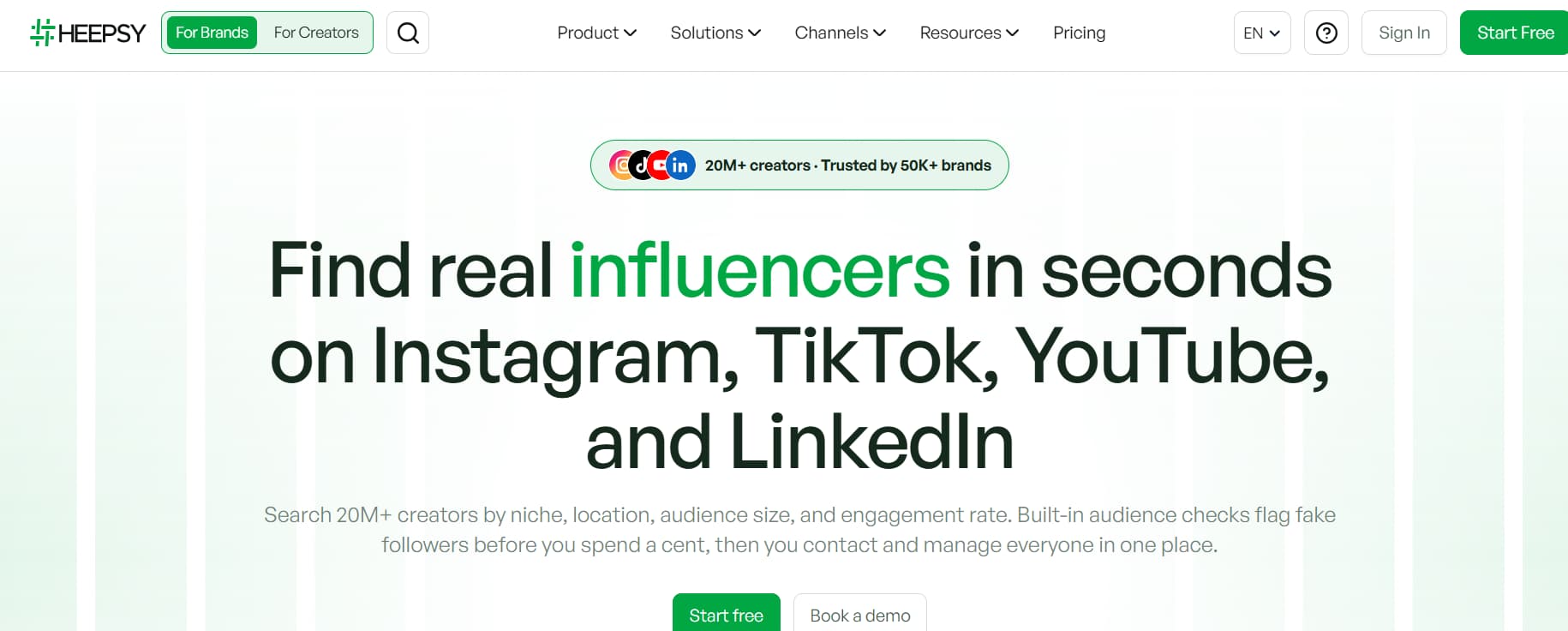
Free includes 500 results and 10 advanced profiles a month. Starter is $69 a month on annual billing, or $89 month to month, with 5,000 results, 100 advanced profiles, and 300 outreach emails. Plus is $149 a month on annual billing and is where creator payments appear. Advanced is $229 a month annual, or $299 month to month. It is a research and light-outreach tool, not an ambassador platform.
Shopify Collabs and native marketplaces. Collabs is free to install on eligible Shopify plans, not Starter or Retail. Commission payouts carry a 2.9% processing fee paid by the merchant. TikTok One and Instagram Creator Marketplace are free inside their own apps. All three are enough for a first test. None of them run a multi-platform program.
Who does not need a paid platform yet
Skip the subscription if the first campaign is under about 10 creators, the names are already known, one person can handle outreach and reporting, and the test is one channel. A spreadsheet, Shopify Collabs, or a native marketplace is enough.
A platform is easier to justify past about 20 active creators, missed follow-ups, manual payment reconciliation, repeatable seeding, several teammates, or a finance team that wants sales attribution.
The conversion step these platforms skip
A creator post is not a sale. It is a spike of comments, story replies, and profile taps that expires. Modash, GRIN, CreatorIQ, Aspire, Upfluence, and HypeAuditor stop at find, hire, pay, and report. None of them is the inbox that answers the comment.
The leak sits in a fixed window:
- The post or story goes live.
- People comment a keyword, reply to the story, or mention the brand.
- Instagram opens a 24-hour messaging window from that interaction.
- A manual reply catches a fraction of it. The rest is gone the next morning.
Gartner expects 60% of brands to use agentic AI for one-to-one interactions by 2028. Influencer traffic is already that moment. Waiting for a new platform does not answer today’s comment. Gartner, 15 January 2026
That is a different job from discovery. A platform can be the right buy and still leave the revenue on the table.
| After the post is live | Modash | GRIN | CreatorIQ | Aspire | HypeAuditor | A DM tool |
| Find and vet the creator | Yes | Yes | Yes | Yes | Yes | No |
| Brief, approve, pay | Partial | Yes | Yes | Yes | No | No |
| Attribute the order | Partial | Yes | Yes | Partial | No | No |
| Reply to the comment in the 24-hour window | No | No | No | No | No | Yes |
| Story-reply to a DM | No | No | No | No | No | Yes |
| One follow-up if they do not buy | No | No | No | No | No | Yes |
Automate the first reply only. The comment keyword sends the link, the code, or the question. The story reply does the same. One follow-up goes out if they do not click. A person takes over when the reply is a complaint, a wholesale ask, or anything the flow was not built for.
Do not automate negotiation with the creator. That stays in GRIN, Aspire, or email. The DM tool starts when the audience talks back.
A workable brief looks like this. The caption says “comment GUIDE.” The comment gets a public reply and a DM with the product link and the creator code. A story sticker does the same job. If there is no click within the window, one follow-up asks if they want the shade, size, or restock alert. The order is tagged with the creator code so GRIN or Shopify still gets the sale.
The platform report will show reach, engagement, and earned media value. Add four numbers the platform does not have:
- Comments and story replies received in the first 24 hours
- Share of those that got a DM
- DM reply rate and link-click rate
- Orders with that creator’s code or link in the same window
A post with 400 comments and 30 manual replies is not a 400-comment campaign. It is a 30-reply campaign.
Keep the platform you already picked. Modash to find them, GRIN to run and pay them, HypeAuditor if the audience needs a fraud check. Add a comment-to-DM tool for the hour the post is live.
InstantDM is the official Meta Business Partner option built for that hour. The free plan includes 500 automations a month. Legend Pro is $12 a month, or $9.99 a month billed annually, with comment-to-DM, story replies, and follow-ups on a flat price rather than a per-contact meter. Trendsetter adds a higher sending cap and API access. Prices are on the InstantDM pricing page. A wider tool comparison is here: Best auto DM tool for influencers.
The platform decision and the inbox decision are separate purchases. Buying GRIN does not answer the comment. Buying a DM tool does not find the creator.
Nano and micro creators still convert
Smaller creators often beat a mega list on cost per sale. Engagement is higher, the audience is tighter, and fees are lower. The same 24-hour reply matters more here, because the audience already trusts the creator and will answer a DM. BCG’s 2026 research makes the same point from the brand side: authenticity, not reach alone, is what separates programs that outperform. Brands using creator marketing to outperform (BCG)
Application marketplaces and tools that can handle a high volume of small creators make that practical. Mega creators still work for an awareness spike.
What to measure
Platforms report earned media value, reach, and engagement rate. Finance needs attributed sales, creator-traffic acquisition cost, content-rights value in paid ads, DM reply rate in the 24 hours after a post, refund rate, and repeat value from creator-sourced buyers.
IAB’s creator-economy report is the budget context. 2025 Creator Economy Ad Spend & Strategy Report (IAB) Nielsen’s influencer research is why the personal reply still matters after the impression. Getting closer: influencers and personal connections (Nielsen)
Export what the platform gives you, then join it to DM and order data.
How to pick in 15 minutes
- Job: discover, run, pay, or measure
- Volume: under 20 creators a month, or an always-on roster
- Buying style: public price and self-serve, or a demo and an annual contract
- Stack: already on Shopify, already in a social suite, or need multi-currency payouts
- Inbox: who answers the comment in the first 24 hours
Then match. Discovery this week: Modash. Shopify plus payments: GRIN. Enterprise governance: CreatorIQ. Seeding and applications: Aspire. One cheap channel: Collabs, Heepsy, or a native marketplace. Forrester’s program guidance is the next read once the tool is chosen. How to level up your creator marketing program (Forrester)
Questions to ask before buying
- What counts as a search, a profile view, an unlock, or a credit?
- Are inactive or duplicate profiles in the database count?
- How often is audience data refreshed?
- Can it flag suspicious follower growth?
- Are creator payments included, or a separate provider?
- Are tax forms and international payouts supported?
- Are transaction fees extra?
- Can creators apply without a manual invite?
- Can creator, content, and revenue data be exported?
- Are seats, brands, or campaigns capped?
- Is an annual contract required?
- What happens to the data after cancellation?
- Are Spark Ads or Partnership Ads supported?
- Can revenue be reconciled with Shopify?
- What are onboarding and migration fees?
- Does the tool reply to comments and story replies, or does that stay outside it?
Limits of this comparison
Modash, GRIN, Heepsy, Upfluence, Shopify Collabs, and HypeAuditor’s public pages were checked on 4 October 2026. HypeAuditor’s $299 Basic figure is from HypeAuditor’s own pricing article, because the public pricing page does not show a full grid. CreatorIQ, Aspire, and impact.com do not publish a rate card, so those figures are reported ranges, not official prices. Plan names, limits, and fees move. Confirm the live page before you buy.
About the author
Aravindh Kumar is an ecommerce and Instagram growth expert with 8+ years of experience in online selling. He has worked with 500+ brands - including Forbes-listed companies - He has helped 200+ Instagram businesses grow their online presence.