Last Updated: 09 November 2026
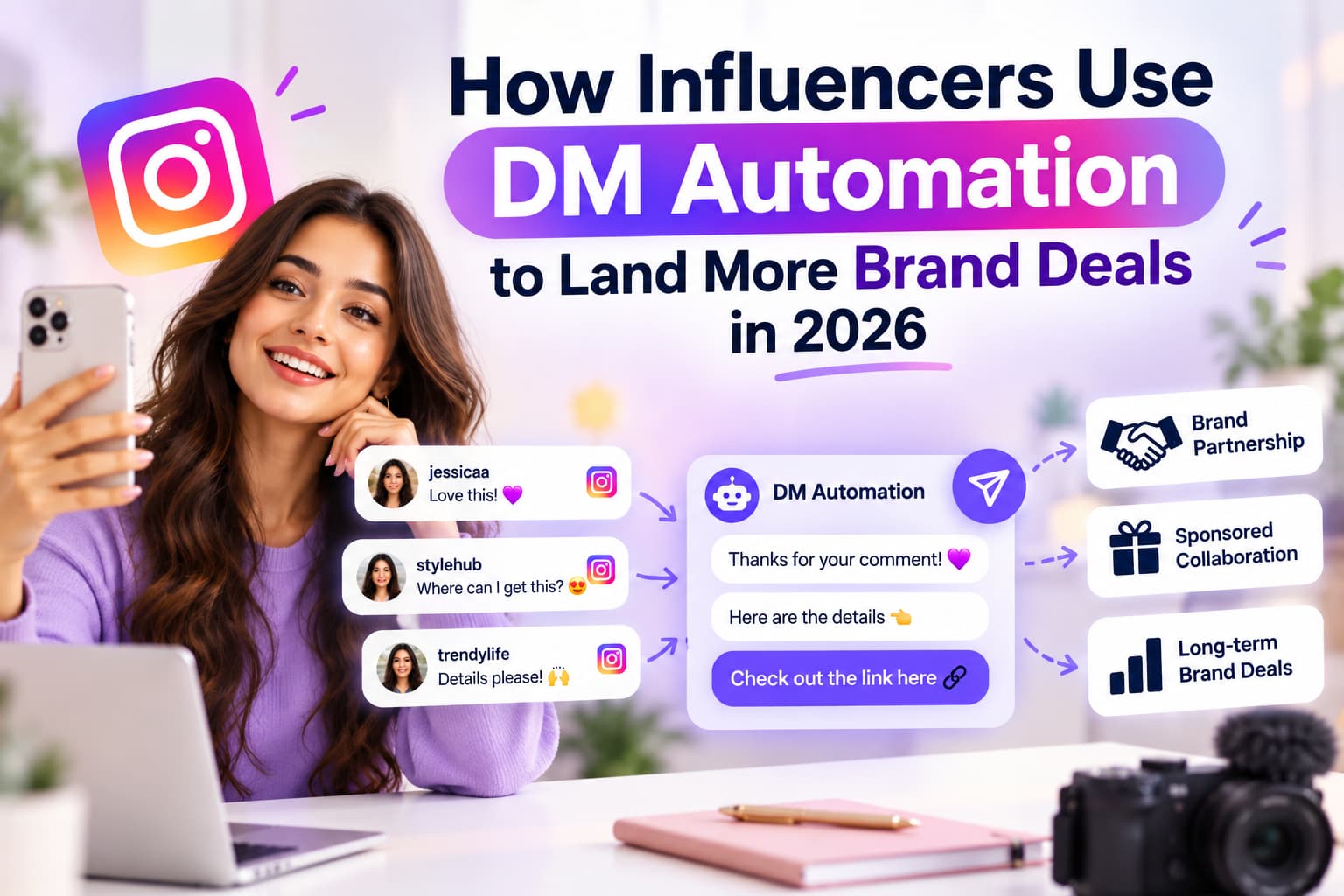
Direct answer: Influencers use DM automation to land brand deals by turning every collab inquiry — a comment, a Story reply, or an inbound brand DM — into an instant professional reply: media kit, rate card, and a few qualifying questions, then a booking link. Speed plus a clean process is what raises close rates. The job is inbound deal flow, not blasting brands, not sending shop links, and not converting a paid Reel’s comments into the brand’s checkout.
| Do this | Not this |
| Instant kit + packages when a brand raises a hand | Reply in two days with “hey what’s the budget” |
| Qualify paid vs seeding before you jump on a call | Treat every “collab?” as a yes |
| Sound like yourself; take over for the deal terms | Automate the negotiation |
| Official Meta API, inbound only | Password bots and cold brand blasts |
This guide is written for the creator receiving brand inquiries — not for the brand paying you to run a campaign. How a brand turns your comments into their sales is a different system.
McKinsey defines influencer marketing as a paid collaboration between creators and brands (What is influencer marketing?). That is the deal this desk is built to catch.
How do influencers use DM automation to land brand deals?
They treat brand outreach the way a small agency would. A keyword such as COLLAB, KIT, or RATES — plus keyword detection on inbound DMs that say “collab,” “partnership,” or “sponsored” — triggers one official-API private reply. That reply delivers a live media kit and packages, asks four qualifying questions, and offers a calendar or brief form. Spam and product-seeding stay out of the pipeline. Negotiation, exclusivity, and usage rights stay human. Creators who run this loop report more inquiries answered, higher close rates, and 10–15 hours a week back — not because they pitch more brands, but because they stop losing the ones already in the inbox.
The deal you never saw
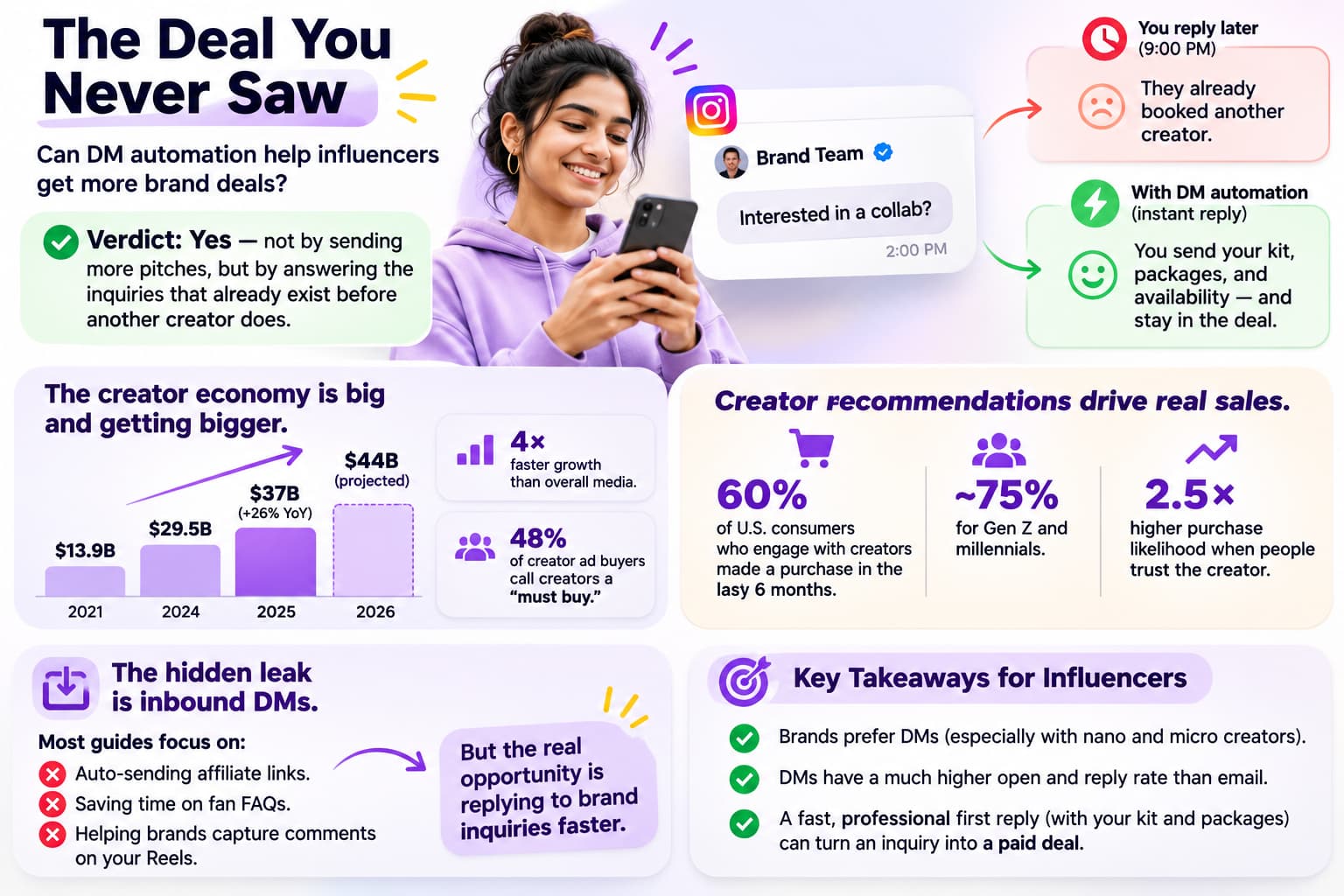
Can DM automation help influencers get more brand deals?
Verdict: yes — not by sending more pitches. By answering the inquiries that already exist before another creator does.
A brand DMs “interested in a collab?” at 2 p.m. You are filming. You reply at 9 p.m. They have already booked someone who sent a kit in ninety seconds. That is not a content problem. That is a desk problem.
Most “DM automation for influencers” content misses this job. One camp teaches you to auto-send affiliate links after a sponsored post. Another camp teaches you to save ten hours on fan FAQs and then route the brand off Instagram into a marketplace. A third camp teaches brands how to capture comments on your Reel. None of those is how you land the next paid contract.
The leak is inbound.
The volume behind that leak is not anecdotal. IAB’s 2025 Creator Economy Ad Spend & Strategy Report projected U.S. creator ad spend at $37 billion in 2025 (up 26% year over year, about 4× overall media growth), after rising from $13.9 billion in 2021 to $29.5 billion in 2024, with $44 billion expected in 2026. Nearly half of creator ad buyers (48%) now call creators a “must buy.” More briefs in market means more DMs in your request folder — and a shorter window before the next creator answers.
Deloitte’s creator research is why the first reply matters: among U.S. consumers who engage with creators, about 60% made a purchase in the last six months based primarily on a creator recommendation; for Gen Z and millennials that share is nearly 75%. Purchase likelihood is about 2.5 times higher when people say recommendations from creators they trust influence them (Brand-creator collaborations). A missed inbound DM is a missed shot at that lift.
Brands already prefer DMs as a first-contact channel for collaborations, especially with nano and micro creators. Reply rate on a tight, professional first message is several times a cold email. Open rate on Instagram DMs sits far above email. That only helps you if the first reply exists. A two-day delay tells the brand what working with you will feel like. Instant kit plus packages tells them the opposite.
| Before a deal desk | After a deal desk | |
| Lifestyle creator, 320k followers | 12 deals / year (~$48k) | 72 deals / year (~$288k) |
| Close rate on inquiries | 18% | 45% |
| Time to first response | 2–4 days | Instant |
| Hours on inquiries | ~15 / week | Near zero on the first pass |
| Micro beauty, 22k, 9.2% engagement | 2 deals / quarter | 12 deals in 6 months |
| Fitness micro, 28k | 40% of 45 monthly inquiries answered | 100% answered; close 22% → 38% |
Same audience. Same rates. Different desk. The conversion lift is not “automation magic.” It is 100% coverage plus a first message that looks like a manager sent it.
Your niche and rates will move the dollars. Unanswered inquiries do not close.
Inbound vs outbound (which problem this article solves)
Outbound is you pitching brands. Cold DMs, emails, marketplaces, “I love your new drop.” Useful. Slow. 1–5% reply is normal.
Inbound is brands already in your comments and request folder. “Collab?” “Send rates.” “Are you open in October?” Warm. Time-sensitive. Several creators get the same message the same afternoon.
DM automation’s highest-ROI job for an influencer in 2026 is inbound. Outbound still needs a human who has watched the brand’s last three posts. Inbound needs a desk that never sleeps. For the wider 2026 picture — Reels for attention, DMs to close, inbound plus a tight outbound list — see Influencer marketing in 2026: how to turn Reels and DMs into real revenue.
Two doors feed inbound:
- A brand messages you directly.
- A brand (or their intern, or their agency) comments COLLAB, RATES, or KIT on a post where you invited that word.
Same flow after the hand goes up. Different trigger. Do not mix this with a campaign keyword a brand assigned you so they can attribute checkout. That keyword is theirs. COLLAB on your grid is yours.
Definition: influencer DM automation for brand deals
Influencer DM automation for brand deals is an official-API workflow on a Business or Creator account. When someone comments a deal keyword or sends an inbound message that matches collab language, the connected professional account sends one private reply with a media kit, packages, and a qualifying question. Further messages wait for their reply. The creator takes over for price, exclusivity, and contracts.
It is not a cold blast to brand inboxes.
It is not “comment LINK for the skirt.”
It is not a marketplace redirect that takes the brand off the thread.
Fan DMs vs brand-deal DMs
What is the difference between automating fan DMs and automating brand deals?
Verdict: same family of triggers. Different asset, different filter, different success metric.
| Fan / audience automation | Brand-deal automation | |
| Who raised the hand | Follower who wants a link, guide, or code | Brand or agency who wants a creator |
| What you send | Product link, lead magnet, FAQ | Media kit, packages, availability |
| Filter | Almost none | Paid vs seeding vs spam |
| Next step | Click or email capture | Qualify → book → human negotiation |
| Metric | Clicks, list growth, hours saved | Inquiries covered, qualified rate, close rate, deal size |
| Failure mode | Robotic shopkeeper | Robotic agent who quotes a custom usage clause |
Saving ten hours on “where is this from?” is real. It is not how you land paid work. If your only automated reply to a brand is “connect with me on a platform,” you handed away the conversation you already won.
The system: COLLAB → KIT → QUALIFY → BOOK
This is the named loop. Four steps. One first message. Human on the close.
1. COLLAB — detect the hand
What keyword should I use for brand inquiries?
Verdict: use COLLAB as the public keyword. Add RATES and KIT only if you want separate doors. On inbound DMs, also match language brands already type: collab, collaboration, partnership, sponsored, brand deal, media kit, rates.
Do not use YES, LOVE, LINK, or the product category word your audience already comments. Those doors belong to fans and to campaign briefs, not to your deal desk.
Put COLLAB in three places:
- A pinned comment or a standing line in the bio (“Brands: comment COLLAB or DM ‘collab’”)
- The first line and last line of a dedicated “work with me” post or Reel
- Spoken in the first three seconds if that Reel exists
One keyword per job. COLLAB starts the deal desk. A brand’s campaign word (GLOW, RITUAL) starts their checkout funnel on a sponsored asset. Keep those files separate or your tags become fiction.
2. KIT — send the decision document
Should I auto-send my rates and media kit?
Verdict: yes, send the kit and packaged rates immediately. Hold custom quotes, usage buyouts, and exclusivity for the call.
Brands ask for a kit because they do not want six emails to learn your niche, audience, and starting packages. An instant PDF or live page is professionalism. An instant “what’s your budget, babe” is not.
The first DM should include:
- One-line positioning (niche, platform, who you reach)
- Link to a live or current kit (followers, engagement, geo, age split, past work)
- Three packages with ranges, not a single made-up number
- One question that sorts paid work from seeding
- A calendar or “reply BRIEF and I’ll send the form”
Update the kit when the numbers move. A six-month-old screenshot is how you look unmanaged. A live page beats a static PDF when a brand’s AI shortlist or an intern opens the link at midnight.
3. QUALIFY — four questions, not a quiz
The first DM earns a reply. Their reply opens the standard 24-hour messaging window so you can keep the thread going (Instagram Messaging API overview). Use that window to sort:
- Paid, gifted, or affiliate?
- Deliverables (Reel, carousel, Stories, usage, whitelisting)?
- Timing (this month, this quarter, always-on)?
- Exclusivity or category lock?
If the answer to (1) is gifted-only and you do not take seeding, decline in one sentence. That is a won hour, not a lost deal.
4. BOOK — then a human
Send the calendar or the brief form after they look qualified. Tag the thread inbound-brand / paid / seeding / not-a-fit. You take over when money, dates, or legal appear.
That is the entire system. Everything below is how to run it without sounding like a bot or stepping on Meta’s rules.
How fast is fast enough?
How fast do I need to reply to a brand DM?
Verdict: minutes, not hours. Instant is the bar. Same-day is already late when the brand messaged five other creators at lunch.
The first communication is the only sample the brand has of what delivery will feel like. Agencies and in-house teams working a flight do not wait four days to find out whether you are organized. They book the person whose kit landed while they still had the brief open.
DataReportal’s Digital 2026 Global Overview Report puts the scale of that inbox in context: more than 6 billion people use the internet, social media users have reached supermajority status, and the average active user spends 2 hours 39 minutes a day on social platforms. Brands hunting inside that attention do not wait on your filming day.
| Response time | What the brand infers |
| Under 2 minutes (automation) | You have a desk |
| Under 2 hours | You are reachable |
| Next day | You are busy; they keep shopping |
| 2–4 days | Working with you will be like this |
You do not need to close in two minutes. You need the kit in two minutes.
Scripts (copy, then sound like yourself)
The first reply can be automated if it sounds like you. Change the jokes. Keep the bones. More swipe copy lives in DM templates.
DM1 — inbound “interested in a collab?” or comment COLLAB
***Hey — thanks for reaching out. Here’s my 2026 media kit and current packages: [kit link].
Quick filter so I send the right next step: is this a paid integration, a gifting brief, or an affiliate test?
If it’s paid, reply with deliverables + month and I’ll send availability.***
DM1 — they asked for rates only
***Rates sit in the kit so they stay current: [kit link].
Starting ranges: single Reel package [range], Reel + Stories [range]. Usage and exclusivity sit on top of that — happy to price those on a 15-min call.
Paid, gifted, or affiliate?***
Product-seeding decline (if you do not take it)
Appreciate you thinking of me. I keep gifting off the calendar this quarter so I can protect paid partners in the same category. If a paid brief opens up, send it — kit is here: [link].
24-hour follow-up if they went quiet after the kit
Circling back in case the kit got buried. Still open on [month] if the brief is paid. No rush either way.
Human takeover line (pin this as a saved reply)
Got it — pulling this out of the auto-flow so I can price usage / exclusivity properly. I’ll reply here as me.
Do not paste a marketplace URL as the whole reply. If you use a platform for contracts later, say so after they are qualified. The thread you already have is the asset.
Triggers remapped to deals (not to merch)
Comment-to-DM, Story reply, and ice breakers are the right mechanics. The payload is the kit, not the affiliate link.
| Trigger | Deal-desk use | Leave this for fans |
| Comment-to-DM | COLLAB / RATES / KIT on a work-with-me asset | LINK, GUIDE, SHOP on outfit or tutorial posts |
| Story reply | “Reply COLLAB for the 2026 kit + October holds” | Discount codes, polls, Q&A |
| Ice breakers (chat entry points) | Work with me / Media kit / Packages | Book a coaching call / Freebie / Merch |
| Inbound keyword on DMs | collab, partnership, sponsored, media kit, rates | “hi,” fire emoji, fan questions |
| Follow-to-DM | Optional welcome. Weak for deals. | Fine for community |
Share-to-DM is a thank-you tool. It is not how brand deals start. Follow-to-DM that pitches a kit to every new follower trains the wrong audience and wastes the first impression.
On a sponsored Reel the brand already paid for, their brief may demand a campaign keyword so they can recap sales. Run that word as a separate automation. Do not reuse COLLAB as the brand’s checkout keyword, and do not reuse their GLOW word as your inbound deal door.
Playbooks by follower tier
Do nano and micro influencers need DM automation to land brand deals?
Verdict: yes. Under-10k paid deals already exist. The leak at every tier below mega is slow, thin first replies — not follower count.
Nano (1k–10k)
Brands who DM you are often founders. They chose you because engagement is dense and the inbox still feels human.
- One keyword: COLLAB. Do not build a maze.
- Kit can be one page: niche, three stats, two pieces of work, two package ranges, email.
- Qualify with one question: paid or gifted?
- Take the call yourself the same day. Automation’s job is coverage, not a four-step bot.
A 22k sustainable-beauty account with 9.2% engagement went from two deals a quarter to twelve in six months after every collab inquiry received the kit instantly. The audience did not triple. The desk appeared.
Micro (10k–100k)
This is the core roster for inbound volume. Forty-plus inquiries a month is common in beauty, fitness, and fashion. Manual reply capacity is usually a third of that.
- COLLAB + RATES as two doors.
- Three packages on the kit (single asset, small campaign, ambassador conversation).
- Four qualification questions.
- Calendar link after they look paid.
- Tag everything. You will forget who was seeding.
The 28k fitness example is the pattern: 45 inquiries / month, 18 answered by hand, all 45 answered with a kit, close rate 22% → 38%. You did not invent demand. You stopped dropping it.
Mid (100k–500k)
Volume and agencies show up. Your risk is looking like a ticket queue.
- Ice breaker: “Work with me.”
- Kit must include audience screenshots a brand can forward internally.
- Auto-decline obvious spam and “promo for promo.”
- A VA or you personally takes over at qualify. Do not let the bot quote a whitelisting fee.
The 320k lifestyle jump (12 → 72 deals / year, 18% → 45% close) is what a professional first pass looks like at this size. Average deal size did not have to rise. Coverage and close rate did.
Macro and managed talent
If an agent already owns inbound, this article is a briefing note for them: instant kit, human on terms. Do not install a public COLLAB door that contradicts the agent’s rate card.
Filter: spam, seeding, paid
Most creator inboxes are not “full of brand deals.” They are full of noise that looks like brand deals.
Route to the kit flow
- collab / collaboration / partnership / sponsored / brand deal / media kit / rates
- A Business account with a real site and a specific deliverable
Park or ignore
- promo for promo, shout for shout
- “check my store,” “I’ll send you a free sample for a Reel”
- accounts with no site, no product, and a kit request
Human review
- gifted + possible paid later
- agencies asking for a “quick rate” with no brief
- category-exclusive requests
Update the filter when a new spam pattern shows up. The point is not a perfect classifier. The point is that a paid brief never sits behind forty “check my store” threads.
What you still answer yourself
Will automation make me look like a bot to brands?
Verdict: only if you automate the part that should sound like a principal. The first reply can be a desk. The deal cannot.
Do not automate:
- Final price
- Usage rights, whitelisting, paid amplification
- Exclusivity windows
- Contract redlines
- “Can you post tomorrow”
- Anything you would not put in writing without reading
A first message that is clear, short, and specific reads as operational, not fake — the same way a studio manager sending a one-pager reads as operational. A bot that “negotiates” a 90-day exclusivity clause reads as fake.
If a brand asks a question the flow cannot answer, send the takeover line and type.
What 2026 changed (short, because the rule is simple)
Is Instagram DM automation allowed in 2026?
Verdict: yes — on a Business or Creator account, through Meta’s official messaging API, and only after the person comments, replies to a Story, or messages you first. Password bots, scrapers, and cold mass DMs to brand accounts you never spoke to are a different product and a different risk. The longer rulebook is Is Instagram automation allowed?.
Design around the constraints:
- Professional account required.
- One unprompted private reply per comment, within seven days of that comment (Send a private reply to a commenter).
- After they reply, the standard 24-hour messaging window covers the rest of the sequence.
- Non-followers often receive the DM in Message Requests. If your public reply on a COLLAB comment does not say “accept the request,” open rate drops.
- Official OAuth only. If a tool wants the Instagram password, stop.
That is enough to run a deal desk.
Two 2026 context notes that change behavior, not just policy:
- Brands shortlist faster. Partnership tools and AI assistants read kits. A stale PDF and a two-day reply lose to a live page that arrived in the same hour as the brief. The same IAB report notes three in four brands are using or planning AI for creator-marketing tasks — which is another reason the kit has to be current when they open it (2025 Creator Economy Ad Spend & Strategy Report).
- The creator who already runs a desk looks like the safer buy. Instant kit is not a gimmick. It is due diligence you did in advance.
Disclosure still sits on you when the post goes live. The FTC is blunt: disclose any financial, employment, personal, or family relationship with the brand, including free or discounted product (Disclosures 101 for Social Media Influencers). Automation does not replace a paid-partnership label.
What to measure (your pipeline, not their ROAS)
A brand will ask you for views. You should also know whether your desk is working.
| Metric | Why it matters |
| Inquiries detected / week | Is the COLLAB door visible? |
| % answered in under 5 minutes | Coverage |
| Kit open rate | Is the first DM worth opening? |
| Paid vs seeding vs spam mix | Are you attracting the right hand-raises? |
| Qualified rate | Are the questions doing work? |
| Close rate on qualified | Is the kit priced and is the human follow-through real? |
| Average deal size | Did professionalism raise the floor? |
| Hours spent on first-pass replies | The original pain |
After you sign, the brand may want a unique word on the sponsored Reel so they can recap orders. That is their funnel. Do not mix it with COLLAB.
Tool criteria for this job (not a roundup)
You do not need a 40-feature chatbot. You need a deal desk that stays inside Meta’s API. Feature-by-feature context for creators is in 7 DM automation features creators need in 2026.
Must-haves for inbound brand deals:
- Official Meta login, Business or Creator account
- Comment-to-DM, Story reply, inbound keyword, ice breakers
- Ability to send a link or file in DM1
- Multi-step questions after they reply
- Tags so paid / seeding / spam do not share a bucket
- Follow-up inside the 24-hour window
- Pricing that does not explode the month a Reel takes off
Category mistakes:
- A generic sales tool whose only example is “comment LINK for the drop” — wrong payload.
- A marketplace whose automated reply is “apply on our platform” — you gave away the thread.
- A brand-side campaign tool whose thesis is “tag leads by creator for checkout” — correct product, different buyer.
Compare official platforms here: best Instagram DM automation tools. InstantDM is built for this desk: official Meta login, comment and Story triggers, kit in DM1, questions after they reply, no per-contact surprise bills. Use it as a setup reference. The system still works if you refuse to publish a rate in DM1 or if a manager takes over at qualify.
Build the kit first. Connect the account. Test COLLAB from a second profile. Then announce the door.
Mistakes that kill deals
- Using LINK or YES as the brand-inquiry word.
- Sending only a marketplace URL.
- Auto-quoting a custom usage fee.
- Letting seeding and paid share one tag.
- A kit with follower count and no packages.
- No Requests line on the public reply to COLLAB.
- Connecting a tool that asked for your password.
- Treating a brand’s checkout keyword as your inbound deal door.