Updated 24 October 2026
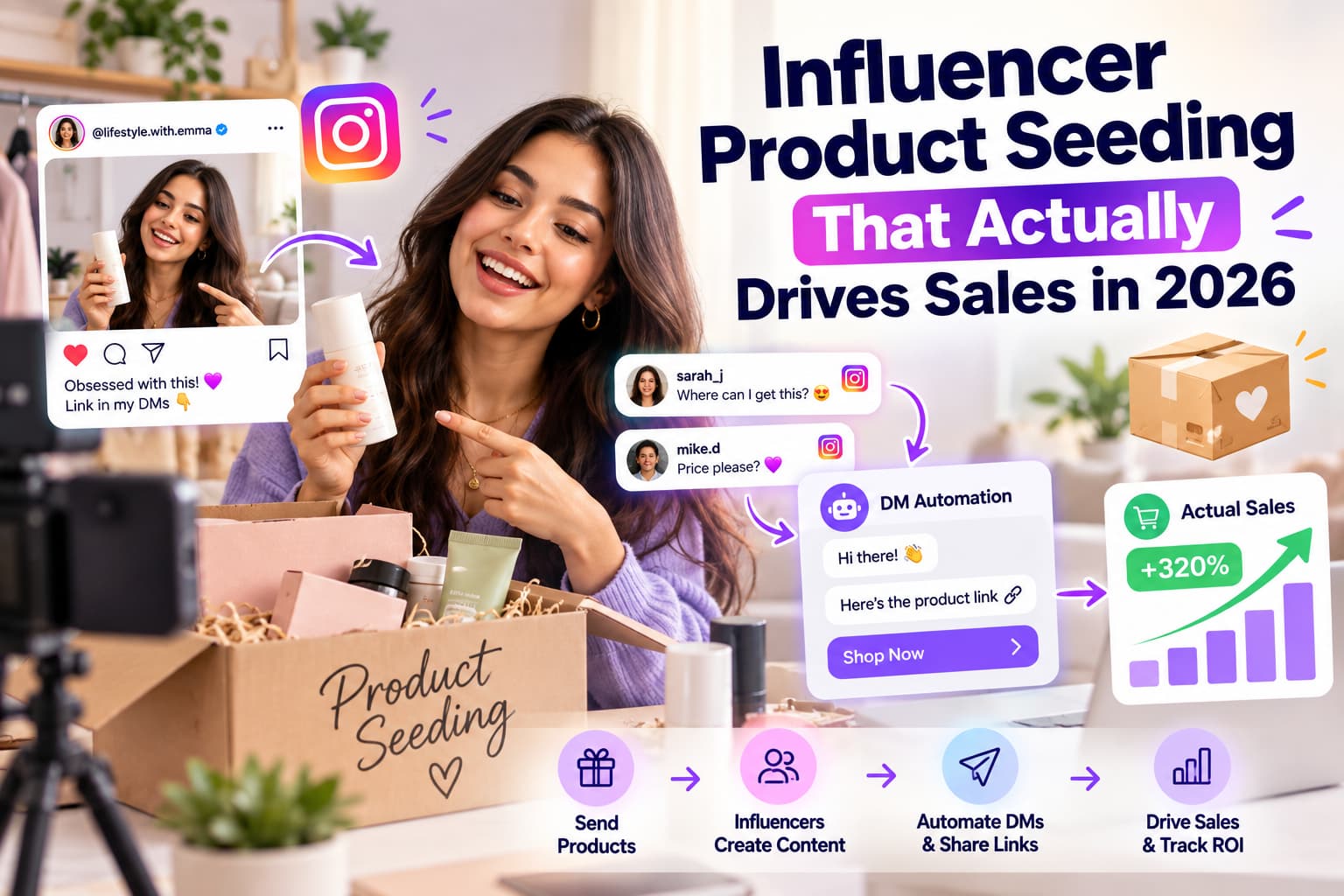
Direct answer: Influencer product seeding is sending free product to fit creators with no paid post required. Campaigns drive sales when each creator gets a unique code, you follow up after delivery without asking them to post, and you capture the people who react to the content they do publish. A box with no follow-up is postage. A post with no proof is a recap, not revenue.
| Do this | Not this |
| Seed 15–30 in-niche nano/micro creators first | Blast 400 lifestyle accounts and hope |
| Unique code + unique creator tag per kit | One shared code across the roster |
| Delivery confirm, then one warm check-in at day 7–10 | Daily “did you post yet?” DMs |
| Measure post rate, code sales, and assisted orders | Recap only views and likes |
| After they post, convert comments on the posting account | Send paid Reel traffic to a shared bio link and hope |
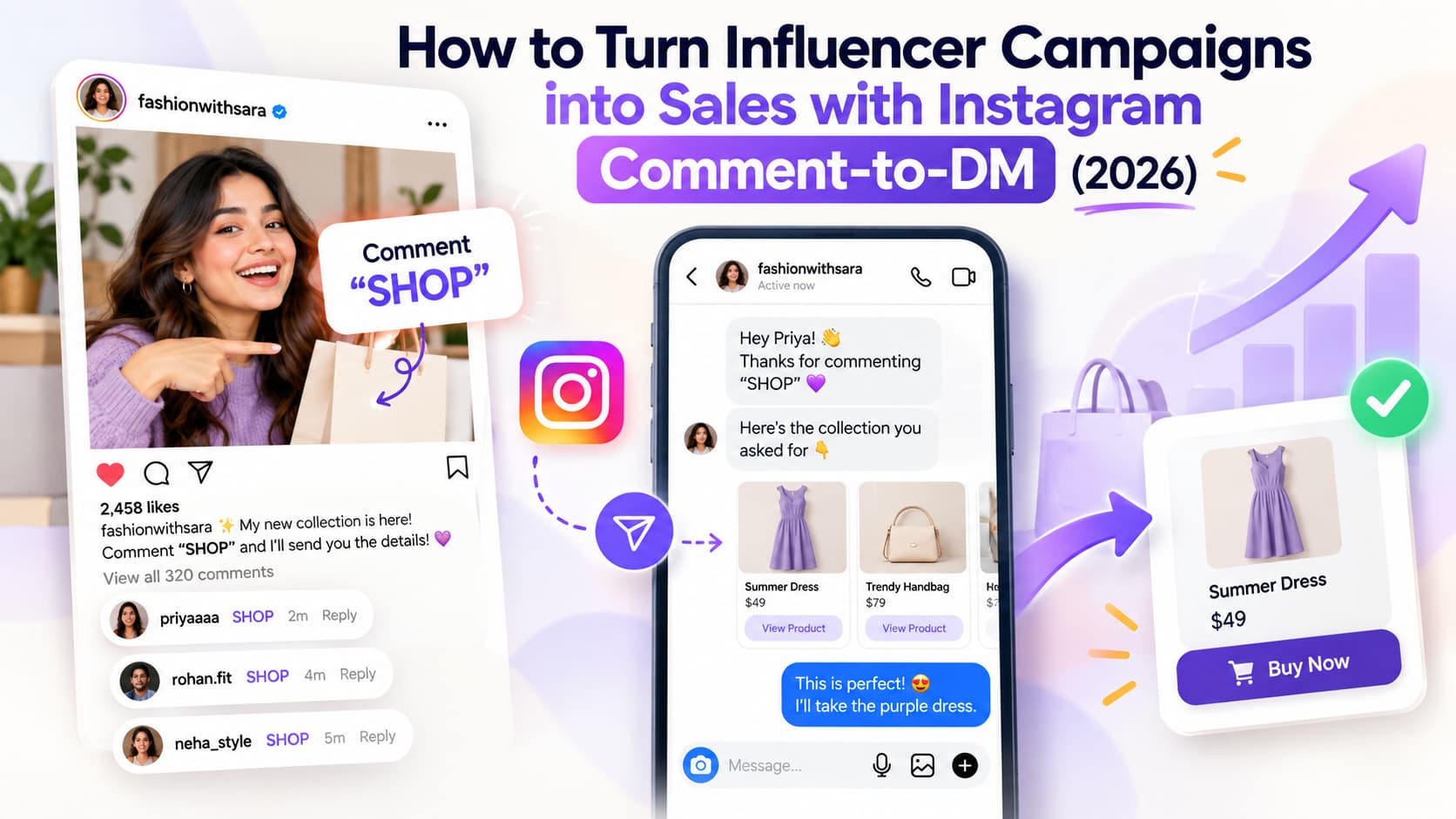
This guide is for the brand paying for product and shipping. It covers who to seed, what to send, how to follow up, and how to prove sales. When a seeded Reel is live and viewers start commenting, close that traffic with Influencer Marketing in 2026: How to Turn Reels & DMs Into Real Revenue.
What is influencer product seeding?
Direct answer: Influencer product seeding (also called creator seeding) is a marketing program where a brand sends free product to hand-picked creators with no fee and no contract to post. The brand is planting the product. Some creators will try it, like it, and share it. Some will not. You measure both.
That is the whole definition. Everything else is operations.
Three things make it different from a sponsorship:
- There is no guaranteed deliverable.
- The only hard cost is landed product (COGS + shipping), usually in the $25–$170 range per creator depending on the kit.
- The content that does go live tends to read as a real recommendation, which is why seeding still grows as a share of influencer work in 2026.
Industry guides now put product seeding at roughly 31% of influencer campaigns, up from about 20% the year before. Average influencer marketing return is often cited around $5.78 per $1. Well-run seeding programs that reuse UGC and attach affiliate commissions are commonly framed at 3–8x when you count content value, not only first-touch orders. Treat those as planning bands. Your list quality moves the number more than your box design. For the wider 2025–2026 creator-marketing picture, see CreatorIQ’s State of Creator Marketing 2025–2026 and BCG’s note that precision beats spray-and-pray in influencer marketing.
What it is not
- It is not a paid Reel with a script.
- It is not a PR mailer sent to whoever has a public address.
- It is not “message every creator in the niche and call it a campaign.”
If you need a guaranteed post on a date, buy a sponsorship. If you need authentic volume plus a pipeline of future ambassadors, run influencer product seeding.
How do product seeding campaigns actually drive sales?
Direct answer: A product seeding campaign drives sales when three loops close: the creator posts or talks about the product, a unique code or link attributes the order, and a follow-up system turns silence into either a post or a clean “no.” Views do not drive sales. Handoffs do.
Most seeding flights look busy and still fail a finance review because they stop at post rate.
Sales come from four places, in this order:
- Direct code or affiliate orders from the creator’s caption, story, or DM.
- Assisted orders in the 7–14 days after a post (branded search, returning visitors, “the one Maya used”).
- UGC you reuse in ads, site modules, and email — this is often larger than first-touch revenue.
- Ambassadors you promote from the creators who posted and sold. Seeding is the intake funnel for paid work. The comment → DM → checkout path after a live post is the DM marketing system that turns Instagram comments into customers.
If you only track (1), you will under-count the program and kill it too early. If you only track reach, you will keep it too long.
Verdict: Seed to create the asset and the relationship. Follow up to raise the post rate. Attribute to prove which creators minted money. Convert the audience of the live post on the account that owns that post.
Why most influencer product seeding campaigns stall
The creative is rarely the failure. The handoff is.
A typical broken flight:
- Brand DMs 200 creators with a generic “we’d love to send you product.”
- Addresses live in 80 chat threads.
- Kits ship with no note, no code, no disclosure line.
- Nobody writes after delivery.
- 18 people post. The brand screenshots reach.
- Finance asks which creator produced orders. Nobody can say.
Picking better creators and writing a nicer note is necessary. It is not sufficient.
A sales-oriented seeding program also needs:
- Sales math, not only post rate. What 100 kits usually become.
- A real DM follow-up cadence that does not nag.
- Two humans in the campaign: the creator you shipped, and the people who react to their content.
- Attribution that survives a shared bio link.
- Failure bands so you know whether to fix the list, the kit, or the follow-up.
- 2026 constraints: gifted disclosure, professional-account messaging windows, claim links instead of address-in-DM chaos.
- Niches beyond US beauty: fashion, home, coaches with a physical kit, India / price-sensitive D2C.
Influencer product seeding vs gifting vs paid sponsorship
Direct answer: Seeding is free product and no required post. Gifting is often the same word with a soft expectation. A paid sponsorship is a fee plus a contracted deliverable. Use seeding to find who converts. Use paid once you already know.
| Influencer product seeding | Influencer gifting | Paid sponsorship | |
| What the creator gets | Product they chose or were sent | Product, sometimes a nicer PR kit | Fee, usually plus product |
| Content obligation | None | Soft / implied | Contracted posts, dates, usage |
| Typical scale | 15–200 nano/micro per wave | A handful of relationships | 1–20 per flight |
| Cost per creator | COGS + ship (~$25–$170) | Same, sometimes plus packaging theater | $200–$10,000+ depending on tier |
| Best for | Authentic UGC, discovery, sales tests | Goodwill, press-adjacent moments | Guaranteed launch coverage |
| How you prove sales | Unique code + follow-up log + post URL | Rarely measured | Code + contracted usage + whitelisting |
Verdict: If the brief says “no pressure to post” and you still measure post rate, you are seeding. If the brief says “Reel by Friday,” you are buying a post and should not call it seeding to dodge the fee.
Mixing the three in one Slack thread is how attribution dies. Separate the roster.
The 2026 math: post rate, first-flight size, cost per sale
What is a good product seeding post rate?
Direct answer: Plan on 30–50% of delivered kits turning into at least one public mention. Mature programs that add a 10–20% affiliate offer on top of the gift often report around 60%. Below 20% after a clean follow-up is a list problem, not a logistics problem. Above 50% with no attributed revenue means you seeded the wrong audience.
Nano creators (roughly 1K–10K) post more often because the kit is a real event in their week. Mid-tier inboxes are already full. That is why conversion seeding leans nano and micro even when the brand wants “big names.”
| Creator tier | Typical post rate on a relevant kit | Role if the goal is sales |
| Nano (1K–10K) | 55–80% when fit is real | Highest conversion per box |
| Micro (10K–30K) | 15–35% | Core roster |
| Micro (30K–100K) | 5–15% | Use after the small list works |
| Mid / mega | Low single digits unless you add a fee | Awareness, not the first 30 kits |
These bands match what 2026 practitioner guides keep repeating. They are not a promise. A $12 sample sent to a 200K lifestyle account will sit in a closet. A $48 hero SKU sent to 25 people who already film that category will move.
How many creators should I seed?
Direct answer: For a first sales-oriented flight, seed 15–30 in-niche nano or micro creators. Do not start at 200. You cannot follow up 200 people well, and follow-up is the lever.
Scale only after you know:
- post rate on this kit
- which creator profiles produced codes
- landed cost per usable post
A second wave of 40–80 is reasonable. Monthly cadence beats one heroic blast per year. Case studies that look huge (hundreds of creators, thousands of posts) are year-one stacks, not week-one plans.
Worked example (planning model, not a case study)
Assume a fashion/beauty kit at $38 landed (COGS + ship). First flight: 25 creators.
| Step | Planning rate | Count |
| Kits delivered | 100% | 25 |
| Creators who post (40%) | 40% | 10 posts |
| Cost of the wave | 25 × $38 | $950 |
| Cost per post | $950 / 10 | $95 |
| Orders on unique codes (planning) | 2–4 per posting creator on a mid-ticket impulse | 20–40 orders |
| If AOV is $42 | — | ~$840–$1,680 first-touch |
First-touch can look flat. Add: UGC you would have paid a UGC shop $150–$400 to shoot, plus any ambassador you do not have to discover cold next quarter. That is why seeding survives a tight CAC conversation when the recap is honest.
If 25 kits produce 3 posts, stop scaling. Fix fit. If 25 kits produce 12 posts and zero codes, the content is reaching tourists. Fix who you seed, or put a better reason to use the code in the caption they actually write.
How do you run an influencer product seeding campaign?
Direct answer: Run it as Seed → Signal → Sequence. Seed the right creators with a film-ready kit and a unique code. Wait for the signal (delivery, reply, post, or silence). Sequence the follow-up and the sales proof. Do not ship first and invent the system later.
That is the operating system. The steps below are the same system written as work.
Step 1 — Pick one sales job
Write one sentence. Examples:
- “We need 20 usable clips and a read on which micro creators sell the serum.”
- “We need launch noise two weeks before the drop, measured in codes, not vibes.”
- “We need to turn last quarter’s best customers who already make content into a cheap ambassador bench.”
If the sentence contains both “go viral” and “prove ROAS,” split the flight.
Step 2 — Build the list like a buyer, not a fan
Priority order that actually posts:
- Existing customers who already create in public.
- Nano/micro creators who already use the category.
- Lookalikes of creators who sold last wave.
- Mid-tier only with a reason (launch week, retail buyer story).
Ignore follower count until the caption language matches your buyer. A 6K skincare account that films routines will outsell a 90K “get ready with me” account that has never mentioned SPF.
Tools help at scale. They do not replace a 20-minute pass where a human watches three videos per creator.
Step 3 — Outreach that does not sound like a brief
Keep it short. Name a specific piece of their content. State there is no obligation to post. Give one next step (claim link or reply with a size).
Weak: “Hi we love your page want free product??”
Stronger: “Your Tuesday routine video is the exact use case for [product]. We can send the full size. No post required. If you want it, here’s the claim link.”
Collect addresses through a claim link that writes a $0 order into Shopify or your 3PL. Do not run address collection as a 40-message DM thread. That workflow breaks before 50 sends.
Step 4 — Ship a kit people can film
Include:
- The hero product they would have bought, not the leftover shade.
- A handwritten note with the unique code and the gifted disclosure line they should use.
- One content hint, not a shot list of twelve mandatory angles.
- Packaging that does not fight the camera.
Handwritten notes are one of the few lifts practitioner research keeps repeating (often cited around a 20% post-rate bump). Believe the direction even if you distrust the exact percentage.
Step 5 — Follow up on a calendar (this is the campaign)
See the next section. If you skip it, you did not run a campaign. You ran fulfillment.
Step 6 — Log the signal
For every creator, store: ship date, delivery date, follow-ups sent, post URL, code, orders, whether you asked for usage rights, whether they should enter the ambassador pool.
A spreadsheet is enough at 30 people. A tool is enough at 150. Dashboards that cannot show “who posted, who sold” are decoration.
Step 7 — Convert posters into a program
Organic posters are not the end. They are the shortlist for affiliate, always-on gifting, or a paid Reel. Brands that treat seeding as a one-off pay the discovery tax every month. When you promote a poster into always-on, run the live asset through the same comment → DM → customer system instead of a shared bio link.
How do you follow up after product seeding without being pushy?
Direct answer: Confirm the box arrived within 1–2 days of delivery. Send one warm check-in 7–10 days later. Do not ask them to post. If there is no post by day 14, stop. If they post, thank them the same day and attach the code, usage-rights ask, and next step. Two creator-facing follow-ups is the ceiling.
The brands that raise post rate without burning the relationship use a clock, not charm.
The creator follow-up clock
| When | Message job | What you must not do |
| Ship day | “It’s on the way, tracking here. No need to post.” | Attach a content brief they never agreed to |
| Day 1–2 after delivery | Confirm arrival. Offer help on shade/size/setup. | “Can’t wait to see the Reel” |
| Day 7–10 | One human check-in. Ask how it felt. | Demand a story |
| Day 14 | Close the loop internally. Park them for a later wave. | Third poke |
| They post | Thank in public or in DM. Ask for rights. Remind the code. | Ghost the person who just worked for free |
| They never post | Leave the door open. Do not punish them in the next wave unless fit was wrong. | Public shade |
Sample delivery confirm
“Hey [name] — tracking says it landed yesterday. If anything’s missing, tell me. Hope it earns a place in the routine. No rush on anything.”
Sample day-7 check-in
“Quick one: did the [product] settle in ok? Curious what you’d change. Either way, glad it’s with you.”
Sample after they post
“That sequence on the shelf is the product. Thank you. If you’re open to it, we can leave [CODE] live for your people, and we’d love permission to reshare the clip on our channels. No extra work.”
Pushy follow-up tries to collect a post you did not buy. Good follow-up collects product feedback and keeps the door open. The post rate rises as a side effect because the brand still exists in the creator’s head during the week they would otherwise forget the box.
Two audiences, two clocks
Follow-up is not one inbox.
Audience 1 — the creator you shipped.
Human, slow, almost never automated beyond reminders to you. Official tools can ping you when tracking flips to delivered. The words should still sound like a person.
Audience 2 — people who comment or reply to the seeded content.
That is a conversion problem on the posting account. Unique keyword, unique code, tag the lead by creator. Ownership models (creator inbox vs brand inbox vs Collab) and 24-hour window rules are in that setup guide and in the influencer Reels-and-DMs playbook.
Seeding that ignores Audience 2 donates the sale to whoever has the better bio link. Seeding that pretends the brand can auto-DM commenters on a creator Reel it does not own will fail the setup. Write the ownership model into the seeding brief before the box leaves.
How do you track sales from product seeding?
Direct answer: Give every creator a unique checkout or affiliate code. Log every post URL. Report orders on code + post date + creator name. Use UTM when they leave the app. Do not use one shared word or one shared code across the roster. Tags in your own CRM help; the order system is the source of truth. For DM-attributed revenue, UTM, and whether the automation itself is working — not only the code — use how to measure Instagram auto reply and DM automation effectiveness.
Shared codes feel tidy. They make the recap impossible. When Maya, Rohan, and Anika all get BRAND15, you paid for a beauty contest of views.
Matrix to copy
| Creator | Handle | Code | Tag | Kit SKU | Delivered | Post URL | Orders | Revenue |
| Maya | @maya.skin | MAYA15 | creator:maya / flight:oct26 | Serum 30ml | 3 Oct | — | — | — |
| Rohan | @rohan.fits | ROHAN15 | creator:rohan / flight:oct26 | Serum 30ml | 3 Oct | — | — | — |
| Anika | @anika.home | ANIKA20 | creator:anika / flight:oct26 | Kit | 5 Oct | — | — | — |
Rules:
- One code per creator per flight. Retire it when the flight ends.
- Put the code on the note in the box and in the day-of-post thank you.
- Pair codes with post URLs. A code used three weeks later with no content may still be theirs; mark it assisted.
- If you also run a keyword on their live post, that keyword must be unique too. Collision is how you lose both the seeding recap and the conversion recap.
What a recap has to survive a budget meeting
- Kits shipped / delivered
- Post rate
- Cost per post
- Code orders and revenue by creator
- Assisted window (optional but honest)
- UGC assets you can legally reuse
- Creators promoted into affiliate or paid
- Creators you will not seed again, and why
Influencer marketing still gets scored on awareness in many 2026 benchmark surveys. Your job is to walk in with orders anyway. If a creator produced a post and no codes, the offer, the landing, or the audience fit broke. That is useful. It is not “seeding does not work.”
Brief lines that belong in every seeding contract
Seeding is “no required post.” It is not “no rules.”
Write down:
- Ownership model for any live content: creator account, brand account, or Collab.
- Unique code.
- Gifted disclosure: the creator must say the product was given. The FTC’s Disclosures 101 for Social Media Influencers is blunt — financial, employment, personal, or family relationships, including free product, need a clear disclosure. See also the FTC endorsements, influencers, and reviews hub and FTC’s Endorsement Guides: What People Are Asking. The creator owns the words. The brand owns making sure they happen. On Instagram, pair that with Meta’s branded content policies, about branded content on Facebook, Instagram and Threads, and Instagram’s get started with branded content / about branded content help pages. Paid amplification of a seeded asset should follow the same branded-content rules and, if you whitelist the creator post, Instagram Partnership Ads.
- Usage rights if they do post (duration, paid amplification or not).
- Whether a 10–20% affiliate offer sits on top of the gift.
- Report due 72 hours after any post, even if that report is three screenshots and a code tally.
If you assume the brand will run automation on a creator Reel with no Collab and no creator-side connection, you assumed a system that does not exist. Put the model in writing.
Playbooks by goal
Evergreen DTC (beauty, fashion, home)
Monthly wave of 20–40 micro/nano. Hero SKU, not minis. Affiliate on top. Follow-up clock. Promote the top 10% into always-on. Layer comment-to-DM and the 24-hour window on the live posts using the Instagram DM strategy 2026 guide.
Launch or restock
Seed 10–14 days before the date you need content, not two days before. You cannot compress trying the product. Pair a waitlist word on brand channels with creator air cover. Do not make the waitlist keyword the same as three creators’ codes. Sequence the brand-side DMs with the same 2026 Instagram DM strategy so follow-ups stay inside the messaging window.
Product seeding for coaches or digital-adjacent brands
Only seed if there is a physical object worth filming (kit, deck of cards, device, book). Otherwise you are begging for a story slide. Follow-up still matters; the “kit” is the unboxing of the method.
India / price-sensitive D2C
Landed cost is the constraint. Do not seed a kit whose shipping equals the margin. Prefer creators who already talk price, shade, or fabric in the caption — that is buyer language. WhatsApp can carry the creator relationship after Instagram outreach; keep the unique code identical across both so the recap does not split. Spoken CTAs on Indian Reels often default to PRICE / OFFER / LINK. Those words are fine for a brand post. They are fatal as a shared seeding code. Give Anika ANIKA20, not PRICE.
Failure modes (fix these before you scale spend)
- One code for the whole roster.
- Follow-up that asks for a post you did not buy.
- 200-person wave with no delivery log.
- Seeding mid-tier first because the founder follows them.
- Mini / tester kits that cannot fill a 15-second Reel.
- No disclosure guidance in the box.
- Recap built on impressions.
- Brand expecting to inherit a creator’s commenters automatically.
- Stopping at the click after a seeded post and never recovering the cart. After the Reel is live, the last mile is comment/DM → link → checkout → abandoned-cart recovery in Instagram DMs.
A post rate under 20% after the clock above means the list is wrong. A post rate over 40% with no revenue means the audience is wrong. A high code use with angry comments means the product is the problem — which is still a successful test.
What changed in 2026
- Seeding is a larger slice of influencer budgets, not a side quest.
- Claim links and $0 Shopify orders replaced “what’s your address?” threads.
- Affiliate-on-top-of-gift is how mature programs push post rate toward 60%.
- Retail and CPG conversations now include social mention volume and whether AI answers mention the brand. A clean definition plus a named system is part of the sales story, not decoration.
- Platform messaging is stricter about user-initiated conversations. That is good news for follow-up that stays human on the creator side and official on the audience side. It is bad news for password tools and cold blasts.
Does influencer product seeding still work in 2026? Yes, when the product is good and the list is tight. It works worse than the threads claim when the brand uses it as unpaid labor at scale.
Close
Influencer product seeding is not a nicer word for “mail free stuff.” It is a sales system with a cheap front end and an expensive mistake if you skip the middle.
Seed fewer people who already live in the category. Put a code in the box. Confirm the delivery. Check in once. Stop. When they post, pay attention the same day — to them, and to the people their content moved.
The campaign is how the product leaves the warehouse. The follow-up is how it becomes a sale you can defend.