last updated: 04 October 2026
Direct answer: To turn an influencer campaign into sales, give every creator a unique keyword, run Instagram comment-to-DM on the account that owns the post, and tag each lead by creator when the DM sends. Reach is rented. The DM is how you keep the buyer and prove who produced the order. Do not send paid Reel traffic to a shared bio link and hope UTM survives.
Do this | Not this | |
CTA | Unique keyword per creator, spoken + first line | “Link in bio” or one shared word like LINK |
Inbox | Tool on the posting account (creator, brand, or Collab) | Brand DMing commenters on a creator Reel it does not own |
Proof | Tag + unique code → sales by creator | Recap of views and likes |
Most influencer campaigns do not fail at creative. They fail at the handoff.
The Reel performs. Comments pile up. The brand screenshots reach for the recap. Then nothing owned remains: no list, no thread, no way to say which creator produced the orders. The traffic was rented. The sale never had a path.
Comment-to-DM is the path. It is the conversion layer that sits on top of an influencer flight so public intent becomes a private, tagged conversation you can follow to checkout.
This guide is written for the brand paying the creator — not for a coach running comment-to-DM on their own account.
McKinsey defines influencer marketing as a paid collaboration between creators and brands, and noted that in a 2022 survey of more than 2,000 global brands about 80 percent used Instagram for it. That is the channel this system is built on. What is influencer marketing? (McKinsey)
Deloitte’s creator research is the reason the handoff matters: among U.S. consumers who engage with creators, about 60 percent made a purchase in the last six months based primarily on a creator recommendation; for Gen Z and millennials that share is nearly 75 percent. Purchase likelihood is about 2.5 times higher when people say recommendations from creators they trust influence them. Attention without a close wastes that lift. Brand-creator collaborations (Deloitte Insights)
How do you turn influencer campaign traffic into sales?
Verdict: Put a unique keyword in each creator’s caption and spoken hook. When someone comments that word, comment-to-DM sends the promised offer from the posting account within seconds. Tag the contact by creator. Track comment → DM open → click → purchase. Do not send the buyer to a bio link and hope UTM survives Instagram.
That is the entire system. Everything below is how to run it without breaking attribution or Meta’s rules.
Definition: Instagram comment-to-DM
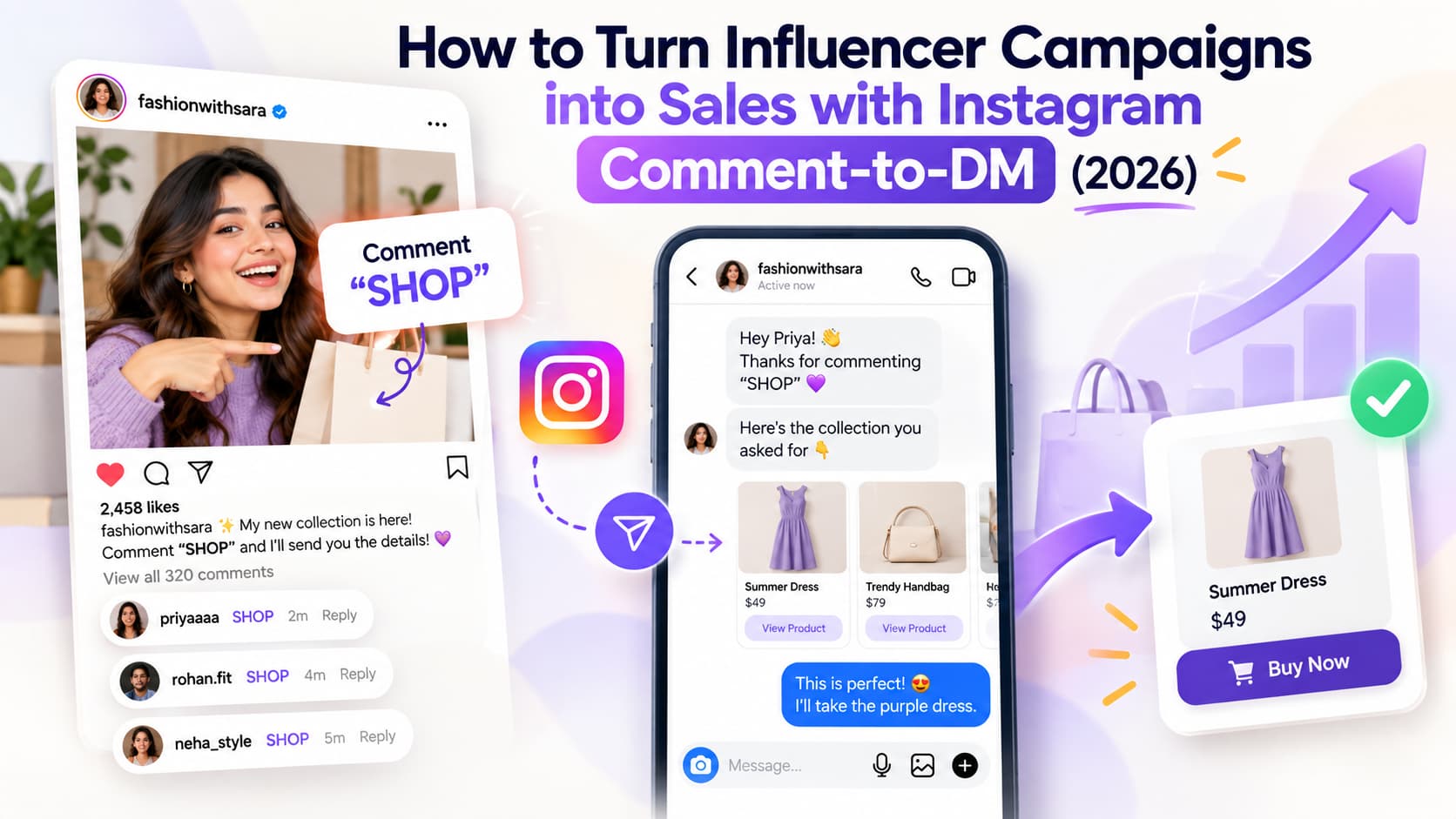
Instagram comment-to-DM (also called a private reply or comment trigger) is an official-API workflow: a person comments a chosen keyword on a post or Reel; the connected professional account sends one private message to that person, usually within seconds, with the link, code, or next step the caption promised.
It is user-initiated. It is not a cold DM. It is not “message everyone who liked the post.” The same mechanic is how AI-influencer and high-comment Reels turn public comments into a private next step.
Definition: Influencer comment-to-DM campaign
An influencer comment-to-DM campaign is a creator flight where the brief includes a keyword CTA, the posting account is connected to a Meta-approved automation tool, and every resulting DM is tagged to that creator so sales can be attributed without relying on bio clicks.
Why influencer campaigns stall at comments
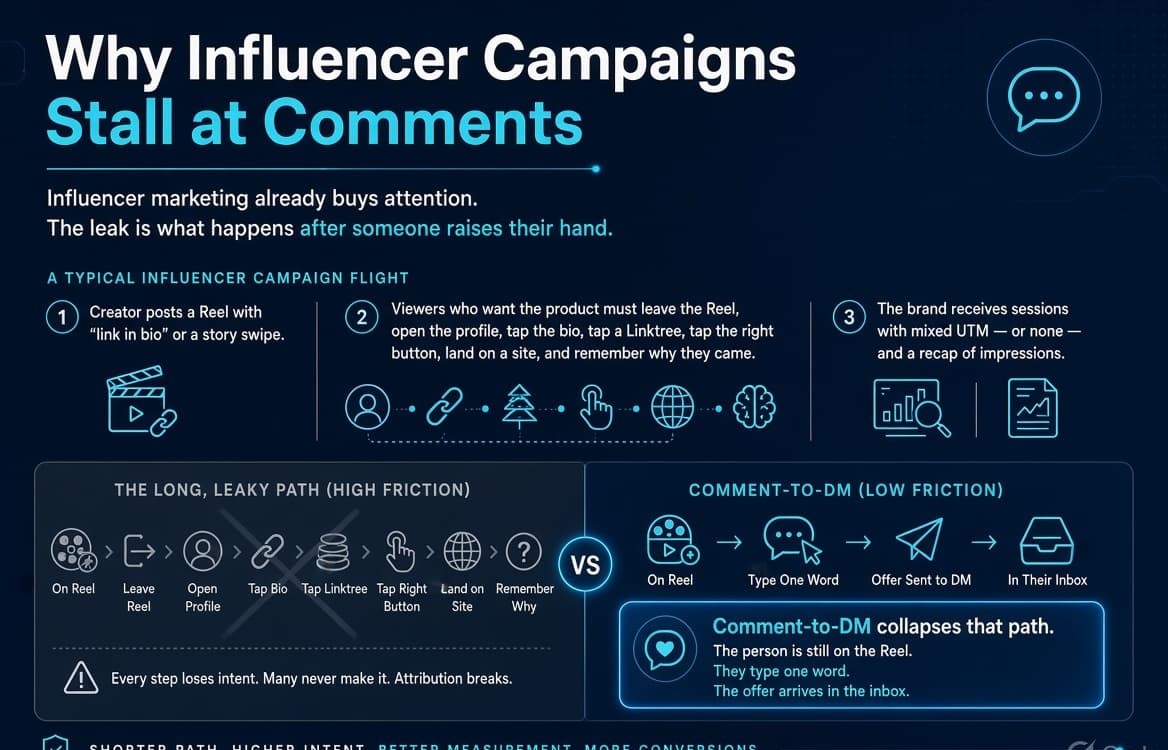
Influencer marketing already buys attention. The leak is what happens after someone raises their hand.
A typical flight looks like this:
- Creator posts a Reel with “link in bio” or a story swipe.
- Viewers who want the product must leave the Reel, open the profile, tap the bio, tap a Linktree, tap the right button, land on a site, and remember why they came.
- The brand receives sessions with mixed UTM — or none — and a recap of impressions.
Comment-to-DM collapses that path. The person is still on the Reel. They type one word. The offer arrives in the inbox.
Comment-to-DM vs link in bio (verdict table)
Link in bio | Comment-to-DM on the same post | |
Intent captured | Anonymous session, if they finish the taps | Named conversation, tagged by creator |
Typical first-click rate | ~0.5–2% of viewers | ~40–70% of people who received the DM |
Open / notice rate | Bio is easy to skip | DMs from a comment they just left get opened |
Attribution | Fragile UTM on a shared link | Unique keyword + unique code + tag at entry |
Follow-up | You do not have a thread | 24-hour window after they reply |
Works for non-followers | Only if they hunt the profile | Yes, with a Requests-folder warning in the public reply |
Best use | Always-on profile traffic | Campaign conversion and recap proof |
Verdict: Use the bio as a backup. Use comment-to-DM as the campaign conversion path. If the only CTA in a paid Reel is “link in bio,” you paid for comments you cannot close. For how creators still use bio tools — and why that path stays a backup — see free link-in-bio tools for creators.
The comparison is not theoretical. Tool-side benchmarks in 2026 consistently show first-message click rates on comment-triggered DMs in the 40–70% range against low-single-digit bio click-through from the same asset. Warm commenters convert to a purchase in roughly the 5–15% range on low-ticket offers and 3–8% on higher ticket, versus ~0.5% on passive bio traffic. Treat those as planning ranges, not guarantees. Your niche, price, and brief quality move the numbers.
What comment-to-DM actually does inside an influencer flight
Creator brief > unique keyword > post goes live > viewer comments the word > public reply (“sent, check DMs”) > private reply delivers the offer > one qualifying question > checkout or booking link > tag creator:name + flight:date > follow-up if they go quiet > recap by creator, not by vanity reach.
Five parts have to exist before you boost anything:
- The promise in the content. The Reel must make one specific next step obvious. “Comment RITUAL and I’ll send the shade match + 15% checkout” beats “link in bio for more.”
- The keyword. One word, unique to that creator, easy to type on a phone.
- The connected account. The tool is authorized on the Instagram account that owns the post. That account sends the DM.
- The first DM. It must deliver what the caption promised and ask one question. Meta allows one unprompted private reply per comment. If DM1 is a dead-end link with no reply prompt, the sequence often dies.
- The tag. If the lead is not tagged at entry, the recap is fiction.
Who owns the inbox
Direct answer: The brand cannot automatically DM people who commented on an influencer’s post unless the brand’s tool is connected to the account that published that post. Comment-to-DM does not jump from @creator to @brand. You choose an ownership model in the brief, or you only get a tracked link and a hope.
Sometimes public engagement on someone else’s post becomes a private conversation on yours. Often it does not.
Can the brand auto-DM people who commented on an influencer’s post?
Verdict: Only if the comment sits on a post the brand (or a Collab the brand co-owns) published, and the brand’s professional account is the one connected to the automation. If the comment sits only on the creator’s Reel, the private reply is sent by the creator’s connected account. The brand then attributes with a unique code and a shared report — it does not inherit the inbox.
The posting account has to be the one connected to a Meta-approved tool such as InstantDM because the private reply is sent by that account, not by the brand watching the comments.
Three ownership models
Model | Where the comment lives | Who sends the DM | Brand owns the list? | When to use |
A. Creator-owned inbox | Creator’s Reel or feed post | Creator’s connected tool | No. Brand gets code / affiliate / screenshot or live report | Seeding, nano volume, creators who will not connect a brand tool |
B. Brand-owned inbox | Brand post, or Collab post the brand co-authors | Brand’s connected tool | Yes | Launches, always-on ambassadors, paid integrations you will retarget |
C. Hybrid | Creator Reel for reach + Collab or brand follow-up asset the same week | Split: creator air cover + brand capture | Partial to yes | Serious always-on programs |
Should the tool connect to the brand or the creator?
Connect InstantDM to whichever account must send the private reply: the creator for Model A, the brand for Model B, and both for Model C, with different keywords so the tags do not collide.
Write the model into the contract. If you assume Model B and the creator posts on their own grid with no Collab, you silently ran Model A.
Instagram Collab posts
A Collab post can appear on both grids. For conversion, treat it as a brand-side asset: the brief should state who connects automation, which keyword is live, and who answers if a thread goes human.
How do you know which influencer actually drove sales?
Direct answer: Give each creator a unique comment keyword and a unique checkout or affiliate code. Tag every DM at send with that creator and flight. Report sales on the intersection of tag + code. Do not use one shared word like LINK across the roster.
Shared keywords feel simple. They destroy the recap. When three creators all say “comment LINK,” you cannot separate their commenters. When they all use BRAND15, you cannot separate their orders. You paid for a beauty contest of views.
Keyword matrix (copy this)
Creator | Handle | Keyword | Code | Tag | Post URL | Go-live |
Maya | @maya.skin | GLOW | MAYA15 | creator:maya / flight:sep26 | — | 3 Oct |
Rohan | @rohan.fits | RITUAL | ROHAN15 | creator:rohan / flight:sep26 | — | 3 Oct |
Anika | @anika.home | SEED20 | ANIKA20 | creator:anika / flight:sep26 | — | 5 Oct |
Rules that keep the matrix honest:
- One keyword per creator per flight. Retire it when the flight ends.
- Do not use YES, LOVE, NICE, or the product category word everyone already types.
- Put the word in the first line of the caption, again at the end, and spoken in the first three seconds of the Reel.
- Pair the keyword with a code even in Model B. Tags fail. Codes in the order system do not.
- Never publish the same keyword on two live creators.
UTM still helps when they leave Instagram. It does not replace the tag. Most of the journey never leaves the app. For storefront and affiliate links delivered in the same DM pattern, see automating influencer storefront links in DMs.
Brief and caption: what the creator must actually say
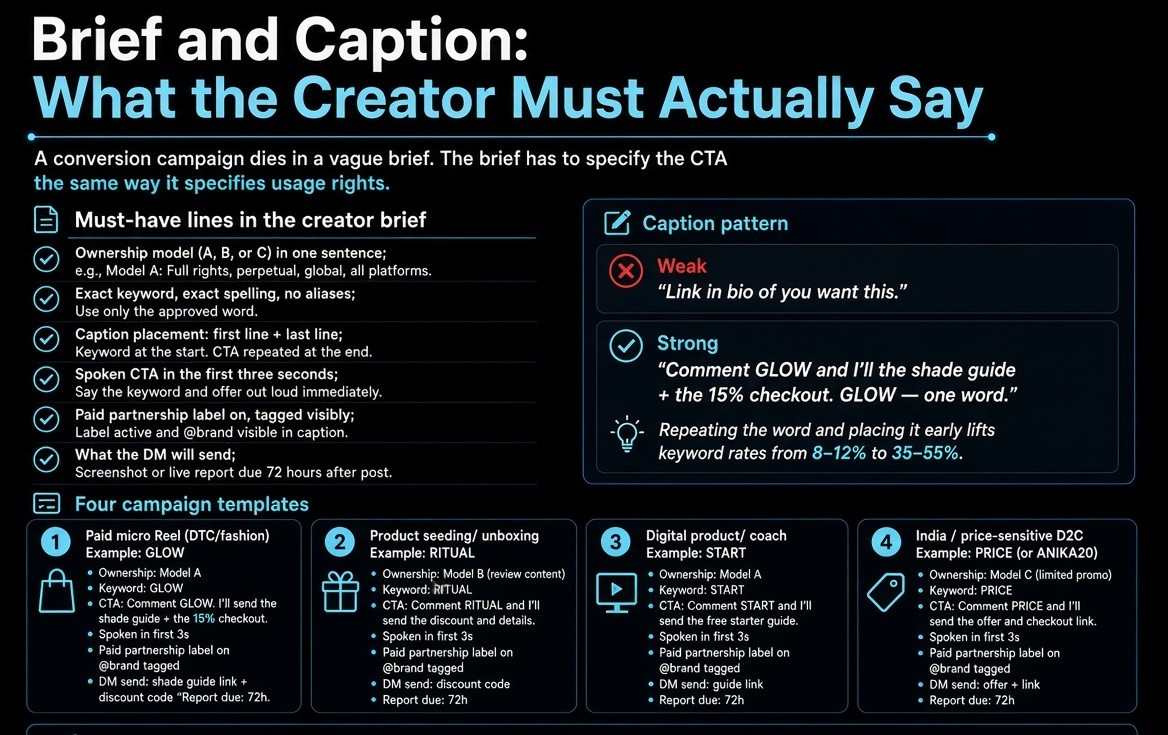
A conversion campaign dies in a vague brief (“mention the brand, keep it you”). The brief has to specify the CTA the same way it specifies usage rights.
Must-have lines in the creator brief
- Ownership model: A, B, or C, in one sentence.
- Exact keyword, exact spelling, no aliases.
- Caption placement: first line + last line.
- Spoken CTA in the first three seconds.
- Paid partnership label on, brand tagged where the viewer can see it without expanding.
- What the DM will send, so the creator does not promise a PDF the brand planned as a checkout link.
- Screenshot or live report due 72 hours after post.
Caption pattern that actually triggers
Weak: “Link in bio if you want this.”
Strong: “Comment GLOW and I’ll send the shade guide + the 15% checkout. GLOW — one word.”
Repeat the word. People skim. Creators who bury the CTA under a paragraph of story get 8–12% keyword rates among commenters. Creators who put the word in the first two lines and say it on camera see 35–55% in well-run flights. That spread is the difference between a recap and a case study.
Four campaign templates
1. Paid micro Reel (DTC / fashion)
Spoken: “If you want the exact set, comment GLOW.”
Caption last line: “Comment GLOW — I’ll DM the look + MAYA15.”
DM1: deliver look list + code + “Want the full set or just the top? Reply SET or TOP.”
2. Product seeding / unboxing
Spoken: “If you want the routine I used, comment RITUAL.”
DM1: how they used it + code + “Is this for you or a gift?”
Follow-up after delivery day +7 if they have not posted — that is seeding ops, not only comment-to-DM, and it belongs in the same flight plan.
3. Digital product / coach adjacent brand
Spoken: “Comment START and I’ll send the outline we use with partners.”
DM1: outline + “Solo or team? Reply 1 or 2.”
Do not pitch the $2,000 offer in message one.
4. India / price-sensitive D2C
Spoken: “Price and offer — comment PRICE.”
DM1: price, UPI-friendly checkout or WhatsApp handoff, size/shade question.
Keyword matches how people actually comment on Indian Reels: PRICE, OFFER, LINK. Still make it unique per creator (PRICE + creator tag is not enough if three people use PRICE; use ANIKA20 as the comment word instead).
Public reply, all four: “Sent. If it is sitting in Message Requests, accept it — that is where non-followers receive it.”
The DM sequence after they comment
Direct answer: DM1 delivers the promise and asks one question. Their reply opens the 24-hour standard messaging window. Then you qualify, send one checkout or booking link, and follow up once if they go quiet. Do not dump a catalog in the first message.
Why DM1 must earn a reply
Meta’s private-reply rule is the constraint: one unprompted message per comment, within seven days of that comment. The first DM is your only free shot. A link with no question ends many threads before the funnel starts. Meta documents that the private reply lands in Inbox if they follow the professional account, and in Message Requests if they do not. Send a private reply to a commenter (Meta for Developers)
After they reply, the standard 24-hour messaging window applies for the rest of the sequence. Instagram Messaging API overview (Meta for Developers)
DM1 pattern:
“Here’s the [thing you asked for]: [link or code]. Quick one so I send the right next step — A or B?”
A or B can be size, set vs piece, self vs gift, 1:1 vs group, COD vs prepaid. One fork. Not a quiz.
Funnel map
Step | Trigger | Job | Track |
Entry | Keyword comment | Start the thread | Comments, DMs sent |
Public reply | Same comment | Tell them to open Requests | Reply impressions |
DM1 | Private reply | Deliver + prompt reply | Open rate, reply rate |
Qualify | Their reply | Route the offer | Qualified rate |
Convert | Your second send | One link | Click rate |
Outcome | Purchase / book | Close | Revenue by tag |
Recover | No reply 12–24h | One nudge | Recovered sales |
What to send by ticket size
Offer | DM1 | When the link appears |
Under ~$100 impulse | Promise + link + one question | Immediately |
$100–$500 | Promise + question, link after the reply | After qualify |
$500+ / booking | Promise + email or slot intent | After 1–2 turns, not a cold checkout |
Ecommerce teams should prefer a checkout link with the creator’s code already applied over “here is a code, go hunt the SKU.” Every extra tap is a lost commenter.
Worked example: three micro creators, one week
Numbers below are a planning model using mid-range 2026 comment-to-DM benchmarks. Replace views and fees with your roster.
Flight: three micro creators, fashion/beauty DTC, $42 AOV, one week of posts.
Creator A | Creator B | Creator C | Total | |
Followers | 40k | 80k | 25k | — |
Views on the flight Reel | 55k | 90k | 35k | 180k |
Keyword comments (2.5% of views) | 1,375 | 2,250 | 875 | 4,500 |
DMs opened (85%) | 1,169 | 1,913 | 744 | 3,826 |
Link clicks (50% of opens) | 585 | 956 | 372 | 1,913 |
Purchases (6% of clicks) | 35 | 57 | 22 | 114 |
Revenue at $42 AOV | $1,470 | $2,394 | $924 | $4,788 |
Same 180k views, bio-only CTA (planning contrast):
1% of viewers reach the site (1,800 sessions) × 1.5% purchase rate ≈ 27 orders ≈ $1,134. The comment-to-DM path in the table is not 10× in every niche. It is routinely several times the bio path because you stopped asking buyers to assemble the funnel themselves.
Add creator fees and product cost before you call it ROAS. The point of the table is the recap: you can see Creator B produced more revenue, not only more views. That is the question finance asks and vanity metrics cannot answer.
How many keyword comments per sale?
At ~10% comment-to-sale on a low-ticket offer, plan on about ten keyword comments per order. At 5% on a mid-ticket offer, about twenty. If a creator cannot produce comments, automation will not invent them. Fix the brief and the content first.
Playbooks by campaign type
Comment-to-DM is not one caption. It changes with the deal.
Paid integration / sponsored Reel
Unique keyword. Model B or C if you can get a Collab post. Code in the checkout. Recap is tag + code, not screenshots of likes. Put the CTA in the usage rights so the creator cannot “keep it natural” by dropping the word.
Product seeding
Seeding without a follow-up is postage. Combine: claim or ship → delivery DM or email → post prompt → comment keyword on the content they do publish → DM to their audience with a creator-specific code. Measure post rate (healthy bands often sit around 30–50% on well-run micro seeding) and assisted sales, not only content volume.
Launch or drop
Run WAIT or a unique waitlist word two weeks out. You are building a hand-raising list. On launch day you message people who already opted in, which is a warmer audience than a cold grid blast.
Always-on ambassadors
Evergreen keyword per ambassador, retired only when the relationship ends. Monthly report: comments, DMs, clicks, revenue by tag. This is how comment-to-DM stops being a stunt and becomes the CRM. Deloitte’s data on repeat creator relationships is the brief for this model: people who keep engaging the same creators are more likely to buy than one-off viewers.
Spark ads / partnership ads
If you whitelist the creator asset, keep the same keyword. Treat ads and organic as one funnel with one word, or your reporting splits for no reason. Instagram’s own partnership-ads product is how brands put spend behind that asset. Partnership ads for creators (Instagram)
Rules that decide whether this works
Is Instagram comment-to-DM allowed?
Verdict: Yes — on a Business or Creator account, through Meta’s official messaging API, and only after the person comments (or otherwise initiates). Cold mass DMs, password-based bots, and scraping tools are a different product and a different risk.
Constraints to design around:
- Professional account required. Personal accounts have no messaging API.
- One private reply per comment, within seven days of that comment.
- Non-followers often receive the DM in Message Requests. Conversion drops unless the public reply says to accept it.
- After they reply, the standard 24-hour messaging window applies for the rest of the sequence.
- Official OAuth only. If a tool asks for the Instagram password, stop.
- Paid and gifted partnerships still need disclosure: paid partnership label and a visible tag. Automation does not replace that duty.
The FTC’s influencer guidance is blunt: disclose any financial, employment, personal, or family relationship with the brand, including free or discounted product. The creator is responsible for the disclosure; the brand is responsible for making sure it happens. Disclosures 101 for Social Media Influencers (FTC)
What if commenters do not follow the posting account?
Expect a lower open rate. Write the Requests line into the public reply. Do not blame the DM copy first.
Is it allowed to automate DMs from an influencer’s post?
Yes, when the connected account is the posting account and the person commented first. That is Model A. It is not the same as the brand DMing those commenters from a second account they never talked to.
Nano, micro, or mega for a conversion campaign?
Verdict: Use nano and micro creators as the conversion base. Use mid and mega for awareness you will recapture with a brand-owned keyword on a Collab or follow-up asset. Follower count is a media plan input. Comment quality and willingness to say the keyword on camera are the conversion inputs.
Tier | Role in this system | Why |
Nano (1k–10k) | High conversion, Model A-friendly | They check DMs. Briefs get followed. Engagement is denser. |
Micro (10k–100k) | Core conversion roster | Best balance of reach and comment quality for DM funnels. |
Mid (100k–500k) | Awareness + Collab if they will run Model B/C | Inbox is busier. Agency layers appear. CTA compliance slips without a tight brief. |
Mega | Reach only unless the contract forces the keyword | Lowest engagement, highest chance the CTA becomes “link in bio.” |
A good conversion creator is not the largest. It is the one whose comments look like buyer language and who will put GLOW in the first line.
Failure modes (fix these before you scale spend)
- One keyword across the whole roster. Attribution dies.
- DM1 is a link with no question. The 1-reply limit ends the thread.
- Brand assumes it will DM commenters on a creator Reel with no Collab and no creator-side tool. That inbox does not exist.
- Keyword is YES or LOVE. You will DM people who were being polite.
- Seeding with no post-delivery follow-up and no keyword on the content they publish.
- Recap built on reach. Finance will ask for orders. You will not have them.
- Tool connected to the wrong account. Test from a second profile before go-live.
- Caption CTA only at the bottom. Trigger rate collapses.
What to put in the recap instead of vanity metrics
Influencer Marketing Hub’s 2026 benchmark still shows brand awareness as the most-selected success KPI (about 55 percent of respondents), even while 87 percent of marketers expect influencer budgets to rise and 72 percent expect those budgets to rise by 50 percent or more. Spend is going up. The default scoreboard is still reach. Influencer Marketing Benchmark Report 2026
Separately, IMH reports that about 70 percent of marketers now measure influencer ROI — and 13.6 percent still say measurement is the hard part. A comment-to-DM recap is how you leave that group. How to measure influencer campaigns (2026)
A recap that survives a budget meeting:
- Views and comment volume (context only)
- Keyword comments (the real top of this funnel)
- DMs sent / opened
- Reply rate to DM1
- Clicks
- Purchases and revenue by creator tag + code
- Cost (fees + product + tool) and ROAS
- Which creators you repeat
If a creator produced comments but no tagged revenue, the offer, the DM, or the landing broke — not “influencer marketing doesn’t work.”
Conclusion
Run the flight on the posting account, with one keyword per creator and a tag at send. InstantDM is the official-API layer that sends the private reply and keeps the creator tag on the lead. Compare other official comment-to-DM platforms here if you are still choosing a tool: best Instagram DM automation tools.