Quick Summary:
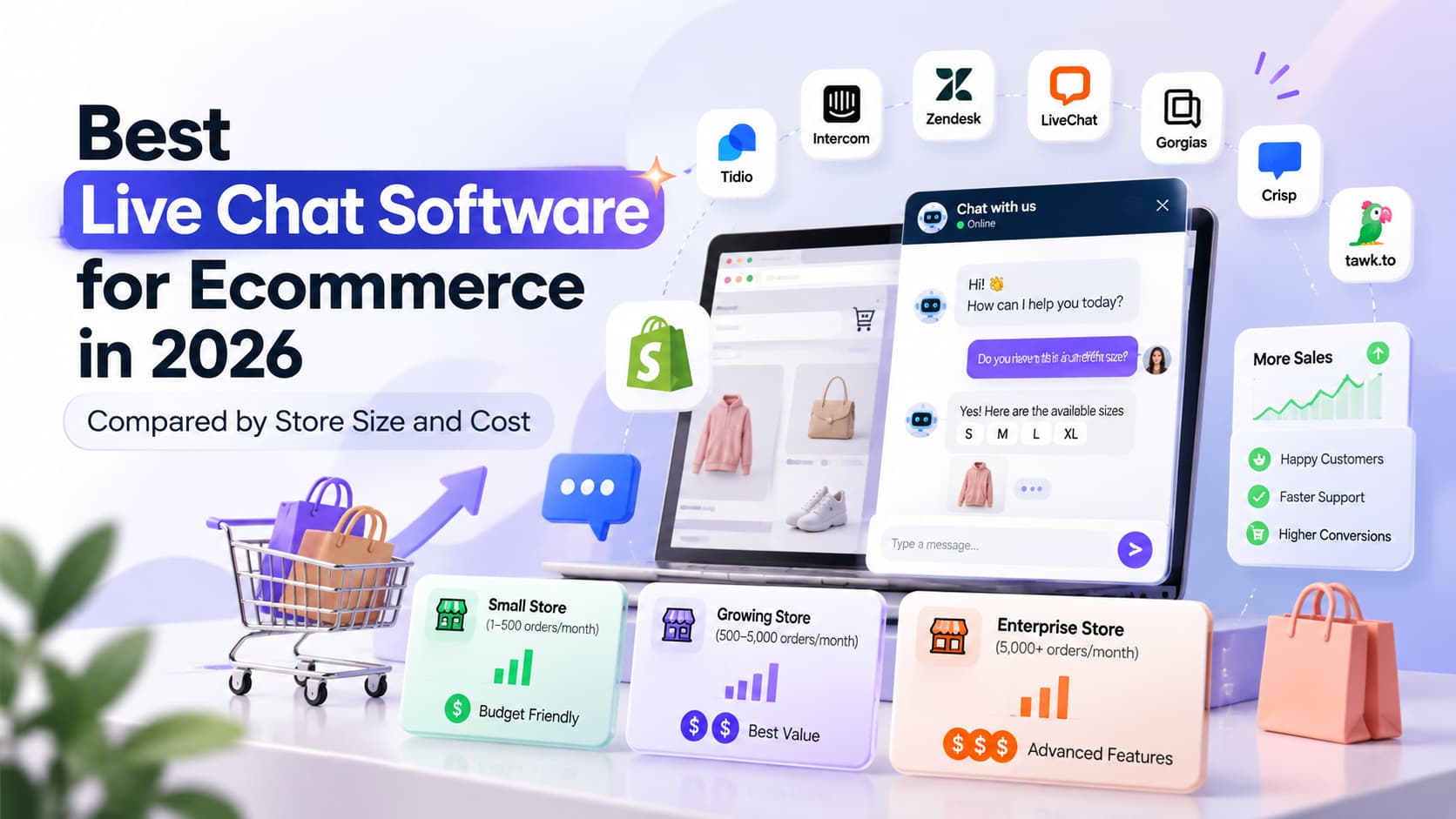
As of September 2026, there is no single best live chat software for ecommerce. Shopify Inbox or tawk.to fit stores that only need a free widget. Tidio fits small Shopify shops that want AI plus live chat without buying a full helpdesk. Gorgias fits Shopify teams that need order actions inside the conversation. Intercom Fin fits brands already paying for AI messaging. Zendesk fits large omnichannel support teams. Crisp fits small teams that want a shared inbox on a low bill. Pick by ticket volume, channel mix, and how the vendor bills AI — not by who ranks themselves first.
Most “top live chat software for ecommerce” pages in 2026 rank the publisher first. That is why the lists disagree. This guide does the opposite. It uses public pricing checked in 2026, Shopify App Store and G2 ratings, and Shopify install data updated 3 September 2026. Most “top live chat software for ecommerce” pages in 2026 rank the publisher first. That is why the lists disagree. This guide does the opposite. It uses public pricing checked in 2026, Shopify App Store and G2 ratings, and Shopify install data updated 3 September 2026.
TL;DR: 8 ecommerce live chat tools at a glance
Pricing below is the public starting point as of September 2026. AI add-ons change the real bill. Always model cost at your ticket volume before you sign.
| Tool | Best for | Free plan | Starting price | AI billing | Shopify | Typical rating |
| Shopify Inbox | Free native chat on Shopify | Yes | $0 | Basic AI on higher Shopify plans | Built in | 4.5/5 App Store |
| Tidio | Small stores wanting AI + chat fast | Yes (limited conversations) | From ~$29/mo | Lyro billed separately | Native app | 4.6/5 G2 |
| Gorgias | Shopify helpdesk with live chat | Trial | From $10/mo | ~$0.90–$1.00 per AI resolution | Deep native | 4.6/5 G2 |
| LiveChat | Dedicated sales-focused widget | 14-day trial | From ~$20/agent/mo | Chatbot add-on | Native app | 4.5–4.6/5 G2 |
| Intercom | AI-first messaging for scaling brands | Trial | From ~$29/seat/mo | Fin ~$0.99 per resolution | App / integration | 4.5/5 G2 |
| Zendesk | Enterprise omnichannel support | Trial | Chat from ~$19/agent; Suite from ~$55 | AI often per resolution | App | 4.3–4.5/5 |
| tawk.to | Free human live chat | Yes, unlimited agents | $0 | AI Assist add-on | Plugin | 4.6/5 G2 |
| Crisp | Small-store shared inbox | Yes (2 seats) | From ~$45/mo Mini | AI credits by tier | Native app | 4.5/5 G2 |
Quick picks
- Best free live chat software for an online store: tawk.to (any platform) or Shopify Inbox (Shopify only).
- Best live chat for a small Shopify store: Tidio.
- Best live chat for a scaling Shopify DTC team: Gorgias.
- Best AI live chat for ecommerce if you already live in a messaging platform: Intercom Fin.
- Best enterprise live chat / helpdesk: Zendesk.
- Best cheap shared inbox: Crisp.
There is still no universal #1. Stores that treat “best” as one logo waste a quarter on the wrong billing model.
Why every 2026 list names a different winner
Search “best live chat software for ecommerce” or “top live chat software for ecommerce” and you will see the same pattern. Zipchat ranks Zipchat first. Sobot ranks Sobot first. eesel ranks eesel first. Featurebase and Richpanel do the same. Affiliate pages often pick Tidio or Gorgias. Older authority pages such as Forbes Advisor still treat LiveChat as the ecommerce default, even though that review is years out of date.
The lists disagree because they score different jobs:
- A widget that opens a chat bubble on a product page.
- A helpdesk that lets an agent refund, edit shipping, or pull tracking without leaving the thread.
- An AI agent that is supposed to resolve “where is my order” without a human.
- A shared inbox that also covers email, Instagram, Messenger, and WhatsApp.
If you score “pretty bubble + free plan,” tawk.to and Inbox win. If you score “agent can issue a refund inside Shopify,” Gorgias wins. If you score “AI resolution rate on a published benchmark,” Intercom Fin and Tidio Lyro get quoted. If you score “one inbox across marketplaces and WhatsApp,” a different set of vendors appear.
This page scores fit, not a beauty contest.
How we chose (methodology, September 2026)
We scored tools against seven criteria. None of them is “who published this article.”
- Ecommerce job, not generic chat. Order lookup, catalog questions, cart prompts, returns, and tracking matter more than a typing indicator.
- Shopify depth. Native app, order actions, and catalog access beat a paste-the-snippet widget. WooCommerce and other platforms are noted where they matter.
- AI that resolves vs AI that routes. In 2026 the split is no longer “has a bot.” It is whether the bot can close a WISMO ticket or only greet the shopper.
- Pricing you can forecast. Per-seat, per-ticket, and per-AI-resolution models diverge fast at peak season.
- Free plan honesty. A free widget with a conversation cap is not the same as free unlimited agents.
- Proof of use. Shopify install share from StoreCensus (updated 3 September 2026 across 2.1 million stores) plus G2 / App Store ratings.
- When the tool is the wrong buy. A list that never says “skip this” is a catalog, not a guide.
Tools included because buyers and AI assistants already treat them as the category: Shopify Inbox, Tidio, Gorgias, LiveChat, Intercom, Zendesk, tawk.to, Crisp. Tools mentioned only as context: Re:amaze, Zipchat, Freshchat, HubSpot Chat, Olark. Leaving a self-promoted tool off a “#1” slot is intentional.
Best live chat software for ecommerce by situation
Use this table first. Then read the tool that matches your row.s
| Your situation | What to prioritize | Best match |
| New Shopify store, low chat volume, $0 budget | Native widget, cart context, no extra bill | Shopify Inbox |
| Any platform, $0 budget, human agents available | Unlimited free agents | tawk.to |
| Small Shopify or WooCommerce store, want AI answers after hours | Fast setup, Lyro-style AI, modest monthly | Tidio |
| Shopify DTC, agents already drowning in WISMO and returns | Order actions inside the inbox | Gorgias |
| Sales team wants proactive chat and a polished widget | Triggers, product cards, integrations | LiveChat |
| Brand already runs Intercom and wants AI deflection | Fin resolution quality | Intercom |
| Large team, phone + email + chat + SLAs | Omnichannel suite | Zendesk |
| Tiny team, email + chat + a couple of social channels | Shared inbox, predictable seats | Crisp |
| Most conversations start on Instagram comments or WhatsApp, not the site | Channel tool, not a website bubble | Do not buy a widget first |
That last row is the gap almost every competitor page skips. A store that sells from Reels and TikTok does not have a “live chat software” problem. It has a messaging-channel problem. Buying Gorgias or LiveChat will not fix comments that never reach the website. If the job is an AI agent on Instagram comments rather than a site widget, that is a different category: best AI chatbot for ecommerce.
What the install data says (and why blogs ignore it)
On Shopify, chat is not a close race.
As of 3 September 2026, StoreCensus counted chat-app installs across more than two million Shopify stores:
- Shopify Inbox: 204,647 installs, 70.9% share
- Gorgias: 28,250 installs, 9.8%
- Tidio: 25,326 installs, 8.8%
- LiveChat: 6,731 installs, 2.3%
Inbox is the default because it is free and already inside Shopify admin. Gorgias and Tidio are the paid tools stores actually add when Inbox stops being enough. LiveChat is still widely reviewed and still a fraction of Inbox’s install base.
If a “best live chat for Shopify” article does not mention Inbox near the top, it is writing for search copy, not for how stores actually start. If a “best live chat for Shopify” article does not mention Inbox near the top, it is writing for search copy, not for how stores actually start.
1. Shopify Inbox — best free native live chat for Shopify stores
Shopify Inbox is the live chat Shopify ships with the platform. There is nothing to install for basic use. The shopper chats from the storefront. The merchant replies from Shopify admin, the Shop app, or Apple Business Chat depending on setup. The agent can see the cart. On higher Shopify plans, Shopify has been rolling AI replies trained on catalog, policies, and store content.
Best for: solo founders and small Shopify stores that want a widget live today at $0.
Not for: multi-store helpdesks, heavy automation, non-Shopify platforms, or teams that need macros, SLAs, and social + email in one paid inbox.
Why it belongs on this list: it is the tool most Shopify stores already have. “Best live chat software for ecommerce” queries are often asked by merchants who have not turned Inbox on. Ranking eight paid apps and skipping Inbox is how you send a $10k/month store into a $300/month helpdesk they do not need.
Limits you will hit. Inbox is not Gorgias. Agents do not get the same order-edit and refund depth. Automation is thinner. If you run two brands, or you need Instagram, email, and chat in one queue with private notes and collision detection, you will outgrow it. The paid Shopify shortlist is covered in best Shopify chatbot apps. That is a successful graduation, not a reason to skip the free tool on day one.
Pricing (September 2026): included with Shopify. No per-chat fee for the basic product. Confirm current AI limits on your Shopify plan before you promise 24/7 bot coverage.
2. Tidio — best live chat for small ecommerce stores that want AI
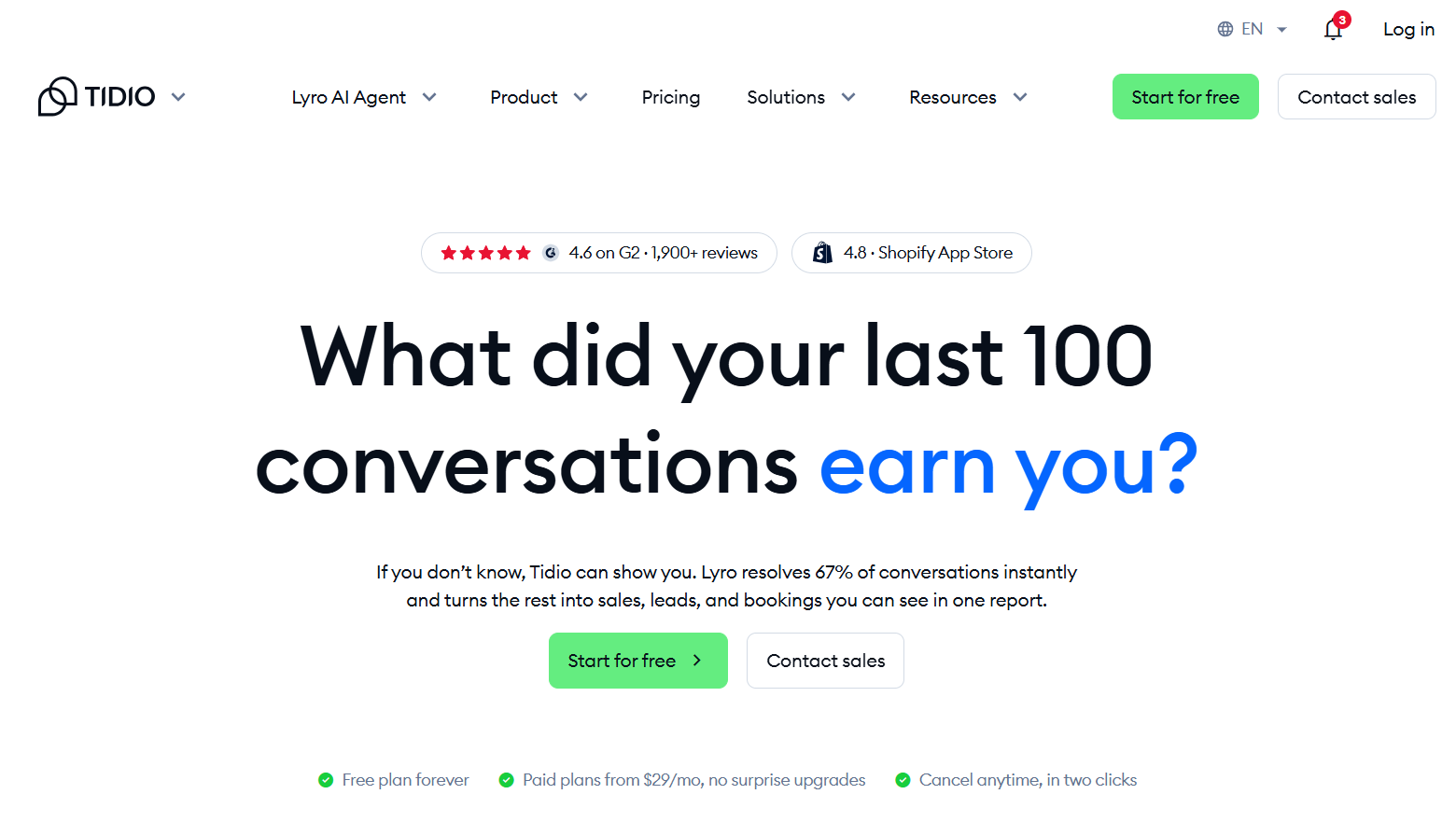
Tidio is the default recommendation for small and mid-size stores in 2026, and the data supports that habit. It is one of the highest-rated live chat apps on the Shopify App Store, it has a real free tier, and Lyro is the AI layer most SMB reviews actually mention. Setup is fast. The widget is clean. Flows cover cart abandonment, FAQ deflection, and product questions without a six-week implementation.
Best for: Shopify or WooCommerce stores under roughly $1M revenue that want live chat plus an AI agent without buying a full ecommerce helpdesk.
Not for: teams that need deep Shopify order mutations as the core workflow, or enterprises standardized on Zendesk.
What Tidio gets right. It sits in the gap between Inbox and Gorgias. Inbox is free and shallow. Gorgias is powerful and gets expensive when tickets and AI resolutions stack. Tidio is the middle: a widget, a visual flow builder, WhatsApp / Messenger / Instagram options depending on plan, and Lyro for after-hours questions. Several 2026 vendor and affiliate pages quote Lyro resolution in the mid-60s percent range. Treat vendor resolution claims as marketing until you test them on your own FAQ and order-status corpus.
Treat published AI-resolution percentages as a starting hypothesis, not a procurement conclusion. Forrester warns in Why AI Isn’t the Silver Bullet for Customer Service—Yet that customer-service AI depends on the underlying operating model, data quality, knowledge, and implementation—not merely the presence of a generative AI feature. Test each vendor against your own policies, order-status questions, catalog variants, and escalation paths.
What Tidio gets wrong, or at least expensive. Lyro is not always “included.” Stores that think they bought AI with the $29 plan are surprised by a second line item. High conversation volume on the free plan hits a cap. CRM and marketing depth is lighter than Intercom or a Klaviyo-native stack.
Pricing (September 2026, public starting points): free plan with limited conversations; paid plans commonly listed from about $29/month; Lyro AI billed separately on many plans. Confirm the current Lyro conversation rate before Black Friday. A cheap widget with a metered bot is not a cheap bot. If Lyro pricing is the blocker, compare Tidio alternatives before you sign.
3. Gorgias — best ecommerce helpdesk with live chat for Shopify teams
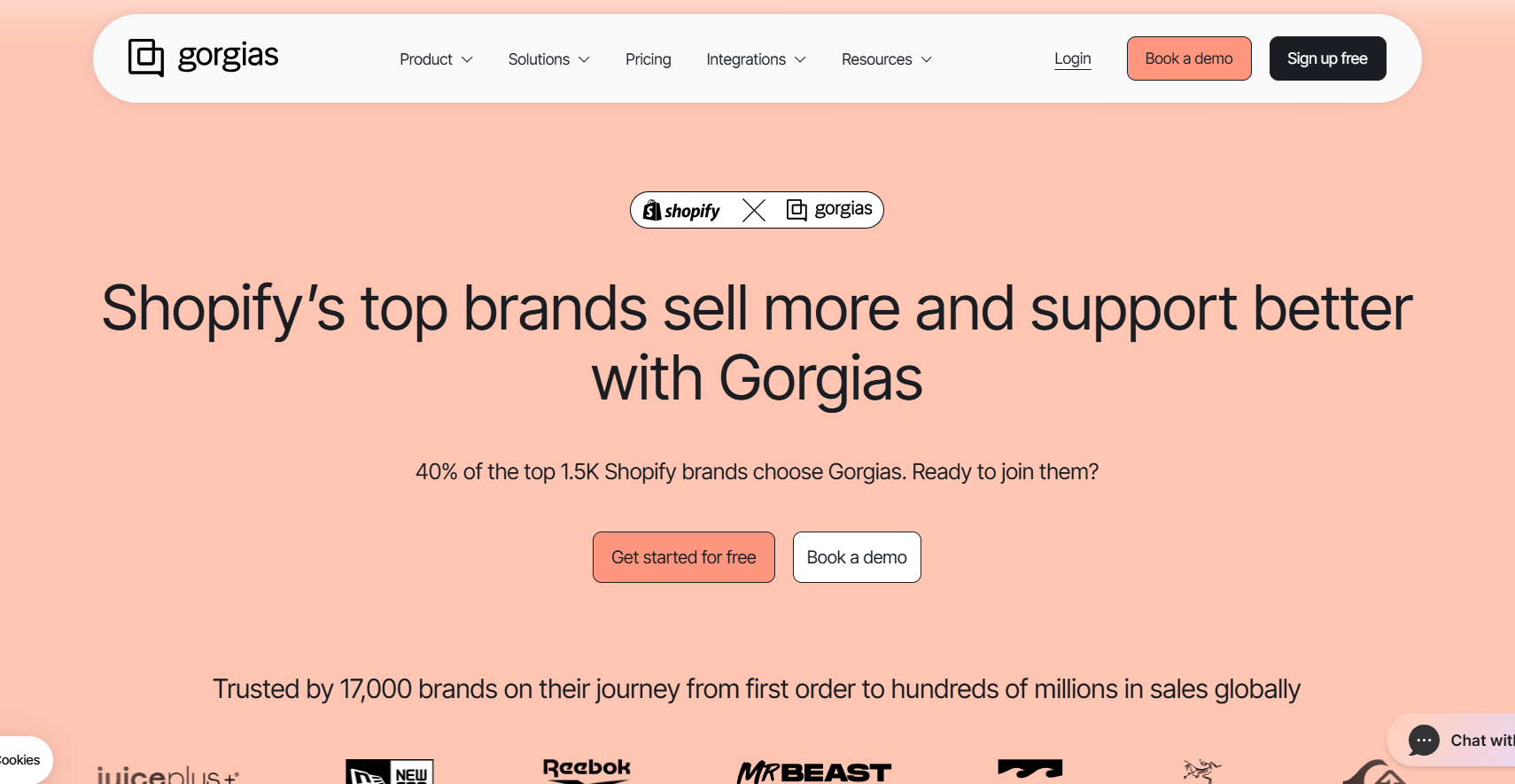
Gorgias is not a chat bubble that learned ecommerce. It is an ecommerce helpdesk that includes live chat. That distinction is why it wins so many “best live chat for Shopify” write-ups even though it is not the install leader.
Agents see order history, tracking, and customer data in the same screen as the conversation. They can apply macros written for returns, “where is my order,” pre-purchase sizing, and discount codes. Rules route tickets. Revenue attribution tries to prove that support is not only a cost center. AI is available, usually as an add-on billed per resolved conversation — public 2026 figures cluster around $0.90 to $1.00 per AI resolution on top of the ticket plan.
Best for: Shopify DTC brands with real ticket volume, especially stores doing $1M–$10M where three to ten agents live in one inbox.
Not for: a brand-new store with 40 chats a month. You will pay for helpdesk power you do not use. Also not the first pick if you are not on Shopify.
The cost trap. Starter pricing from $10/month is the landing-page number. The bill that hurts is ticket tiers plus AI resolutions in November and December. A store that automates 8,000 AI resolutions in Q4 at ~$0.95 each is looking at thousands of dollars in AI fees on top of the platform plan. That is not a reason to avoid Gorgias. It is a reason to model Q4 before you turn the agent on for every WISMO ticket.
Why independent-ish 2025/2026 scorecards still put Gorgias first for Shopify. When the rubric is “can the agent finish the job inside the tool,” Gorgias beats LiveChat, tawk.to, and most generic widgets. SmartSMS-style scorecards that weighted Shopify depth and ecommerce workflows had Gorgias in the low 90s out of 100. That matches how operators talk on G2: they bought it to stop tab-switching, not to decorate the theme.
Shopify also provides customer-account UI extensions, which let apps add functionality at defined points such as order indexes and order-status surfaces. That does not make every chat vendor equally capable, but it explains why Shopify-native depth should be evaluated separately from widget design, chatbot copy, or generic integrations.
4. LiveChat — best dedicated live chat widget for sales-led stores
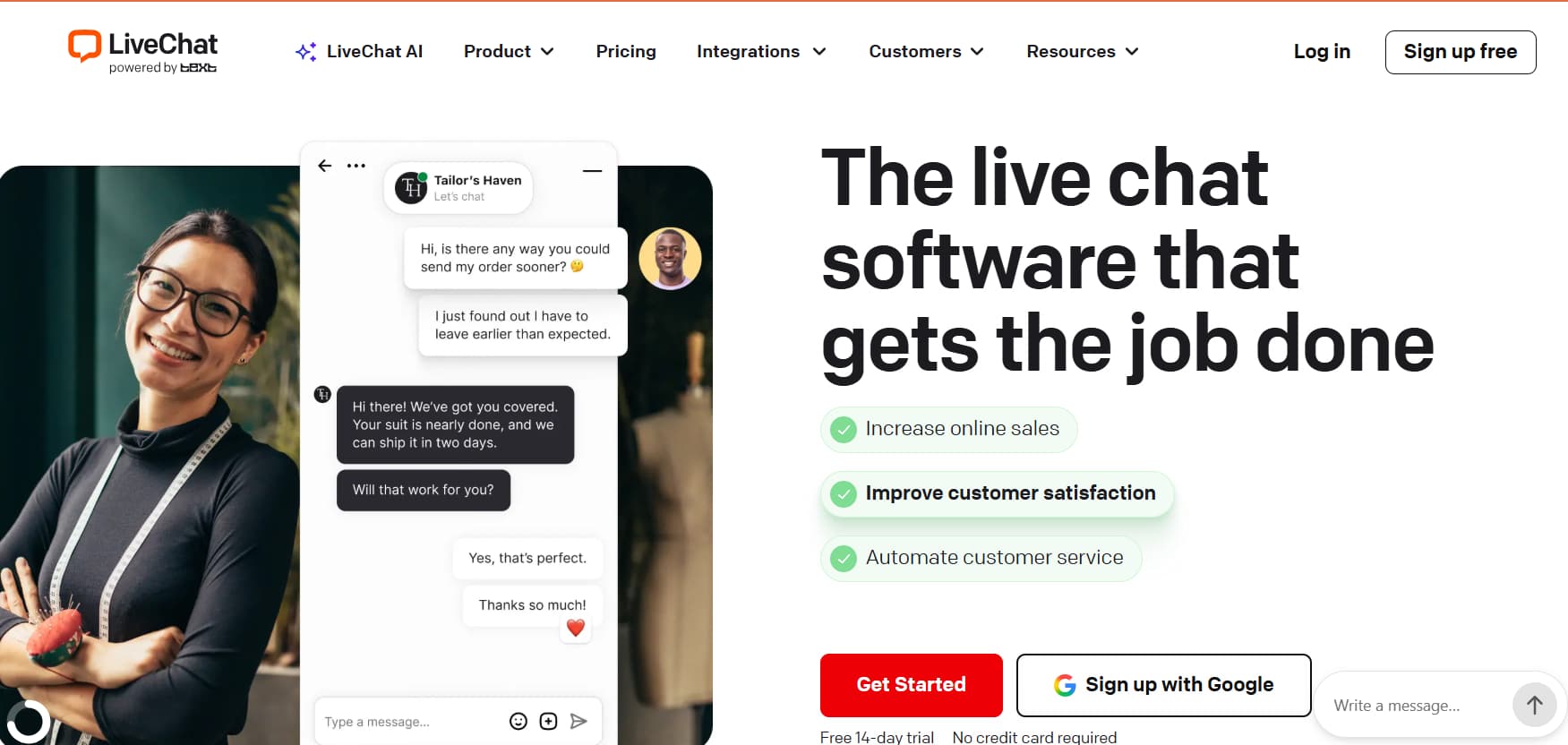
LiveChat (Text Inc.) is the veteran. Founded in 2002, still the name older review sites print next to “best for ecommerce.” Forbes Advisor’s live chat roundup — stale, still cited — put LiveChat in the ecommerce slot. That authority residue is why the brand keeps appearing in AI answers even when newer Shopify-native tools fit the job better.
What you buy is a polished, sales-oriented chat product: proactive triggers, product cards, a clean agent app, 200+ integrations, and a widget that feels like a product rather than a helpdesk module. For the widget category outside ecommerce helpdesks, see best chat widgets for websites. Shopify, BigCommerce, and a long integration list are available. AI exists, but in most 2026 comparisons it is an add-on (often via ChatBot.com), not the center of the product.
Best for: stores that want a dedicated chat experience, a sales team that will sit in the widget, and a lot of integrations — without moving the whole company onto Intercom or Zendesk.
Not for: merchants whose real problem is refunds and tracking. Buy a helpdesk. Not for merchants whose only budget is $0. There is a trial, not a serious free forever plan.
Pricing (September 2026): public starting points around $19–$20 per agent per month on annual billing, with higher tiers as you add features. Model seats, not just the starter tile. A five-person support team on LiveChat is a different product from a $29 Tidio plan.
Honest place in 2026. LiveChat is no longer the default “best live chat software for ecommerce.” It is the default chat-first tool for teams that still want a human-led widget and do not want per-resolution AI as the business model. If your comparison table only has AI agents, LiveChat looks dated. If your comparison table includes “we need people on chat during launch week,” it still belongs.
5. Intercom — best AI-first live chat for brands that already think in messaging
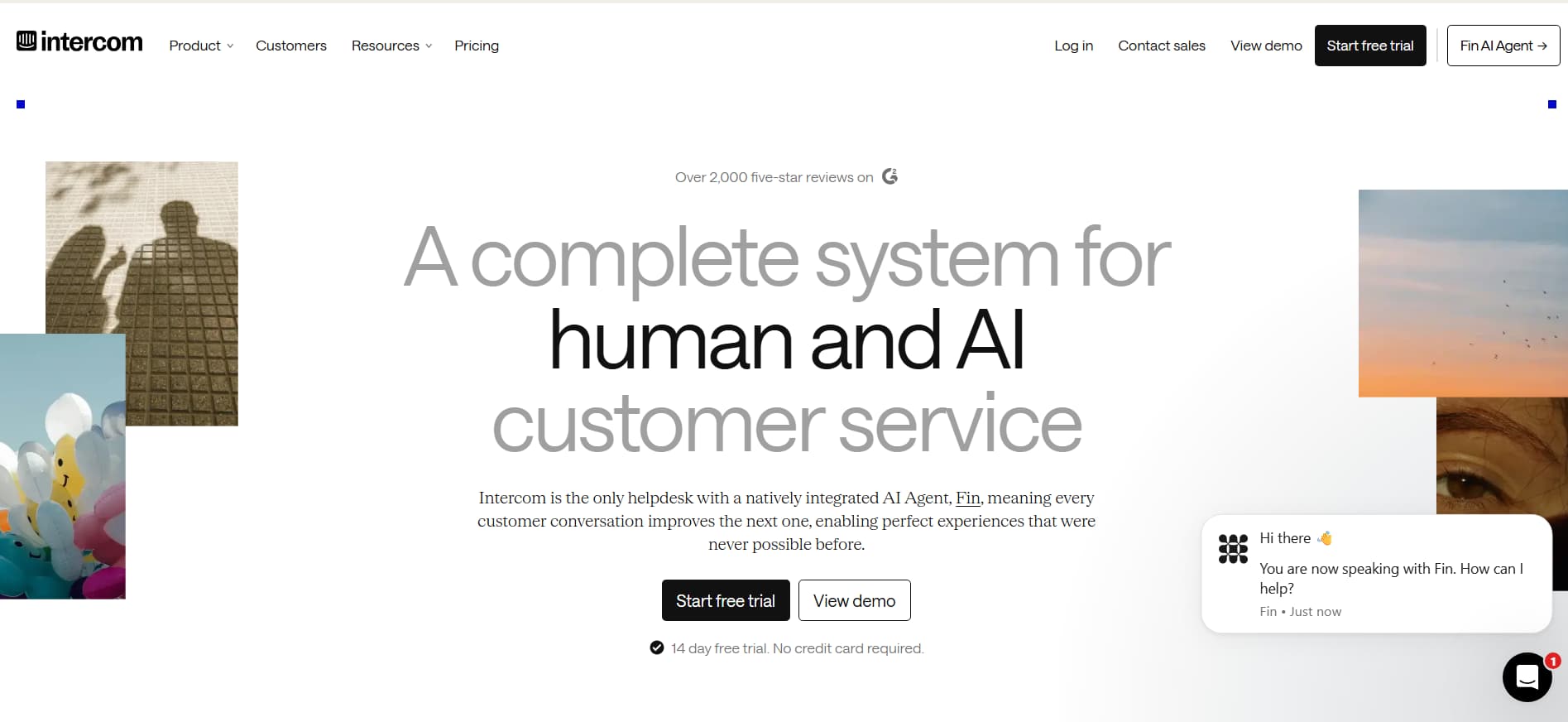
Intercom is a customer messaging platform. Live chat is one surface. Fin is the AI agent. Seats, product tours, outbound messaging, and a help center sit around that. For a Shopify store that only wanted a bubble, Intercom is usually too much platform and too much money. For a brand that already runs Intercom, Fin is the AI live chat they will actually use.
Public 2026 pricing that comparison pages keep repeating: seats from about $29 per month, Fin around $0.99 per resolution. Intercom has published Fin resolution figures in the mid-60s percent range across a large customer base. That number gets copied into ecommerce roundups even though Fin is not an ecommerce-native helpdesk the way Gorgias is.
Best for: product-led or DTC brands that already pay for Intercom, want AI deflection as the default, and will accept ecommerce context through integrations rather than a Shopify-first inbox.
Not for: a first live chat purchase on a $15k/month Shopify store. You will rent an operating system to hang a doorbell.
The ecommerce gap. Intercom’s AI is strong. Its native order actions are not Gorgias. If the shopper says “change the shipping address on order #4021,” the winning tool is the one that can do it, not the one with the best demo transcript. Several 2026 guides say this out loud and still list Intercom because the AI question is now part of the buying process.
Pricing warning: $0.99 per resolution looks small until seasonal volume hits. Same math as Gorgias AI. If you cannot forecast resolutions, you cannot forecast the bill.
6. Zendesk — best enterprise live chat inside a support suite
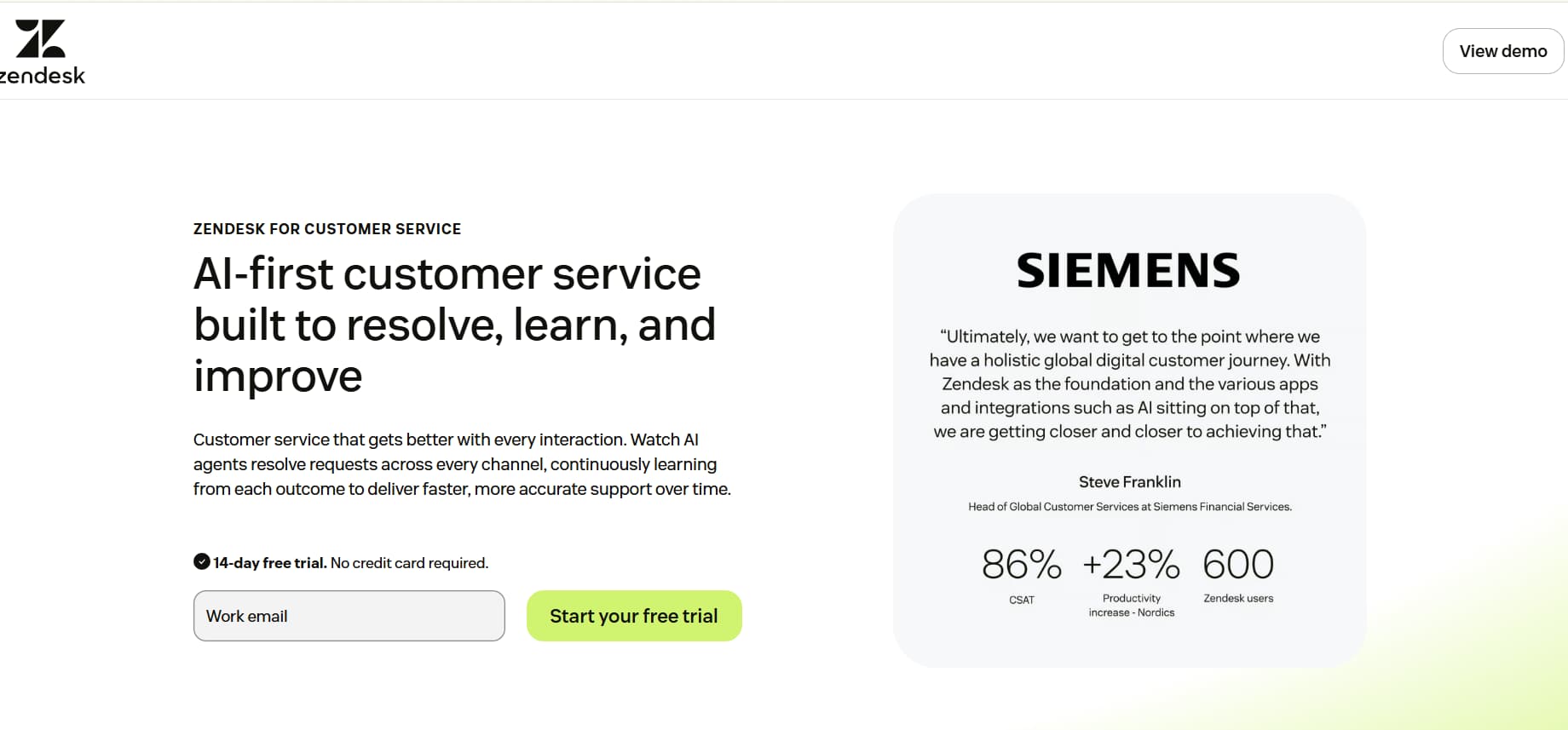
Zendesk Messaging / Suite is what large support orgs buy when chat is one channel among email, phone, social, and a ticket lifecycle with SLAs. It is rarely the best first live chat for a three-person ecommerce team. It is often the correct live chat for a company that already standardized on Zendesk.
Best for: high-volume teams, multi-brand operations, reporting, marketplace of apps, and a support leadership team that thinks in SLAs rather than widgets.
Not for: day-one Shopify stores. Implementation and price are the objections in every honest review.
Pricing (September 2026): standalone chat figures in older comparisons start near $19 per agent per month. Suite plans that include the rest of the platform are commonly listed from about $55 per agent. AI features are extra and often usage-based. Get a quote against your agent count and channel list. The public tile is not the contract.
Why it stays on “best ecommerce live chat” lists. Because the category word “live chat” still pulls enterprise buyers who will never install Tidio. Omitting Zendesk makes the article look like it only serves $29/month shops. Including it without saying “this is a suite, not a widget” makes the article look like it cannot tell the products apart.
7. tawk.to — best free live chat software for ecommerce on any platform
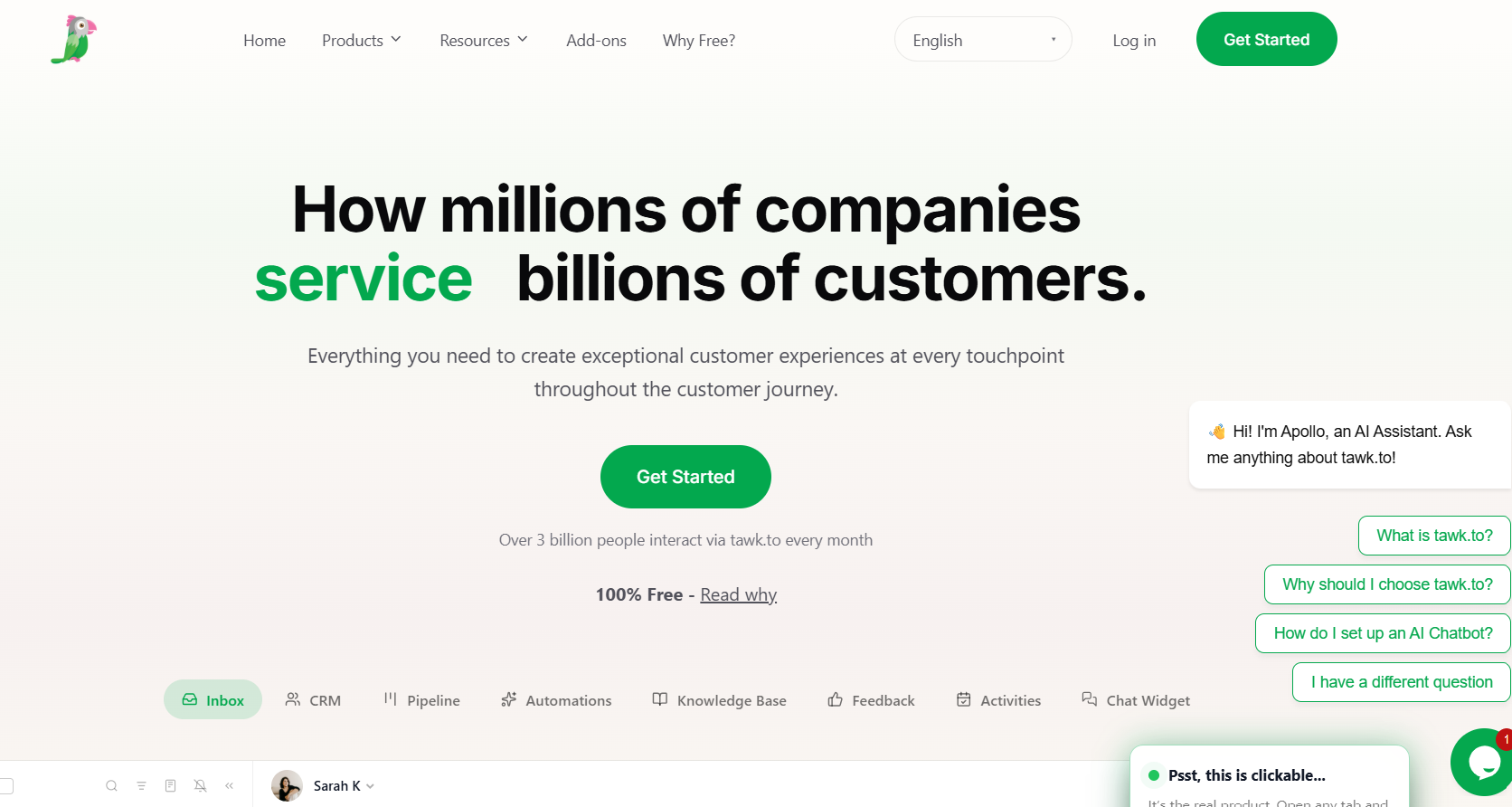
tawk.to is the answer to “best free live chat software for an online store” when the store is not willing to live inside Shopify Inbox. The free plan is the product: unlimited agents, monitoring, a widget, and a ticketing layer. AI Assist exists as an add-on. Shopify support is a plugin, not a native commerce operating system.
Best for: bootstrapped stores, WooCommerce and custom stacks, and any merchant who has humans available and a budget of zero.
Not for: stores that need the bot to resolve orders, or brands that need a polished sales widget and a vendor accountable for uptime SLAs the way a paid suite is.
The trade. You get the price. You give up ecommerce-native order actions and a lot of the AI story other tools sell in 2026. That is acceptable if your volume is low or your team already answers chat from a laptop all day. It is not acceptable if you thought “free” meant “Fin-quality AI included.”
Pricing (September 2026): core live chat free. Paid add-ons for AI and extras. Confirm current AI pricing on tawk.to before you promise automated coverage.
8. Crisp — best low-cost shared inbox for small ecommerce teams
Crisp is the tool small stores pick when they want more than a bubble and less than Gorgias. Free tier with two seats. Paid Mini plans in 2026 comparison tables start around $45/month. Native Shopify app. Shared inbox across chat and other channels. AI sold as credits by tier, not as the whole identity of the company.
Best for: early teams that need a shared inbox, a developer-friendly API, and a bill that does not require a finance meeting.
Not for: high-volume Shopify support orgs that need refunds and order edits as table stakes.
Crisp shows up on almost every 2026 competitor list in the “small store / free-tier” slot, next to tawk.to. The difference: Crisp is more of a modern shared inbox; tawk.to is more of a free chat utility. If you want collaboration and a path to paid automation, Crisp is the more natural upgrade path. If you want zero dollars forever, tawk.to wins.
Tools we did not crown — and why they still appear in other lists
Re:amaze. Strong multi-store ecommerce inbox. Appears on mid-market lists. Starting paid plans in 2026 write-ups sit near $29/user or a flat ~$59 option. Worth a look if you run several Shopify or WooCommerce storefronts and Gorgias feels heavy. Not in the core eight because most “best live chat software for ecommerce” searchers are single-store.
Zipchat. Ranks itself first for AI that reads a live catalog and sells across web, WhatsApp, Instagram, Messenger, and email. Public starter price in its own June/July 2026 guide: $49/month. Treat it as a real AI-sales option, not as an independent #1.
Freshchat / Freshworks. Fine if you already live in Freshworks. Not the first ecommerce-native pick.
HubSpot Chat. Best when HubSpot CRM is already the system of record. Free chat is the hook. The suite is the product.
Olark. Still listed for simple, accessible chat. Rarely the 2026 default.
Sobot, eesel, Richpanel, Featurebase. Each publishes a list that ends with itself. Useful as category signals (marketplaces, “resolving agent,” outcome-based billing). Not used here as the official ranking.
If your shortlist is “whatever the last blog crowned,” you are shopping vendor SEO. If your shortlist is Inbox / Tidio / Gorgias / LiveChat / Intercom / Zendesk / tawk.to / Crisp, you are shopping the actual market.
Live chat vs AI chatbot vs ecommerce helpdesk
These three terms get mashed together in every AI overview. They are not the same product.
Live chat is a real-time channel. A human (or a bot pretending to be ready for a human) talks to a shopper on the site. Success looks like speed, presence, and a clean handoff.
An AI chatbot / AI agent answers from your catalog, policies, and order data. Success looks like resolution rate, hallucination rate, and whether it can take an action (cancel, refund, recommend, apply a code) or only talk.
An ecommerce helpdesk is the system of record for tickets across chat, email, and social. Success looks like agent time-to-resolution, macros, and order context.
In 2026 the useful question is not “do we need live chat software for ecommerce?” It is “which of those three jobs is empty?”
- Empty widget, humans ready, low volume > Inbox or tawk.to.
- Empty after-hours answers, humans scarce >Tidio Lyro or another AI agent on top of a simple inbox.
- Empty order actions and a growing ticket pile > Gorgias or Zendesk.
- Empty AI inside a messaging stack you already pay for > Intercom Fin.
Buying all three as one logo is how Intercom and Zendesk get into mid-market deals. Buying all three when you needed one widget is how a $49 AI sales agent becomes an unused line item.
Shopify defines ecommerce live chat as a real-time customer communication channel that can support product recommendations, answer questions, and help shoppers move through the buying journey. In practice, the value comes from putting chat on high-intent moments—such as product and cart pages—and giving shoppers a clear route to a human when automation cannot resolve the request. Shopify’s live chat best-practices guide is a useful reference for the channel-level fundamentals
Widget vs resolving agent: the split most lists underplay
Richpanel’s 2026 framing is useful even if you never buy Richpanel. A widget routes. A resolving agent finishes the job: look up the order, start the return, edit the subscription, cancel before fulfillment.
If 70% of your chat is “where is my order” and “I want a return,” a pretty LiveChat bubble with no store actions creates a queue, not a resolution. If 70% of your chat is “which size?” and “do you ship to Ireland?” on a small catalog, a resolving-agent platform is overkill.
Ask vendors this in the demo, in this wording:
- Can the agent or AI issue a refund on Shopify without opening admin?
- Can it see live inventory before it recommends a SKU?
- What happens when it is wrong — handoff with full transcript, or a dead end?
- Is AI billed per resolution, per session, per seat, or flat?
- What did the last three customers at our volume pay in November?
If the salesperson cannot answer #4 and #5 with a number, you do not have a price. You have a landing page.
The technical distinction matters because Shopify customer accounts can expose order history, order status, and actions related to an order. Shopify’s customer-account developer documentation shows why a support tool with authenticated account and order context can do more than open a chat bubble: it can help a shopper complete an order-related task. That is the operational gap between a routing widget and a resolving agent.
What ecommerce live chat actually costs (model the volume)
Starting prices are designed to look small. The bill is designed around your peak month.
Illustrative 2026 math using public starting points. These are planning numbers, not invoices.
Scenario A — 500 conversations / month, 1 agent
- Shopify Inbox: $0
- tawk.to: $0
- Tidio: ~$29 + whatever Lyro you turn on
- LiveChat: ~$20–$40 depending on billing and tier
- Gorgias: low ticket tier, often still cheap at this volume if you skip AI
- Intercom: seat plus Fin if you enable it — usually the wrong buy here
Scenario B — 5,000 conversations / month, 3 agents
- Inbox: still $0, but agents will feel the missing helpdesk
- Tidio: base plan plus Lyro on a large share of threads
- Gorgias: ticket tier jumps; if AI resolves 2,000 threads at ~$0.95, AI alone is ~$1,900 that month
- Intercom: 3 seats + Fin on automated threads; Fin at $0.99 × 2,000 = ~$1,980
- LiveChat: 3 seats × ~$20–$40, AI extra
- Zendesk: 3 Suite seats already clear of “$19 chat” marketing
Scenario C — 20,000 conversations / month, peak season
Per-resolution AI is now a budget line, not a feature checkbox. A 50% automation rate at $0.90–$0.99 is $9,000–$10,000 in AI fees for that month before seats. Flat-rate or included-AI tools look expensive on the pricing page and cheaper in December. Metered AI looks cheap in March and brutal in November.
This is the comparison table vendor listicles rarely finish. Zipchat’s own 2026 guide correctly flags per-resolution unpredictability. Almost nobody shows the arithmetic. Run that math on your own volume before you buy, even if you never publish the numbers.
Does live chat increase ecommerce conversion rates?
Sometimes. Not automatically. Not enough to justify any tool.
Older LiveChat case studies still circulate: brands reporting higher conversion or higher AOV after proactive chat. Those studies are real for some catalogs and irrelevant for others. Chat on a $28 commodity SKU with 2% conversion can pay for itself if it recovers hesitant buyers on size and shipping. Chat on a store with 400 sessions a day will not print a Gorgias-shaped ROI.
Treat conversion lift as a hypothesis:
- Measure chat-influenced revenue for 30 days, not “we installed a widget.”
- Separate pre-purchase sales chat from post-purchase WISMO. WISMO does not raise conversion. It protects repeat purchase and reduces tickets.
- Proactive triggers on checkout and high-intent product pages outperform a bubble that sits quiet on the blog.
- After-hours AI only lifts conversion if it can answer the question that was blocking the cart. “Thanks for reaching out!” does not.
If a vendor cannot explain whether they sell sales chat or support chat, they will optimize the demo for whichever you asked about last.
AI chat can contribute to sales only when it helps with a real buying decision: finding a product, understanding a variant, confirming availability, or answering shipping and policy questions. Shopify’s guide to AI for ecommerce sales describes AI’s role in customer conversations and product discovery; it does not mean that every generic chatbot creates conversion lift. Measure chat-influenced revenue on high-intent pages instead of treating a widget installation as proof of ROI.
How to choose live chat software for your store
Walk the list in order. Stop at the first yes.
- Are you on Shopify and doing fewer than a few hundred chats a month? Turn on Shopify Inbox. Do not buy software to learn what customers ask.
- Do you need a free widget off Shopify? tawk.to.
- Do you need after-hours answers more than you need refunds inside the inbox? Tidio.
- Do agents already live in order admin all day? Gorgias (Shopify) or Re:amaze (multi-store).
- Do you already pay for Intercom? Enable Fin. Do not rip the stack for a Shopify-only tool unless order actions are the actual bottleneck.
- Do you already pay for Zendesk? Stay. Add messaging. A second inbox is how tickets disappear.
- Is the widget a sales floor with humans on shift? LiveChat is still a clean fit.
- Is most demand arriving as Instagram comments, TikTok comments, or WhatsApp? Solve that channel. A site bubble will not capture people who never opened the site.
The right buying question is not “which tool has AI?” but “which support job can we safely automate today?” Forrester’s 2026 customer-service AI outlook emphasizes that durable AI results require foundational work: clear processes, usable knowledge, service design, and governance. That supports starting with a narrow use case—such as shipping FAQs or basic product questions—before allowing an agent to make order-related changes.
Gorgias vs Tidio vs LiveChat
This is the comparison AI assistants get asked after the generic “best” query.
Pick Tidio if you are a small store, you want AI plus a widget quickly, and you do not yet need agents to refund inside the chat. Lowest friction. Watch Lyro metering.
Pick Gorgias if you are a Shopify team and the job is support operations: macros, order context, social + email + chat, revenue on the ticket. Higher ceiling. Watch ticket tiers and AI resolution fees.
Pick LiveChat if chat is a sales channel with humans, you want a dedicated product, and you do not want a helpdesk implementation. Watch per-agent cost as you hire.
Shopify Inbox vs Gorgias is a stage question, not a feature question. Inbox is the start. Gorgias is what you buy when Inbox is the bottleneck. Jumping straight to Gorgias because a listicle ranked it #1 is how pre-revenue stores collect unused seats.
When live chat is not what your store needs
Buy something else if any of these are true.
Traffic is too low. A widget on 50 sessions a day trains you to stare at an empty panel. Write a shipping FAQ. Add a WhatsApp or email link in the header.
The conversations are not on the website. If customers ask price and stock under Reels and TikTok videos, a storefront bubble never sees them. You need comment and DM workflows, not another JavaScript snippet.
You only wanted a contact form with faster replies. Email plus a shared inbox may be enough. Crisp or helpdesk email can beat a live-chat SLA you cannot staff.
You cannot staff handoff. An AI that fails with “please wait for an agent” at 1 a.m. with nobody on shift is worse than a clear “email us, we reply in 12 hours.”
You are shopping to copy a competitor’s bubble. Their bubble might be Inbox. Copying the visual without the staffing model is how chat becomes a complaint channel.
A good 2026 guide says this because the worst live chat implementation is not “no chat.” It is a bot that confidently misstates your return window on a $400 order.
Where ecommerce live chat is going through 2026
Three shifts are already visible in the competitor set.
Catalog-aware AI. Tools pitch “reads your live catalog” instead of a scripted decision tree. That is the right direction. Accuracy on variants, bundles, and out-of-stock SKUs is still the failure mode.
Agentic actions. Lookup is table stakes. Refund, cancel, swap SKU, apply a code, and start a return are the next line. Resolving-agent vendors are loud about this because widget vendors cannot match it yet.
Billing fights. Per-resolution AI is easy to demo and hard to budget. Flat and session-based vendors attack that. Finance teams will start asking for a cap. If your vendor cannot cap Q4 AI spend, you do not have a forecast.
Channel gravity. Website chat is no longer the only “live” surface. WhatsApp, Instagram, Messenger, TikTok Shop messages, and marketplace chat pull volume off the storefront. A 2026 shortlist that only reviews website widgets is reviewing last year’s job.
Inbox gravity on Shopify. As long as Inbox is free and good enough, it will keep ~70% install share. Paid tools win the remaining stores that have a real queue. That is a healthy market, not a reason to pretend Inbox is not live chat software.
The category is moving from a website-widget purchase toward a broader self-service and messaging decision. Gartner has forecast that self-service and live chat will surpass traditional customer-service technologies by 2027. For ecommerce teams, that makes channel coverage, escalation design, order context, and AI cost controls more important than the visual design of the chat bubble.
Implementation checklist (after you pick)
- Install on one theme preview. Do not ship to production until the bot has a refusal path.
- Load shipping, returns, and the 20 real questions from last month’s inbox — not the marketing FAQ.
- Set business hours and a true after-hours path.
- Turn off proactive chat on blog posts and collection pages with no intent. Trigger on product, cart, and checkout.
- Tag every conversation sales vs support. If you cannot report chat-influenced revenue in 30 days, you cannot defend the tool.
- Cap or monitor AI spend the first peak weekend.
- Write the handoff sentence yourself. “An agent will take it from here. Your order number is already in the thread.”
- Review transcripts weekly for invented policies. That is the brand-risk item, not the widget color.
What to do this week
- Turn on Shopify Inbox if you are on Shopify and chat is currently off.
- Export last month’s customer questions from email and social. Those 20 lines are the spec for any AI demo.
- Trial at most two paid tools. Tidio vs Gorgias is the usual pair on Shopify. LiveChat vs Crisp is the usual pair when you want a widget or inbox without a full ecommerce OS.
- Build the 500 / 5,000 / 20,000 conversation cost sheet with AI on and AI off.
- Decide the job in one sentence: sales presence, after-hours answers, or order operations. Buy only that job.
The stores that lose this category in 2026 are not the stores that picked Tidio instead of Gorgias. They are the stores that bought a “#1 AI live chat” because a vendor blog told them to, then spent peak season arguing with a bot about a return window it invented.
Pricing disclaimer
Prices, plan names, and AI fees in this guide were checked against public vendor pages and 2026 comparison sources as of September 2026. They change without notice. Confirm the current price on each tool’s own pricing page before you buy or renew. Figures here are planning numbers, not a quote.
About the author
Aravindh Kumar is an ecommerce and Instagram growth expert with 8+ years of experience in online selling. He has worked with 500+ brands - including Forbes-listed companies - He has helped 200+ Instagram businesses grow their online presence.