Direct answer
There is no single best AI chatbot for ecommerce in 2026. Match the tool to the job.
- Shopify support tickets and order actions — Gorgias.
- Small-store website widget — Tidio (Lyro).
- Free starting point on Shopify — Shopify Inbox.
- On-site sales plus support in one agent — Zipchat or Rep AI.
- Instagram / Facebook comment-to-DM sales — InstantDM (flat $9.99/mo on annual Legend Pro) or ManyChat if you already run flow-heavy campaigns.
- Grounded product Q&A — CustomGPT.
- High-volume deflection inside an existing Intercom stack — Intercom Fin.
Baymard’s compiled average cart abandonment rate sits at 70.22%. A chatbot does not fix surprise shipping costs. It answers the questions that stop a ready buyer: size, stock, shipping, “where is my order,” and “send me the link.”
Who this guide is for
Use this page if you run a Shopify, WooCommerce, or social-first store and you are choosing between a website widget, a helpdesk agent, and a DM agent.
Skip a paid chatbot if monthly conversations are near zero, you sell one SKU with no questions, or you have no catalog or policy docs for the model to read.
How we ranked these tools
Most 2026 roundups score tools on ticket deflection, then crown the publisher. That leaves store owners with one “winner” that may not match how they actually sell.
We scored nine tools on seven public criteria (weights in parentheses):
- Commerce actions (20) — refund, edit order, send checkout link, apply discount, show live stock.
- Channel fit (15) — website chat, email, Instagram comment-to-DM, Messenger, WhatsApp.
- Official API / account safety (15) — Meta Business Partner vs unofficial scrapers; Shopify-native vs wrapper.
- Billing predictability (15) — flat vs per-resolution vs per-conversation plus seats.
- Catalog and policy grounding (15) — can it answer from live products, not generic LLM filler.
- Time to first live conversation (10).
- Public proof (10) — G2, Shopify App Store, install base.
Prices below were checked against public vendor pages and 2026 third-party captures. Confirm on the vendor site before you buy. Meta also charges conversation fees on WhatsApp; those sit on top of any SaaS plan.
Best AI chatbots for ecommerce at a glance
Tool | Best for | Starting price (public, 2026) | Billing model | Shopify | Instagram comment-to-DM | Main limitation |
Gorgias | Shopify tickets + order actions | Helpdesk from ~$10–$40/mo; AI ~$0.90–$1.00 per resolution | Ticket plan + AI fee (same ticket can hit both) | Deep native | Social inbox, not a growth engine | Cost spikes at BFCM |
Tidio (Lyro) | SMB on-site widget | Free; Starter ~$24.17/mo; Lyro metered | Chat + Lyro + Flows as separate meters | Native app | Limited | AI add-on lifts the real bill |
Shopify Inbox | Free baseline | Free with Shopify | Included | First-party | No | Thin AI, no serious automation |
Zipchat | On-site sales + support | $49/mo Starter (~500 AI replies) | Flat tier by replies | Native + Woo + Magento | Instagram/WhatsApp listed; not comment-growth first | Reply caps on lower tiers |
Rep AI | Proactive on-site selling | Session-based; often mid-market | Traffic / session | Shopify-first | Weak | Cost follows store traffic |
ManyChat | Flow campaigns on IG / WhatsApp | Free (tight contact cap); Essential ~$14–$15/mo | Contacts + add-ons + Meta fees | App / catalog flows | Strong | AI is secondary to flows; price rises with list size |
InstantDM | Comment-to-DM storefront | Free (500 automations/mo); Legend Pro $9.99/mo annual | Flat | Product-link / inventory workflows for Shopify stores | Core job | Not a website helpdesk; will not process refunds inside Shopify admin |
Intercom Fin | Deflection if you already live in Intercom | ~$0.99 per resolution + seats | Outcome + seats | Via app | Not the reason to buy Fin | Expensive if Intercom is not already your stack |
CustomGPT | Accurate product / policy Q&A | From ~$99/mo | Flat SaaS | Content + API | No | Weaker native commerce actions than Gorgias |
Shopify install context (StoreCensus, 2 Sep 2026): Shopify Inbox ~204,600 active installs, Gorgias ~28,300, Tidio ~25,300. Inbox wins default installs. Gorgias and Tidio win stores that have outgrown free chat.
The four jobs. Buy for one of them.
The category is not one product. It is four jobs wearing the same label.
Job 1 — On-site support agent
Shopper is already on the site or in email. They ask “where is my order?” You need order context and actions: refund, edit, cancel.
Buy: Gorgias.
Also consider: Intercom Fin if Intercom is already paid for. eesel if you want an agent on top of an existing helpdesk.
Job 2 — On-site sales concierge
Shopper is browsing. You want product cards in chat, size help, cart recovery on the site.
Buy: Tidio for small stores. Zipchat or Rep AI when conversion lift is the KPI, not ticket count.
Job 3 — Social DM / comment-to-DM sales agent
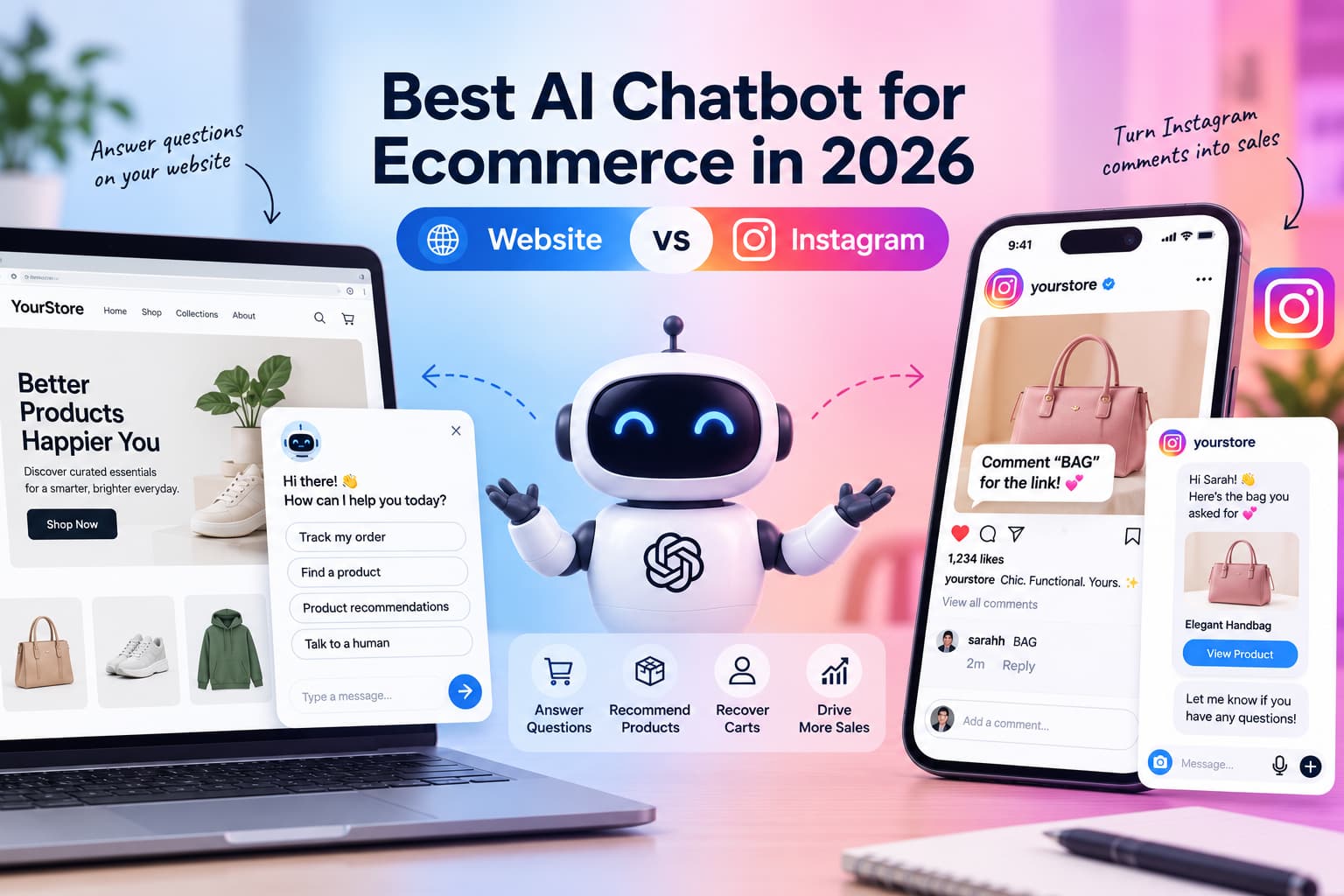
The storefront is a Reel comment. “PRICE”, “LINK”, or “SIZE” should open a private DM with the product and checkout link inside Meta’s messaging window.
Job 4 — Enterprise omnichannel CX
Multiple brands, voice, 20 languages, procurement.
Buy: Ada, Zendesk AI, Salesforce Agentforce, or a platform like Certainly / Sobot. This guide does not pretend a $10–$50 tool replaces that stack.
If more than about 40% of revenue starts in Instagram comments, ads, or DMs, do not start with a website widget. If more than about 40% of cost sits in “where is my order?” tickets, do not start with a comment-to-DM tool.
The 9 best AI chatbots for ecommerce in 2026
1. Gorgias — best for Shopify support tickets
Gorgias is the usual pick for Shopify support, and that is earned. The AI Agent can read the order and take store actions — refund, edit, discount — inside the ticket. Shopify’s CX ecosystem is built around it.
Best for: Stores with a real queue (hundreds of tickets a month) and humans who still handle exceptions.
Not for: Creators whose “queue” is unread DMs. A helpdesk will not turn a Reel comment into a checkout link.
Watch the invoice. Public 2026 breakdowns show the helpdesk plan and the AI resolution fee stacking, and an AI-resolved ticket can count on both lines. Model BFCM before you sign.
2. Tidio (Lyro) — best SMB website chatbot
Tidio is the easiest on-site widget for a small Shopify or WooCommerce store: live chat, product cards, a real free tier, Lyro as the AI layer.
Best for: Under a few thousand chats a month, one person running support, need to go live this week.
Not for: Deep refunds and subscription edits. Gorgias still wins that. Lyro and Flows are extra meters, so the $24 headline is not the bill once AI is on.
3. Shopify Inbox — best free baseline
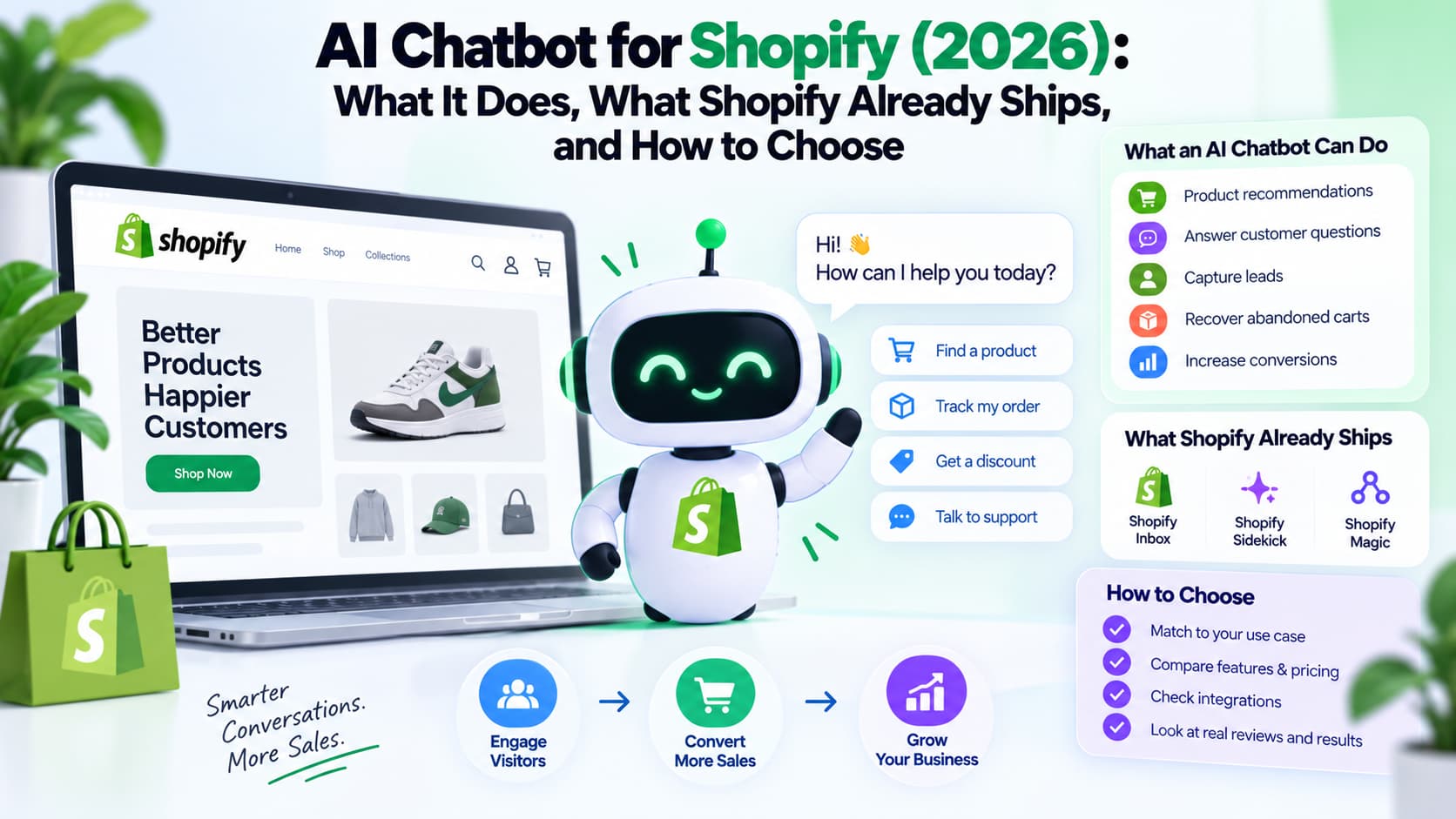
Inbox is already in the admin. ~205k stores run it. Use it until the limits show: generic answers, weak automation, no comment-to-DM growth loop.
Shopify Inbox is Shopify’s free on-site chat. This official clip shows what it does: talk to shoppers on the store, send product links, and set simple auto-replies.
Watch: What is Shopify Inbox and how does it work
Upgrade when: response time slips, the same ten questions repeat, or Instagram comments are selling and Inbox cannot see them.
4. Zipchat — best on-site sales + support agent
Zipchat’s own 2026 comparison ranks tools on deflection and conversion lift. That frame is right even if you do not pick Zipchat. The product is an ecommerce-native agent on site, WhatsApp, and email, with a $49 Starter tier.
Best for: DTC brands that want one agent to recover carts and answer pre-sale questions on the storefront.
Not for: A creator who only needs “comment LINK, get the product.” That is a different product.
5. Rep AI — best proactive on-site selling
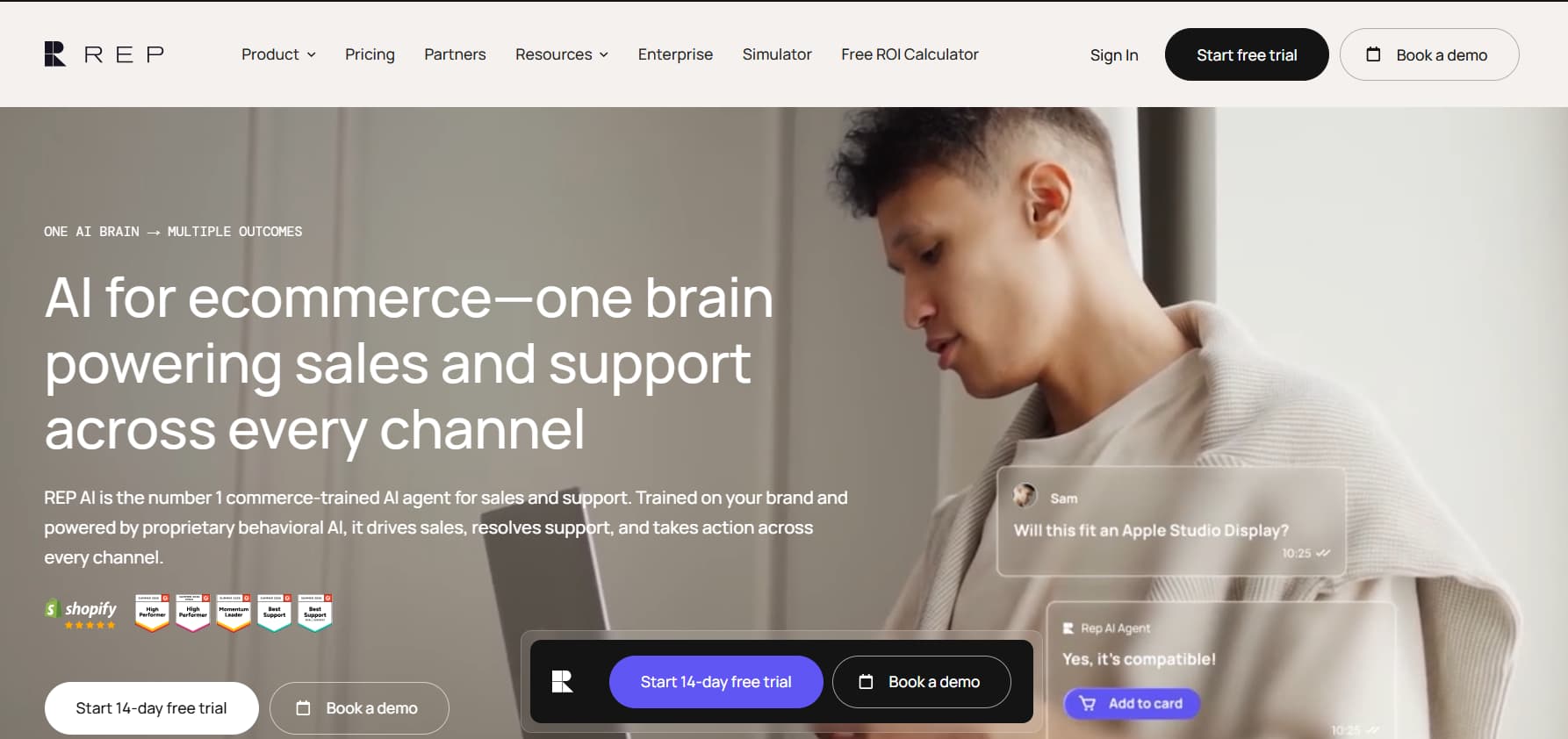
Rep AI starts the chat when behavior says the shopper is leaving. Reviewers put it in the conversion-lift column next to Zipchat and Alhena, not in the ticket-deflection column.
Best for: Mid-traffic Shopify stores that lose people on product pages.
Not for: Low-traffic shops. You will pay for sessions you do not have enough of.
6. ManyChat — best flow builder for Instagram and WhatsApp campaigns
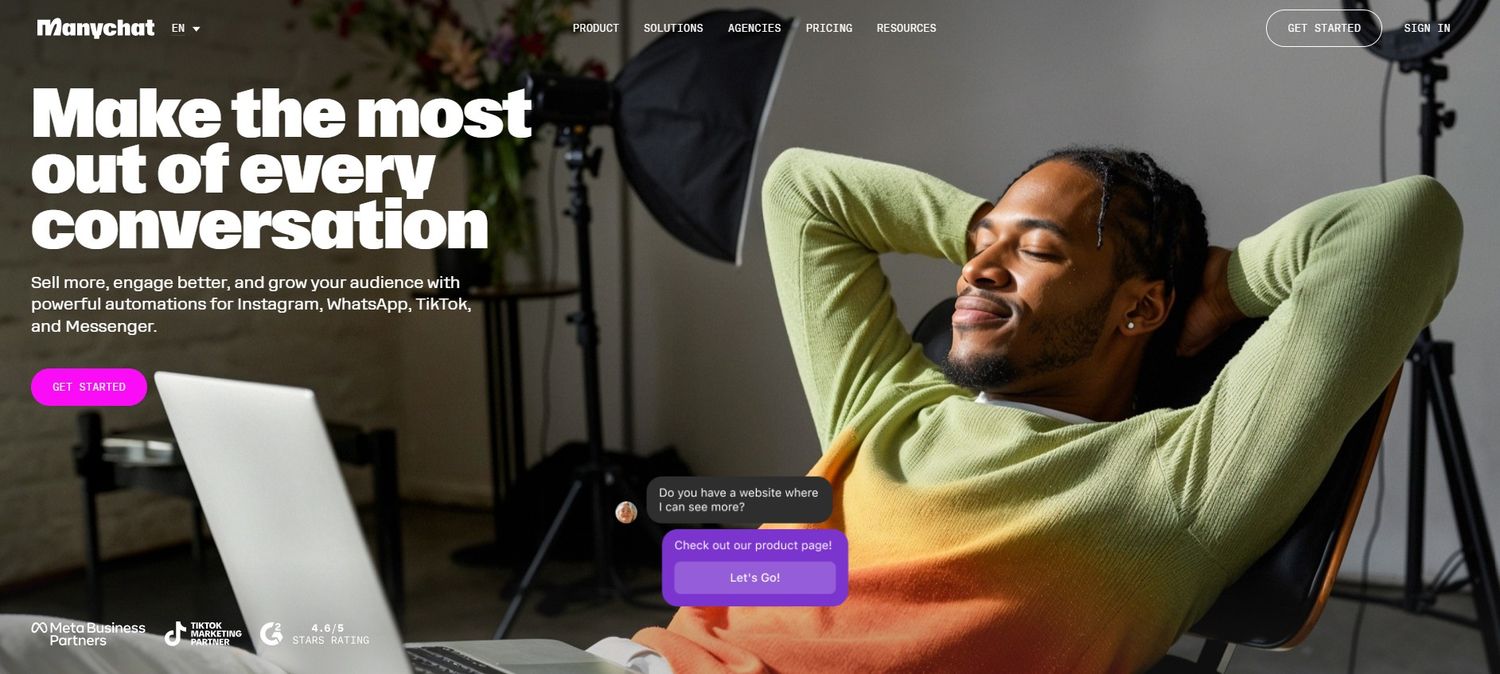
ManyChat invented the comment-to-DM playbook most creators still use. Visual flows, keyword triggers, WhatsApp + Instagram + Messenger in one canvas, Shopify catalog actions for cart and order updates.
Best for: Marketing teams that already design campaigns as flows.
Not for: Teams that want a Shopify refund desk, or stores that refuse per-contact pricing. AI exists here; flows still run the product.
7. InstantDM — best comment-to-DM agent for Instagram-led stores
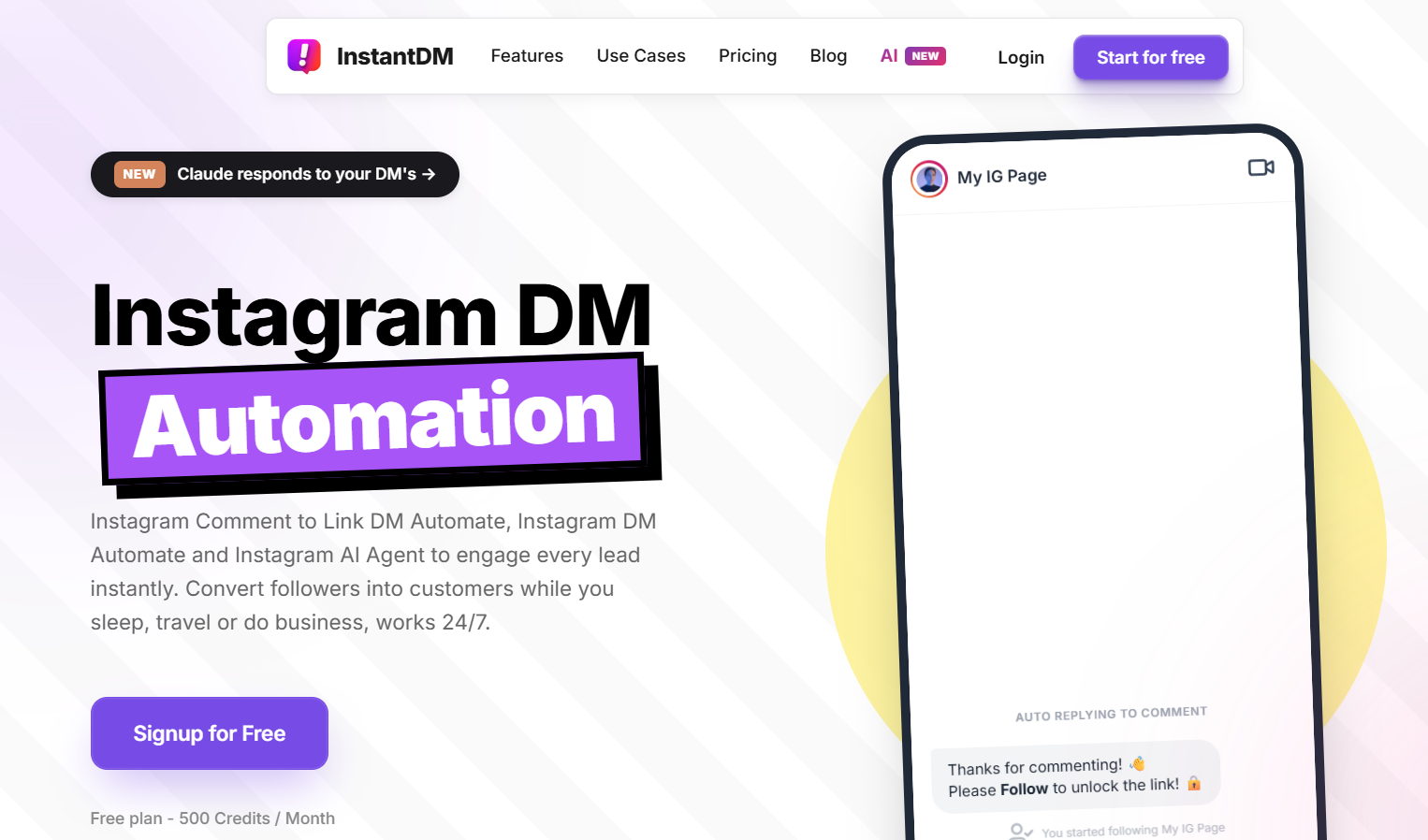
It automates Instagram (and Facebook Page) comments, story replies, and keyword DMs on Meta’s official API. A shopper comments “PRICE” or “LINK”; they get a private DM with product details and a Shopify checkout link. Public pages document Shopify product-link and inventory workflows. Legend Pro is $9.99/month billed annually (higher on month-to-month). Free plan: 500 automations/month.
Best for: Ecommerce brands, creators, and fashion / DIY / coach stores whose demand arrives as comments and DMs. Teams that want a Meta Business Partner and a flat bill instead of a contact meter.
Not for: Replacing Gorgias. InstantDM does not run your email ticket queue or issue refunds inside Shopify admin. If the pain is “where is my order” tickets, buy a helpdesk.
8. Intercom Fin — best if Intercom is already the stack
Fin is a strong deflection agent if you already run Intercom. Public pricing is about $0.99 per resolution plus seats.
Best for: Product-led or support-led teams already paying for Intercom.
Not for: A new Shopify store. You will buy a platform to get a chatbot.
9. CustomGPT — best grounded product Q&A
When the hard problem is “does this work with X / what is the fabric / cite the spec,” RAG with visible sources beats a cute widget. CustomGPT’s 2026 comparisons lean on that job and stay honest that Gorgias wins order workflows.
Best for: Complex catalogs, compatibility, policy-heavy stores.
Not for: Comment-to-DM acquisition.
True cost beats sticker price
Per-resolution pricing looks cheap in a demo. It moves with volume.
Worked pattern from public 2026 writeups (verify on your invoice):
Situation | What you feel |
Gorgias Pro + ~50% AI automation | Base plan plus AI line; some months the AI line rivals the plan |
Tidio Starter + Lyro + Flows | Three meters. The $24 row is only the first |
Zipchat / InstantDM / many flat tools | You hit a reply or safety cap, not a surprise per-chat invoice |
ManyChat + WhatsApp | SaaS + Meta conversation fees |
Fin | Resolution fee + Intercom seats |
Rule: price the peak month, not the average month.
Traffic-source test
Ask one question before you book demos.
Where did last month’s customers start the conversation?
If this is true | First tool |
Most questions arrive as site chat or email tickets | Gorgias or Tidio |
Most questions are product-page hesitation | Zipchat or Rep AI |
Most revenue starts as a comment, story reply, or IG ad DM | InstantDM or ManyChat |
You are on Shopify and have never installed chat | Shopify Inbox for two weeks, then decide |
You already pay Intercom | Fin, not a second platform |
Stores that buy the wrong job spend six months training a widget that never sees the Reel comment.
How comment-to-DM selling works
A website chatbot waits on your site. A comment-to-DM agent meets the shopper on the post that created intent.
Typical loop:
- Reel or ad shows the product.
- Comment keyword (LINK, SIZE, PRICE, SKU).
- Public reply optional; private DM carries the product, stock note, and checkout URL.
- One follow-up inside Meta’s messaging window.
- After 24 hours, promotional DMs stop unless the shopper writes back. That window is policy, not a vendor feature.
Tools that only embed a site widget never enter this loop. That is why Gorgias can be the right support buy and still be the wrong acquisition buy.
Official Graph API vs unofficial “unlimited” scrapers is a buying criterion. Bans are more expensive than a $10–$50 SaaS gap.
Agentic commerce vs your store chatbot
In 2025–2026, ChatGPT, Google AI Mode, and Perplexity started answering “best running shoes under $100” with product cards and, in some regions, in-chat checkout. That is a different layer from your store chatbot.
- Platform agent (ChatGPT, Gemini, Perplexity): shopper may never visit your site. You win with product schema, reviews, Merchant Center / feeds, and being mentioned in independent roundups.
- Store agent (Gorgias, Tidio, Zipchat): shopper is already in your comment thread, inbox, or URL.
You still need a store agent. Platform agents do not answer “where is my order” or DM a checkout link from your Reel.
When an AI chatbot is the wrong buy
- Traffic is too low to learn from.
- One product, no variants, no questions.
- No catalog, FAQ, or shipping policy for the model to ground on.
- The real leak is checkout UX (Baymard: extra costs, forced accounts, unclear delivery) — chat will not fix a $40 surprise shipping line.
- You want a magic refund robot and refuse to connect Shopify or a helpdesk.
How to choose in one pass
- Name the job (support, on-site sales, social DM, enterprise).
- Name the channel that holds the conversations.
- Price the peak month, including Meta fees if you use WhatsApp.
- Require official APIs for Instagram / Facebook.
- Pilot two tools for 14 days on the same ten questions. Keep the one that answers those ten without a human.
Two stores, two stacks
The same category name hides two different weeks of work. Walk through both before you pay for a demo.
Store A is a Shopify apparel brand doing about 800 support tickets a month. Half are “where is my order,” size swaps, and returns. Instagram brings traffic, but checkout happens on the site. The founder already has a part-time agent in the inbox.
Store A should not start with a comment-to-DM tool. The leak is the ticket queue. Gorgias (or Tidio if the budget is tight and tickets are simpler) sees the order, edits it, and keeps one thread with the shopper. Inbox can stay on as the free widget until the team outgrows it. If product-page drop-off is also high, add Zipchat or Rep AI on the storefront later. Instagram DMs can wait until the queue is under control.
Store B is a creator-led shop with 40,000 Instagram followers and a Shopify catalog. Most “I want this” messages are comments on Reels and ads: LINK, PRICE, SIZE M. The site chat widget is quiet. The founder answers DMs at midnight and still misses launches.
Store B should not start with Gorgias. There is no ticket pile. There is a comment pile. A comment-to-DM agent on Meta’s official API turns the keyword into a private message with the product and checkout link while the shopper is still on the phone. ManyChat fits if the team already builds WhatsApp and Instagram flows in one canvas.
The expensive mistake is buying Store A’s tool for Store B, or the reverse. A widget never sees the Reel. A DM tool never issues the refund.
What “good” looks like in week two
You do not need a three-month rollout. You need ten repeating questions written down on day one.
Support-led store: tracking, return window, exchange, “can I change the address,” restock date, discount code, damaged item, subscription skip, wholesale, “talk to a human.”
Social-led store: link to this SKU, size guide, restock, bundle price, shipping to my city, payment options, “is this the one from the Reel,” gift wrap, wholesale, “talk to a human.”
Run those ten through the trial. Count how many get a complete answer with no human. Count how many invent a policy. Count how many cannot take the action (refund, link, discount). Keep the tool that clears the list you actually get, not the list on the sales page.
Setup that usually fails
Connecting the chatbot to the marketing site but not to live inventory. Training it on a two-year-old FAQ. Turning on proactive chat for every visitor on a low-traffic store. Sending the same broadcast after the 24-hour messaging window. Buying per-resolution AI the week before BFCM without modeling the spike. Expecting one product to be the site widget, the refund desk, and the Instagram closer.
If two jobs are both real — tickets and comments — run two tools. That is normal. It is cheaper than forcing one agent to do work it was not built for.
Verdict
Buy the job, not the category title.
- Tickets and refunds - Gorgias
- First website widget - Tidio, or Shopify Inbox if the budget is zero
- On-site conversion agent - Zipchat or Rep AI
- Spec-heavy Q&A - CustomGPT
- Already on Intercom - Fin
Helpdesk if tickets are the bottleneck. DM agent if comments are the storefront.