Last updated: October 3, 2026
TL;DR
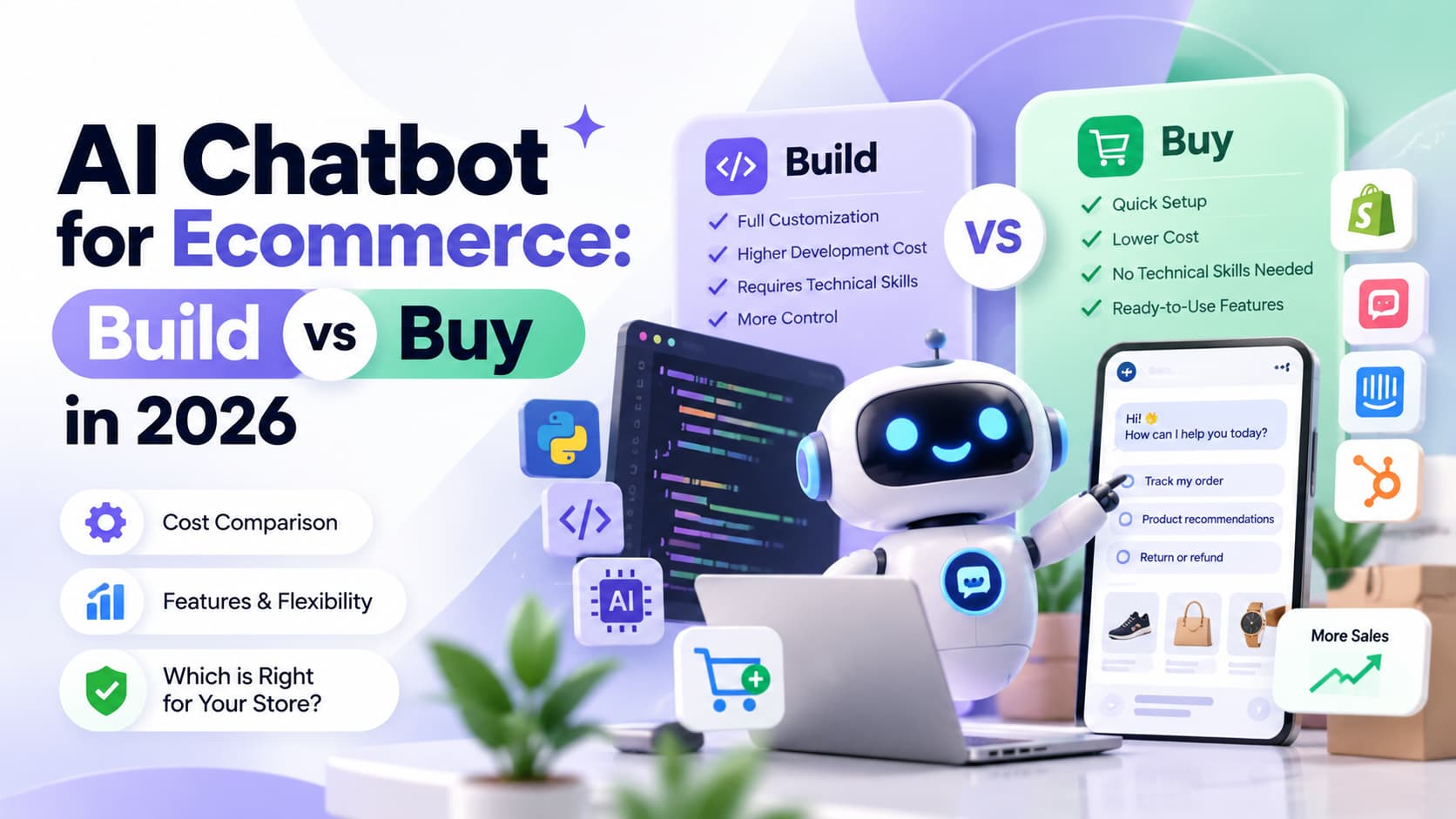
For most Shopify and WooCommerce stores in 2026, buying an AI chatbot beats building one. A production custom build is commonly estimated at $77,000 to $168,000 in year one and three to six months before the first live conversation. A bought platform can go live in hours to days. Public list prices in October 2026 start around $24 to $64 a month for a small site agent, and climb fast once per-resolution or per-conversation meters turn on.
| Situation | Verdict |
| Under 200 tickets a month, standard questions | Buy |
| Site tickets and social threads both matter | Hybrid: buy both layers, build nothing yet |
| A workflow no vendor covers, and a funded owner | Build that slice only |
| No unique workflow, or no funded owner | Buy |
That is not the whole decision. Buy the layer you need. Build only if a vendor cannot meet the workflow and you can fund the upkeep.
- Site tickets and order actions: buy a helpdesk agent. Compare current Shopify chatbot apps before you install one.
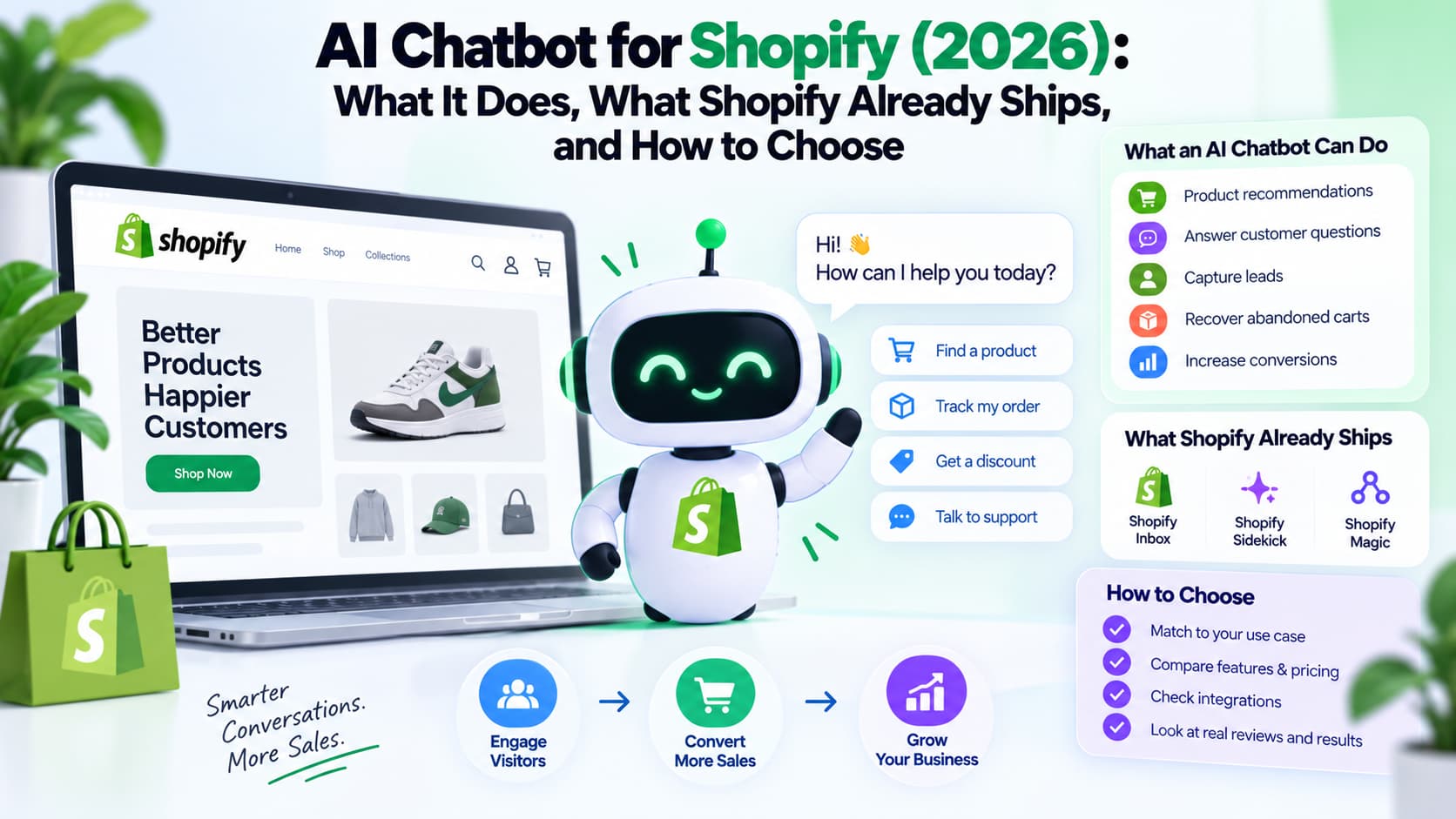
- On-site selling: buy a catalog agent. Shopify Inbox is the free native starting point. Sidekick is the merchant assistant inside admin, not a shopper chatbot.
- Comments, DMs, and WhatsApp: buy a messaging tool on official APIs. The website-versus-Instagram split is a separate choice.
- Custom build: only with a unique workflow and a funded owner.
If either condition for a build is false, buy.
Is it cheaper to build or buy an AI chatbot for ecommerce in 2026?
Buying is cheaper for nearly every store once you count year-one engineering, infrastructure, and the months the custom bot earns nothing.
| Path | Year-1 cash out | Time to first live conversation | Who owns model drift |
| Build custom (retrieval, catalog, actions) | $77,000–$168,000 commonly cited; some mid-market estimates run $125,000–$280,000 | 3–6 months typical; 6–12 months for several workflows | You |
| Buy a site or helpdesk agent | Setup often $0–$6,000, then a subscription plus usage | Hours to a few weeks | Vendor |
| Buy a messaging agent | Often a free tier, then a low monthly plan on official APIs | Same day | Vendor, plus your conversation design |
| Hybrid (buy site and buy messaging) | Usually well under $1,000 a month for a small brand | Days | Split |
Public 2026 guides put a production ecommerce chatbot at $77,000 to $168,000 in year one, against a subscription that used to be quoted from $49 a month. That buy-side floor has moved. Zipchat’s pricing page on October 3, 2026 lists Starter at $64 a month billed annually, then Pro at $240, Scale at $480, and Scale plus at $960. Extra reply packs are $49 for 250 replies on the lower tiers. Treat every build figure as a planning range, not an invoice.
The direction of the math is stable. A single store pays the full cost of a build. A platform spreads model upgrades, connector breakage, and prompt failures across thousands of catalogs.
The line most “buy is cheap” articles skip is how the buy is billed. October 2026 public prices:
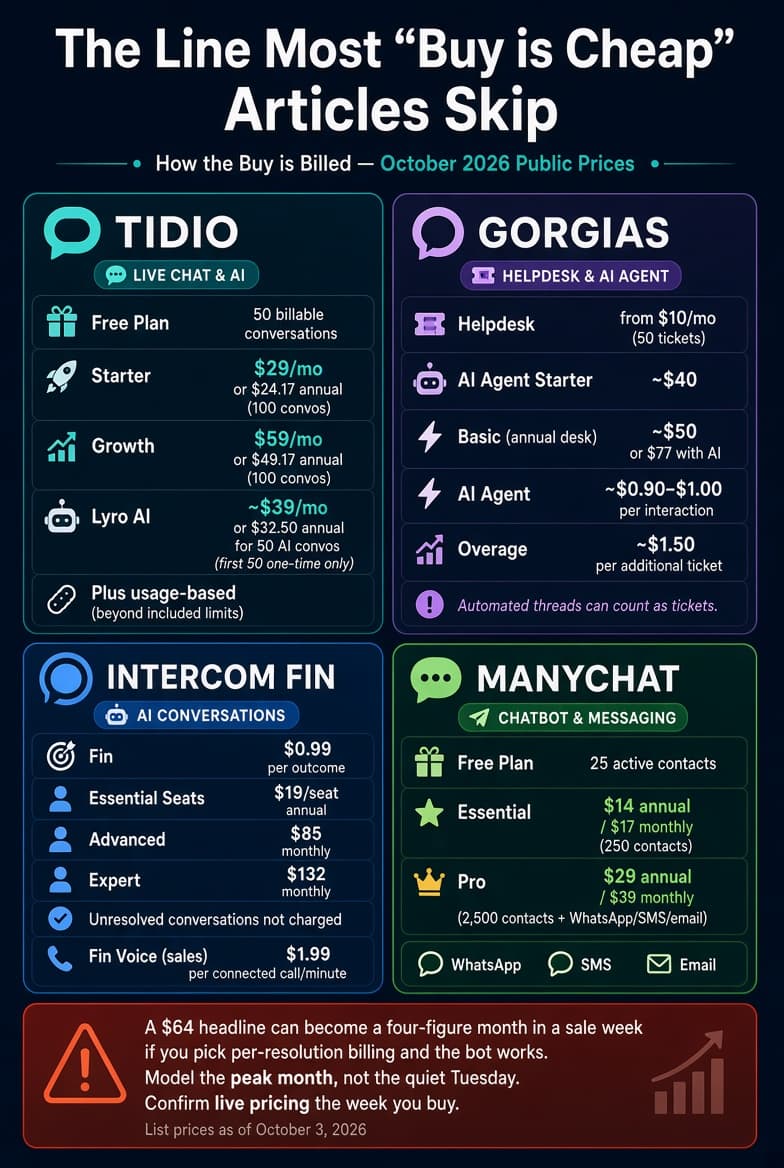
- Tidio live chat starts free (50 billable conversations). Starter is $29 a month, or $24.17 billed annually, for 100 conversations. Growth starts at $59 a month, or $49.17 annually. Lyro, the AI agent, is a separate meter: about $39 a month, or $32.50 annually, for 50 AI conversations. The first 50 Lyro conversations are a one-time allowance, not a monthly refill. Plus starts in the hundreds and is usage-based. Confirm on Tidio pricing.
- Gorgias helpdesk alone starts at $10 a month for 50 tickets on monthly billing. With the AI Agent toggle on, the Starter card is about $40. Basic is about $50 a month annually for the desk, or $77 with AI Agent included. AI Agent is about $0.90 per automated interaction on annual billing and $1.00 on monthly. Past the included allowance, interactions are about $1.50, and a fully automated thread can also count as a ticket. Confirm on Gorgias pricing.
- Intercom Fin is $0.99 per outcome. Essential seats are $19 per seat a month on annual billing. Advanced is $85. Expert is $132. A conversation Fin cannot resolve is not charged. Fin Voice is $1.99 per voice outcome and sold through sales. Confirm on Intercom pricing.
- Manychat Free includes 25 active contacts. Essential is $14 a month billed annually ($17 monthly) for 250 contacts. Pro is $29 a month annually ($39 monthly) for 2,500 contacts, which is the tier that adds WhatsApp, SMS, and email. Confirm on the live pricing page the week you buy.
A $64 headline can become a four-figure month in a sale week if you pick per-resolution billing and the bot works. Model the peak month, not the quiet Tuesday. Confirm the live pricing page the week you buy. These are list prices as of October 3, 2026.
How much does it cost to build a custom ecommerce AI chatbot?
A realistic custom build is not “paste the store URL into ChatGPT.”
Production work includes:
- Catalog ingestion that stays in sync when price, stock, and variants change. A custom build reads the Shopify product resource.
- Retrieval so answers cite real SKUs, not invented specs.
- Tool use: order lookup, refund, discount, checkout, CRM write-back. Order actions sit on the Shopify order resource.
- Guardrails: brand voice, no invented policies, escalation rules.
- Channel adapters: site widget, WhatsApp, Instagram, email. Messaging has to use the WhatsApp Cloud API and the Instagram Graph API, not a scraper.
- A golden set of 50 to 200 real customer questions, rerun after every model change.
- Transcripts, thumbs-down, containment, and revenue attribution.
- Data processing, retention, and — if you touch Meta — the 24-hour messaging window and official API rules. For shopper data, see the GDPR overview and CCPA.
Published complexity bands are a useful check:
| Complexity | Typical cost band | Timeline | What you get |
| Basic rule-based | $5,000–$30,000 | 4–8 weeks | FAQ and keyword order tracking |
| AI-powered chatbot | $40,000–$150,000 | 3–6 months | Service plus product recommendations |
| Multi-agent | $150,000–$500,000+ | 6–12 months | Support, personalization, and inventory actions |
| Enterprise autonomous | $300,000–$1,000,000+ | 8–18 months | End-to-end agentic commerce |
Year two is not free. Model APIs, vector databases, embedding refreshes, a Shopify or Meta API change, and an engineer who can debug a bad retrieval all persist. Teams that “finish the bot” in month five discover they bought a product that needs a maintainer.
A founder building this on nights and weekends with LangGraph or n8n spends less cash and more calendar. Opportunity cost is still cost. Every month the bot is in staging, a bought agent could have been answering “where is my order?” and recovering carts.
Why rule-based ecommerce chatbots fail in 2026
Rule-based bots fail because customers do not speak in your flowchart. They write “wheres my stuff,” paste a screenshot, mix languages, or ask for a size after you already recommended a color.
Public comparisons in this category repeat the same pattern. Rule-based resolution often lands near 52 percent of queries. LLM-powered agents are cited around 78 percent, and well-trained store agents above 85 percent. Containment for rules is often 20 to 40 percent. Leaders claim 70 to 90 percent. Use those as category signals, not as a promise for your catalog. A 2,000-SKU fashion store with messy size charts will not match a 40-SKU supplement brand.
The worse failure is a confident wrong answer: a 30-day return window you do not have, an out-of-stock size, yesterday’s price. Shoppers then ignore chat and open a ticket anyway.
Rules still have a job. Keyword triggers are excellent for routing. “Price” on a Reel opens a DM. “Order” goes to tracking. Rules should start the thread. A grounded model should continue it. The difference between a script and an agent that can act is covered in the AI agent versus chatbot guide. Buying a 2019 flow builder and calling it AI is how stores relive 2022. Chatfuel pricing and Manychat still sell that flow layer. It is a router, not a catalog brain.
Build vs buy vs hybrid
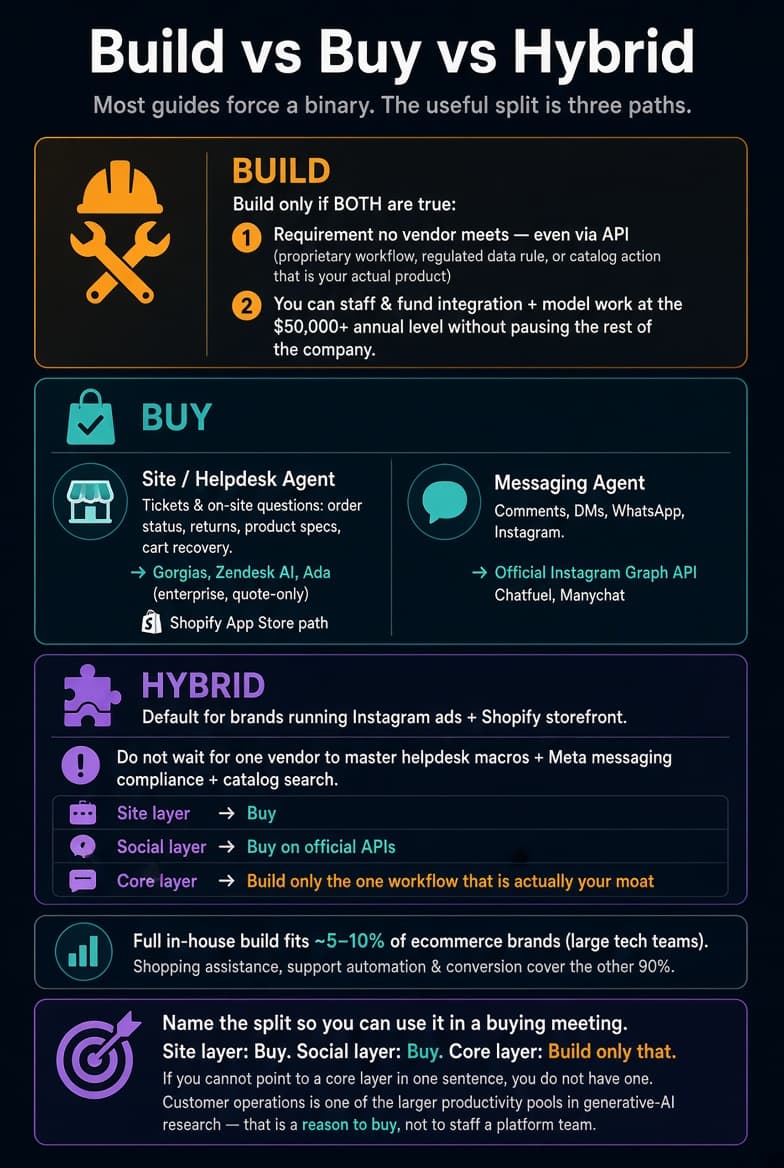
Most guides still force a binary. The useful split is three paths.
Build if both are true:
- You have a requirement no vendor meets even through an API. A proprietary workflow, a regulated data rule, or a catalog action that is your actual product.
- You can staff and fund integration and model work at a meaningful annual level — the $50,000-plus bar that keeps showing up in 2026 guides is directionally right — without pausing the rest of the company.
Buy a site or helpdesk agent if the pain is tickets and on-site questions: order status, returns, product specs, cart recovery on the storefront. Which app fits that job is covered in the Shopify chatbot app comparison. Shopify’s own notes on AI chatbots for stores and AI tools for ecommerce are the platform view. Gorgias on the Shopify App Store and Zendesk AI are the helpdesk end of that buy. Ada is the enterprise end, and it is quote-only.
Buy a messaging agent if a material share of demand arrives as comments, DMs, and WhatsApp. Which tool fits that channel is covered in the website-versus-Instagram ecommerce guide. The official path is the Instagram Graph API. Chatfuel and Manychat sit on that side.
Hybrid if you need both jobs. This is the default for brands that run ads to Instagram and also run a Shopify storefront. Do not wait for one vendor to be excellent at helpdesk macros, Meta messaging compliance, and catalog search.
Published decision matrices put a full in-house build in range for roughly 5 to 10 percent of ecommerce brands, usually those with large tech teams. Shopping assistance, support automation, and conversion cover the other 90 percent.
Name the split so you can use it in a buying meeting. Site layer: widget and helpdesk AI. Buy it. Social layer: Instagram, WhatsApp, Messenger, TikTok comments. Buy it on official APIs. Core layer: the one workflow that is actually your moat. Build only that. Customer operations is one of the larger productivity pools in published generative-AI research. That is a reason to buy. It is not a reason to staff a platform team.
If you cannot point to a core layer in one sentence, you do not have one.
Which path fits your store?
One “build” column does not beat four “buy” columns.
| Factor | Favors build | Favors buy a site agent | Favors buy a messaging agent | Favors hybrid |
| Monthly support tickets | 5,000+ with unique actions | 100–5,000 standard ecommerce tickets | Tickets are not the pain; DMs are | Tickets and DMs both matter |
| Share of conversations on Instagram or WhatsApp | Low | Low | High | Split |
| Timeline | Can wait 3–12 months | Need results this quarter | Need results this week | Messaging this week, site this month |
| Team | Model, data, and a product owner | Ops or support lead | Founder or social manager | Ops and social, no model hire |
| Budget, year one | $100,000+ dedicated | Under $10,000 | Low hundreds to low thousands | Combined subscriptions |
| Data rules | Must stay in your own environment | Standard store plus help center | Official Meta or WhatsApp Cloud API | Mix |
| Unique workflow | Yes, and no API covers it | No | No | One slice is unique |
| Competitive moat | The agent is the product | The agent is an operational tool | The inbox is the storefront | Operational tool plus one custom score |
A practical cutoff used across 2026 guides: under roughly 50 to 100 customer interactions a day, a no-code bought tool is enough. Past that, you still usually buy. You buy a more serious agent and measure containment weekly.
Ticket volume is a decent first filter, not the only one. Under 200 tickets a month, a custom build rarely pays for itself. Between 200 and 500, buy unless queries need live order edits and personalized retrieval. Above 500 with complex actions, start with helpdesk depth and build only if the platform cannot perform the action.
Do not use ticket volume alone if the store is social-first. A brand can have 80 site tickets and 2,000 Instagram comment threads. Site-only math will tell that brand to buy a widget and ignore the channel that already converts.
The true cost of buying
Buy-side failure modes belong in the same article as the $77,000 scare.
Per-resolution sticker shock. If the bot contains 70 percent of 8,000 peak-month conversations at Intercom’s $0.99 outcome price, that line is about $5,500 plus seats. Gorgias can bill the same thread as a ticket and an automated interaction, then $1.50 past the allowance. Zendesk pricing is the same shape: a seat plus an AI resolution meter, commonly cited around $1.50 committed and $2 pay-as-you-go. That can still beat a human queue. It is not the number on the homepage.
Seat and add-on walls. Tidio’s $24.17 Starter tile does not include a monthly Lyro refill. Add Lyro at $32.50 and the small-store AI stack is already near $57 before Flows. A tool that looks cheap at two agents becomes the expensive line at six.
Catalog freshness. An agent that crawled the store in April will lie in October. Ask how often products, inventory, and policy pages re-index. Daily is table stakes. Near-real-time inventory is the difference between a sales agent and a refund generator.
Channel claims. “We support Instagram” can mean a notification in a shared inbox, not comment-to-DM inside the 24-hour window. If social is a real channel, watch a demo on a live comment, not a website widget.
Vendor learning versus your data. Platforms improve across thousands of stores. That is the argument for buying. It is also why your size chart and restock logic will not match a custom system unless you invest in examples and evaluation. Buying removes infrastructure work. It does not remove product work.
Lock-in. You may not own the prompts, the evaluation set, or a usable transcript export. Budget a quarterly export and a written escalation playbook so you can leave.
Compliance on social. A custom Instagram bot on unofficial methods looks cheap until the account is restricted. Official Graph API access, the WhatsApp Business platform, and the 24-hour customer-care window are cost lines. “We have a developer” is not a complete build case for social.
When building actually makes sense
Build is rare. It is not stupid.
Valid cases in 2026:
- The chatbot is the product. You sell the agent, not the candles.
- You cannot put transcripts or catalog embeddings on a third-party vendor for a reason a data-processing agreement does not solve.
- You need real-time write actions against internal systems no platform will certify.
- Volume is high enough that vendor resolution fees exceed a dedicated team, and you already have that team.
- You are building a proprietary ranking model on years of exclusive purchase data, and that model is a moat.
Invalid cases that still get funded:
- “ChatGPT is only $20.” The model is not the system.
- “We do not want vendor lock-in.” You will lock into your own on-call rotation.
- “Our brand voice is unique.” That is a system prompt and a style guide, not a six-month platform.
- “We will use n8n and figure it out.” Fine for a prototype. Not a peak-season strategy.
- “The helpdesk is expensive.” Compare it to a fully loaded engineer, not to zero.
If you build, time-box a proof of concept at $8,000 to $25,000 and one workflow. Order status or product questions. One channel. Single-workflow production often lands at $35,000 to $70,000. Multi-workflow runs $70,000 to $150,000 or more. If the proof cannot beat a bought agent on 50 real queries, stop.
How to choose a buying option
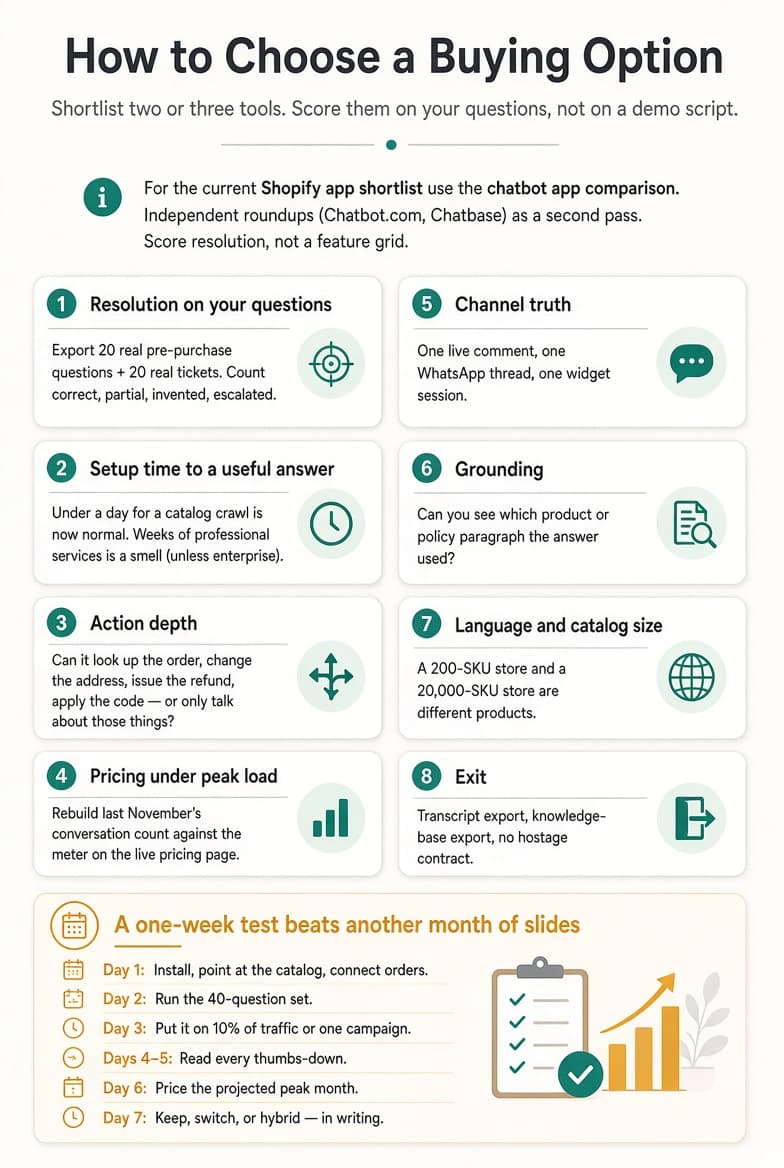
Shortlist two or three tools. Score them on your questions, not on a demo script. For the current Shopify app shortlist, use the chatbot app comparison. For the channel split, use the ecommerce comparison. Independent roundups such as Chatbot.com’s ecommerce chatbot list and Chatbase’s Shopify chatbot notes are useful as a second pass. Zipchat’s Shopify app is the install path if the site layer is the one you are testing. Score resolution, not a feature grid.
- Resolution on your questions. Export 20 real pre-purchase questions and 20 real tickets. Count correct, partial, invented, and escalated.
- Setup time to a useful answer. Under a day for a catalog crawl is now normal. Weeks of professional services is a smell unless you are enterprise.
- Action depth. Can it look up the order, change the address, issue the refund, apply the code — or only talk about those things?
- Pricing under peak load. Rebuild last November’s conversation count against the meter on the live pricing page.
- Channel truth. One live comment, one WhatsApp thread, one widget session.
- Grounding. Can you see which product or policy paragraph the answer used?
- Language and catalog size. A 200-SKU store and a 20,000-SKU store are different products.
- Exit. Transcript export, knowledge-base export, no hostage contract.
A one-week test beats another month of slides. Day 1: install, point at the catalog, connect orders. Day 2: run the 40-question set. Day 3: put it on 10 percent of traffic or one campaign. Days 4 and 5: read every thumbs-down. Day 6: price the projected peak month. Day 7: keep, switch, or hybrid, in writing.
A 90-day playbook
Days 1–14. Tag last month’s conversations: site chat, email, Instagram comment, Instagram DM, WhatsApp, marketplace. If you cannot tag them, you are not ready to build. You are ready to instrument.
Days 15–30. Buy the painful layer first. If order-status tickets are drowning the team, buy helpdesk AI. If comments are the storefront, buy messaging. Do not start with the layer that looks modern in a deck.
Days 31–45. Add the second layer only if the first is stable. Hybrid fails when both tools go live on the same Monday and nobody owns evaluation.
Days 46–60. Build a golden question set. Fifty real questions, expected answers, required citations, required actions. This set is more valuable than the vendor. Take it with you if you switch.
Days 61–75. Clean titles, attributes, size charts, and policy pages. Agents fail on missing data more often than on missing models.
Days 76–90. Only now, if a workflow is still impossible, scope a single build. One workflow. One owner. A kill date.
Ship a bought layer while you learn. Do not disappear into retrieval architecture for a question a platform already answers.
Key takeaways
- Buying an AI chatbot for ecommerce is cheaper and faster than building for the large majority of Shopify and WooCommerce stores in 2026.
- Year-one custom builds are commonly estimated at $77,000 to $168,000 and three to six months. Bought tools start in the tens of dollars a month and get expensive on usage.
- As of October 3, 2026, Zipchat Starter is $64 a month annually, Intercom Fin is $0.99 per outcome, Gorgias AI Agent is about $0.90 to $1.50 per automated interaction on top of tickets, and Tidio Lyro starts near $32.50 to $39 for 50 conversations.
- Buy the site layer and the messaging layer. Build only a proven core.
- Model the peak month, not the homepage price.
- Rule-based flows still route. They should not be the brain.
- Test 40 real questions on your catalog before you sign an annual contract.
Conclusion
The build-versus-buy question is settled for most stores: buy the commodity layers. The unsettled question is which layer you buy first.
If the pain is tickets, buy helpdesk AI. If the pain is on-site discovery, buy a catalog agent. If the pain is comments that never become conversations, buy a messaging tool on official APIs. If the pain is a workflow no product supports, build that slice only.
Do not spend a quarter reconstructing retrieval, guardrails, and messaging compliance so you can answer “where is my order?” A platform already does that. Spend the quarter on a cleaner catalog, a golden question set, and a channel mix you can measure.
Shortlist two tools. Run forty real questions. Price the peak month on the live pricing page. Go live on one layer in a week, not six.
About the author
Aravindh Kumar is an ecommerce and Instagram growth expert with 8+ years of experience in online selling. He has worked with 500+ brands - including Forbes-listed companies - He has helped 200+ Instagram businesses grow their online presence.