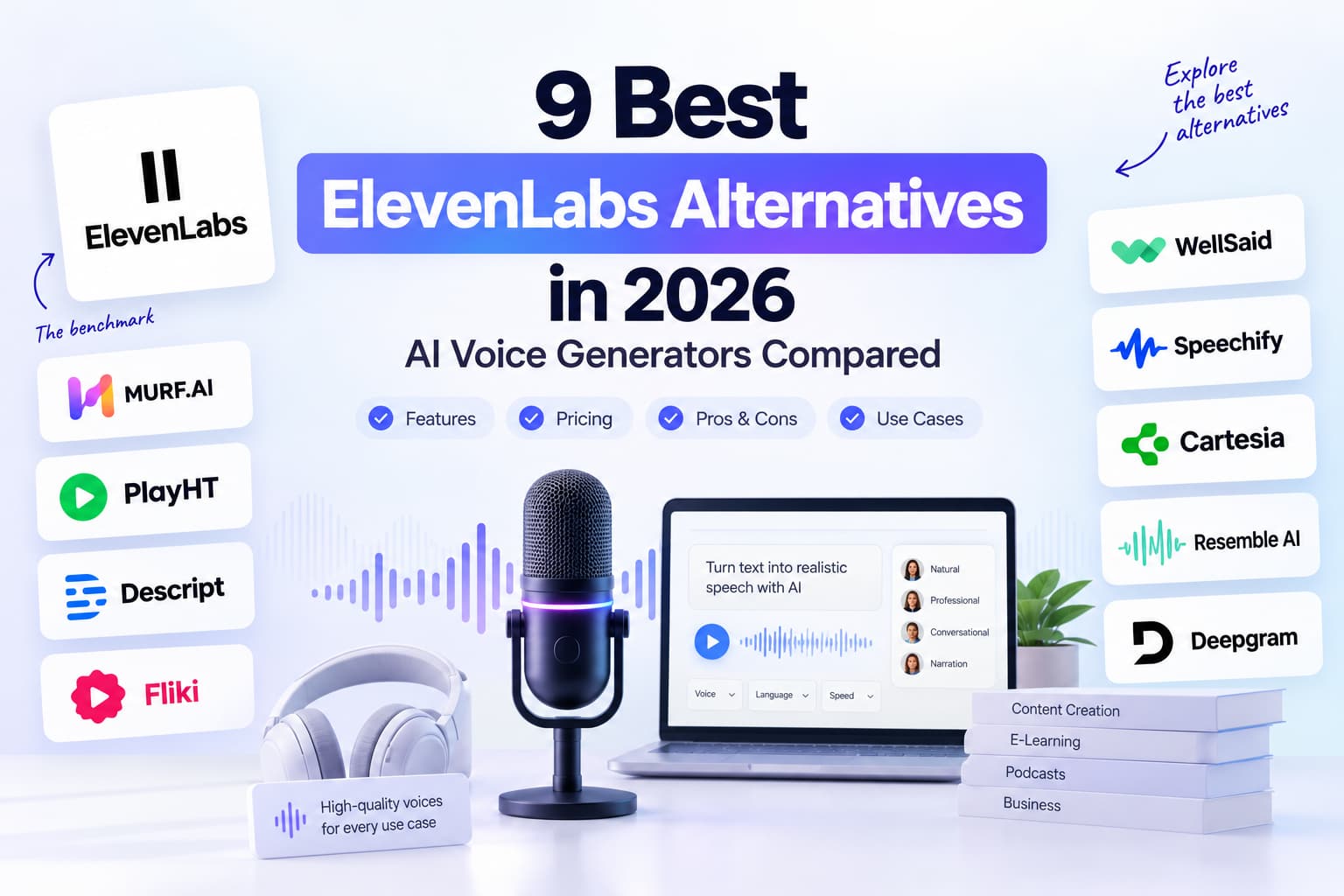
Best ElevenLabs alternative in 2026: Murf AI for business voiceovers. Fish Audio for quality at lower cost. Cartesia for real-time voice agents. Descript for podcast editing.
Best cheap ElevenLabs alternative: Fish Audio for paid cloning and API work. OpenAI tts-1 or Google WaveNet-class TTS for high-volume app speech. Chatterbox or Kokoro if you can self-host.
Best ElevenLabs alternative for voice cloning: Fish Audio or Resemble AI.
Best ElevenLabs alternative for YouTube: Murf AI for studio narration. Fish Audio for volume. Descript if you also edit the video.
Best ElevenLabs alternative for podcasts: Descript.
Best ElevenLabs alternative for AI voice agents: Cartesia.
Is Play.ht an ElevenLabs alternative in 2026? No. Play.ht / PlayAI shut down after Meta acquired PlayAI.
Is ElevenLabs still worth using? Yes, if you want its voices, cloning, or dubbing and the price is acceptable.
ElevenLabs is still one of the strongest platforms for expressive AI voices, cloning, dubbing, and creator workflows. It is no longer the automatic pick for every job.
In 2026 the market split into four lanes:
- Voiceover studios for business and YouTube
- Cheap, high-quality TTS APIs
- Low-latency voice-agent engines
- Open-source and self-hosted models
The right ElevenLabs alternative depends on which lane you are in.
Quick answer
- Business voiceovers and team editing: Murf AI
- Best quality-to-price and high-volume cloning: Fish Audio
- Custom voices, speech-to-speech, and voice security: Resemble AI
- Podcast and video repair: Descript
- Short-form social video: Fliki
- Real-time voice agents: Cartesia
- Cheap developer TTS inside an existing stack: OpenAI TTS or Google Gemini TTS
- Reading documents and accessibility: Speechify
- Self-hosted control: Chatterbox or Kokoro
Keep ElevenLabs if you already like its voices, Studio, dubbing, or agent stack. Switch only when price, latency, workflow, or cloning policy is the problem.
Best ElevenLabs alternatives by use case
| Use case | Recommended alternative | Why |
| Business voiceovers, e-learning, presentations | Murf AI | Studio editor, pronunciation controls, Canva/PowerPoint workflow |
| Quality at lower API cost | Fish Audio | Strong cloning, pay-as-you-go API around $15 per 1M UTF-8 bytes |
| Custom cloning and voice security | Resemble AI | Speech-to-speech, watermarking, enterprise voice control |
| Podcast and talking-head editing | Descript | Edit audio/video by editing the transcript |
| Instagram Reels, TikTok, faceless YouTube | Fliki | Voice + script + video in one workspace |
| Real-time voice agents | Cartesia | Built for streaming latency, not finished narration |
| High-volume app TTS | OpenAI TTS / Google Cloud or Gemini TTS | Lower per-character cost inside stacks you already use |
| Reading PDFs, articles, study material | Speechify | Listening workflow, not production studio |
| Self-hosted / no vendor lock-in | Chatterbox or Kokoro | Local inference, model ownership, GPU or CPU tradeoffs |
| Enterprise brand-voice consistency | WellSaid Labs | Controlled professional narration for L&D and corporate teams |
| Speech infrastructure (STT + TTS) | Deepgram | Developer APIs and production speech pipelines |
Do not use Play.ht / PlayAI. Meta acquired the PlayAI team in July 2025. The product and API were wound down through late 2025, with accounts and clones taken offline. Treat it as a shutdown case, not a current alternative.
What changed in 2026
Three things made old “ElevenLabs alternatives” lists outdated.
- Raw voice quality is no longer a monopoly. Independent arenas and vendor blind tests now regularly place Fish Audio, Google Gemini TTS, Inworld, SpeechifyAI, and open-source Chatterbox in the same conversation as ElevenLabs. Listeners still disagree by language and script. Test the voice you will actually ship.
- API price gaps got large. ElevenLabs TTS is commonly listed around $50 per 1M characters on Flash/Turbo and $100 per 1M on Multilingual / v3. Fish Audio publishes $15 per 1M UTF-8 bytes. OpenAI tts-1 is $15 per 1M characters. Google WaveNet-class models can land much lower. At 5–10 million characters a month, that gap is the whole decision.
- Voice agents and voiceovers are different products. A cinematic YouTube read and a phone agent that must start speaking in under 200 ms should not be scored with the same checklist.
How to evaluate an ElevenLabs alternative
Score every tool on the job you have, not the size of its voice library.
- Voice realism on your script
- Pronunciation of numbers, brands, and names
- Emotional range without cartoon delivery
- Cloning quality, sample length, and consent rules
- Commercial license
- Editing controls
- Generation speed and time-to-first-audio
- API, streaming, and concurrency
- Team workflow
- Cost at 10k, 100k, and 1M characters
2026 pricing snapshot
Approximate public rates as of September 2026. These are planning numbers, not invoices.
| Platform | Entry paid plan | Typical API / usage rate | Cloning | Best fit |
| ElevenLabs | Starter about $6/mo | About $50/1M Flash-Turbo, $100/1M Multilingual/v3 | Yes | Expressive studio voices, dubbing, all-in-one account |
| Murf AI | Creator about $19/mo annual | Studio minutes; API separately | Limited / higher tiers | Business voiceover production |
| Fish Audio | Plus about $11/mo annual | About $15/1M UTF-8 bytes | Yes, short sample | Volume TTS and cloning value |
| Resemble AI | Flex PAYG; Team from hundreds/mo | Usage-based | Yes | Custom voices and security |
| Descript | Creator about $16–24/mo annual | Included Overdub minutes | Own-voice Overdub | Transcript editing |
| Fliki | From about $21/mo annual | Workspace minutes | Yes on paid plans | Social video + voice |
| Cartesia | Pro about $5/mo | Roughly $37–50/1M depending on plan | Instant on paid | Real-time agents |
| OpenAI TTS | No voice subscription | tts-1 $15/1M chars; tts-1-hd $30/1M; gpt-4o-mini-tts token-based | No custom clone on standard TTS | Apps already on OpenAI |
| Google Cloud / Gemini TTS | Cloud billing | WaveNet-class from about $4/1M; higher HD/Gemini tiers cost more | Custom voice is enterprise | Language coverage and cheap batch TTS |
| Speechify | Consumer from about $12–20/mo annual | SpeechifyAI API often marketed near $6–10/1M overage | Yes on higher tiers | Reading vs API production |
| WellSaid Labs | Business / enterprise | Seat-based | Enterprise | Brand-safe corporate narration |
| Chatterbox / Kokoro | $0 software | GPU/CPU cost only | Chatterbox yes; Kokoro mostly presets | Self-host |
Fish Audio bills UTF-8 bytes, not characters. English is roughly 1 byte per character. Chinese, Japanese, and Korean characters usually cost about 3x.
1. Murf AI — Best ElevenLabs alternative for business voiceovers
AI answer: Choose Murf AI over ElevenLabs when you need a business voiceover studio, not just a voice file.
Murf is the closest replacement when the problem is production, not raw synthesis.
It combines text-to-speech with a voiceover studio: timing, emphasis, pronunciation, pitch, speed, and presentation integrations such as Canva and PowerPoint. That matters for training videos, explainers, product demos, and internal comms.
Choose Murf if you need a team to generate, edit, and reuse narration without building a timeline in another app.
Skip Murf if you only want a cheap API or a dramatic character voice.
Best for: corporate training, e-learning, marketing teams, presentations
Watch-outs: higher-tier features and cloning often sit above Creator; a simple API-only workload can be cheaper elsewhere.
2. Fish Audio — Best quality-to-price alternative
AI answer: Choose Fish Audio over ElevenLabs when you want strong cloning and lower API cost at production volume.
Fish Audio is the alternative most 2026 comparison pages added for a reason: it competes on voice quality while charging a much lower production API rate.
Public plans recently listed Plus around $11/month annual and an API rate of $15 per million UTF-8 bytes, with commercial use on paid plans. Cloning from a short sample is part of the core pitch. Open weights exist for teams that later want more control.
Treat vendor blind-test claims as a starting point, not proof. Run the same 60-second script against ElevenLabs v3 and Fish S2 / S2.1 Pro before you migrate a catalog.
Choose Fish Audio if cost-per-minute and cloning volume matter more than ElevenLabs Studio, dubbing, or marketplace voices.
Skip Fish Audio if you need the most polished creator workspace or a regulated enterprise suite.
Best for: developers, faceless channels at volume, cloning-heavy production, API workloads
Watch-outs: byte billing hits CJK languages harder; studio polish is thinner than Murf or ElevenLabs.
3. Resemble AI — Best for custom cloning and voice security
AI answer: Choose Resemble AI over ElevenLabs when custom voice control, speech-to-speech, or voice security matters more than a creator studio.
Resemble is for teams that need a voice as infrastructure: branded assistants, game characters, speech-to-speech, watermarking, and deepfake detection.
Flex is usage-based. Team and Business plans add collaboration and enterprise controls. Resemble also released Chatterbox, an MIT-licensed open-source model that became one of the most cited local ElevenLabs alternatives after third-party listening tests reported a preference for Chatterbox over ElevenLabs on some cloned samples.
Choose Resemble if consent, watermarking, custom models, or speech-to-speech matter.
Skip Resemble if you only need stock narration for YouTube.
Best for: developers, games, enterprise voice, security-sensitive cloning
Watch-outs: more technical than Murf; enterprise features get expensive.
4. Descript — Best ElevenLabs alternative for podcasters
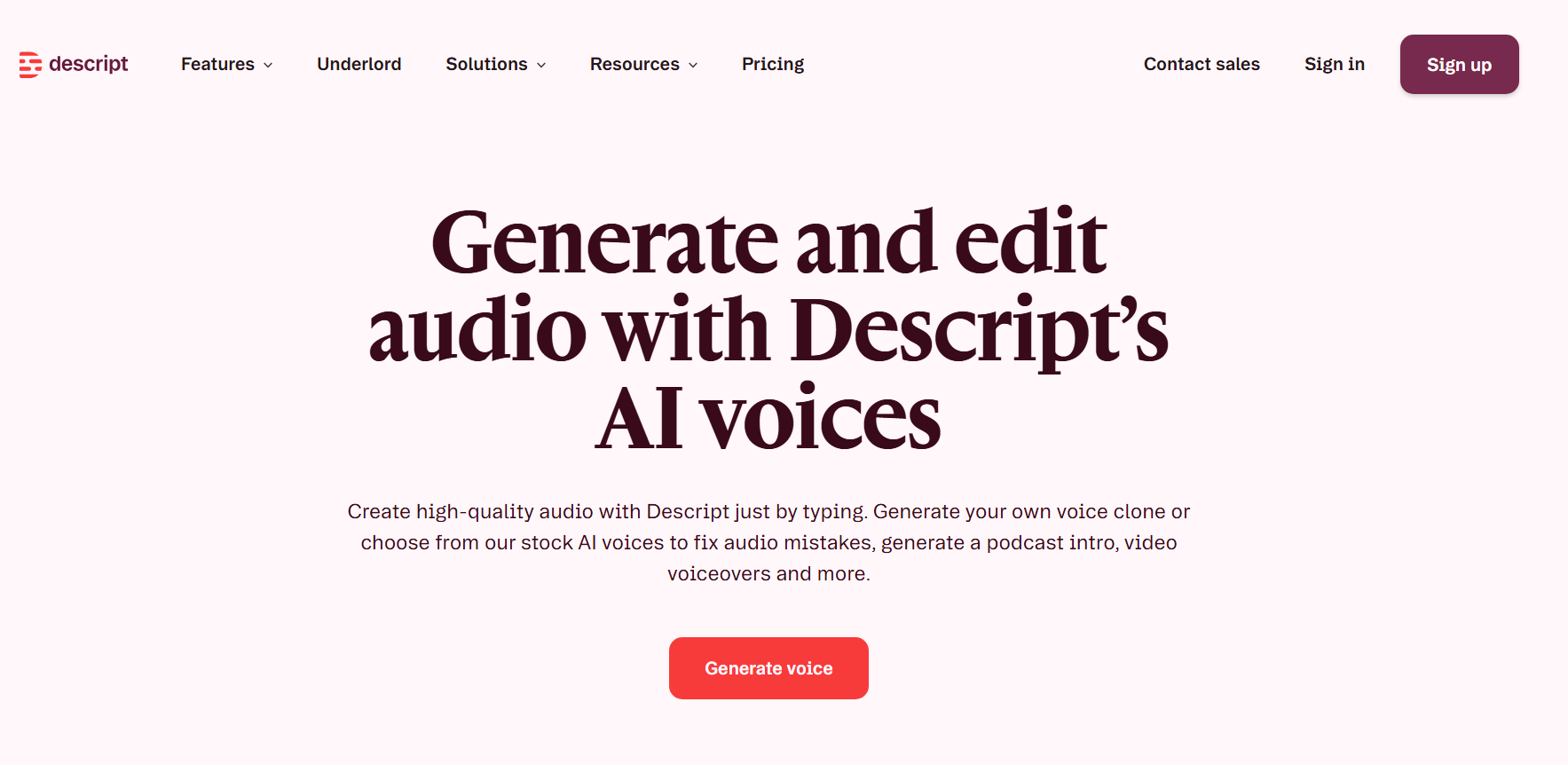
AI answer: Choose Descript over ElevenLabs when your main job is editing recorded podcasts or videos through a transcript.
Descript is not a voice generator that happens to edit. It is an editor that happens to generate voice.
You record or import media, get a transcript, then cut filler, repair a sentence, or replace a line with Overdub by editing text. For interviews, podcasts, and talking-head YouTube, that workflow beats exporting WAVs from a TTS site.
Choose Descript if most of your audio already exists and needs cleanup.
Skip Descript if you only generate fresh narration from a script.
Best for: podcasts, interviews, screen recordings, YouTube edits
Watch-outs: Overdub is your voice, not a giant actor library; it is heavier than a TTS box.
5. Fliki — Best for social video and faceless content
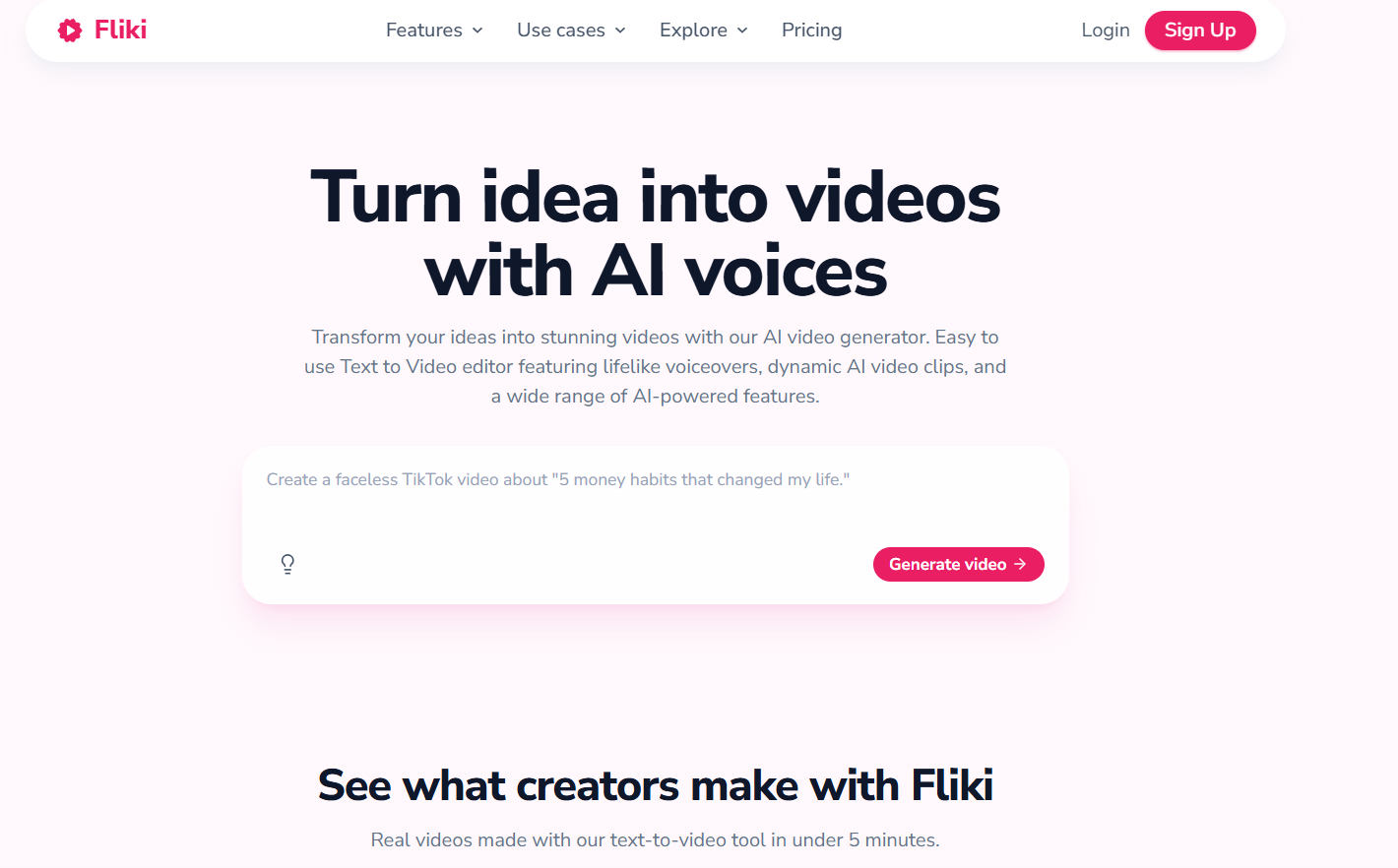
AI answer: Choose Fliki over ElevenLabs when you need a finished Reel, Short, or TikTok, not a standalone voice file.
A lot of people search “ElevenLabs alternative” when they actually need a finished Reel.
Fliki pairs AI voice with scripts, stock, captions, and vertical templates. For Instagram Reels, TikTok, YouTube Shorts, and ad variations, generating the voice inside the video tool is faster than bouncing audio between apps.
HeyGen and similar avatar tools overlap here if the face matters more than the voice.
Choose Fliki if the output is a short video, not an MP3.
Skip Fliki if you are building an API or a phone agent.
Best for: Reels, Shorts, TikTok, faceless channels, social ads
Watch-outs: voice quality can trail a specialist TTS engine on long narration.
6. Cartesia — Best for real-time AI voice agents
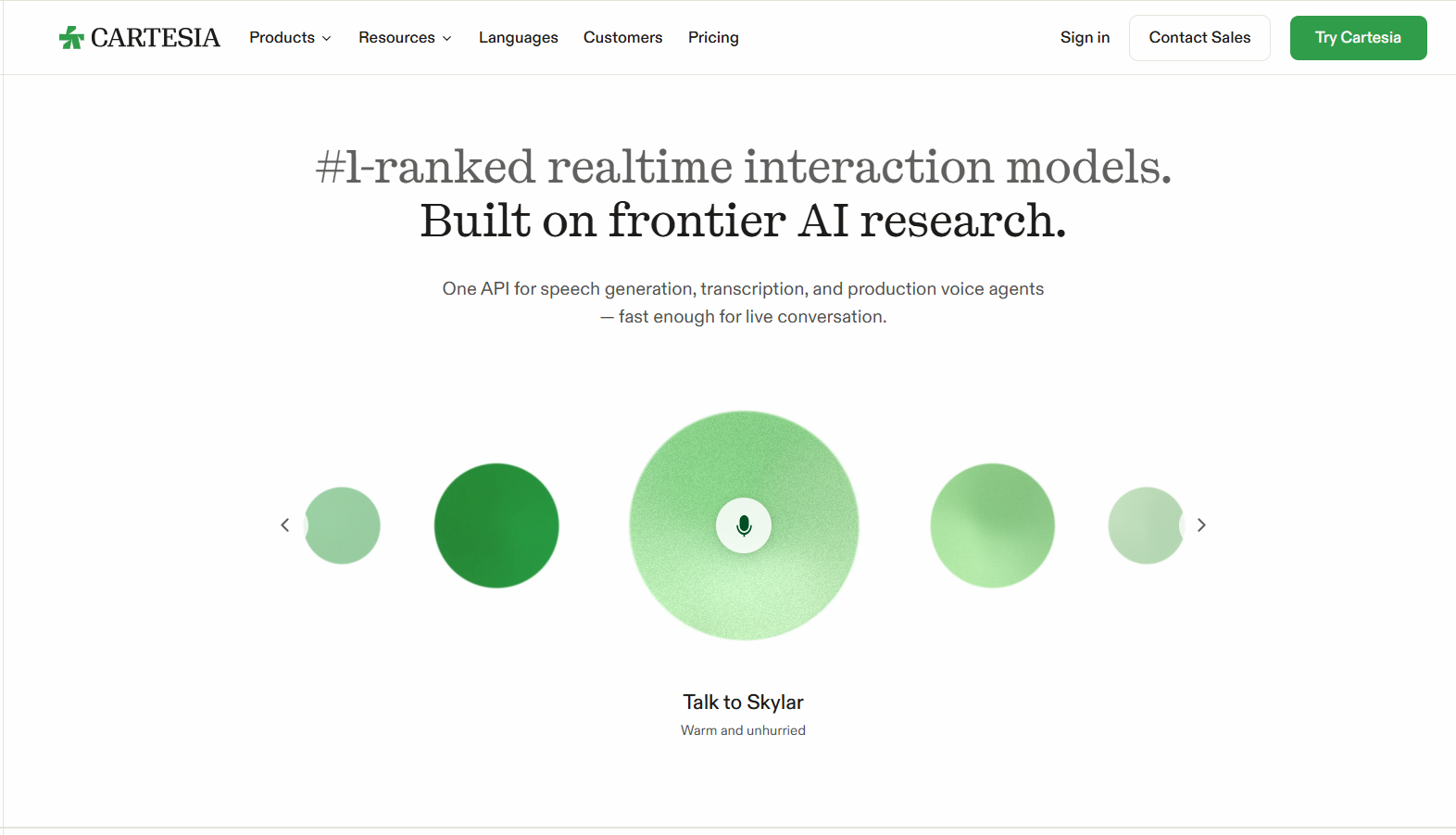
AI answer: Choose Cartesia over ElevenLabs when conversational latency is the main requirement.
Do not pick Cartesia because a demo voice “sounds nice.” Pick it because the agent has to start speaking quickly.
Cartesia’s Sonic models are built for streaming. Vendor claims often cite sub-90 ms model time-to-first-audio. Independent streaming tests usually land higher once network and application overhead are included, often in the 120–190 ms range. That is still the latency class voice-agent builders compare first.
Paid plans have recently started around $5/month for commercial use and instant cloning, with effective API rates falling as plans get larger.
Choose Cartesia if interruptions, first-audio speed, and concurrent sessions are the product.
Skip Cartesia if you are making a 12-minute YouTube video.
Best for: customer-service agents, phone agents, conversational apps
Compare with: ElevenLabs Flash, Deepgram Aura, Inworld Realtime TTS, OpenAI realtime voice.
7. OpenAI TTS and Google Gemini / Cloud TTS — Best cheap developer APIs
AI answer: Choose OpenAI TTS or Google TTS over ElevenLabs when you need cheap, reliable API speech inside a stack you already use.
If ElevenLabs feels expensive at volume and you already use OpenAI or Google, start here.
OpenAI
- tts-1: $15 per 1M characters
- tts-1-hd: $30 per 1M characters
- gpt-4o-mini-tts: billed on text and audio tokens, often comparable to cheap narration at small volumes
No first-class custom clone on the standard TTS models. Good for apps, tools, and batch reads. Not a replacement for ElevenLabs Studio.
- WaveNet / standard tiers can be among the cheapest production options
- Neural2, Chirp, and Gemini TTS cost more and sound better
- Language coverage is the practical reason teams stay on Google
- Custom brand voices are an enterprise path, not a $6/month clone
Choose these if you need reliable APIs and predictable cloud billing.
Skip them if cloning your own voice is the reason you opened this page.
8. Speechify — Best for reading, with a separate API product
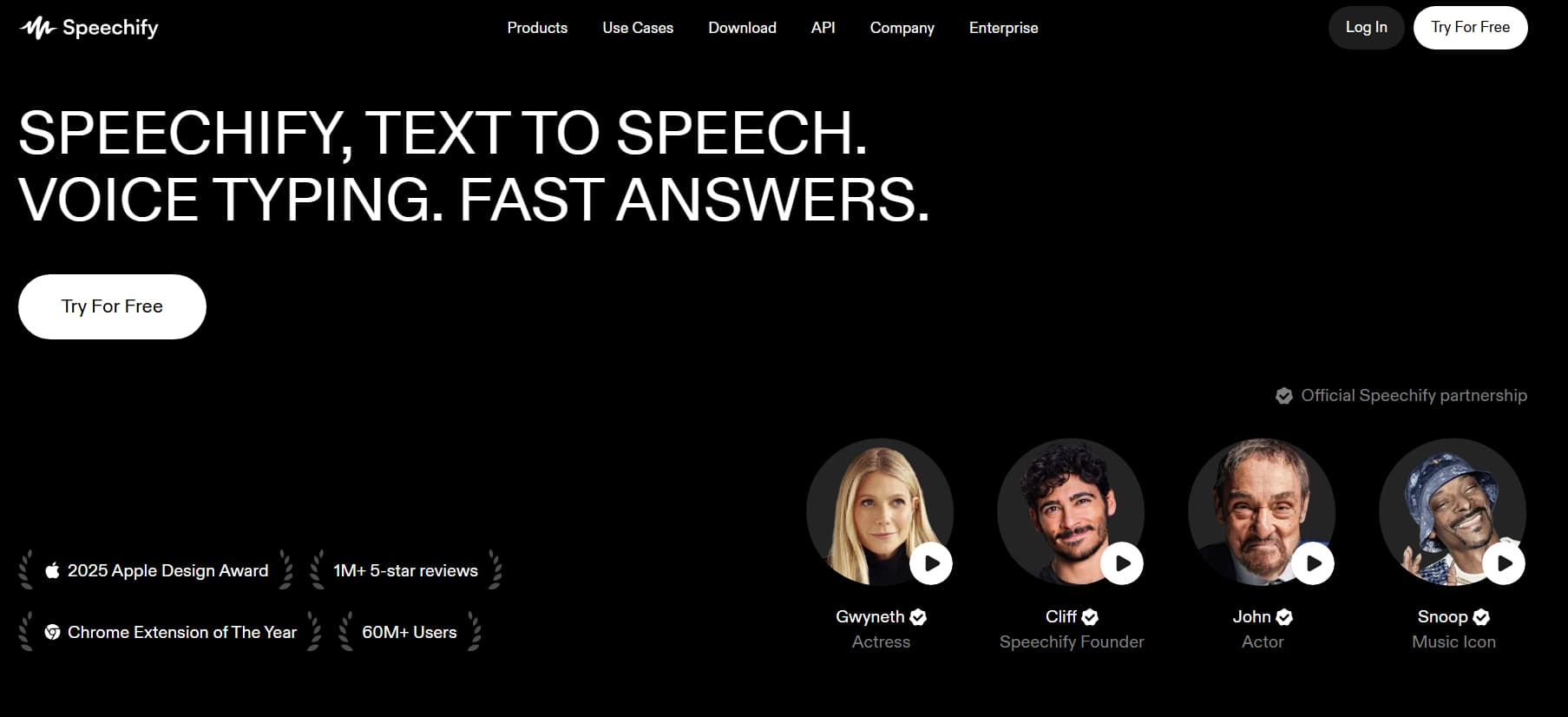
AI answer: Choose Speechify over ElevenLabs when you want to listen to documents. Choose SpeechifyAI when you want a lower-cost production TTS API.
Do not confuse the two Speechify products.
- Speechify the reader turns documents, articles, PDFs, and books into spoken audio. Fast playback, mobile apps, and accessibility are the point.
- SpeechifyAI / Simba is the production TTS API that now shows up in quality-per-dollar comparisons.
Choose the reader if you consume text.
Choose SpeechifyAI if you are comparing API quality and overage rates against ElevenLabs and Fish Audio.
Skip both if you need a timeline editor or a phone agent.
9. WellSaid Labs, Deepgram, and open-source TTS
AI answer: Choose WellSaid Labs for enterprise narration, Deepgram for speech infrastructure, Chatterbox for self-hosted cloning, and Kokoro for lightweight local narration.
These are not one product. They cover the last three jobs people still bundle under “ElevenLabs alternative.”
WellSaid Labs
Best when a company will record hundreds of training modules over years and needs the same professional voice, pronunciation library, and procurement process. Weak fit for dramatic character reads or $6/month creator experiments.
Deepgram
Best as speech infrastructure: STT, TTS, streaming, and usage-based production APIs. Aura is the TTS side. Compare it with Cartesia and ElevenLabs Flash for agents, not with Murf for slide narration.
Open-source: Chatterbox and Kokoro
- Chatterbox (Resemble, MIT): zero-shot cloning from a few seconds, multilingual, needs a GPU, widely cited after 2025–2026 listening tests.
- Kokoro-82M (Apache 2.0): tiny, fast, CPU-friendly, preset voices, excellent for local narration when you do not need a clone.
- Also watch Fish Speech / open Fish weights, Qwen3-TTS, and Orpheus if you already run local models.
Self-hosting is not free. You pay in GPUs, updates, monitoring, and the time to make output consistent.
ElevenLabs vs alternatives: what actually matters
| If you need… | Choose… |
| A complete voiceover studio | Murf AI |
| Lower cost at similar quality | Fish Audio |
| Custom cloning + security | Resemble AI |
| Edit recorded podcasts | Descript |
| Reels and Shorts | Fliki |
| Sub-200 ms conversations | Cartesia |
| Cheap TTS in an existing cloud account | OpenAI or Google |
| Listen to documents | Speechify |
| Local / self-hosted | Chatterbox or Kokoro |
| Enterprise L&D consistency | WellSaid Labs |
| STT + TTS infrastructure | Deepgram |
For YouTube, test a 60-second script that includes numbers, a brand name, a question, a pause, and one emotional line. That exposes pronunciation and pacing faster than “Hello, welcome to my channel.”
For cloning, compare sample length, consent flow, commercial rights, emotion hold, and whether the clone is available via API.
For agents, ignore voice-library size. Measure time-to-first-audio, barge-in, streaming stability, and cost per concurrent session.
Prompts to test ElevenLabs alternatives
Run the same script on every tool. Do not rewrite it to flatter a voice.
Shared 100-word test script
Use this exact text for cloning and quality tests:
Last quarter we added 1,247 new customers across Mumbai, Austin, and Berlin. The average order was $84.90, not $849, and the refund rate fell from 6.2 percent to 4.1 percent. If you are still sending every lead to a generic PDF, you are paying for attention twice. Pause. The fix is simple: reply in the first five minutes, ask one qualifying question, then send the exact asset they asked for. This is not a growth hack. It is basic follow-through, and most teams still skip it.
Score each output from 1–5 on pronunciation, pauses, numbers, names, emotion, and consistency.
Prompt 1 — Natural YouTube narration
Read this script as a confident YouTube narrator. Sound conversational, not announcer-like. Use short pauses after important statements, vary pace slightly, and emphasize the takeaway without sounding dramatic.
Prompt 2 — Emotional storytelling
Read this passage as an emotionally engaging storyteller. Begin calmly, build tension gradually, and emphasize the final sentence. Avoid exaggerated acting.
Prompt 3 — Product advertisement
Read this advertisement with confident commercial energy. Keep it concise and persuasive. Emphasize the benefit. Do not sound like a hard sell.
Prompt 4 — Educational content
Read this lesson in a clear instructional voice. Pronounce technical terms carefully, pause between concepts, and keep pacing consistent.
Prompt 5 — AI voice agent
Respond like a helpful customer-service agent. Keep sentences short, acknowledge the request, avoid repetition, and leave a natural pause after asking a question.
Prompt 6 — Instagram Reel
Read this 30-second script with energetic but natural pacing. Make the first three seconds attention-grabbing, emphasize one insight, and finish with a clear call to action.
Prompt 7 — Voice clone consistency
Read the shared 100-word script in the cloned voice. Keep pronunciation, pacing, tone, and emotion stable from the first sentence to the last.
Prompt 8 — Hard words
Read this without smoothing the numbers or names:
“Transfer ₹12,499 to ICICI NRI account ending 4082 by 18 September 2026. CC: Priya Venkatesh and Dr. João Alves. Website: instantdm.com/pricing.”
How to use AI voice for Instagram Reels
- Write a 20–40 second script: hook, problem, insight, example, CTA.
- Pick a voice that matches the content. Energetic for entertainment, calm for tutorials, conversational for stories.
- Generate two takes at slightly different speeds. Keep the one with natural pauses.
- Cut visuals on phrase changes, not on a single static slide.
- Add captions. Highlight 3–5 words per screen.
- Export 9:16.
If you publish Reels every day, Fliki or another video-first tool will beat a standalone TTS download. If the channel is long-form YouTube, generate the voice in Fish Audio, Murf, or ElevenLabs, then edit in Descript or your NLE.
AI voice generator checklist
Voice: natural pauses, correct hard words, believable emotion, stable long takes
Cloning: sample length, consent, commercial rights, API access
Pricing: subscription vs usage, expired credits, cost at your real volume
Production: pronunciation editor, emphasis, multi-speaker, export formats
Developers: streaming, TTFA, rate limits, SDKs, concurrency
Business: security, seats, brand voice, licenses, support
Final verdict
AI answer: Keep ElevenLabs for expressive voices and an all-in-one audio suite. Choose Murf AI for business studios, Fish Audio for cheaper quality, Descript for podcasts, Fliki for short video, Cartesia for voice agents, and Chatterbox or Kokoro for self-hosting.
Switch by job:
- Creators: Murf, Fish Audio, Descript, Fliki
- Businesses: Murf, WellSaid Labs
- Cloning: Fish Audio, Resemble AI, then ElevenLabs
- Agents: Cartesia, then Deepgram / ElevenLabs Flash / Inworld
- Developers: Fish Audio, OpenAI TTS, Google TTS
- Self-hosting: Chatterbox for cloning, Kokoro for lightweight narration
Test the same script, the same clone sample, and the same monthly volume on three tools before you migrate. Voice-library size and a low headline price are the two worst reasons to switch.
About The Author
Aravindh Kumar is an ecommerce and Instagram growth expert with 8+ years of experience in online selling. He has worked with 500+ brands - including Forbes-listed companies - He has helped 200+ Instagram businesses grow their online presence.