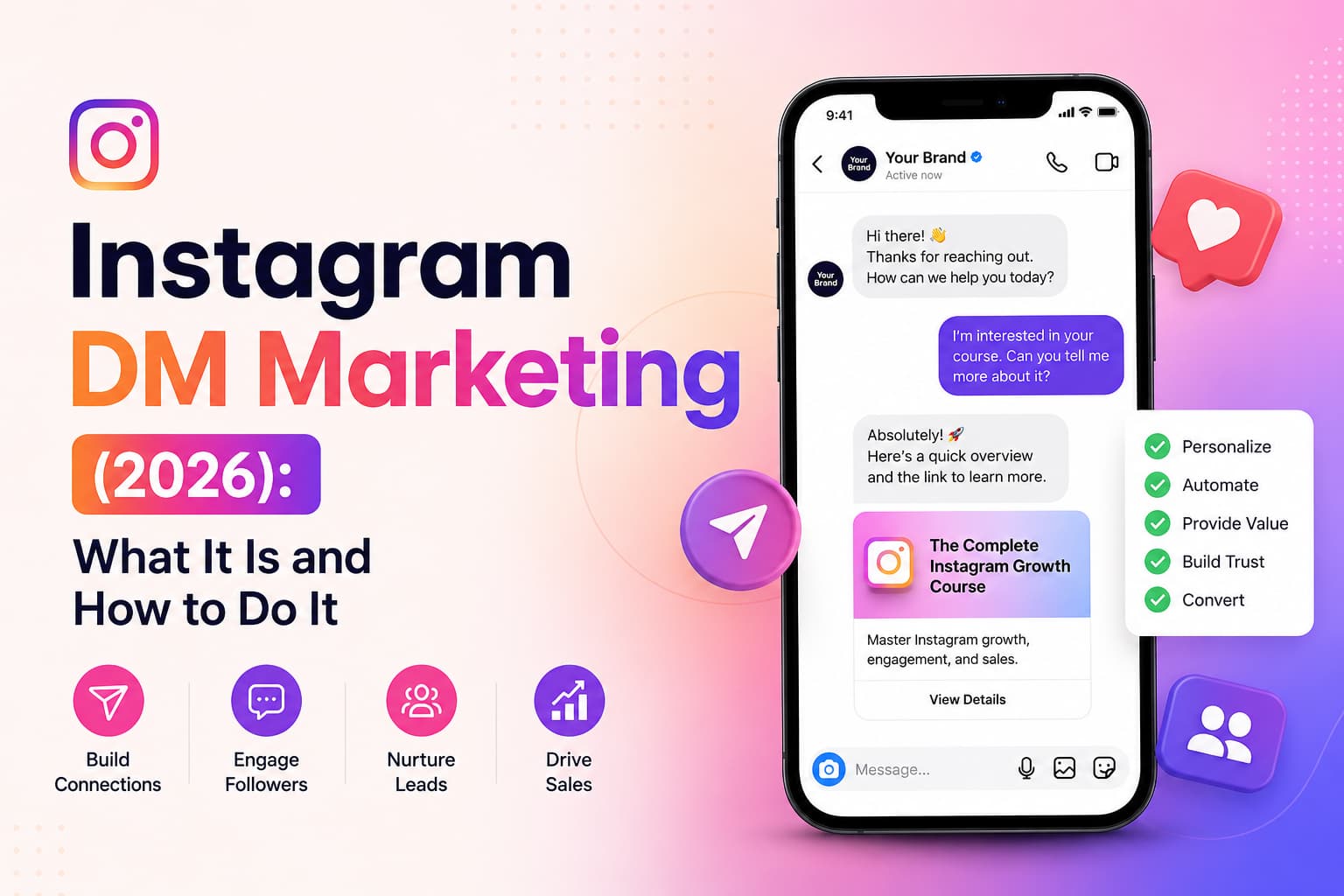
TL;DR
Instagram DM marketing is the practice of treating direct messages as a real sales channel — not a support inbox you check when you remember. In 2026, DMs open at 80–90%, convert at 7–20% on warm intent, and beat email, feed posts, and link-in-bio on almost every commercial metric that matters.
The system has four jobs: capture engagement (comment, story reply, keyword, ad tap, live comment), qualify the person in chat, own the contact (email/phone/tag), and close with a follow-up sequence. Automation runs the first reply in under a second. A human or an AI agent handles the conversation that actually sells.
This playbook covers the full loop — including viral-month cost, Meta rate limits, click-to-message ads, Live keywords, collab posts, follower-gating, India/Bharat pricing, and AI agents versus flow trees — then shows you how to launch the first funnel in an afternoon.
If you only do one thing after reading: put a keyword CTA on your next Reel (“Comment GUIDE”), send the resource in DM within seconds via the official Instagram API, ask one qualifying question, and capture an email before you send the final link. That single loop is how accounts with 8K followers outsell accounts with 200K.
What Instagram DM marketing actually is
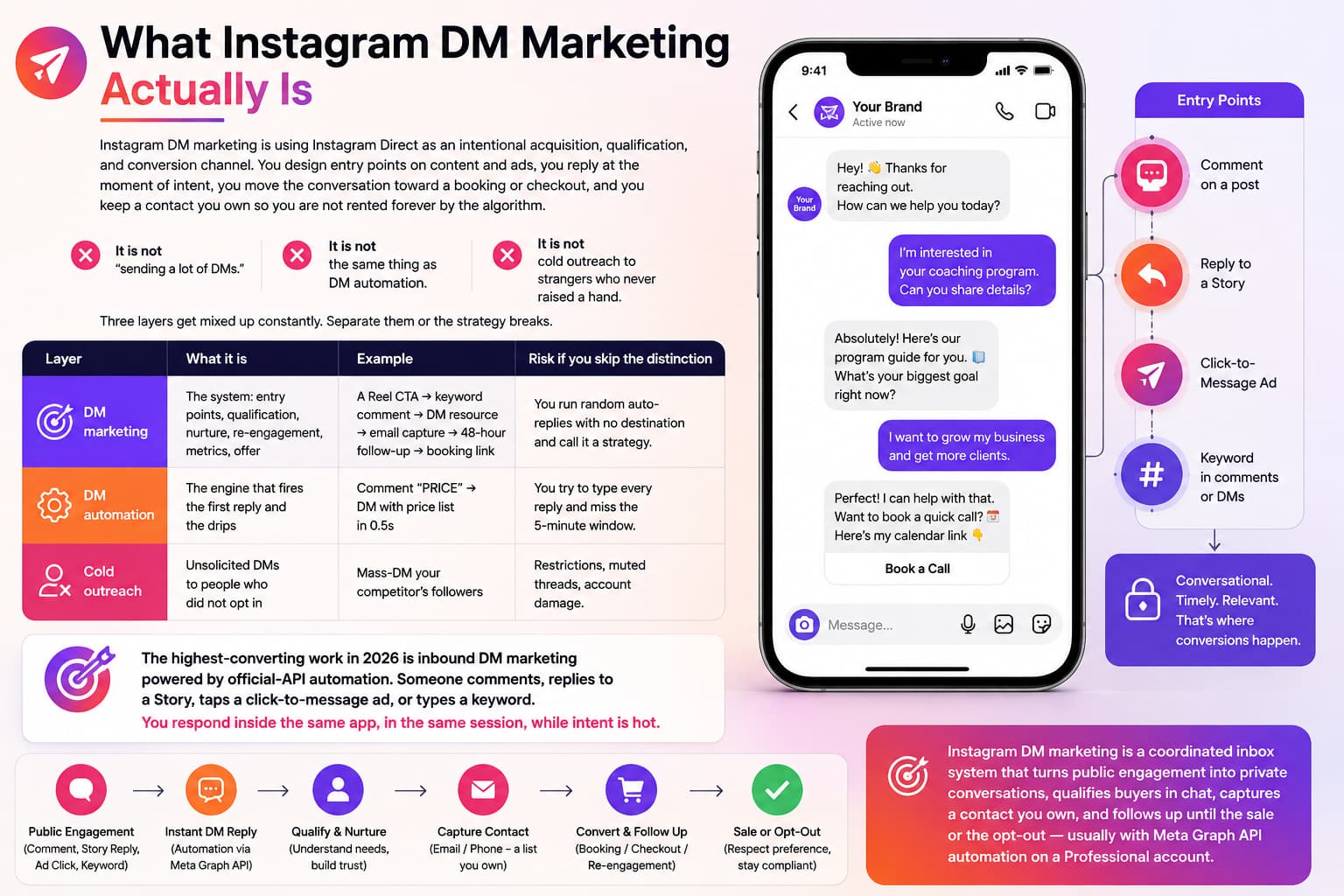
Instagram DM marketing is using Instagram Direct as an intentional acquisition, qualification, and conversion channel. You design entry points on content and ads, you reply at the moment of intent, you move the conversation toward a booking or checkout, and you keep a contact you own so you are not rented forever by the algorithm.
It is not “sending a lot of DMs.”
It is not the same thing as DM automation.
It is not cold outreach to strangers who never raised a hand.
Three layers get mixed up constantly. Separate them or the strategy breaks.
| Layer | What it is | Example | Risk if you skip the distinction |
| DM marketing | The system: entry points, qualification, nurture, re-engagement, metrics, offer | A Reel CTA - keyword comment - DM resource - email capture - 48-hour follow-up - booking link | You run random auto-replies with no destination and call it a strategy |
| DM automation | The engine that fires the first reply and the drips | Comment “PRICE” - DM with price list in 0.5s | You try to type every reply and miss the 5-minute window |
| Cold outreach | Unsolicited DMs to people who did not opt in | Mass-DM your competitor’s followers | Restrictions, muted threads, account damage |
The highest-converting work in 2026 is inbound DM marketing powered by official-API automation. Someone comments, replies to a Story, taps a click-to-message ad, or types a keyword. You respond inside the same app, in the same session, while intent is still hot.
That is the whole game.
Instagram DM marketing is a coordinated inbox system that turns public engagement into private conversations, qualifies buyers in chat, captures a contact you own, and follows up until the sale or the opt-out — usually with Meta Graph API automation on a Professional account.
Why DMs became the conversion layer in 2026
Public Instagram is a reach engine. Private Instagram is a sales engine. Treating them as the same channel is why so many accounts have “good engagement” and a quiet Stripe dashboard.
Four structural reasons this flipped.
1. Open rates are not comparable to email.
Well-timed Instagram DMs open in the 80–90% range. Email still sits around 20–30% for most creator lists. A message that is actually seen does not need a clever subject line. It needs a useful first line and a next step.
2. Intent is already in the room.
A commenter who types “LINK,” “PRICE,” or “GUIDE” is not a cold lead. They performed a public action on your content. DM marketing starts at that signal. Feed posts and link-in-bio ask a stranger to leave the app and hunt. DMs stay inside the session.
3. Speed compounds.
Public research that marketers keep citing (LeadResponse and similar response-time studies) shows replies inside the first minute convert several times better than replies after 30 minutes. MIT / InsideSales-style work on lead response has said for years that contacting a lead within five minutes makes qualification dramatically more likely. On Instagram, five minutes is already late. Sub-second first replies are now table stakes, which is why automation exists.
4. Instagram itself rewards conversation.
Adam Mosseri has said for years that content shared in DMs is one of the strongest ranking signals. Comment-to-DM loops create comments and private shares. Both help distribution. A keyword CTA is not a growth hack bolted onto the algorithm. It is the algorithm’s preferred behavior, productized.
Channel comparison
| Channel | Typical open / notice rate | Typical click or next-step rate | Where conversion happens | Main failure mode |
| Instagram DMs (intent-triggered) | 80–90% | 40–60% click on a well-placed link | Inside the thread or one tap later | No follow-up after message 1 |
| 20–30% | 2–5% | Landing page | List fatigue, spam folder | |
| Feed post / Reel | Algorithm-dependent | Often under 1% of reach to a site | Link in bio | Friction, forgotten CTA |
| Stories (swipe / link sticker) | 5–10% complete the story | 1–3% tap | External page | Link sticker ignored |
| Paid feed ads to a landing page | Impression-based | 0.5–2% CTR common | Landing page | CPC without a conversation |
DMs do not replace content. Content creates the signal. DMs convert the signal.
The SIOS framework: Signal - Inbox - Ownership - Sale
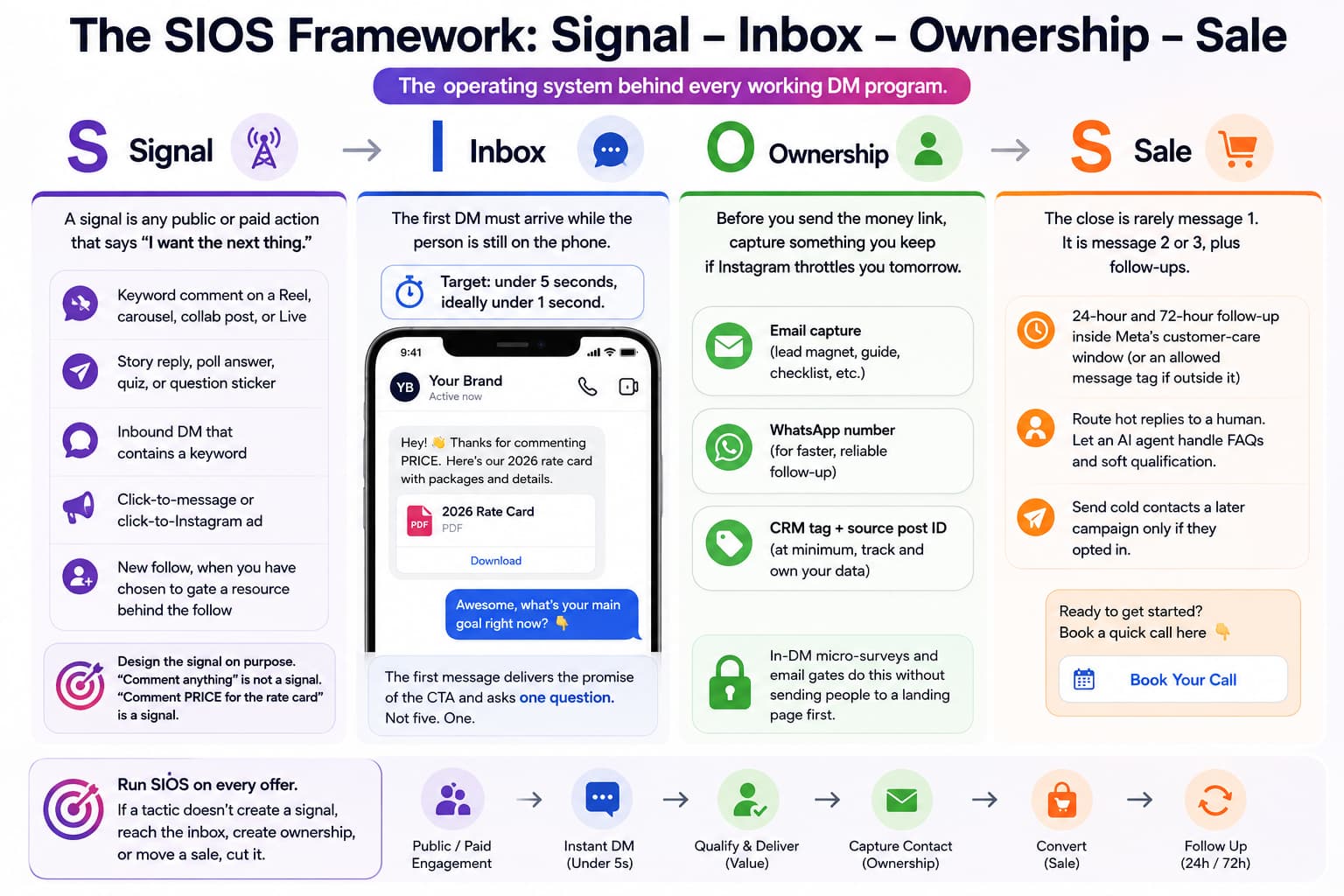
Name it so a team can remember it. SIOS is the operating system behind every working DM program we see.
1. Signal
A signal is any public or paid action that says “I want the next thing.”
- Keyword comment on a Reel, carousel, collab post, or Live
- Story reply, poll answer, quiz, or question sticker
- Inbound DM that contains a keyword
- Click-to-message or click-to-Instagram ad
- New follow, when you have chosen to gate a resource behind the follow
Design the signal on purpose. “Comment anything” is not a signal. “Comment PRICE for the rate card” is a signal.
2. Inbox
The first DM must arrive while the person is still on the phone. Target: under 5 seconds, ideally under 1 second. The first message delivers the promise of the CTA — the guide, the price band, the checklist, the booking context — and asks one question. Not five. One.
3. Ownership
Before you send the money link, capture something you keep if Instagram throttles you tomorrow: email, WhatsApp number, or at least a CRM tag plus a source post ID. In-DM micro-surveys and email gates do this without sending people to a landing page first.
4. Sale
The close is rarely message 1. It is message 2 or 3, plus a 24-hour and 72-hour follow-up inside Meta’s customer-care window (or an allowed message tag if you are outside it). Route hot replies to a human. Let an AI agent handle FAQs and soft qualification. Send cold contacts a later campaign only if they opted in.
Run SIOS on every offer. If a tactic does not create a signal, reach the inbox, create ownership, or move a sale, cut it.
DM marketing vs DM automation vs campaigns
Automation is reactive. A person does X, you do Y. Comment keyword - DM. Story reply - DM. Ad tap - welcome flow. Live comment - DM. This is how you never miss the first minute.
Campaigns are proactive. You message a list of people who already raised a hand: people who asked about a product, downloaded a guide last month, booked once, or abandoned a checkout. You do not blast your entire follower list. That is how accounts get muted.
The CRM / tagging layer is the memory. Without tags you cannot run a campaign. “Everyone who commented PRICE in July” is a segment. “All followers” is a hope.
You need all three. Automation without campaigns leaves money in threads that went quiet. Campaigns without automation means you will send the first campaign three weeks late. Tags without either is a spreadsheet you never open.
The nine Instagram DM marketing plays that still convert in 2026
Do not run all nine. Pick two inbound plays and one follow-up play. Add paid when organic capture is stable.
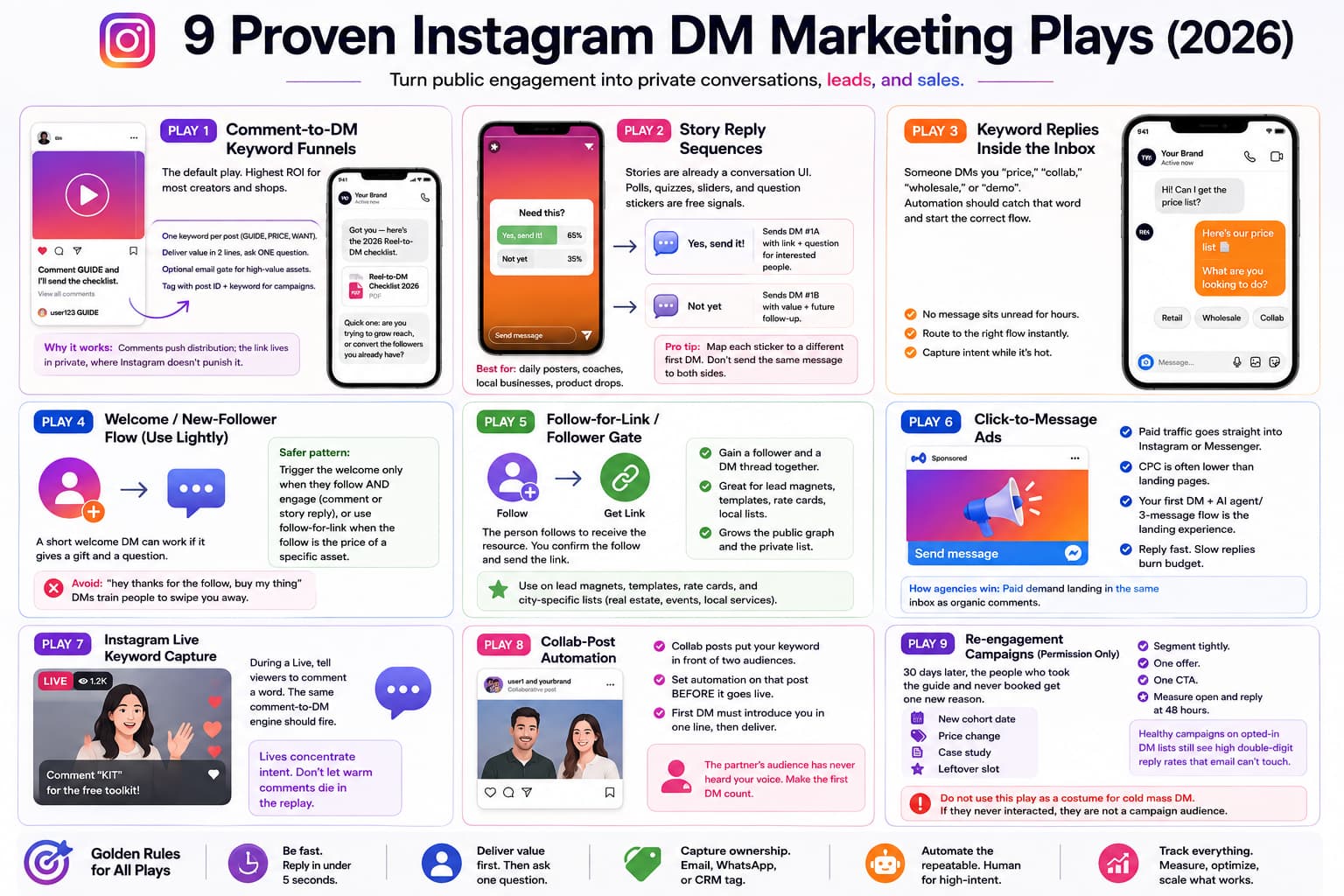
Play 1. Comment-to-DM keyword funnels
The default play. Highest ROI for most creators and shops.
You publish a Reel or carousel. The last line is a CTA: “Comment GUIDE and I’ll send the checklist.” A Meta-compliant tool watches that post (or every new post) and DMs the resource when the keyword appears.
Why it works: comments push distribution; the link lives in private, where Instagram does not punish it the way it punishes links in captions and comments.
How to run it:
- One keyword per post. GUIDE, PRICE, WANT, LIST, DROP. Short, obvious, hard to typo.
- First DM delivers value in two lines, then asks one question.
- Optional email gate before the final link if the asset is high-value.
- Tag the contact with the post ID and the keyword so you can campaign later.
Starter script:
Got you — here’s the 2026 Reel-to-DM checklist.
Quick one: are you trying to grow reach, or convert the followers you already have?
That question is the qualification fork. Growth answer - nurture sequence. Convert answer - offer or booking link.
Play 2. Story reply sequences
Stories are already a conversation UI. Polls, quizzes, sliders, and question stickers are free signals.
Map each sticker to a different first DM. A “Need this / Not yet” poll should not send the same paragraph to both sides.
Best for: daily posters, coaches, local businesses, product drops.
Play 3. Keyword replies inside the inbox
Someone DMs you “price,” “collab,” “wholesale,” or “demo” with no comment involved. The same automation should catch that word and start the correct flow so those messages do not sit in Requests for six hours.
Play 4. Welcome / new-follower flow (use lightly)
A short welcome DM can work if it gives a gift and a question. A “hey thanks for the follow, buy my thing” DM is how you train people to swipe you away.
Safer pattern: trigger the welcome only when they follow and engage (comment or story reply), or use follow-for-link when the follow is the price of a specific asset.
Play 5. Follow-for-link / follower gate
The person follows to receive the resource. You confirm the follow and send the link. You gain a follower and a DM thread in one motion. This is one of the few plays that grows the public graph and the private list together.
Use it on lead magnets, templates, rate cards, and city-specific lists (real estate, events, local services).
Play 6. Click-to-message ads
Meta lets you send paid traffic straight into Instagram or Messenger conversations. CPC is often lower than traffic to a landing page because the destination is a chat, not a form.
The landing experience is your first DM plus an AI agent or a tight three-message flow. If you pay for the click and then reply in 40 minutes, you lit the budget on fire.
This is also how agencies justify retainers: paid demand landing in the same inbox as organic comments.
Play 7. Instagram Live keyword capture
During a Live, tell viewers to comment a word. The same comment-to-DM engine should fire. Lives concentrate intent. Letting those comments die in the replay is leaving a warm room empty.
Play 8. Collab-post automation
A collab post puts your keyword in front of two audiences. Set the automation on that post before it goes live. The partner’s audience has never heard your voice, so the first DM must introduce you in one line, then deliver.
Play 9. Re-engagement campaigns (permission only)
Thirty days later, the people who took the guide and never booked get one new reason: a new cohort date, a price change, a case study, a leftover slot. Segment tightly. One offer. One CTA. Measure open and reply at 48 hours. Healthy campaigns on opted-in DM lists still see high double-digit reply rates that email cannot touch.
Do not use this play as a costume for cold mass DM. If they never interacted, they are not a campaign audience.
Scripts that sound like a person
Frameworks do not convert. Lines do. Keep each message under 250 characters when you can. One idea per bubble. Ask a question that can be answered in four words.
Resource delivery (comment-to-DM)
Here’s the checklist I mentioned — saved it as a one-pager so you can use it tonight.
Are you running this on a personal brand or a shop account?
Price request
Honest range: the audit is ₹4,999 / $59 if you just want the recording, ₹14,999 / $179 if you want the 45-min live teardown.
Which side are you closer to?
Localize the currency. A US-only price in a Bharat comment thread feels like you are not paying attention.
Story reply (they answered “struggling with sales”)
Same. Reach is cheap this year, trust is not.
Want the 3-DM sequence we use after a Reel pops, or the version for quiet weeks?
Click-to-message ad opener
You tapped through on the “book a walkthrough” ad — I’ll keep this short.
Are you looking for this week or just mapping options?
Soft close after they go quiet (24 hours)
Circling back in case this got buried. I can send the short version (2 steps) or we can book 15 minutes. Which is easier right now?
Re-engagement (opted-in, 30 days later)
You grabbed the Reel checklist last month. We added a “quiet week” variant that doesn’t need a viral post.
Want that one?
Write like you text. If a sentence could appear on a billboard, delete it.
Metrics that matter (ignore vanity)
If you cannot see these numbers, you are decorating, not marketing.
| Metric | What it tells you | Healthy range in 2026 |
| Trigger rate | % of viewers who use the keyword | 3–8% on a clear CTA Reel |
| Time to first DM | Speed from signal to inbox | Under 5 seconds; under 1s is the bar |
| Open rate | Did the DM get seen | 80–90% on intent-triggered DMs |
| Reply-to-click | Of people who continue, how many tap | 40–60% when the link is earned |
| Click-to-conversion | Landing or checkout conversion | 5–15% depending on offer |
| Follow-up lift | Extra conversions from message 2 and 3 | Often +80% vs one-and-done |
| Revenue per DM | The only number finance cares about | Offer-dependent; track it weekly |
| Cost per conversation | Tool bill ÷ conversations started | This is where flat-rate wins |
Vanity metrics to stop reporting as success: raw DMs sent, follower count, “inbox zero.”
Instrument the keyword at the post level. One Reel will outperform ten others. Double down on the CTA style that triggered, not on the tool settings.
What a viral month actually costs
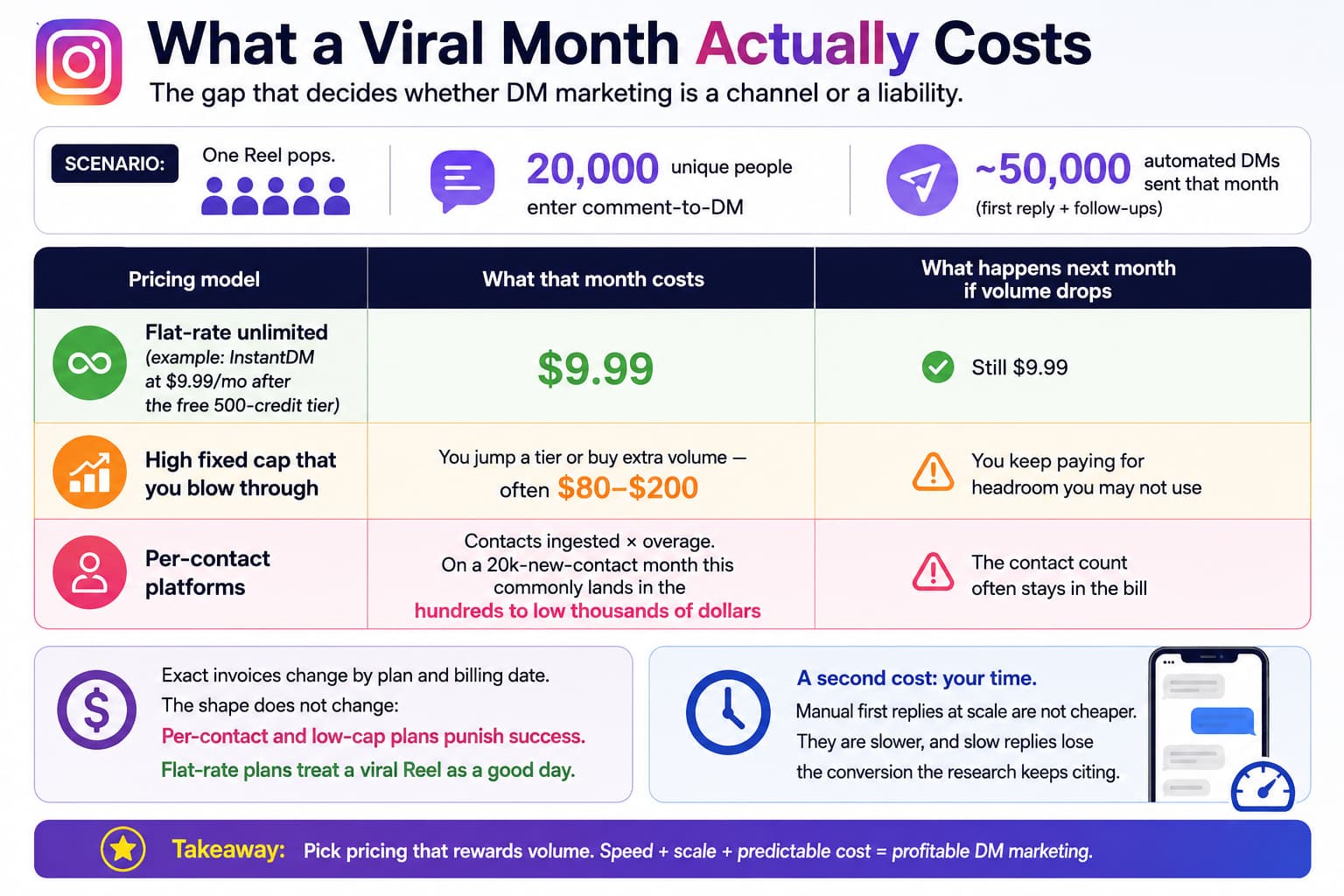
This is the gap that decides whether DM marketing is a channel or a liability.
Assume one Reel pops. You collect 20,000 unique people into comment-to-DM. You send ~50,000 automated DMs that month (first reply + follow-ups).
| Pricing model | What that month costs | What happens next month if volume drops |
| Flat-rate unlimited (example: InstantDM at $9.99/mo after the free 500-credit tier) | $9.99 | Still $9.99 |
| High fixed cap that you blow through | You jump a tier or buy extra volume — often $80–$200 | You keep paying for headroom you may not use |
| Per-contact platforms | Contacts ingested × overage. On a 20k-new-contact month this commonly lands in the hundreds to low thousands of dollars | The contact count often stays in the bill |
Exact invoices change by plan and billing date. The shape does not change: per-contact and low-cap plans punish success. Flat-rate plans treat a viral Reel as a good day.
A second cost: your time. Manual first replies at scale are not cheaper. They are slower, and slow replies lose the conversion the research keeps citing.
Safety, compliance, and rate limits
Grey-hat browser extensions, scraped sessions, and “unlimited cold DM” Chrome tools are how accounts lose the year. Official Instagram DM marketing runs on the Instagram Graph API through a Professional account (Business or Creator) connected to a Meta app that has messaging permissions.
Non-negotiables:
- Official API only. No password logging, no unofficial clients, no Selenium farms.
- Intent first. Automate replies to people who commented, replied, tapped an ad, or messaged you. Do not harvest follower lists and spray.
- Respect the 24-hour standard messaging window for promotional follow-ups, unless you are using an approved message tag that actually applies.
- Pace during spikes. Meta enforces private-reply and API-call limits. A serious tool watches those limits and queues instead of bursting. InstantDM’s Viral Mode exists for this exact failure mode: a Reel explodes, you do not want the app to fire faster than the platform will tolerate.
- Human-like variation. Same three sentences to 8,000 people is how threads get ignored even when they are technically compliant. Spintax or an AI agent that writes to the goal beats a frozen template.
- Easy opt-out. If someone says stop, stop. Store the tag.
Safe daily volume is not a single magic number. It depends on account age, engagement quality, prior restrictions, and whether traffic is inbound. Inbound comment-to-DM at scale is a different risk profile from outbound blasting. Treat any article that says “send 2,000 cold DMs a day, it’s fine” as a threat to your account.
Meta Partner status is not a branding sticker. It is a filter for whether the vendor is allowed to do this work on the official pipes.
What Meta’s docs actually allow
This is the part most strategy posts paraphrase wrong. The rules below are from Meta’s Instagram Messaging and Private Replies docs, not from tool marketing pages.
1. You need a Professional account.
Instagram Messaging API is for Business and Creator accounts. Personal accounts are not a supported DM-marketing surface.
2. Comment-to-DM is “Private Replies,” and the first send is one message.
When someone comments on a post, Reel, ads post, or Live, the official feature is Private Replies. Meta’s limitation list is explicit:
- You may send one private reply to that commenter.
- For posts, Reels, and ads posts, that reply can go out within 7 days of the comment.
- For Instagram Live, the private reply can go out only while the broadcast is live. When the Live ends, that door closes.
- Follow-up DMs are allowed only after the person replies to that first private message. Then the 24-hour standard messaging window opens.
That is why “comment GUIDE - instant DM” is compliant, and why “comment GUIDE - 12-message blast with no reply” is not. Message 2 and message 3 in this playbook are for people who answered. They are not a second and third private reply to a silent commenter.
3. The 24-hour window is for conversations, not for cold lists.
After a person messages you (or replies to your private reply, or taps through a click-to-message ad and messages you), you have 24 hours to reply. Messages inside that window may include promotional content. Meta’s policy overview says people expect a fast reply and that timely replies perform better. That is the official basis for “first DM in seconds,” not a growth-hack blog.
4. Tags are not a loophole for sales sequences.
Message tags exist for specific 1:1 updates outside the 24-hour window. Meta states they may not be used for promotional content (deals, offers, coupons, discounts). The Human Agent path is for a person who needs more time to answer — Meta describes a 7-day human-agent window, not an automated promo drip. One-time notifications are not available on the Instagram Messaging API.
5. Click-to-Instagram ads are a first-class entry point.
Ads that click to Instagram Direct send the click into a chat with the Professional account. Meta also documents lead gen in Instagram Direct and partner-app message flows so the first message can be a flow you already built. If you pay for that click, the first DM has to be ready.
6. Ice Breakers and Quick Replies are official inbox tools, not grey-hat.
Ice Breakers: up to 4 starter questions on the compose screen (not on desktop). Quick Replies: up to 13 tappable buttons inside a thread. Use them for the one-question qualify step in SIOS.
7. Published rate limits (per Instagram Professional account).
From Meta’s Messenger Platform rate limits:
| Endpoint | Official cap |
| Private Replies to comments on posts and Reels | 750 calls per hour per Professional account |
| Private Replies to Live comments | 100 calls per second per Professional account |
| Send API — text, links, reactions, stickers | 300 calls per second per Professional account |
| Send API — audio or video | 10 calls per second per Professional account |
| Conversations API | 2 calls per second per Professional account |
| High-volume inbox | If an Instagram Professional account sends and receives more than 72,000 messages, new messages stop displaying in Inbox and the account cannot send until volume drops |
How to choose a DM marketing tool
Choose on four filters.
- Is it on the official Graph API? If the setup asks for your Instagram password, leave.
- How do they bill a viral month? Flat-rate unlimited vs per-contact vs capped credits.
- Which triggers do you actually need? Comment-to-DM, story reply, keyword DM, Live, collab posts, click-to-message ads, follower-gate, in-DM email capture, AI agent.
- Can you run it from a phone? If you travel or you are a one-person team, web-only tools die at the airport.
- Once you know the four filters that matter (official Graph API, billing model, triggers, and mobile access), the next step is seeing how the current tools actually stack up. Here’s a full side-by-side comparison of the best Instagram DM automation tools in 2026: Best Instagram DM Automation Tools.
Honest shortlist for 2026
| Tool | Best when | Watch-out |
| InstantDM | You want Instagram/Facebook/Meta ads DMs on a flat $9.99/mo with unlimited sending after the free 500-credit plan, native iOS/Android, comment-to-DM, story replies, AI agent, follower-gate, email capture, scheduled posts with auto-DM, collab and Live triggers | Not a full WhatsApp + SMS suite |
| ManyChat | You need Instagram plus Messenger, WhatsApp, SMS, and a giant flow template library | Per-contact billing grows with success |
| Inrō | You want an Instagram-only AI-first inbox with a built-in CRM narrative | Pricing scales with contacts; web-first |
| ReplyRush / LinkDM-class tools | You want a simple capped or budget plan for link delivery | Caps become the product during a spike |
| Meta Business Suite | You are testing saved replies and want zero vendor | No comment-to-DM engine, no sequences, no spike handling |
Full comparison and pricing math:
The tool decides speed, safety, and whether a good week bankrupts the channel.
AI agents vs flow trees
2024–2025 tools taught everyone to draw flowcharts. 2026 tools that win conversations set a goal.
- Flow tree: if they say PRICE, send block A; if they say DEMO, send block B. Brittle the moment someone types a sentence instead of a keyword.
- Goal-based agent: “Qualify whether they are a coach or a shop, answer pricing honestly, collect email, book a slot if they are ready, otherwise tag and nurture.” The model works toward the goal. You still constrain it with your offer, your tone, and your handoff rules.
Use both. Keywords and comment triggers should still fire a deterministic first DM so the promise of the CTA is kept exactly. After that, an agent can qualify. That hybrid is how you stay on-brand without building a 90-node spiderweb.
InstantDM’s agent is built this way: you set the job (qualify, FAQ, book, sell), it works inside the thread, and you are not metered per witty sentence.
Do not let the agent dump a checkout link in message 1. That is the same mistake as a 12-line welcome broadcast.
Niche playbooks
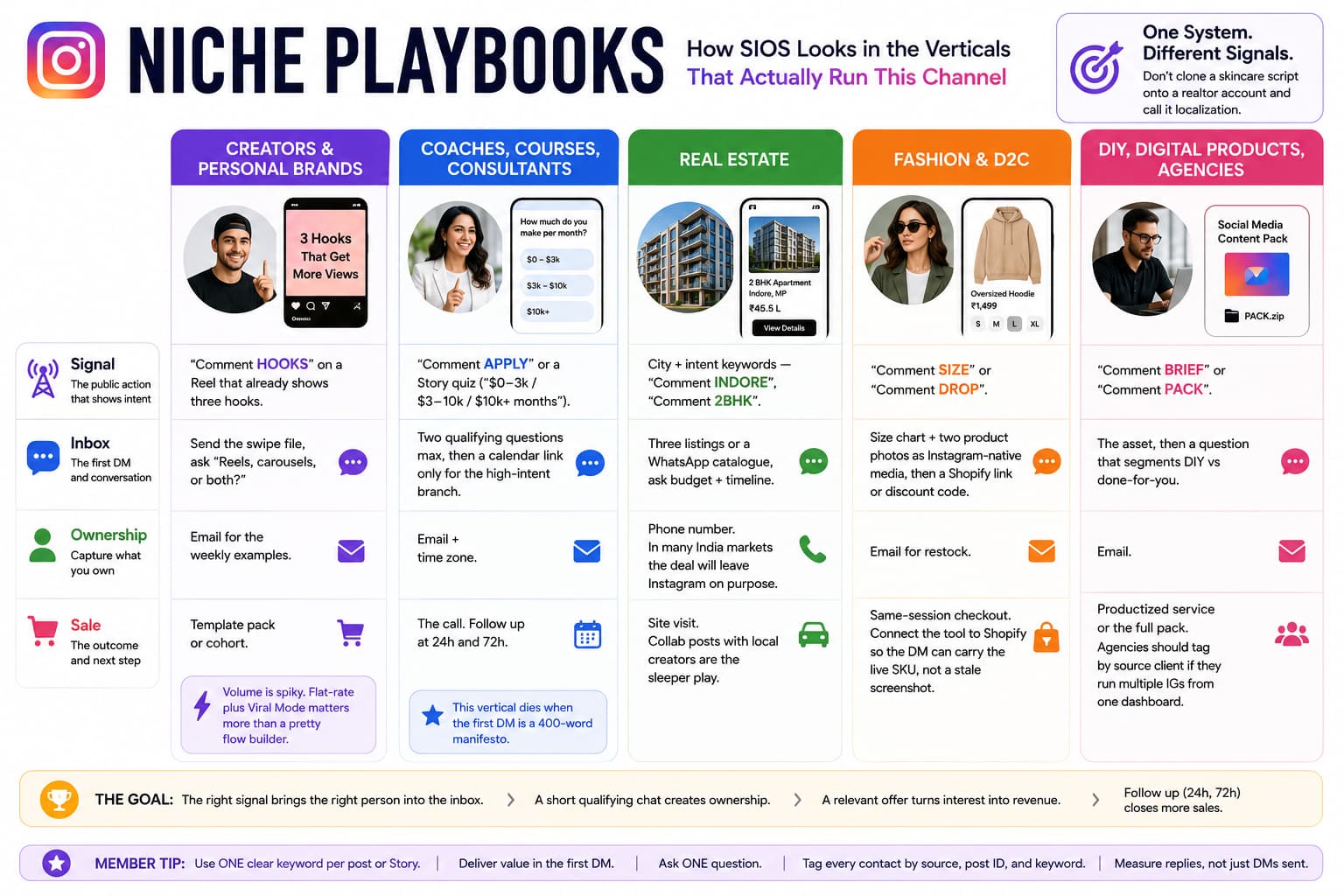
Here is how SIOS looks in the verticals that actually run this channel.
Creators and personal brands
Signal: “Comment HOOKS” on a Reel that already shows three hooks.
Inbox: send the swipe file, ask “Reels, carousels, or both?”
Ownership: email for the weekly examples.
Sale: template pack or cohort.
Volume is spiky. Flat-rate plus Viral Mode matters more than a pretty flow builder.
Coaches, courses, consultants
Signal: “Comment APPLY” or a Story quiz (“$0–3k / $3–10k / $10k+ months”).
Inbox: two qualifying questions max, then a calendar link only for the high-intent branch.
Ownership: email + time zone.
Sale: the call. Follow up at 24h and 72h. This vertical dies when the first DM is a 400-word manifesto.
Real estate
Signal: city + intent keywords — “Comment INDORE”, “Comment 2BHK”.
Inbox: three listings or a WhatsApp catalogue, ask budget + timeline.
Ownership: phone number. In many India markets the deal will leave Instagram on purpose.
Sale: site visit. Collab posts with local creators are the sleeper play.
Fashion and D2C
Signal: “Comment SIZE” or “Comment DROP”.
Inbox: size chart + two product photos as Instagram-native media, then a Shopify link or discount code.
Ownership: email for restock.
Sale: same-session checkout. Connect the tool to Shopify so the DM can carry the live SKU, not a stale screenshot.
DIY, digital products, agencies
Signal: “Comment BRIEF” or “Comment PACK”.
Inbox: the asset, then a question that segments DIY vs done-for-you.
Ownership: email.
Sale: productized service or the full pack. Agencies should tag by source client if they run multiple IGs from one dashboard.
One system, different signals. Do not clone a skincare script onto a realtor account and call it localization.
India, Bharat, and every market that hates surprise SaaS bills
What changes outside that bubble:
- Price sensitivity is a feature of the market, not a personality flaw. A flat $9.99 (or a free 500-credit start) is the difference between testing the channel and never starting.
- UPI, local payment comfort, and rupee-first offers in the DM copy. If your first message quotes only USD, you told half the thread this product is not for them.
- WhatsApp is often the close. Capture the number in IG, continue where the customer already lives. The Instagram thread is the capture layer, not always the checkout layer.
- Trust language. Official Meta Partner, no password, no shadowban history — these are not footer badges. They are the reason a cautious operator will try automation at all.
- Regional CTAs. Keywords in Hindi, Tamil, or Hinglish on regional Reels. The engine does not care. The audience does.
Put currency, partner status, and flat-rate math in the first screen of the offer. Do not make the reader translate the product into their market.
Build the system in 14 days
Days 1–2. Foundation
Switch to a Professional account if you have not. Connect a Meta-verified tool. Turn on comment-to-DM on a single existing post as a dry run. Send yourself the test.
Days 3–5. One inbound machine
Script one Reel around a single keyword. Film the CTA on a piece of paper at the end if you have to. Attach the automation before you publish. First DM = resource + one question. Tag = keyword + month.
Days 6–8. Ownership
Add an email or phone capture step for the high-value asset. Export those contacts somewhere you control. If you skip this, you are building a castle on a rented plot.
Days 9–11. Follow-up
Write message 2 (24 hours) and message 3 (72 hours). Keep both shorter than message 1. Route “ready” replies to you. Let automation or an agent handle “not now.”
Days 12–14. Measure and kill
Look at trigger rate, time-to-DM, replies, clicks, revenue. Kill the keyword that nobody uses. Double the CTA style that worked. Only now consider a Story play or a click-to-message ad.
You do not need a 12-flow empire. You need one post that prints conversations.
Mistakes that quietly kill otherwise decent programs
Cold blasting followers. This is how DM marketing got a bad name. It is also how you earn restrictions.
One message, no follow-up. Half the conversions live in message 2. Almost nobody operationalizes the 24-hour send.
Link in sentence one. You promised value in the public CTA. Pay that invoice first.
Five qualifying questions. People are in a chat, not a loan application.
Same script on every niche and every country. See the playbooks above.
Choosing a tool by homepage adjectives. Choose by API + billing model + triggers + mobile.
No owner tag. If you cannot pull “everyone who asked for PRICE in August,” you cannot run a campaign. You can only hope.
Publishing the Reel, then building the automation. Attach the keyword first. Viral does not wait for you to finish the flow.
Ignoring Live, collabs, and ads. Organic comment-to-DM is the beginning of the system, not the whole map.
Measuring DMs sent. Measure revenue per conversation and cost per conversation.
Start the first funnel today
- Open your next Reel draft. Write a one-word CTA.
- Connect a Professional Instagram account to a Meta-verified tool. InstantDM’s free plan includes 500 credits a month, which is enough to prove the loop.
- Attach comment-to-DM before you publish.
- First message: deliver, then one question.
- Tag the contact. Add a 24-hour follow-up.
- Look at trigger rate after 48 hours. Iterate the CTA, not the whole philosophy.
Instagram DM marketing is not a growth hack and it is not a chatbot demo. It is the conversion layer for an account that already knows how to make content. The accounts winning in 2026 are the ones that answered in a second, sounded like a person, owned the contact, and did not get a surprise invoice when the Reel finally worked.
About The Author:
Aravindh Kumar is an Ecommerce and Instagram growth expert with 8+ years of experience in online selling. He has worked with 500+ brands - including Forbes-listed companies - He has helped 200+ Instagram businesses grow their online presence.