Last updated: September 2026
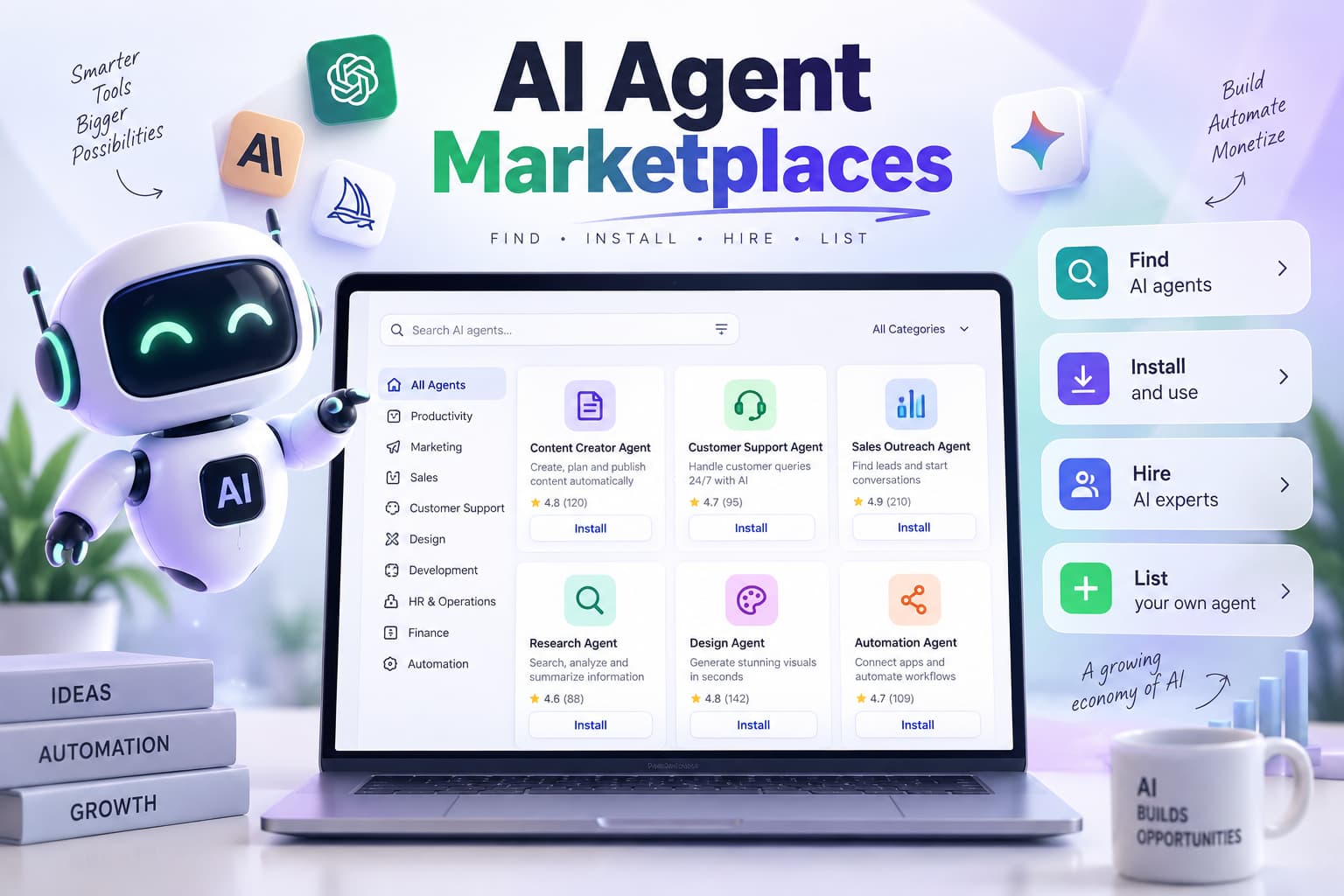
AI agent marketplaces are stores. You use them to find, install, hire, buy, or sell ready-made agents, skills, templates, and tools.
They are not the same thing as agent platforms. A platform is where you build and run an agent. A marketplace is where a finished agent, template, or skill is listed. If you need to design orchestration, evals, or a custom runtime, start with our comparison of the best AI agent platforms in 2026. This guide is only for distribution: browse a catalogue, clone a listing, hire capacity, or publish work you already have.
In 2026 those catalogues include enterprise cloud stores, vendor app exchanges, hire markets, skill registries, and independent directories. The useful question is not “who has the biggest list.” It is which store matches the budget and stack you already use, and how fast a listing can move from discovery to a real workflow.
Marketplace vs platform vs framework
| Purpose | What you do | Examples | |
| Framework | Write agent logic | Code and host it yourself | LangGraph, CrewAI |
| Platform | Build, orchestrate, and run agents | Create and operate them | Relevance AI, Lindy, n8n, Copilot Studio, Agentforce |
| Marketplace | Discover or sell ready-made agents | Browse, install, hire, or list | GPT Store, AgentExchange, AWS Marketplace, Google Cloud Marketplace, AI Agents Directory |
Some companies operate both layers. Relevance AI has a builder and an Agent Store. Salesforce has Agentforce and AgentExchange. Microsoft has Copilot Studio and Marketplace. This article reviews only the store layer: what is listed, how it is vetted, how you pay, and who it is for.
How these marketplaces were compared
- Size and focus of the catalogue
- Vetting: reviews, partner checks, install proof
- Time from discovery to a working install or hire
- Buyer pricing: free, usage, contract, or pay-per-task
- What creators can actually earn by listing
- Fit with a stack you already buy through
- Terms after install: ownership, updates, support
- Intended buyer: consumer, mid-market, enterprise, or developer
Catalogue counts and prices below are vendor-reported or third-party snapshots from 2026. Check live terms before you buy or list.
Quick comparison
| Marketplace | What you get | How you pay | Vetting | Best for |
| OpenAI GPT Store | Custom GPTs inside ChatGPT | Included with ChatGPT; limited creator payouts | Community + OpenAI review | Individuals and small teams |
| Salesforce AgentExchange | Partner agents, apps, Slack tools, MCP servers | Licence + usage or private offer | Partner security review | Salesforce customers |
| Microsoft Marketplace | AI apps and agents for Microsoft 365 and Azure | Usage / MACC | Partner-vetted | Microsoft estates |
| AWS Marketplace – AI Agents & Tools | Deployable agents, tools, and services | Usage, contract, or SaaS | AWS review | AWS procurement teams |
| Google Cloud Marketplace | Partner agents for GCP and Gemini Enterprise | Usage / GCP commit | Google partner process | Google Cloud customers |
| Relevance AI Agent Store | Cloneable sales, ops, and research agents | Platform subscription after clone | Platform-verified listings | Teams already on Relevance |
| AI Hive Marketplace | Production templates | From about $29/mo (vendor-listed) | Peer review | Mid-market and regulated teams |
| UpAgents | Hired task capacity | Pay per task | Ratings + platform rules | Teams that want help, not ownership |
| Agent skills / MCP directories | Installable skills and tool servers | Mostly free | Stars, manifests, community | Developers extending an existing agent |
| AI Agents Directory | Neutral index of agents and skills | Free to browse | Curated listings | Anyone shortlisting before lock-in |
1. OpenAI GPT Store
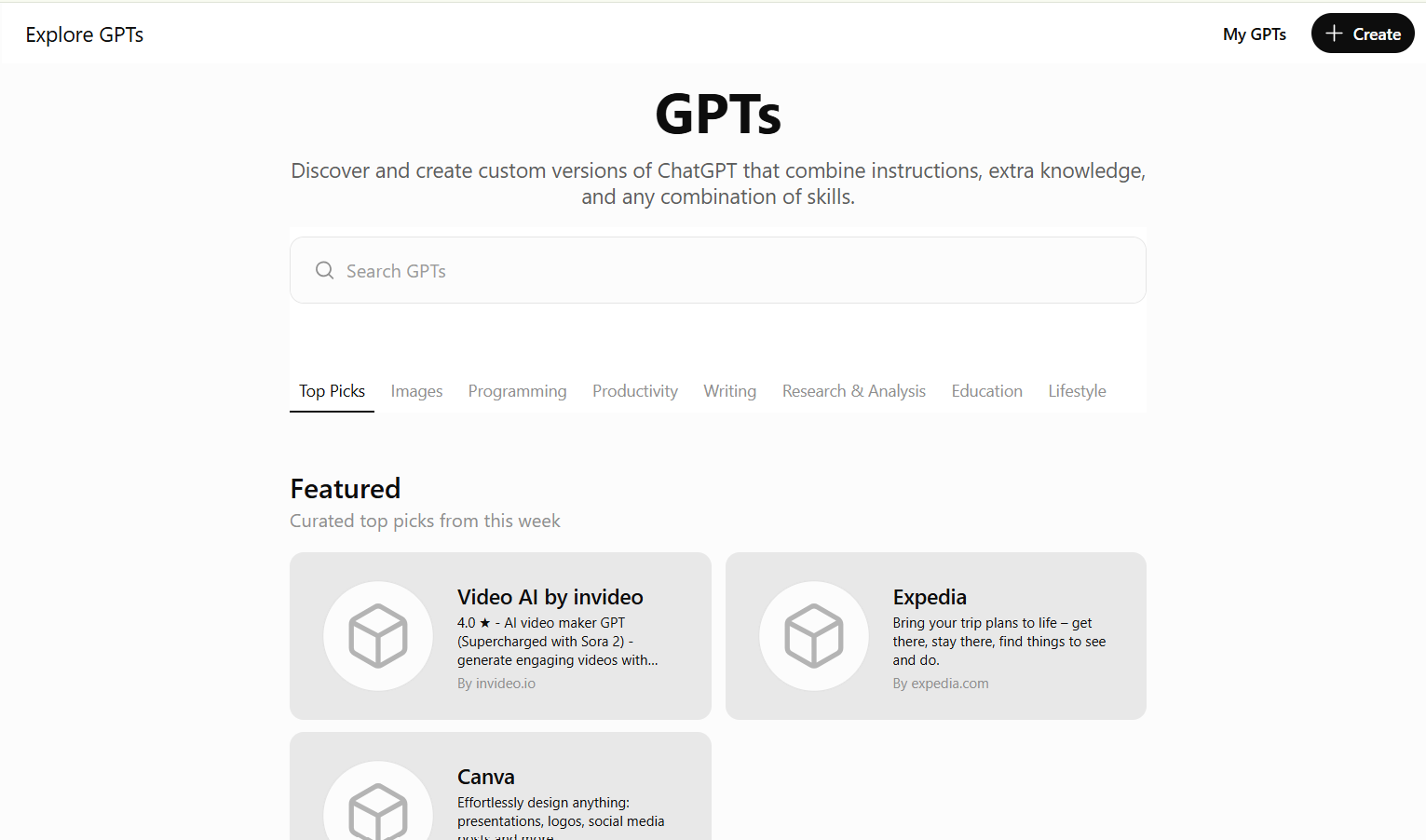
The largest consumer store. You find and run custom GPTs inside ChatGPT, with no infrastructure to stand up.
Public listings are only a slice of what exists. Third-party snapshots put Store listings in the mid-100,000s; millions of GPTs stay private. Use is bundled with ChatGPT plans. Creator payouts have been narrow, opaque, and often limited by country.
As of mid-August 2026, new GPT creation and Store submissions from personal ChatGPT accounts were limited to Business, Enterprise, and Edu workspaces. Existing GPTs still run. Confirm current account rules in OpenAI’s GPT creation rules before you treat the Store as a publishing plan.
Use it when someone on the team just needs a working agent today.
Skip it when you need procurement, field-level security, or predictable creator revenue.
2. Salesforce AgentExchange
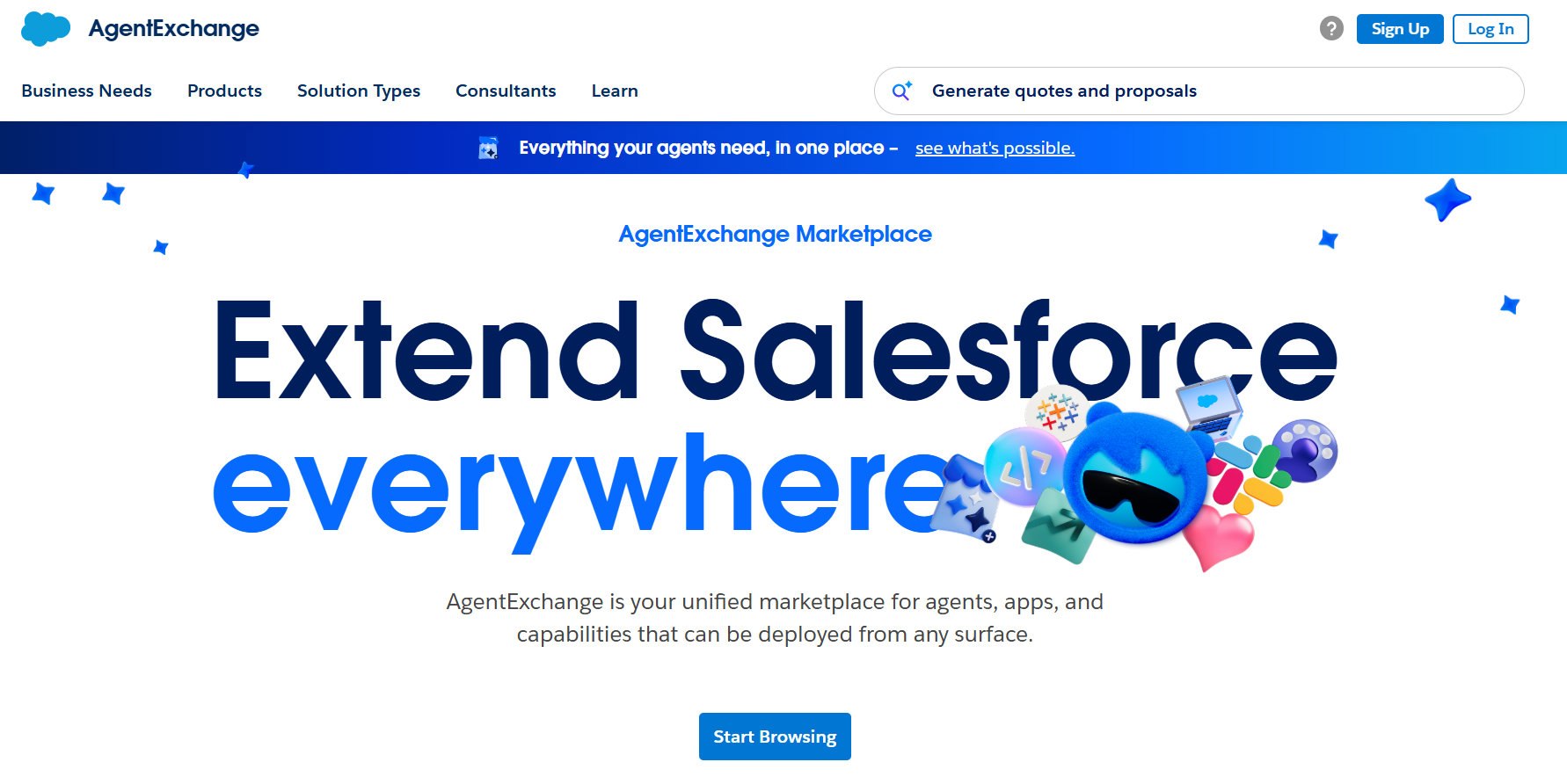
The Salesforce and Slack storefront. Partner agents, apps, Slack tools, and MCP servers install into an existing org.
In 2026 Salesforce combined AppExchange, Slack Marketplace, and the Agentforce catalogue under the AgentExchange name. Public figures sit around 10,000+ apps, 2,600+ Slack listings, 1,000+ Agentforce agents, tools, and MCP servers, and about 13,000 listings in total. Pricing is subscription, consumption, or private offer on top of Salesforce licences.
This is the catalogue, not the Agentforce builder. If the question is how to design and govern an agent on Salesforce data, that belongs in a platforms comparison.
Use it to install a partner agent that already respects Salesforce permissions.
Skip it if Salesforce is not the system of record.
3. Microsoft Marketplace
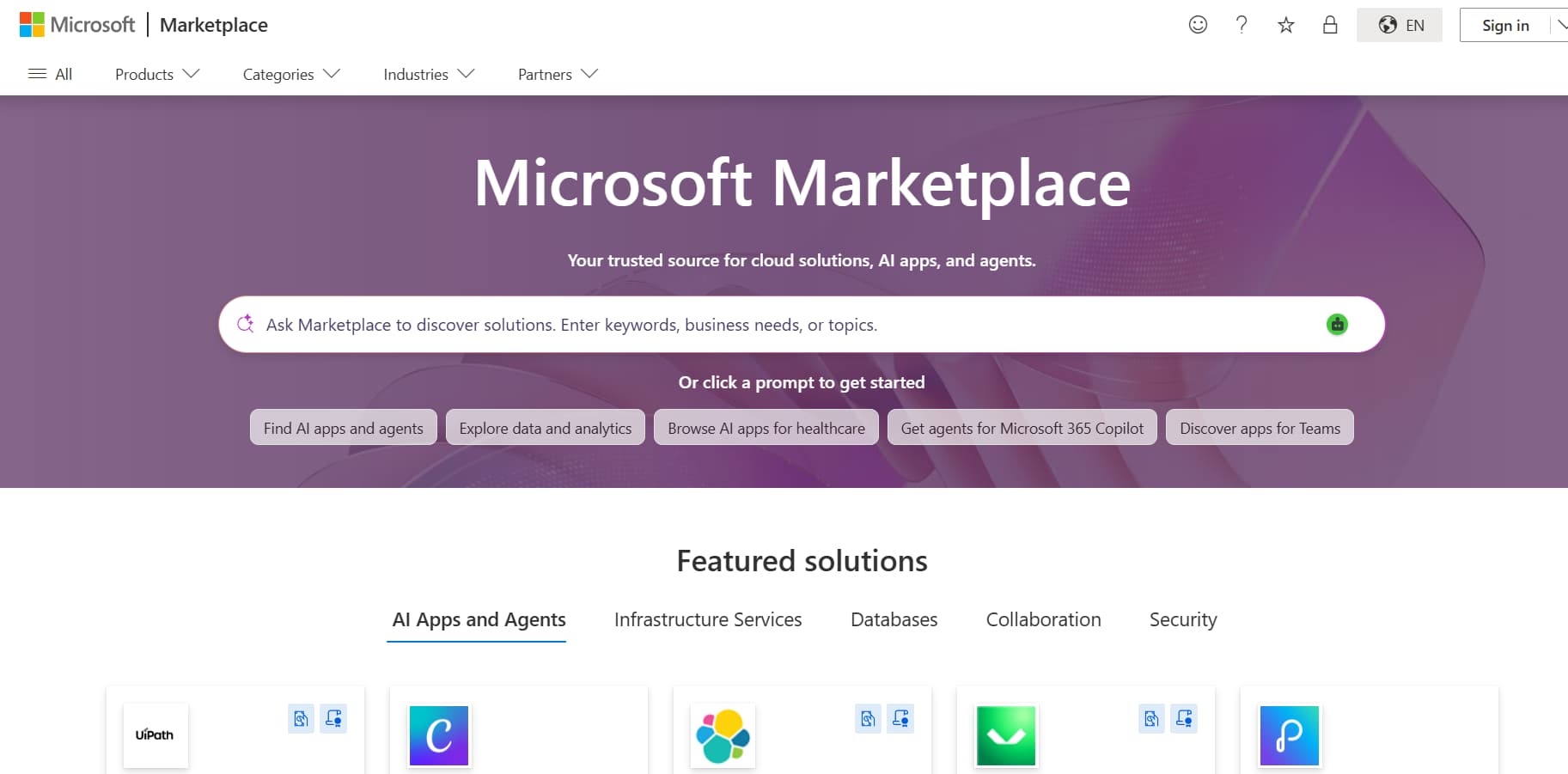
The buying catalogue for Microsoft 365 and Azure. Partner and first-party agents deploy into Teams, Outlook, SharePoint, Dynamics, or Azure.
Mid-2026 landscape reports put the wider Microsoft catalogue at 11,000+ models and 4,000+ AI apps and agents (vendor-reported). Billing is usage, capacity packs, or MACC against existing Microsoft spend.
Copilot Studio is the builder. This entry is only the store you purchase through.
Use it to buy an agent on a Microsoft contract you already have.
Skip it if the company is not a Microsoft estate.
4. AWS Marketplace — AI Agents & Tools
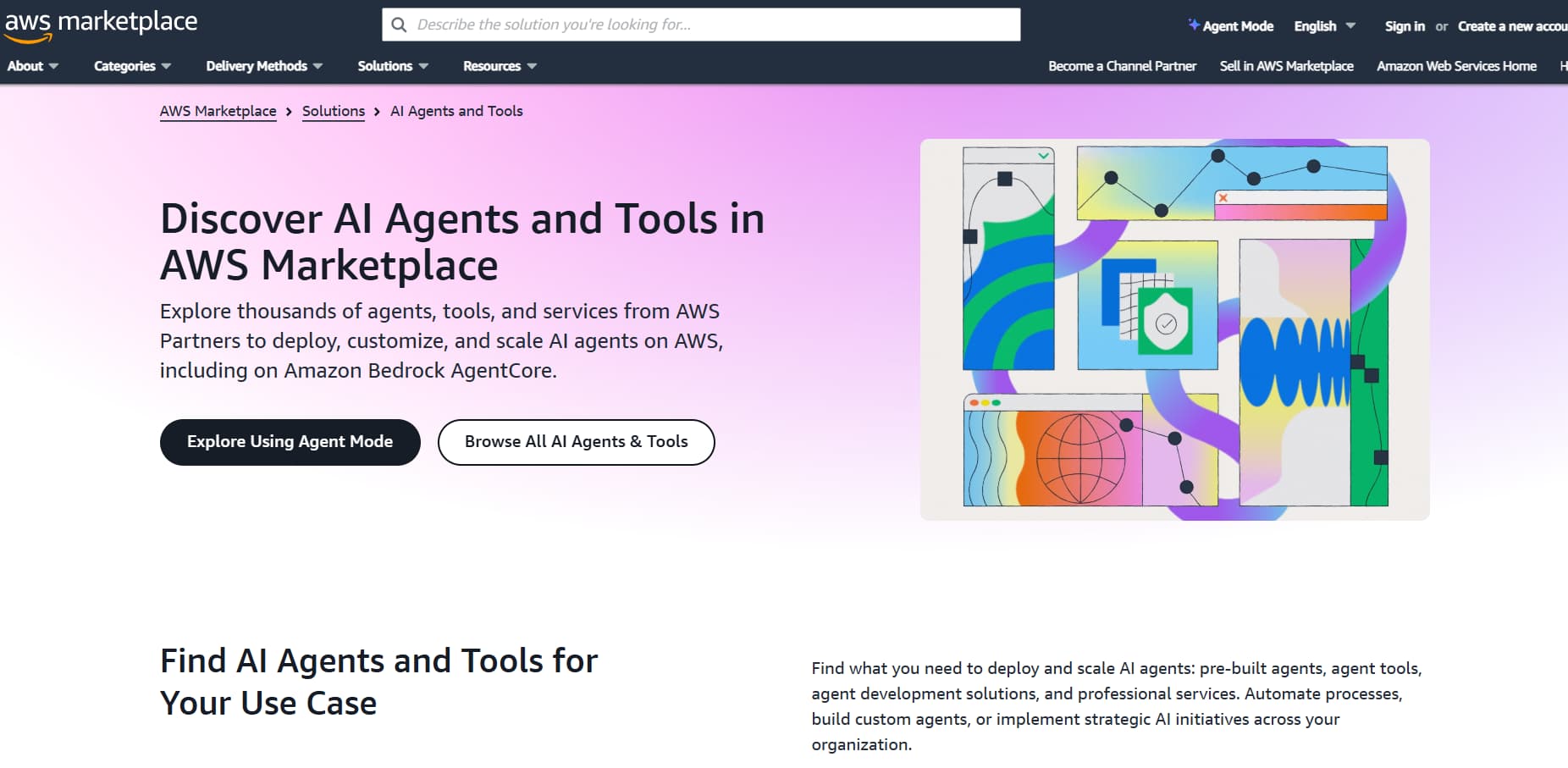
The AWS buying path for agents, tools, and services sold as SaaS, containers, APIs, or Bedrock-related listings.
Listings go through AWS review and can follow standard Marketplace contracts. You pay usage, subscription, or a private deal, and the invoice stays inside AWS. Discovery, deployment options, and MCP-capable listings are documented in the AWS Marketplace buyer guide for AI agents.
Use it when security review, billing, and deployment need to stay on AWS.
Skip it if you are not on AWS. Bedrock as a runtime is a platform decision, not a store decision.
5. Google Cloud Marketplace
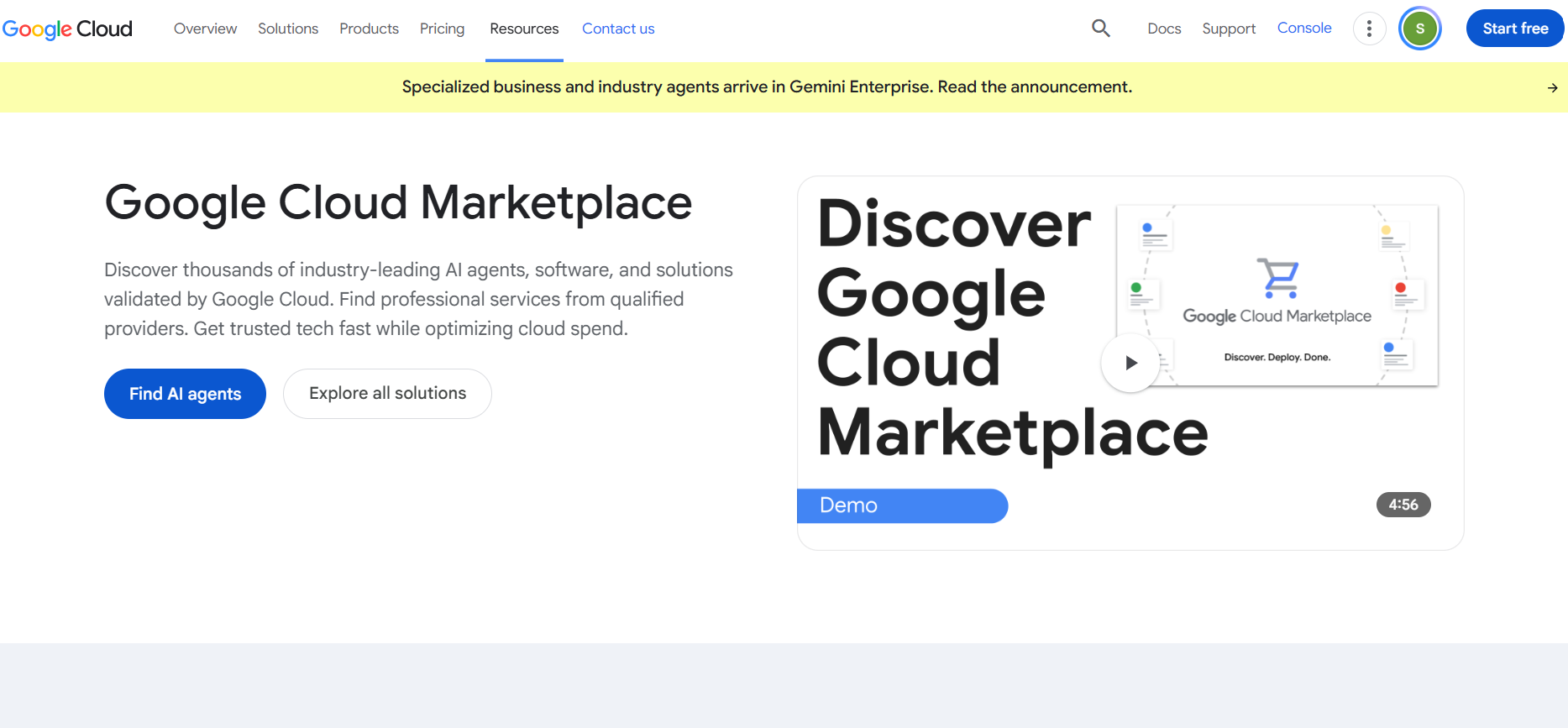
The Google-stack catalogue. Partner agents list on Cloud Marketplace and can import into Gemini Enterprise, including A2A-style listings.
You pay through GCP usage and commitments. A listing marked free can still generate model and runtime cost.
Use it if Gemini Enterprise or Google Cloud is already the estate.
Skip it if there is no GCP footprint.
6. Relevance AI Agent Store
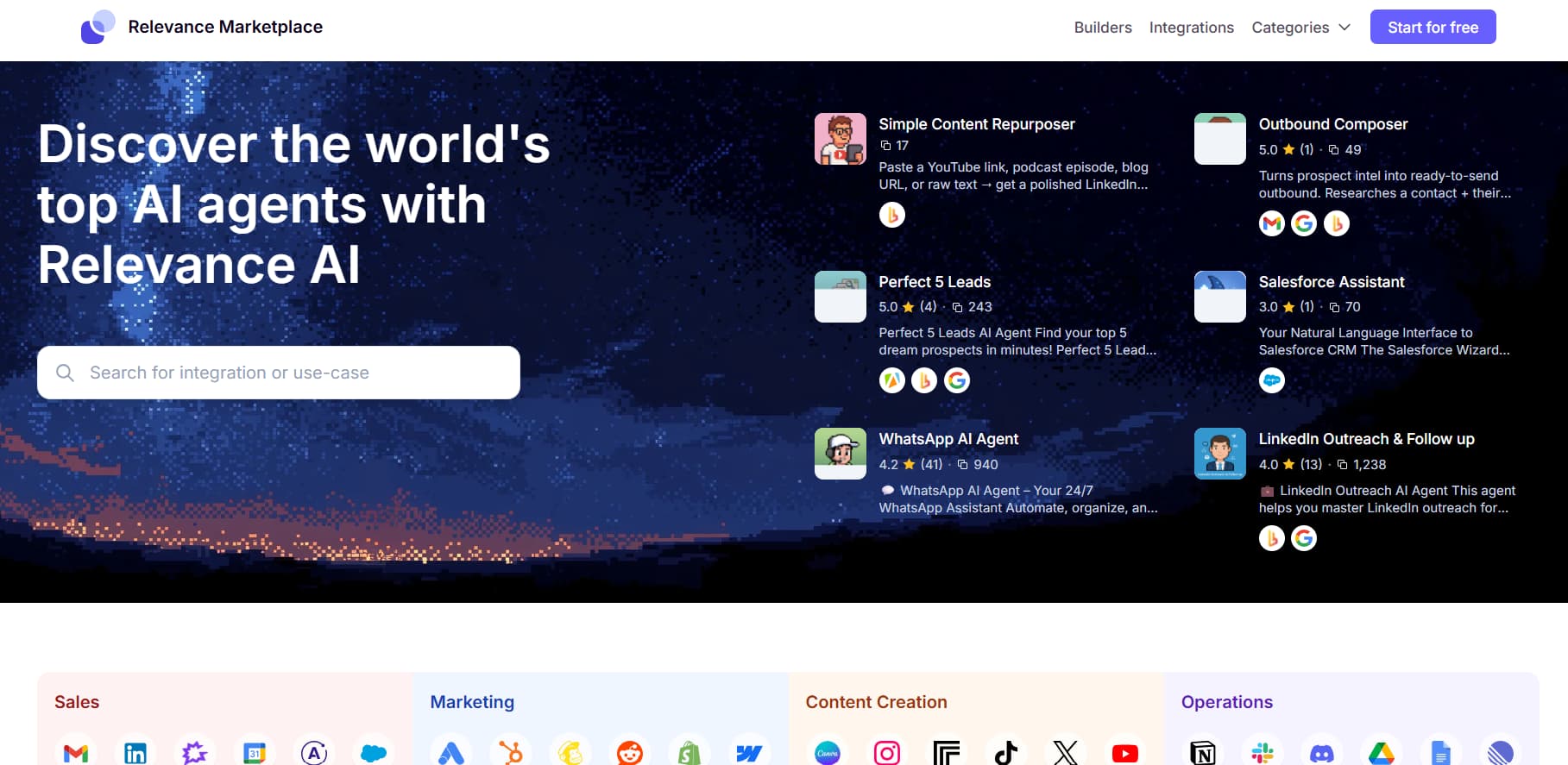
A clone-into-account store for sales, marketing, ops, and research agents. You browse a listing, clone it, connect tools, and edit prompts.
You then pay for the Relevance platform. Public prices moved through 2025 and 2026, so do not budget from an old “Pro from $19” screenshot. Check current Team and Enterprise tiers.
Use it to start from a working business template instead of a blank canvas.
Skip it if you have not already chosen Relevance as the place those agents will run.
7. AI Hive Marketplace
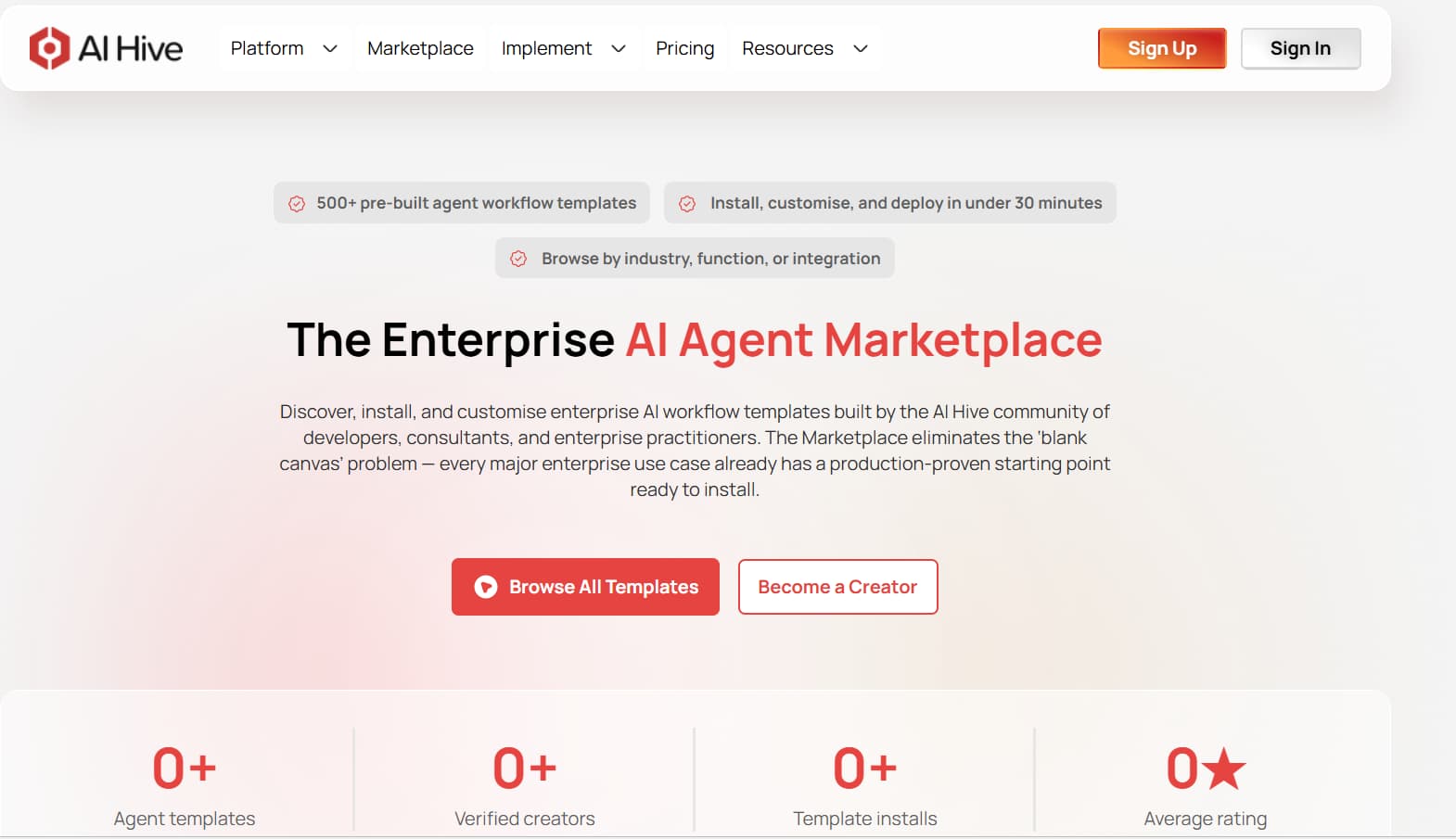
A template store for mid-market and enterprise teams, including cloud, on-prem, and air-gapped installs.
Listings target BFSI, healthcare, logistics, IT, retail, and manufacturing. The vendor describes 500+ peer-reviewed production templates. Platform pricing is listed from about $29 a month; template fees can sit on top.
Use it when a security team needs a template with recognisable deployment options.
Skip it if you want consumer GPTs or a one-off hired task.
8. UpAgents and pay-per-task hire markets
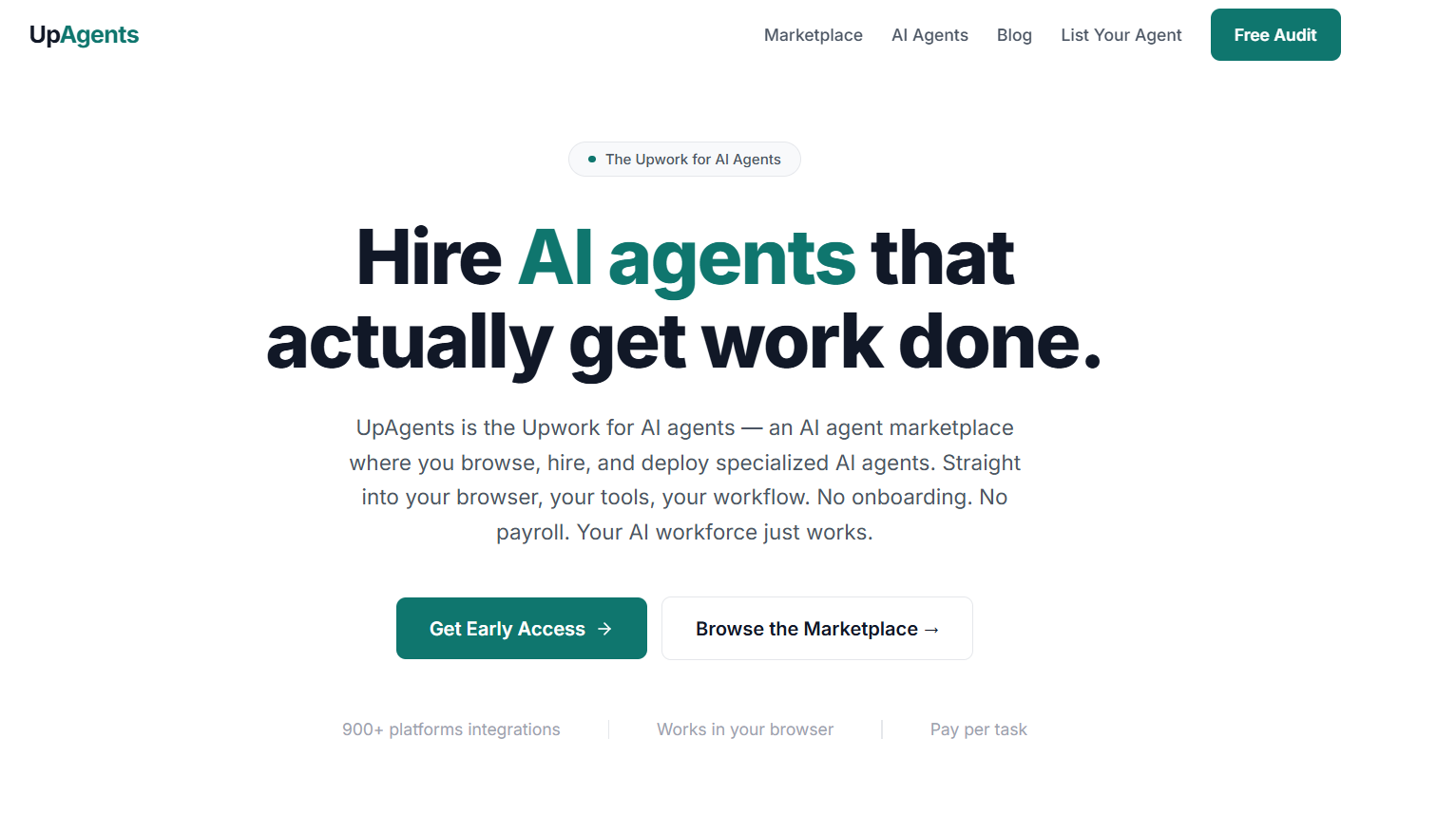
These are capacity markets. You hire an agent to finish a job. You do not take home a long-lived internal system.
UpAgents is the clearest named example: role- and industry-packaged agents, tool connections, ratings, and human approval options. Peers should be judged on integrations and approval gates, not on the brand name. You pay per completed task.
Use it to pilot a function or absorb burst work.
Skip it if you need an agent you own, logs you control, or a runtime inside your own network.
Hiring an agent does not replace a channel tool. If the work is keyword triggers, story replies, or comment-to-DM, see Instagram DM automation tools compared.
9. Agent skills and MCP directories
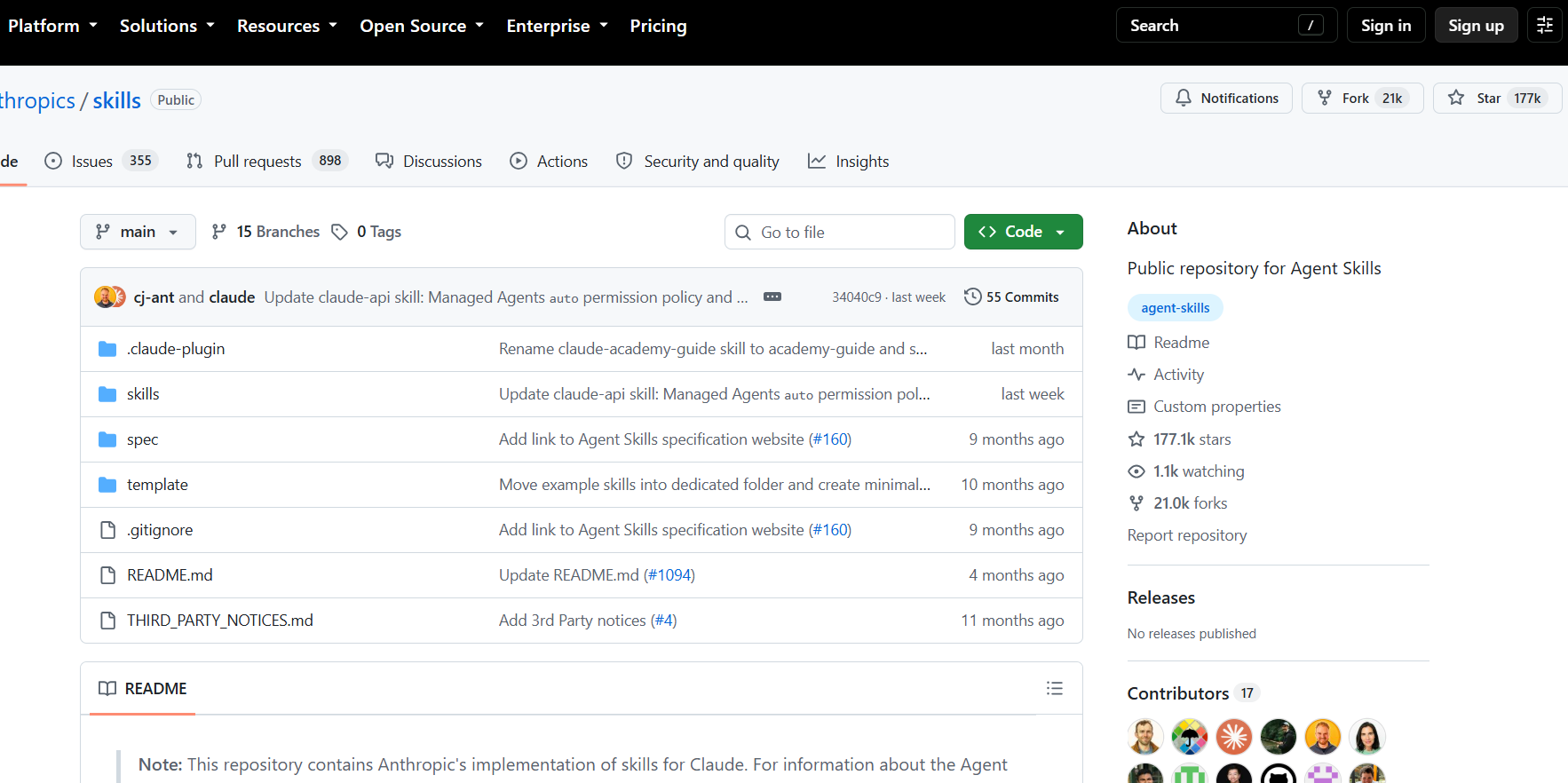
A plugin layer, not a finished employee. You install a skill or MCP server onto an agent you already run.
These directories feed Claude Code, Codex, ChatGPT-compatible agents, and other runtimes that speak open skill or MCP formats. Index sizes in 2026 look huge. Treat “a million skills” as crawl size, not a million certified production agents. Most listings are free.
Use it to add one capability: docs lookup, a browser, a ticket tool.
Skip it if you still need a full business agent or a governed enterprise runtime.
Skills directories only help if the runtime can call the tool. InstantDM exposes comments, DMs, publishing, and insights as an MCP server for Instagram comments, DMs, and publishing, so a coding agent can use the official Graph API instead of a scraper.
10. AI Agents Directory
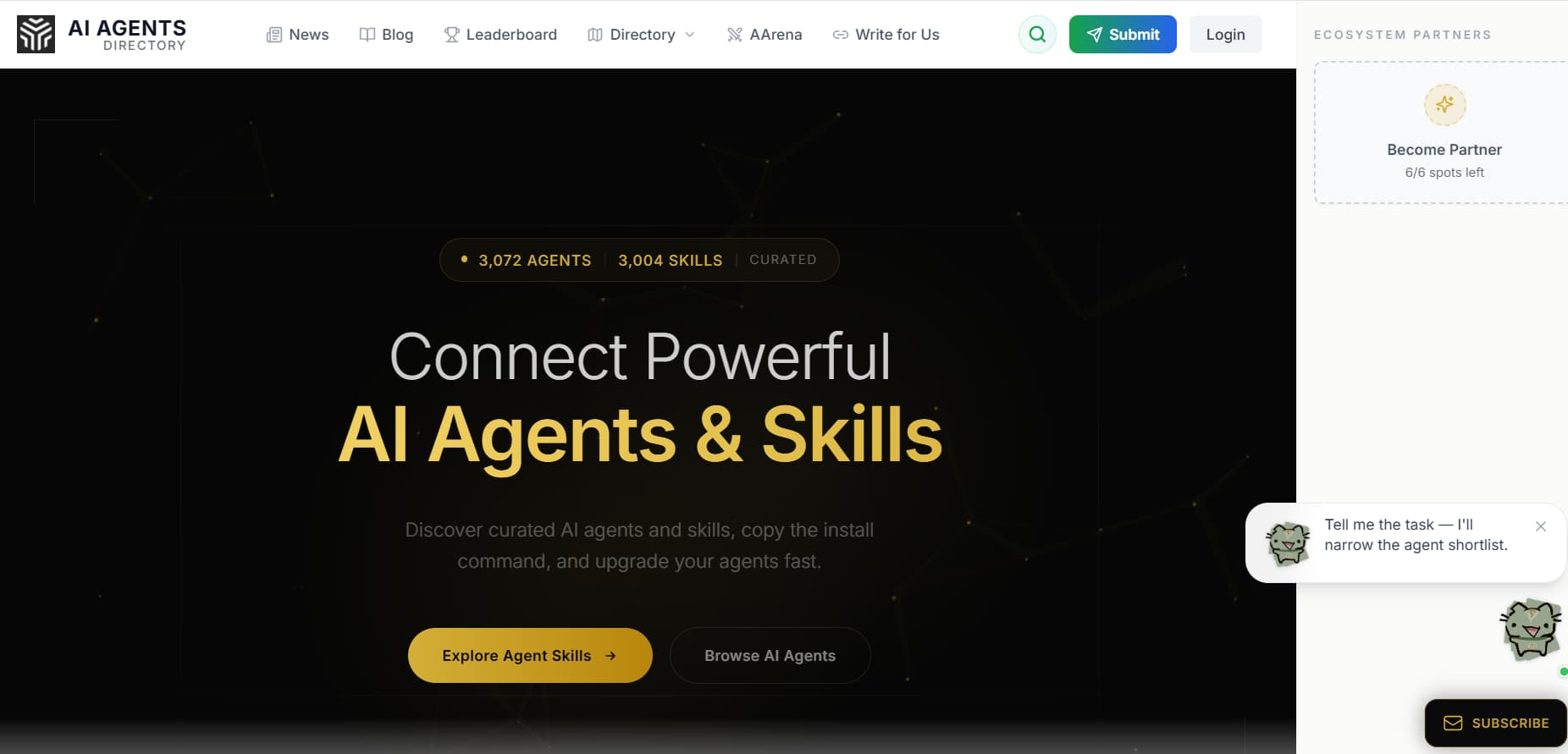
A neutral index, not a runtime and not a purchase order. Sites such as aiagentsdirectory.com list agents and skills across vendors so you can map the field before you enter a paid ecosystem.
Browsing is free. Listing is usually free or inexpensive.
Use it to build a shortlist without locking into a stack.
Skip it if you already know the estate and only need that vendor’s official catalogue.
Other catalogues worth knowing
| Catalogue | When it matters |
| Oracle Fusion AI Agent Marketplace | Fusion is the system of record |
| Agent.ai | You want a public business-agent network |
| Agentverse | You need open registration and discovery |
| Poe | You want to set your own creator price |
| Apify Store | The job is crawlers, actors, or pay-per-result data work |
| ServiceNow, Kore.ai, or Moveworks stores | The buyer sits in ITSM or the employee assistant |
| Hugging Face Spaces | You are showing a demo, not running procurement |
How to choose
Start with the buying path you already have.
- Salesforce - AgentExchange
- Microsoft 365 or Azure - Microsoft Marketplace
- AWS - AWS Marketplace
- Google Cloud or Gemini Enterprise - Google Cloud Marketplace
- Oracle Fusion - Oracle’s catalogue
- Need a business template on a host you accept - Relevance Agent Store or AI Hive
- Need the job done once - a pay-per-task hire market
- Need a skill for an agent you already run - MCP or skills directories
- Need a map first - AI Agents Directory or GPT Store
Then decide two things: whether you want to own the listing after install or only hire the task, and whether you need a full agent or just a skill.
If there is no cloud or CRM estate yet, use a directory or the GPT Store to look around. Choosing a builder is a separate step.
A marketplace listing will not run comment-to-DM or story replies on Instagram. For that last mile, compare purpose-built Instagram AI agent tools that use the official Graph API.
How the money works
| Model | Where it shows up | What you pay for |
| Bundled with the chat product | GPT Store | Access, not a separate agent licence |
| Contract and usage | AWS, Microsoft, Google, Salesforce | A listing bought through existing procurement |
| Clone, then subscribe | Relevance Agent Store, AI Hive | The template plus the host platform |
| Pay per task | Hire markets | An outcome, not an asset |
| Free or open | Skills and MCP directories | A capability pack |
Creators usually earn more from hire markets and niche business templates than from the GPT Store. Enterprise catalogues pay through partner programs, not consumer revenue share. Read current payout rules, geography limits, and listing fees before you invest in a listing.
Model tokens, seat licences, and conversation credits are runtime costs. They sit with the platform you run on, not with the store you browsed.
Bottom line
Match the store to the buying path you already have, then test one listing on one real task.
- Ready GPT today - GPT Store
- Salesforce org - AgentExchange
- Microsoft estate - Microsoft Marketplace
- AWS procurement - AWS Marketplace
- Google Cloud or Gemini - Google Cloud Marketplace
- Business template to clone - Relevance Agent Store or AI Hive
- Hired task - pay-per-task markets
- Extra skill on an existing agent - MCP or skills directories
- First look across vendors - AI Agents Directory
If the real job is building the agent, this is the wrong list. Use a platforms guide for that.