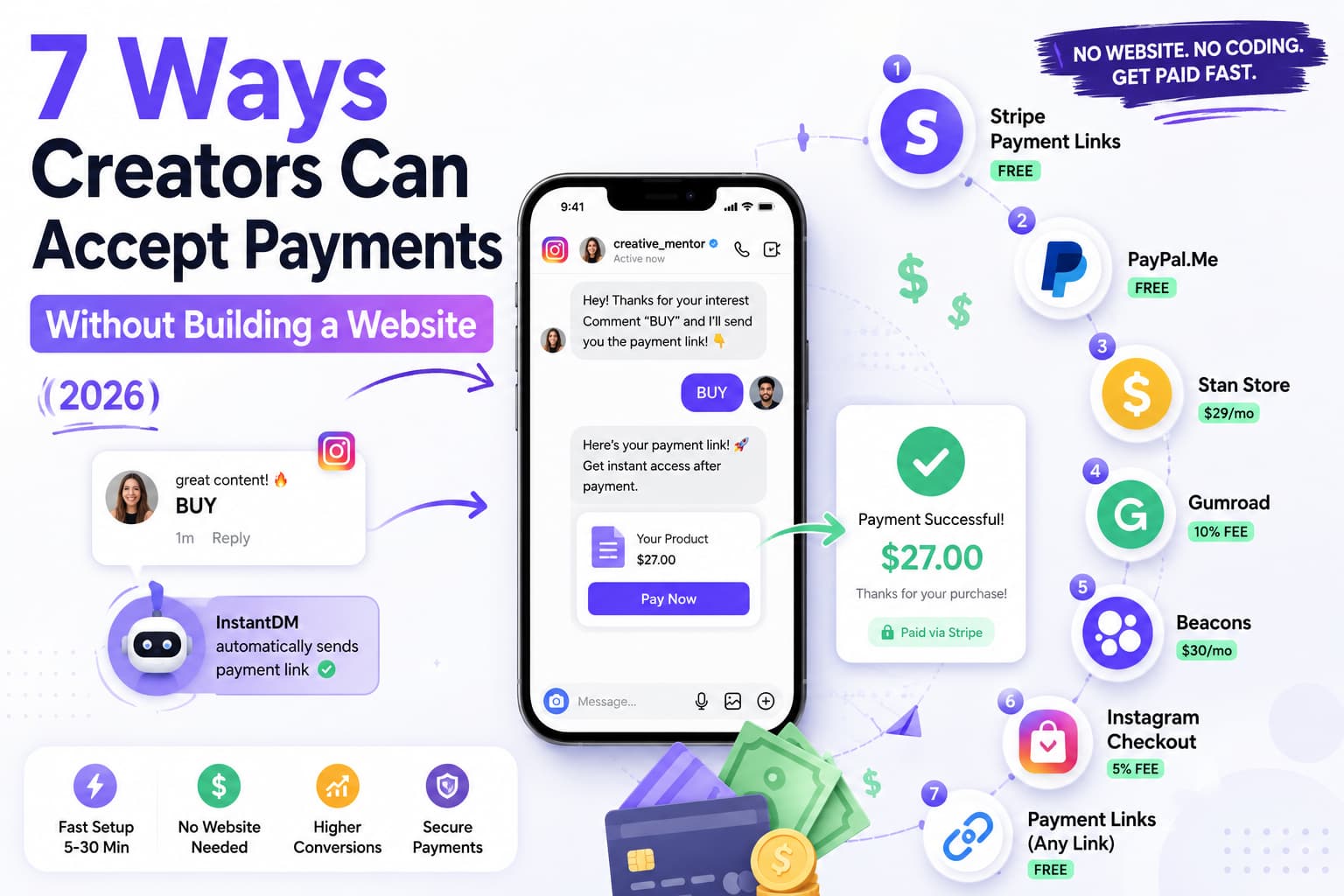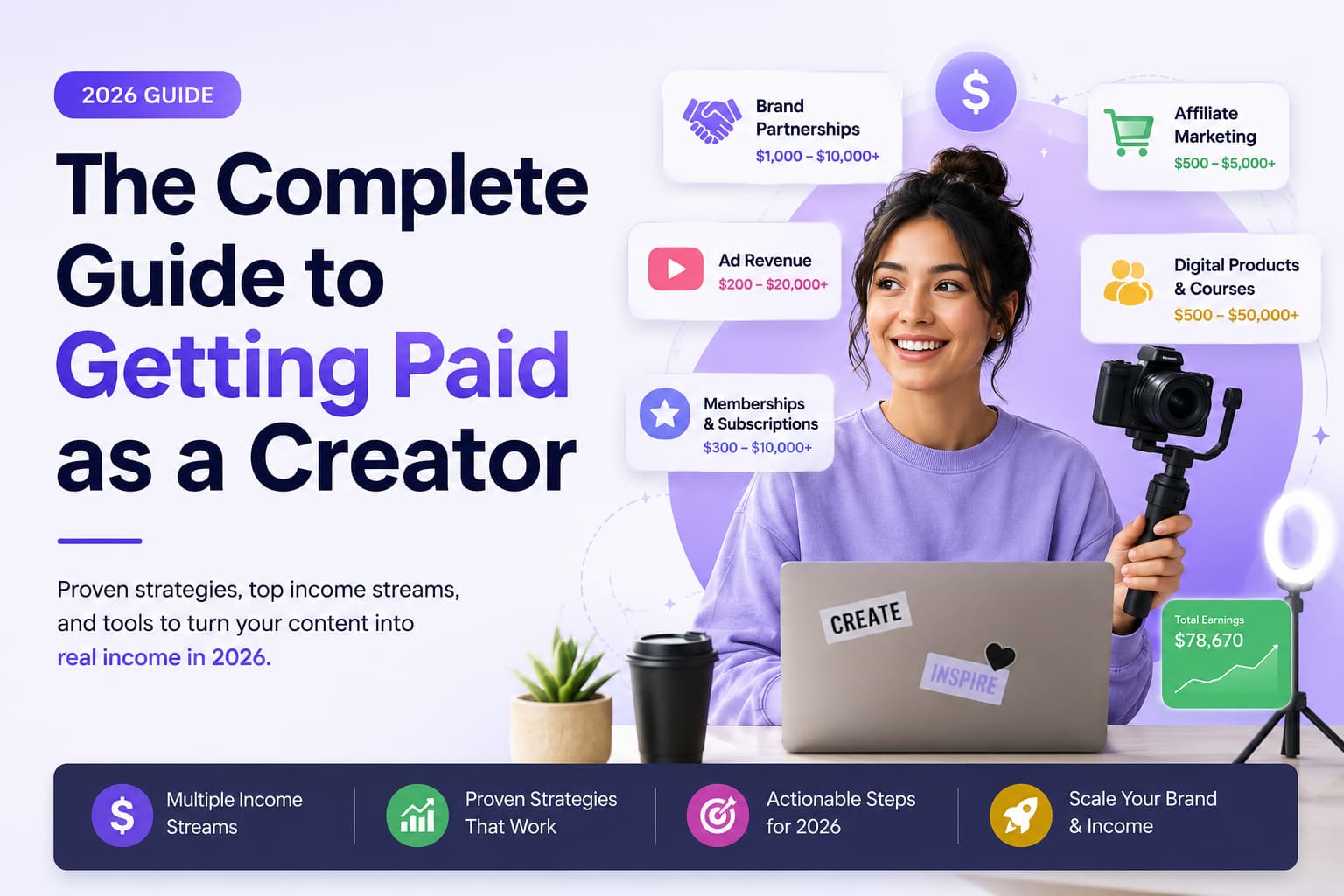
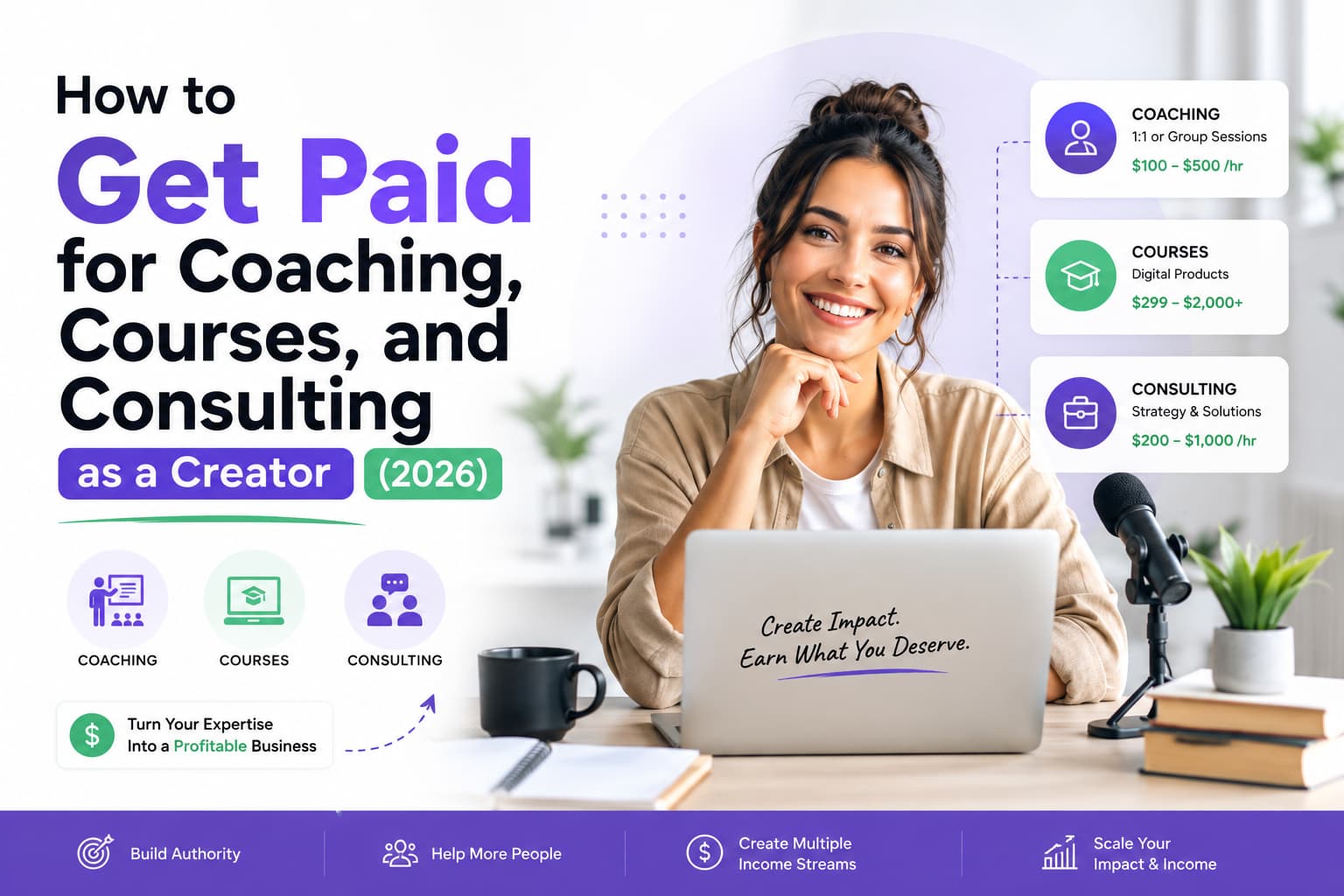
Creators get paid for coaching, courses, and consulting by packaging an offer, taking payment through Stripe, PayPal, or a checkout page, then delivering the work. Coaching typically costs $100–$500/hour. Courses typically cost $49–$999. Consulting typically costs $150–$500/hour. You do not need a website. A Stripe Payment Link (2.9% + $0.30, stripe.com/pricing, October 2026) or a PayPal.Me link (3.49% + $0.49, paypal.com, October 2026) is enough to collect the first payment.
Start with 1:1 coaching if you need cash this month. Turn repeating questions into a course. Move into consulting retainers when clients want you inside the business, not on a single call.
Last updated: October 2026.
How do creators get paid for coaching, courses, and consulting?
Creators get paid for coaching, courses, and consulting in the same four moves: name the result, pick a price, send a checkout or invoice, deliver. Coaching is paid per session, package, or monthly retainer. Courses are paid at checkout on Teachable, Thinkific, Stan Store, Gumroad, or a Stripe link. Consulting is paid as a prepaid strategy call, a project invoice, or a monthly retainer. Stripe or PayPal processes the money. Calendly, Stan, or a course platform handles booking and access. Instagram, TikTok, YouTube, and email are how buyers find you — they are not how the bank transfer happens.
Key takeaways
- Coaching, courses, and consulting are three different offers. Coaching is 1:1 time. A course is a recorded product. Consulting is strategy or a project.
- Typical 2026 ranges: coaching $100–$500/hour, courses $49–$999, consulting $150–$500/hour. Charge the outcome, not the clock.
- You get paid when the buyer hits Stripe, PayPal, Stan, Teachable, or an invoice — not when they comment, DM, or book a free call.
- Start with 1:1 coaching. You do not need a course, a website, or 10,000 followers to take the first payment.
- Hold 25–30% of every payout for quarterly US self-employment tax.
What “get paid” actually means
Getting paid is a payment event, not a content event.
1. Buyer agrees to the offer (session, course, or project).
2. You send a Stripe Payment Link, PayPal.Me, Stan checkout, Teachable checkout, or an invoice.
3. They pay. Stripe/PayPal/the platform takes the fee.
4. You get a receipt. Then you deliver the call, the login, or the work.
5. For 1:1, take payment before the session. For courses, grant access after payment. For consulting, take a deposit before kickoff.
If step 2 never happens, you did not get paid. A booked Calendly slot with no charge is not income.
Coaching vs courses vs consulting — which first
- No audience, need money this month: sell 1:1 coaching. One $200 session is faster than building a course.
- Same five questions in DMs every week: record the answers as a $49–$199 course.
- Clients ask you to fix the business, not coach the person: switch that work to consulting (project or retainer).
- Do not launch all three in week one. Stack them: coaching cash → course leverage → consulting retainers.
For every creator income stream, see how creators getting paid.
For checkout options with no website, see 7 ways creators can accept payments without building a website 2026
What’s the difference between coaching, classes, and consulting?
Service | How you get paid | Pricing | Time investment | Scalability | Best For |
Coaching: | 1-on-1 sessions | $100-$500/hour | High (1:1 time) | Low | Deep transformation |
Classes | Digital product | $49-$999 | Low (create once, sell forever) | ||
Consulting | Strategy sessions | $150-$500/hour | High | Medium (1:1 or group) | Medium Business strategy & |
Group coaching | Group sessions | $50-$200/person | Medium (group time) | Community Building | Medium |
Workshops | Live sessions | $29-199 | Medium (live delivery) | Medium | Skill training |
Verified October 2026. Ranges are what creators charge in practice, not list prices from one platform.
Group coaching and hybrid offers
The table already includes group coaching ($50–$200/person) and workshops ($29–$199). Those sit between 1:1 and a recorded course.
Hybrid is the mix most mid-size creators end up with: a course for the framework, plus a weekly group call or a monthly consulting retainer for the hard cases. Example: $199 course + $99/month group office hours, or a $2,000 consulting project that includes the course as pre-work. You still get paid the same way — checkout for the course, Stripe/invoice for the live piece.
How to Get Paid Coaching as a Creator
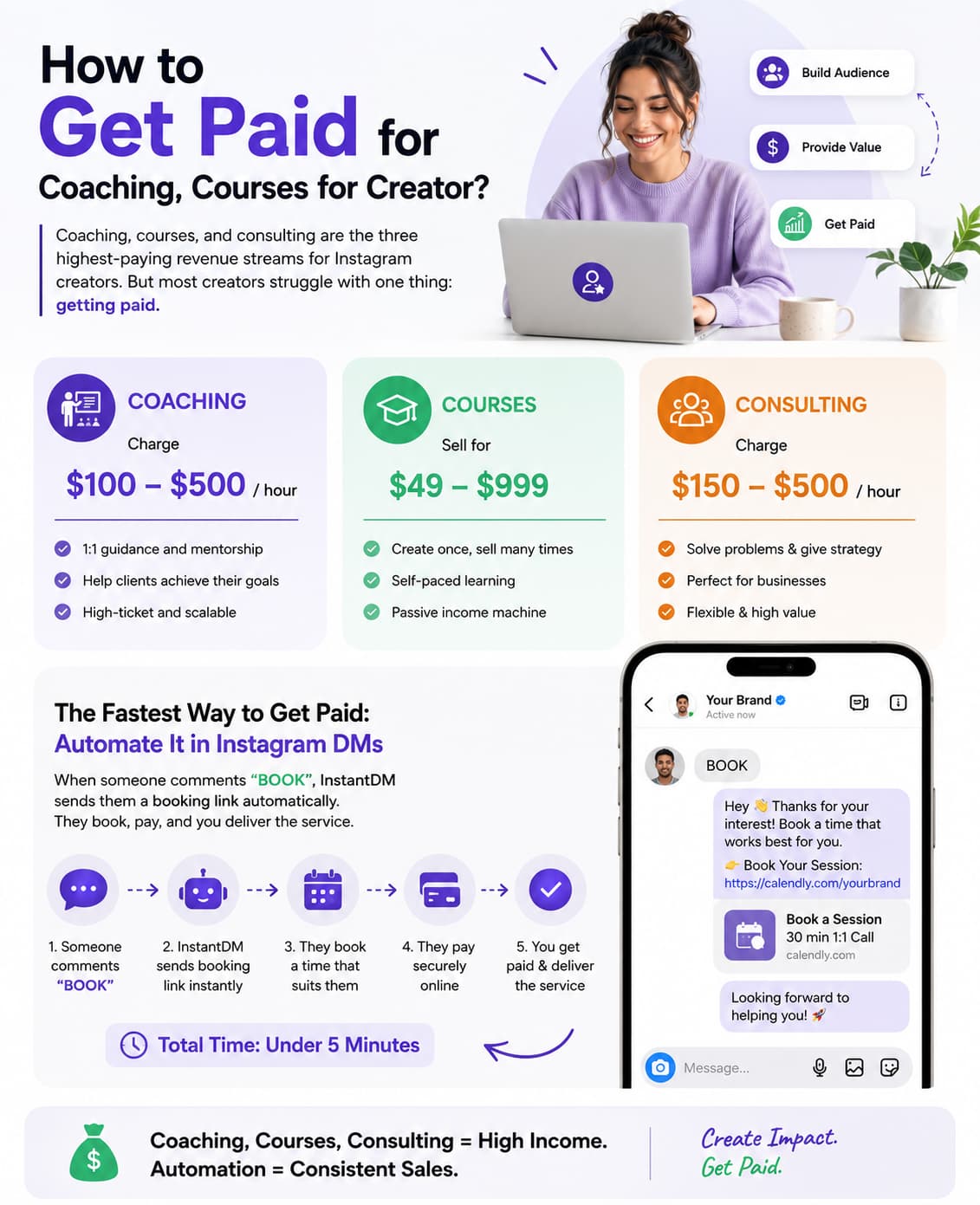
Coaching is the highest-paid service for creators. You sell 1-on-1 sessions where you help someone achieve a particular result.
Coaching Pricing Guide
Session Type | Price | Duration | Best For |
Discovery call | Free | 15-30 minutes | Qualifying leads |
Single session | $100-$300 | 60 mins | |
Package (4 sessions) | Rapid gains | 60 min each | $400-$1,000 |
Monthly retainer | Deeper transformation | $500-$2,000/mo | 4 calls per month |
VIP day | $1,000-$5,000 | Full day | Intensive change |
Setup Coaching Payments
Step 1: Build your coaching offer
- Pick your niche (fitness, business, mindset, etc.)
- Define the result that you help people achieve
- Set your price based on the value of that outcome
Step 2: Make a booking system
- Calendly - free plan available
- Set your availability (eg. Tuesdays and Thursdays 10am-2pm)
- Enter your coaching price and payment terms
- Stripe or Paypal payments
Step 3: Collect payment before the call
Create a Stripe Payment Link or a PayPal.Me link for the session or package. In Calendly, turn on payments so the slot is held only after Stripe charges the card (Calendly + Stripe, 2.9% + $0.30, October 2026).
Put that same link in your bio, your email, and — if you sell from Instagram — in a reply when someone asks to book. Payment first, calendar second. Total time to first paid session: under 15 minutes of setup, then under 5 minutes per buyer.
Coaching Payment Calculations
Hourly Rate | Sessions/Month | Monthly Revenue | Annual Revenue |
$100/hr | 10 | $1,000 | $12,000 |
$200/hr | 10 | $2,000 | $24,000 |
$300/hr | 10 | $3,000 | $36,000 |
$500/hr | 10 | $5,000 | $60,000 |
$200/hr | 20 | $4,000 | $48,000 |
$300/hr | 20 | $6,000 | $72,000 |
If you charge $200 an hour and see 10 clients a month, you’re making $2,000 a month.
At 20 sessions you're making $4000/month.
Three coaching packages (with math)
Package A — Single session, $150
One 60-minute call. Hours in: 1. Rate: $150/hour. Use this to test demand. 8 sessions/month = $1,200.
Package B — 8-week coaching, $1,200
Eight 45-minute calls (6 hours on the calendar) plus async voice notes. If your 1:1 rate is $150/hour, 6 hours = $900 of time. The extra $300 is the plan, the homework, and the guarantee they show up for eight weeks. Two clients at a time = $2,400/month.
Package C — 12-week + VIP, $5,000
Twelve calls (9 hours) + one half-day working session (4 hours) = 13 hours. At $200/hour that is $2,600 of time. The rest is the outcome (the thing they hired you to change) and limited availability. One of these per quarter is $20,000/year on top of weekly 1:1s.
Build A first. Sell B when people rebook. Sell C when a client says “just tell me what to do for 90 days.”
How to Get Coaching Clients on Instagram
1. Set Up Comment-to-DM Automation
Convert casual scrollers into qualified leads, without spending half your day in your inbox. Post actionable advice, client case studies or tactical breakdowns that solve a specific pain point. Then close with a frictionless call to action: "Comment 'BOOK' and I’ll send you the private link."
As soon as they leave a comment, the automation tool will instantly send your Calendly link right to their inbox. This takes all friction out of the purchase – prospects grab an open calendar slot when their buying intent is at its highest peak. You can also create unique trigger words for different campaigns so you can segment your audience seamlessly (e.g. "GUIDE" to give away a free resource and build your email list, vs "SCALE" for a high ticket strategy audit).
2. Create an Evergreen “Highlights Funnel”
Daily Stories disappear after 24 hours but serious, high-intent prospects will thoroughly audit your profile before reaching out. Organise your Story Highlights into focused buckets to turn them into a structured, 24/7 sales pitch:
- Client Wins & Social Proof: Real before-and-after results, video testimonials and unfiltered message screenshots to show your method works.
- How it works: A real, honest look at what working together really looks like from week to week.
- FAQs & Objection Handling: Simple answers to questions about your pricing ranges, weekly time commitment, and who your coaching program is (and isn’t) for.
- Booking: Explain how to book a spot for consultation in a simple manner, with a direct link sticker.
3. Optimise Your Bio for High-Intent Conversion
Skip the vague buzzword titles like “Empowering leaders to thrive.” Your bio should be a high converting landing page that answers 2 core questions in seconds: Who do you help? and What measurable outcome do you deliver?
Example: "I help fitness coaches reach $10k/month without paying for ads. Free 15-minute roadmap call "
If you have multiple offers, anchor that clear promise in a direct booking link or simplified link hub. Make it a habit to send followers to this link in your post captions, carousel closers, and video sign-offs. The fewer taps and hurdles it takes for a viewer to go from consuming your content to getting on your calendar, the higher your client conversion rate will be.
High-Converting Bio Frameworks
A generic bio repels serious buyers. To maximize link clicks and DM triggers, structure your profile with three distinct lines: your value proposition, social proof, and a single frictionless call-to-action (CTA).
- Line 1 (The Hook): State the exact transformation and target audience. Avoid vague aspirations. Use formulas like: I help [ideal client] achieve [measurable result] in [timeframe] without [main pain point].
- Line 2 (The Authority): Establish credibility instantly. Add tangible proof such as: Featured in Forbes | Helped 150+ founders add $50k MRR | Certified ICF Coach.
- Line 3 (The Action): Direct attention immediately to the link or your automated DM keyword. Example: Grab the Free 90-Day Growth Roadmap below
Use a native link-in-bio tool or direct booking page. Avoid cluttering the destination page with ten competing options; limit choices to your primary lead magnet, flagship course, and 1-on-1 application to keep conversion rates high.
How to Convert Your Courses into Paid Courses as a Creator
The most scalable revenue stream for creators are courses. Create once, sell forever. No 1 on 1 time required.
List of course prices
Course Type | Price | Length | Best For |
Mini-course | $29-99 | 1-2 hours | Fast skill training |
Full course | $99-$499 | 5-10 hours | Premium course |
Complete learning | $499-$999 | 10-20 hrs | Deep transformation |
Membership | $9-$99 per month | Continuous learning | Deep transformation |
Ongoing | 4-8 weeks | $299-$999 | Cohort-based |
Setting Up Course Payments
Step 1: Build your course
- Choose your subject (what do people ask you most?)
- Describe your modules (5-10 modules, 3-5 lessons each)
- Record your lessons (use your phone/laptop)
- Edit and upload to your course platform.
Step 2: Select a course platform
Platform | Pricing | Features | Best For |
Teachable | $39/mo | Full Course Platform, Payments, E-mail | Professional courses |
Thinkific | $49/mo | Course builder | Community Certificates |
Gumroad | Free (10% fee) | All-in-one | Simple selling, file transfer |
Stan Store | $29/mo | Link-in-bio + course hosting for Instagram creators by | Podia |
Podia | $39/mo | Courses, memberships, email | Simple all in one |
Step 3: Put checkout on a link you can send
If the course lives on Teachable ($39/mo, teachable.com/pricing, October 2026), Thinkific, Stan Store ($29/mo, stan.store, October 2026), or Gumroad (10% per sale, gumroad.com, October 2026), copy the product URL. If you host files yourself, use a Stripe Payment Link and send the login after the receipt.
Share that URL in bio, email, Stories, and comments. The platform grants access after payment. You are not paid when someone comments “COURSE.” You are paid when checkout completes.
Course Payment Math
Course Sales/Month | Price | Monthly Revenue | Yearly Revenue |
$49 | 10 | $490 | $5,880 |
$49 | 50 | $2,450 | $29,400 |
$99 | 10 | $990 | $11,880 |
$99 | 50 | $4,950 | $59,400 |
$199 | 10 | $1,990 | $23,880 |
$199 | 50 | $9,950 | $119,400 |
$4,950/month at $99 per course with 50 sales per month.
You make $9,950/month (50 sales at $199).
How to Sell Courses on Instagram
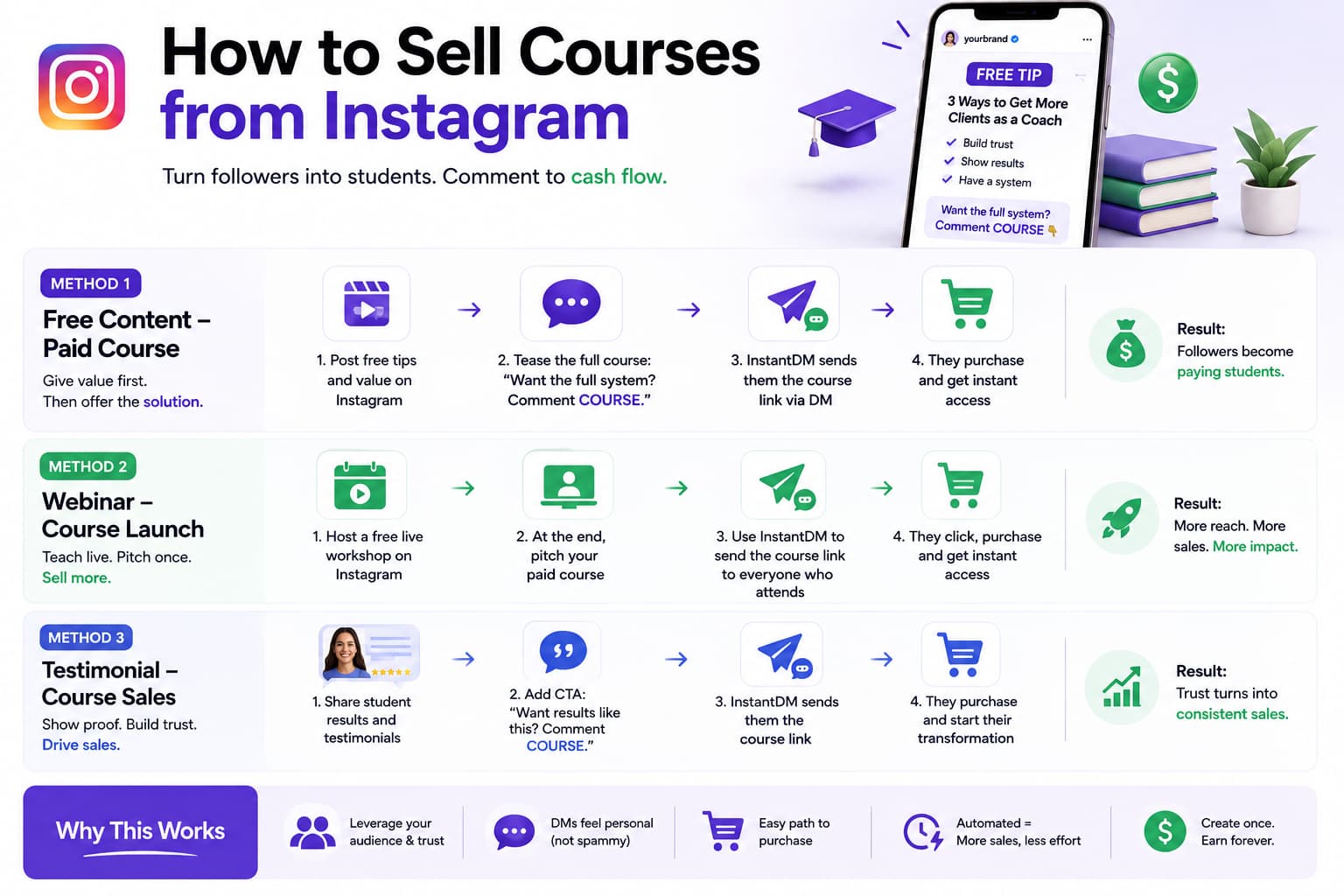
Method 1: Free content vs Paid course
- Post free tips & value on IG
- Preview the full course: "Want the whole system? Comment COURSE.
- Instagram Automation tool, DMs them the course link
- They buy and get instant access
The "Pain-to-Product" Content Playbook
To drive consistent "COURSE" comments, structure your feed content around the tension between what to do (free) and how to implement it step-by-step (paid).
- The Carousel Teardown: Slide 1 highlights a common, costly mistake. Slides 2 through 6 provide the conceptual framework to solve it. Slide 7 demonstrates a real case study of the solution in action. Slide 8 delivers the CTA: "Want my exact plug-and-play templates and weekly workflow? Comment 'COURSE' and I'll DM you instant access."
- The Behind-the-Scenes Reel: Show yourself working inside the course dashboard, reviewing student submissions, or updating a proprietary spreadsheet. Visualizing the tangible product removes friction and skepticism before the prospect even opens their DMs.
Method 2: Webinar - Launch course
- Instagram free live workshop
- At the end, promote your paid course
- Send the link of the course to all those who attend by using Instagram Automation tool.
Method 3: Testimonial – Course sales
- Post student results and testimonials
- Want results like this? Comment SET.
- Instagram Automation tool, provides them with the course link
Getting Paid for Consulting as a Creator
Consulting is strategy work. You are helping business to solve particular problems – marketing, growth, operations or product strategy.
Consulting Rate Guide
Type of Consulting | Price | Duration | Best For |
Strategy call | $150-$300 | 60 min | Fast Strategy Session |
Half-day consulting | 4 hours | $500-$1,500 | Deep strategy dive |
Full-day consulting | $1,000 - $5,000 | 8 hours | Comprehensive strategy |
Monthly retainer | $1,000-$5,000/mo | 10-20 hours / month | Advice on moving to a project basis |
$2,000-$20,000 | varies | Specific deliverables |
How to Set Up Payments for Consulting
Step 1: Identify your consulting offering
What do you fix? I help DTC brands go from $10K to $100K/month.
What is your perfect client? E-commerce brands that make $10K-$50K/month
And what happens? (e.g., “3x revenue in 90 days”)
Step 2: Develop a booking and payment system
- Schedule with Calendly
- Stripe or PayPal
- Require prepayment ahead of the session
- Send project work contract
Step 3: Invoice or link, then kickoff
For a single strategy call: Stripe Payment Link or Calendly payment, paid before the call.
For a project: send a simple invoice (Stripe Invoice or PayPal) for 50% to start, 50% on delivery. Do not start work on a verbal yes.
For a retainer: charge the month in advance on the same date.
Attach a one-page scope: what’s included, what’s not, reschedule window (24 hours), refund rule. Then send the kickoff time.
Math Consulting Payment
Hourly Rate | Hours/Month | Monthly Revenue | Yearly Revenue |
$150/hour | 10 | $1,500 | $18,000 |
$200/hr | 10 | $2,000 | $24,000 |
$300 / hour | 10 | $3,000 | $36,000 |
$500/hr | 10 | $5,000 | $60,000 |
$200 per hour | 20 | $4,000 | $48,000 |
$300 per hour | 20 | $6,000 | $72,000 |
Project vs retainer vs hourly
- Hourly ($150–$500/hour): use for a first diagnostic. Cap it at 2 hours or it turns into unpaid Slack.
- Project ($2,000–$20,000): one outcome, one deadline, one invoice. Example: “rewrite your offer and sales page in 14 days.”
- Retainer ($1,000–$5,000/month): 2 calls + async questions. Bill on the 1st. Stop the work if the invoice is unpaid.
Creators undercharge consulting by billing it like coaching (time) instead of like a project (result). If the deliverable is a plan they will run without you, it is consulting. Price the plan.
What are the best payment methods for coaching, courses and consulting?
Best payment method | for fees | Setup Time | |
Stripe | All services | 2.9% + $0.30 | 5 minutes |
PayPal | All services | 3.49% + $0.49 | 5分钟 |
Calendly + Stripe | Coaching / consulting | 2.9% + $0.30 | 10 Minute |
Teachable | Courses | 5% + transaction charge | 30 minute |
Stan Store | Courses (Instagram) | Stripe fees only | |
Gumroad | 30 minutes | Digital products | 10% per sale |
5 min |
Verified October 2026. Stripe fee from stripe.com/pricing. PayPal fee from paypal.com. Teachable fee from teachable.com/pricing. Gumroad 10% from gumroad.com. Stan Store $29/mo from stan.store. InstantDM is not in this table because it does not process payments.
Best Practice: Accepting Stripe and PayPal
When someone comments "BOOK" or "COURSE" automation tool can send them both payment options. Let the buyer choose.
Why it works
- Some like Stripe (credit card)
- Some buyers prefer PayPal (i.e. account balance)
- Offering both boosts conversion rates
- You get paid no matter what
Deposits, payment plans, and BNPL
- 1:1 and consulting: take 100% before the call, or 50% deposit on projects over $1,000.
- Courses over $300: offer 3 payments (example: $399 course = 3× $133). The platform or Stripe Billing runs the schedule. You still owe tax on each installment when it clears.
- High-ticket ($2,000+): some coaches use client financing / BNPL so the buyer pays monthly and you get most of the fee up front. That is a lender, not Stripe. Only use it if you can still deliver if the buyer defaults on the lender.
Do not start a $5,000 consulting project on “I’ll pay you Friday.”
How the money actually lands
1. Pick the offer (session, course, project).
2. Create the checkout (Stripe link, PayPal.Me, Stan, Teachable, invoice).
3. Send the link — bio, email, DM, or comment reply.
4. Buyer pays. You get an email receipt.
5. You deliver (Zoom, course login, or files).
6. You keep the receipt for tax. US creators: quarterly estimates (April 15, June 15, September 15, January 15).
That is the whole “how to get paid” loop. Everything else is distribution.
Sending the checkout link from Instagram
If the buyer is already in comments or DMs, send the same Stripe/PayPal/Stan/Teachable link there. Manual reply works. If comment volume is high, an Instagram DM automation tool can send that link when someone comments BOOK, COURSE, or CONSULT. InstantDM does this: it DMs the checkout link. Stripe or PayPal still processes the payment. This instagram automation tool does not collect the money, host the course, or replace Calendly. Use it after the offer and checkout already exist. Do not build the offer around the keyword.
The Post-Purchase Retention & Upsell Strategy: Turning One-Time Buyers into Recurring Revenue
Getting a new lead on Instagram takes work, creativity and consistent content creation. If your monetisation engine stops the moment a prospect buys a $49 mini-course or books a $150 consulting session, you’re leaving more than half your potential revenue on the table.
The real secret to building a six-figure creator business isn’t just making that first sale – it’s creating an automated ascension flywheel that systematically moves buyers from low-ticket products up into high-ticket coaching retainers.
Free Content & Lead Magnets: satisfy immediate curiosity and build trust by providing bite-sized value. $29-$99 Mini-Courses: target one specific isolated bottleneck quickly to establish paid-buyer intent.
$299–$999 Full Courses & Group Cohorts: Offers the full end-to-end framework and systematic roadmap. $1,000–$5,000 1-on-1 Retainers & VIP Days: Provides direct, hands-on execution, rapid customisation, and personalised accountability.
Implement Automated 7 Day & 14 Day Check-Ins
Set up an automated trigger through your CRM or email marketing provider when someone buys an online course or completes a single strategy call:
Day 7 Check-in: Send a personal message that says, “What’s your biggest takeaway so far? "Reply if you get stuck."
Day 14 Case study: Send a detailed breakdown of a client that implemented the whole system and had a 1 on 1 follow up.
The Follow-Up Offer “Like what you see, but want to have me audit your strategy in person? Reply ‘AUDIT’ to book a VIP accelerator call at an exclusive student rate.
Create an Off-Boarding to Retainer Pipeline
Don’t finish a 60-minute consulting call or a 4-week coaching package with a plain ‘Good luck!’ Instead, use this 3-step closing sequence during the last 10 minutes:
Review the Transformation: Detail what they did, the milestones achieved, their 90-day targets.
Find the Next Bottleneck: Next, identify the challenge they will inevitably face as they scale, whether it be pipeline management, team hiring, or conversion optimisation.
Offer Continuous Support: Sustain regular execution and momentum through a monthly recurring advisory retainer ($1,000-2,500/month for two 45-minute sprint calls and async Slack access).
Pro-Tip: Client Contracts and Refund Policies
Use these operational safeguards to prevent chargebacks and maintain the health of your payment merchant accounts:
Digital Products & Instant Access Courses: Ensure that it is clearly stated on the checkout page that purchases are non-refundable once content has been accessed, or are subject to a strict 14-day action-based refund policy requiring proof of completed assignments.
High Ticket Consulting & 1:1 Coaching: Embed e-signature agreements into your Calendly intake process. Get clients to sign off on scope boundaries, rescheduling policies that require at least 24 hours notice, and intellectual property terms before the kickoff call.
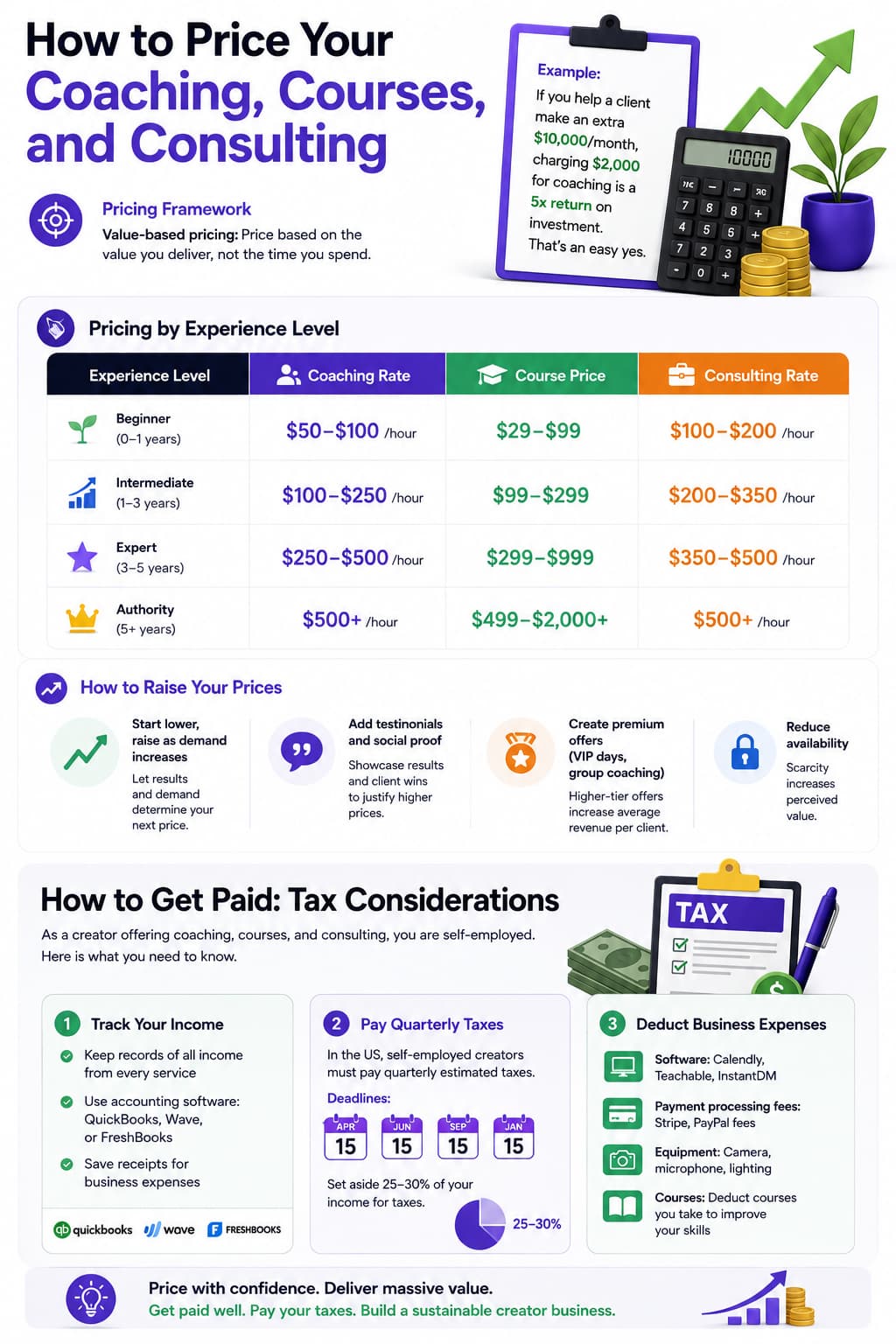
Pricing Your Coaching, Courses and Consulting: A Pricing Framework
Value-based pricing: Charge for the value you provide, not the time you invest.
If you help a client make an extra $10,000/month, charging $2,000 for coaching is a 5x ROI. Oh, hell yes.
Pricing by Experience Level
Experience Level | Coaching Rate | Course Price | Consulting Rate |
Beginner (0-1 years) | $50-$100/hour | $29-$99 | $100-$200/hour |
Mid level (1-3 years) | $100-$250/hr. | $99-$299 | $200-$350/hr |
Expert (3-5 yrs) | $250-$500/hour | $299-$999 | $350-$500/hour |
Authority (5+ years) | $500+/hour | $499-$2,000+ | $500+/hour |
How To Increase Your Prices
- Start low, go up as demand goes up
- Add and social proof
- Develop high-end products (VIP days, group coaching)
- Less available (scarcity increases value)
Income by stage
- $0–$1,000/month: 1:1 only. 5–8 sessions. No course. No retainer.
- $1,000–$5,000/month: keep 1:1, add one $99–$199 course for the questions you repeat. Optional group at $50–$200/person.
- $5,000+/month: fewer 1:1s, one flagship course or cohort, 2–4 consulting retainers.
The stage is about which offer you sell, not follower count.
Payment: Tax implications
As a creator selling coaching, courses & consulting, you are self-employed. This is what you need to know.
- Monitor your earnings
- Log all income from each service
- Utilise accounting software: QuickBooks, Wave, or FreshBooks
- Keep receipts for business expenses
- Make Quarterly Tax Payments
Self-employed creators in the US pay quarterly estimated taxes.
Deadlines:
- April 15
- June 15
- September 15
- January 15
Allocate 25-30% of your income for taxes.
Business Expenses
- Software: Calendly, Teachable.
- Payment Processing Fees: PayPal fees , Stripe
- Equipment: Camera, microphone, lighting
- Courses: Subtract courses you take to improve your skills
How We Researched This Guide
We looked at three things: what creators actually charge, what payment systems hold up, and what Instagram DM flows convert.
- Pricing research — We pulled rate ranges from creator communities, course marketplaces, and coaching directories. The numbers reflect what creators charge in practice, not aspirational blog math.
- Payment testing — We set up Stripe, PayPal, and Calendly across test accounts to confirm fees, payout times, and setup friction. The 2.9% + $0.30 Stripe figure and the 3.49% + $0.49 PayPal figure come from the payment providers' own documentation.
We update this guide when pricing, platform features, or Instagram's rules change.
Last reviewed: October 2026
How to Get Paid as a Creator: What Do Redditors Say?
Reddit discussions in r/InstagramMarketing, r/creators and r/entrepreneur consistently recommend these strategies:
Automated Payment Link Distribution
Calendly
Best for scheduling. Free plan and Stripe integration are loved by Reddit users.
Teachable
Best for courses. Redditors love the full course platform.
Stripe
Best for payments. Reddit users are loving the 2.9% + $0.30 fee structure.
Gumroad
Best for fast digital product sales. Redditors love the no monthly fee with 10% fee model.
About the Author
Aravindh Kumar is an ecommerce and Instagram growth specialist with 8+ years of experience in online selling. He has worked with 500+ brands including Forbes-listed companies to help them build more than 200 profitable Instagram sales channels.