Last Updated: 09 November 2026 Short answer: Growth marketing for small businesses is a data-driven way to win and keep customers by running small, measurable experiments across the whole customer journey, from first discovery to repeat purchase and referral. To start: set one measurable goal, record your baseline numbers (cost per customer, conversion rate, repeat rate), run one experiment per week on the channel where your customers already are, then scale what works and drop what doesn’t.
Key takeaways
- Growth marketing replaces guesswork with a test-measure-learn loop.
- You need four numbers to start: new customers, acquisition cost, conversion rate, and repeat purchase rate.
- Social media is the cheapest place to run experiments, especially when you pair posts with automated DMs.
- A 90-day plan with one experiment per week gives you about 12 data points, enough to find your first reliable winner.
1. What is growth marketing for small businesses?
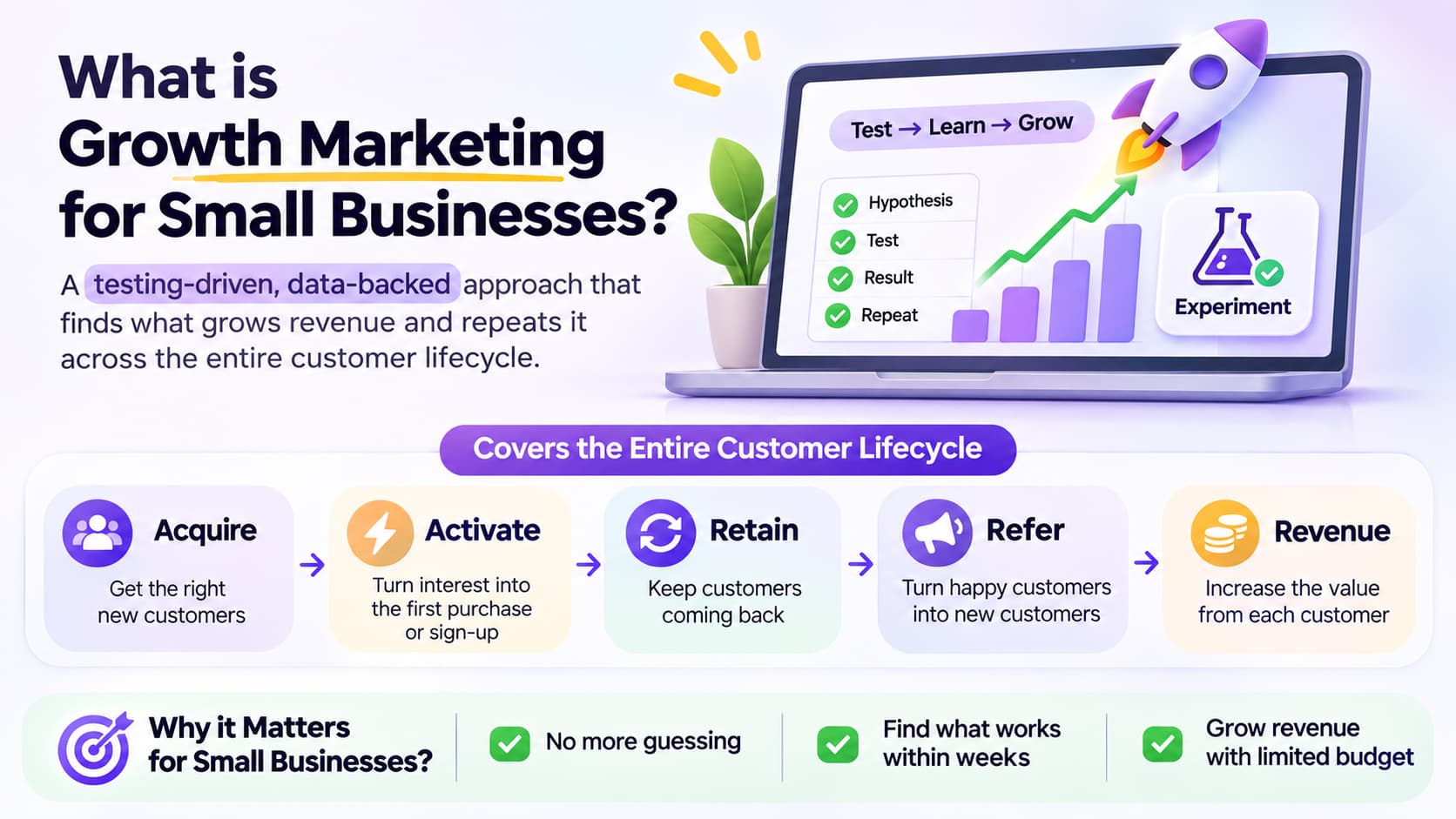
Growth marketing is a testing-driven approach that uses data to find which marketing actions grow revenue, then repeats those actions across the entire customer lifecycle. Unlike one-off campaigns, it treats every post, email, and offer as an experiment with a hypothesis and a result. As a Forbes article on the topic puts it, growth marketers approach their strategies like scientists, with experimentation at the center.
For a small business, that matters for one reason: you cannot afford to guess. A big brand can burn budget on a flop. You need to know within weeks, not quarters, which efforts pay off.
Growth marketing covers more than getting new customers. It includes activation (the first purchase or sign-up), retention (repeat purchases), referrals, and revenue per customer.
2. What is the difference between growth marketing and digital marketing?
Growth marketing differs from digital marketing in method, not channel: digital marketing is defined by where you promote (online), while growth marketing is defined by how you decide (experiments and data). A growth marketer may use the same channels, such as email or Instagram, but tests and measures every move.
| Growth marketing | Digital marketing | Traditional marketing | |
| Core idea | Test, measure, and scale what works | Promote through online channels | Build awareness through offline media |
| Scope | Full customer journey | Mostly acquisition and awareness | Awareness |
| Decisions based on | Experiment results | Mix of data and judgment | Judgment and reach estimates |
| Typical example | A/B testing two Instagram offers and tracking sales | Publishing blog posts for traffic | A local radio or billboard ad |
| Feedback speed | Days to weeks | Weeks to months | Months |
3. What is the AARRR framework for small businesses?
The AARRR framework, created by investor Dave McClure, breaks growth into five stages: Acquisition, Activation, Retention, Referral, and Revenue. It tells you where customers are leaking out so you test the right stage first.
| Stage | Question to answer | Small business tactic | Metric |
| Acquisition | How do people find us? | Short videos, local SEO, collaborations | New visitors or followers per week |
| Activation | Do they take the first step? | Free guide, discount code, first-order offer | Conversion rate to lead or first purchase |
| Retention | Do they come back? | Email and DM follow-ups, loyalty perks | Repeat purchase rate |
| Referral | Do they bring others? | “Bring a friend” rewards | Referrals per 100 customers |
| Revenue | Is it profitable? | Bundles, upsells, price tests | Revenue per customer, LTV |
Fix the earliest broken stage first. More traffic does not help if few visitors convert.
4. How do you start growth marketing? A 6-step plan
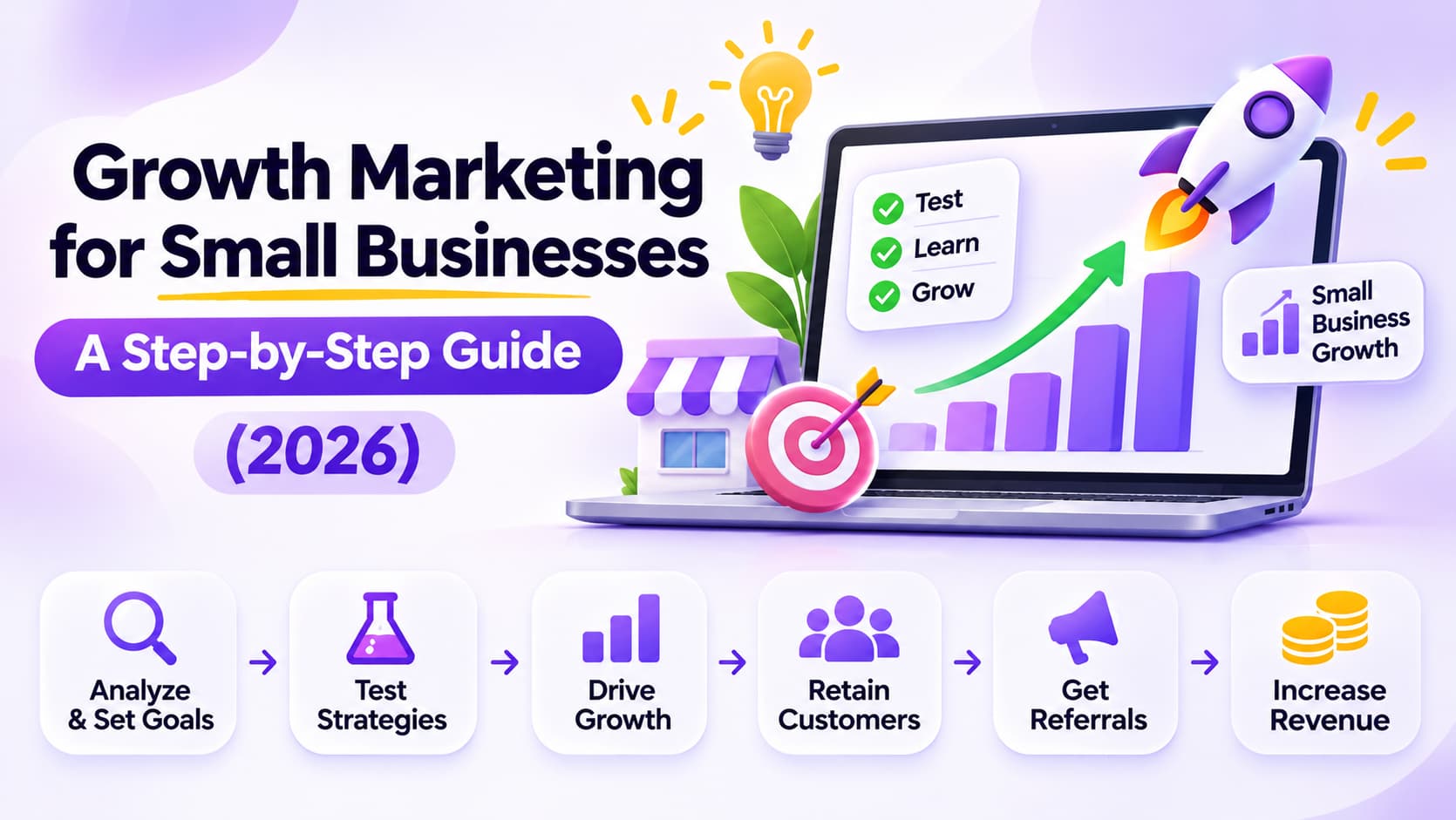
To start growth marketing as a small business, follow six steps: set one goal, measure your baseline, choose one channel, list experiment ideas, run one test per week, and review monthly.
- Set one measurable goal. Example: “Add 40 new customers in 90 days” or “Raise repeat purchase rate from 15% to 22%.” One goal keeps testing focused.
- Record your baseline. Write down current new customers per month, marketing spend, conversion rate, and repeat purchase rate. Without a baseline you cannot tell whether a test worked.
- Pick one channel to start. Choose where your customers already spend time. For most consumer and service businesses that is Instagram or Facebook.
- Build an experiment backlog. List 10 ideas, then score each from 1–10 on Impact, Confidence, and Ease (the ICE method). Average the three and test the highest scores first.
- Run one experiment per week. Change one variable only: the hook, the offer, the call to action, or the posting time. Run it long enough to get a meaningful sample.
- Review monthly and decide. For each test choose: scale it, iterate on it, or drop it. Write the result down so you never repeat a failed test.
5. What are the best low-budget growth marketing strategies for small businesses?
The best low-budget strategies are the ones that use customers and content you already have: re-engaging existing customers, referral rewards, short-form social content, email and DM follow-ups, and testimonials. They cost time rather than ad spend.
The Ansoff Matrix, created in 1957, gives you four directions for growth. Most small businesses should start with the first two.
| Ansoff pillar | What it means | Small business example | Risk |
| Market penetration | Sell more of your current offer to your current market | Loyalty perk, birthday offer, more frequent posting | Low |
| Market development | Take your current offer to a new audience | New neighbourhood, new platform, new customer segment | Medium |
| Product development | New offers for your current customers | Seasonal item, add-on service, digital product | Medium |
| Diversification | New offers for a new market | Adjacent product line for a new audience | High |
Seven tactics to test first (ordered by typical effort):
- Win-back email to customers who have not purchased in 60–90 days.
- Referral offer with a reward for both the referrer and the new customer.
- Customer testimonials as short videos or screenshots in posts.
- Comment-to-DM offers on social posts (see Section 6).
- Email or DM welcome sequence for new leads.
- Bundle or upsell test at checkout or booking.
- Local collaboration, such as a joint giveaway with a neighbouring business.
6. How can a small business use social media for growth marketing?
A small business can use social media for growth marketing by turning every post into a measurable experiment: publish content with one clear call to action, move interested people into direct messages, capture their contact details, follow up automatically, and track which posts produce sales. We call this The Social Growth Loop.
The Social Growth Loop (5 steps)
- Post with one clear call to action. Example: “Comment GUIDE and I’ll send you the checklist.”
- Reply instantly with a DM. Comment-to-DM automation sends the offer the moment someone comments, so interest never goes cold. The same approach works for story replies and Live comments.
- Capture the lead. Ask for an email or phone number inside the conversation with a visual DM automation flow. If your audience is split across platforms, set up the same flow for Facebook.
- Nurture with follow-ups. Follow up with people who replied to your first DM but have not bought yet, and personalize the message: McKinsey reports that faster-growing companies derive 40% more of their revenue from personalization than slower-growing ones. Follow-up messages can do this automatically, within Meta’s messaging window (rules below). For multi-step conversations, add delays and branching conditions.
- Measure and repeat. Compare posts by comments, DMs opened, leads captured, and sales. Double down on the post types that win.
Know Meta’s rules before you automate. Instagram automation requires a Business or Creator account; Instagram’s Help Center explains how to switch to a professional account. Under Meta’s private reply rules, a business can send one private reply to a person who commented, within 7 days of the comment (for Instagram Live, only while the broadcast is running). It can send follow-ups only if that person replies, and within 24 hours of the reply. Automation tools build on Meta’s official Instagram Messaging API, so check any provider’s setup against Meta’s documentation.
Tools that make the loop run without extra staff
- Scheduling with the offer attached: schedule each post with its automation already set, so it goes live ready to capture comments.
- Better link behavior: an open-in-app link opens in the target app instead of Instagram’s in-app browser.
- AI replies for common questions: an AI agent can answer FAQs inside the conversation, with a human taking over when needed.
- Account safety: automation should run on Meta’s official API. Review any tool’s safety documentation before connecting your account.
7. What metrics should a small business track for growth marketing?
Track six metrics: customer acquisition cost (CAC), conversion rate, repeat purchase rate, churn rate, customer lifetime value (LTV), and the LTV to CAC ratio. Likes and follower counts are vanity metrics unless they connect to one of these.
| Metric | Formula | What it tells you |
| CAC | Total marketing spend ÷ new customers acquired | What you pay to win one customer |
| Conversion rate | Customers or leads ÷ people who saw the offer × 100 | How persuasive your offer is |
| Repeat purchase rate | Customers who bought 2+ times ÷ total customers × 100 | How well you retain |
| Churn rate | Customers lost in a period ÷ customers at the start × 100 | How fast you leak |
| LTV | Average order value × orders per year × years retained (use gross margin for a stricter view) | What a customer is worth |
| LTV : CAC | LTV ÷ CAC | A widely cited rule of thumb is 3:1 or better |
Worked example (illustrative numbers, not a real client): A bakery spends $600 in a month on marketing and wins 30 new customers. CAC = $600 ÷ 30 = $20. The average customer spends $18 per order, orders 8 times a year, and stays 2 years. LTV = $18 × 8 × 2 = $288. LTV : CAC = 288 ÷ 20 = 14.4 : 1, a healthy return, so the bakery can afford to test more acquisition spend.
Social media tracking tip: use Instagram’s built-in Insights to see which content drives reach and engagement, and tag leads by source post in a spreadsheet or CRM so you can connect a post to actual revenue. Add UTM parameters to every link so Google Analytics can attribute web sales.
8. How do you run a growth experiment?
A growth experiment changes one variable, defines success before it starts, runs for a set time, and records the result. Use this template for each test.
| Field | Example |
| Hypothesis | If we offer a free recipe card in a comment-to-DM, lead capture will rise 20% versus a discount code |
| Variable changed | Offer type only |
| Success metric | Leads captured per 1,000 reach |
| Duration and sample | 2 posts per version over 2 weeks |
| Result | Written after the test |
| Decision | Scale, iterate, or drop |
Two cautions: do not stop a test early because the first day looks good, and do not compare posts published at very different times or with different audiences without noting it. Marketing leaders see the value too: Deloitte’s 2026 CMO Survey reports a desire for some risk-taking and disciplined experimentation to strengthen core strategies.
9. A 90-day growth marketing plan
A practical 90-day plan has three phases: foundation (weeks 1–2), experimentation (weeks 3–8), and scaling (weeks 9–12).
| Weeks | Focus | Actions | Output |
| 1–2 | Foundation | Set goal, record baseline, add UTM links, set up lead capture | Baseline sheet |
| 3–4 | Acquisition tests | Test 2 hooks and 2 calls to action on social posts | 4 results |
| 5–6 | Activation tests | Test offers (guide vs discount) and DM wording | 2–4 results |
| 7–8 | Retention tests | Launch a follow-up sequence and a win-back message | Repeat rate change |
| 9–10 | Referral test | Launch a simple “bring a friend” reward | Referrals per 100 customers |
| 11–12 | Scale and review | Put winners on autopilot, drop losers, plan next quarter | Next-quarter backlog |
10. Growth marketing examples for small businesses
Real example: The beverage developer Flavorman moved from random email efforts to personalized messages using customer data and, according to Constant Contact’s case write-up, raised its email open rate by 11% and grew its list by another 11%.
Illustrative scenarios (hypothetical, to show the method):
- Neighbourhood salon: hypothesis that a “comment BOOK for this week’s open slots” offer fills quiet days. Metric: bookings per post. Decision: scale if bookings beat the usual weekly average.
- Online jewelry shop: test a free care-guide PDF versus a 10% code in the DM. Metric: email captures per 1,000 reach, then first-purchase rate from each group.
- Fitness coach: test a Reel with a “comment PLAN” call to action against a static post. Metric: DMs started and trial sign-ups.
11. Common growth marketing mistakes to avoid
- Testing too many things at once, so you cannot tell what worked.
- Chasing followers instead of customers. Follower growth that does not convert is a vanity metric.
- No baseline, so every result is ambiguous.
- Ignoring retention. Keeping a customer usually costs less than winning a new one.
- Over-automating the human moments. Automate speed and routine answers, and keep a person available for complex questions.
- Skipping platform rules. Use tools built on official APIs and follow Meta’s messaging policies.
12. Which growth marketing tools do you need, by budget?
Budget benchmark: Gartner’s 2026 CMO Spend Survey found marketing budgets average 7.8% of company revenue. The vast majority of respondents ran companies with more than $1 billion in revenue, so treat it as a reference point, not a target for a small business.
| Budget | Core tools | Notes |
| $0 | Spreadsheet, Google Analytics, native Instagram Insights. | Enough to run the 90-day plan |
| Under $100 per month | Email platform, scheduler, a paid InstantDM plan for unlimited automations and post scheduling | Compare automation tools on price and limits before you commit |
| $100–500 per month | Add small paid social tests and a CRM | Only after a free-channel winner is proven |
Conclusion
Growth marketing for small businesses comes down to a habit: pick one goal, measure a baseline, run one experiment a week, and keep what works. Social media is the fastest place to practice because feedback arrives in days, and automating the comment-to-DM step means you capture interest while it is warm.