
Instagram remains one of the most powerful platforms for influencers in 2026, but the way money actually flows has shifted. Direct platform payouts exist and are worth enabling, yet they rarely form the bulk of sustainable income. The creators who consistently earn treat Instagram as an attention and relationship engine, then route that attention into multiple controlled streams: affiliate commissions, brand collaborations, owned digital offers, and structured Amazon storefronts. Automation helps remove friction, especially around link delivery and basic recruiting or lead qualification, but only when it stays within Meta’s rules.
This guide answers four practical questions that keep coming up for creators:
- What are the best programs for influencers to earn through Instagram?
- What are the best strategies to promote Amazon products as an influencer?
- What are the best strategies for influencers to grow their Amazon storefronts?
- What tools can help automate recruiting (or high-intent conversations) on Instagram?
It draws from current 2026 rates and practices across major guides, official program details, creator discussions, and tool comparisons, while filling common gaps: realistic expectations, integrated systems rather than isolated tactics, transparent tool evaluation, and real experiences from people doing the work.
What Are the Best Programs for Influencers to Earn Through Instagram in 2026?
There is no single “best” program. The accounts that perform well stack several. Native Instagram features provide some income and social proof. Affiliate networks and brand marketplaces supply volume and higher-ticket opportunities. Owned products and services deliver the highest margins and the most control.
Native Instagram Monetization Features
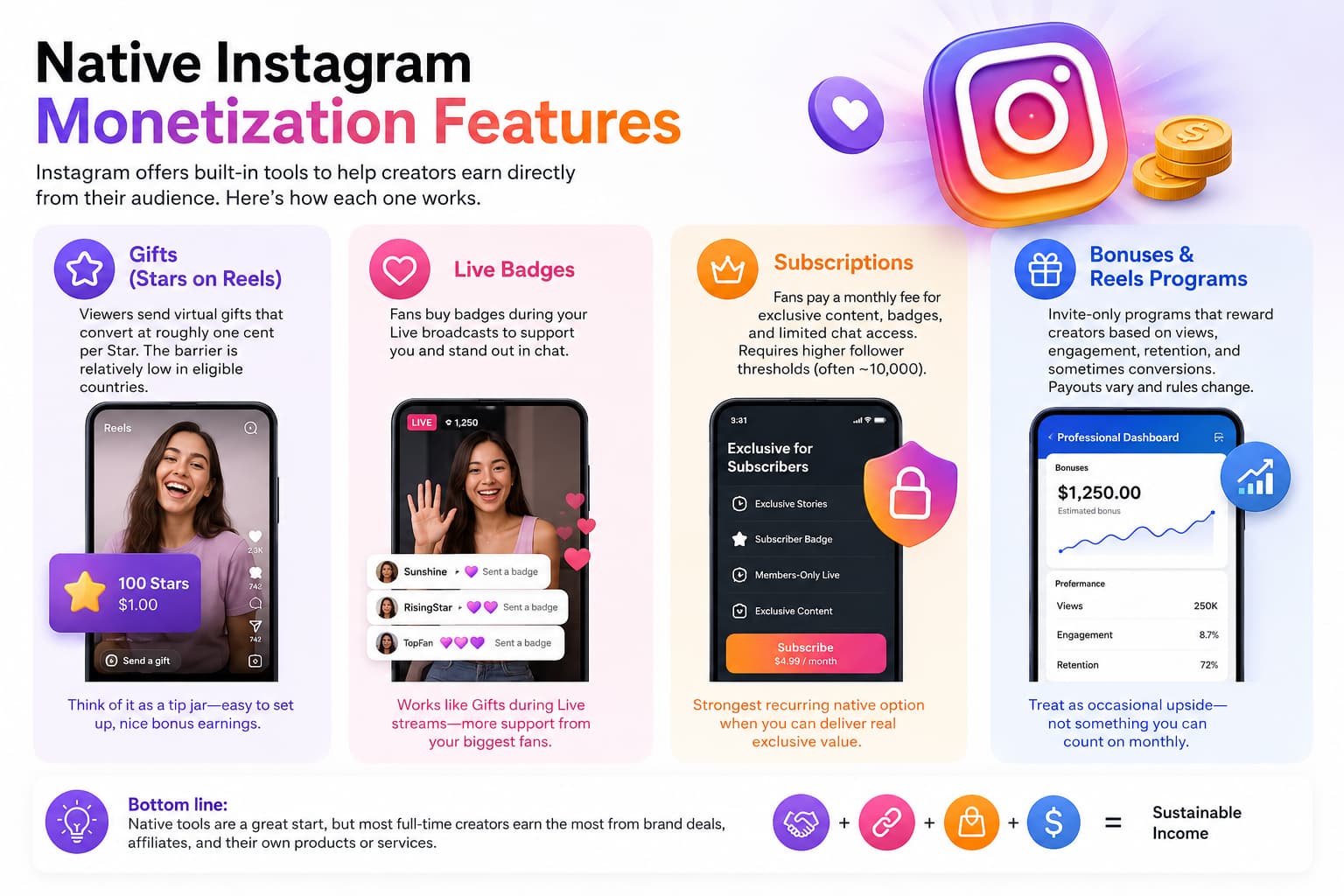
Instagram’s built-in options are accessible once you have a professional account and meet basic eligibility (usually 18+, good standing, and region-specific thresholds).
Gifts (Stars on Reels) let viewers send virtual gifts that convert at roughly one cent per Star. The barrier is relatively low in eligible countries. Live Badges work similarly during broadcasts. These function more like tip jars than primary income. Many creators leave them on because the setup cost is near zero, then treat any earnings as a bonus.
Subscriptions require a higher follower threshold in most markets (commonly around 10,000) and let fans pay a monthly fee for exclusive content, badges, and limited chat access. Meta takes no cut on web-based subscriptions in many cases, though Apple and Google take their share on in-app purchases. This is the strongest recurring native option when you can reliably deliver exclusive value.
Bonuses and Reels performance programs are invite-only and change frequently. Payouts vary by views, engagement, retention, and sometimes conversions. Treat them as occasional upside rather than something you can forecast.
These native tools rarely replace the need for external streams. Most full-time creators report that brand deals, affiliates, and owned offers still drive the majority of income.
Affiliate Programs
Affiliate marketing remains the lowest-friction starting point because many programs have no minimum follower count. You promote products you actually use or believe in and earn a commission on qualifying purchases.
Amazon Associates continues to deliver volume for many Instagram creators because of product breadth and high buyer trust, even though commission rates on most physical goods sit in the 1–4.5% range (higher on certain categories such as luxury beauty or digital items). Networks like LTK, ShopMy, and Mavely frequently pay higher percentages (often 10–30% depending on the brand and category) and feel more creator-oriented for fashion, beauty, and lifestyle.
Here is a simplified 2026 commission snapshot many creators reference:
| Platform | Typical Commission Range | Notes |
| Amazon Associates | 1–20% (most physical 1–4.5%) | Highest volume, short cookie window |
| LTK | 10–25% | Strong in fashion & lifestyle |
| ShopMy | 10–30% | Creator-friendly, higher margins |
| Mavely | Up to 30% | Growing quickly in beauty & home |
The practical difference in 2026 is speed. Amazon’s standard cookie window is short. Creators who deliver links almost instantly via automated comment-to-DM responses capture purchases that would otherwise disappear. Manual replies hours later simply miss the window.
Brand Deals and Creator Marketplaces
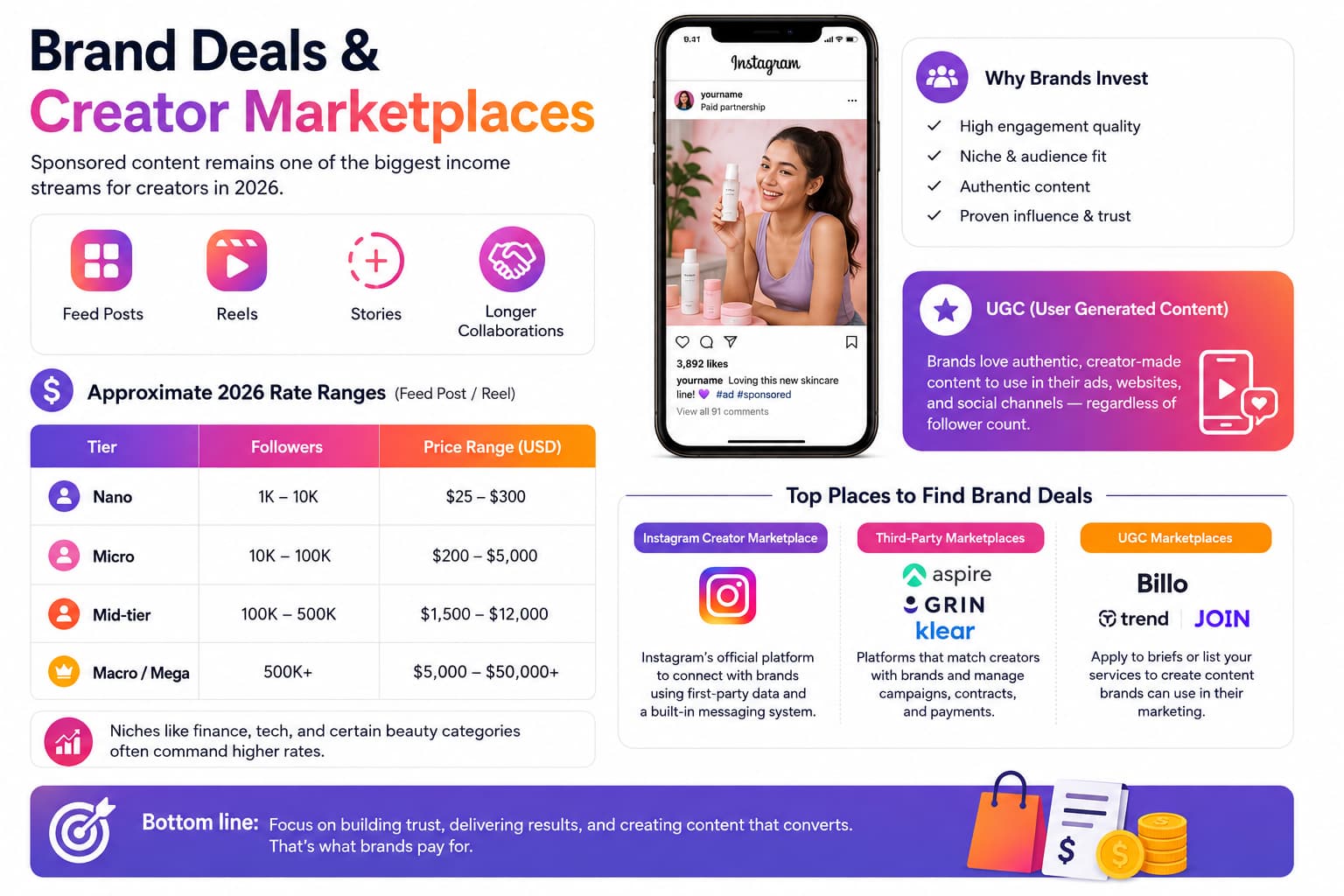
Sponsored posts, Reels, Stories, and longer collaborations still form the largest single line item for many mid-tier and larger accounts. Rates in 2026 continue to scale more with engagement quality, niche, and audience fit than raw follower count.
Approximate 2026 ranges (feed post / Reel):
- Nano (1K–10K): $25–$300
- Micro (10K–100K): $200–$5,000
- Mid-tier (100K–500K): $1,500–$12,000
- Macro / Mega: $5,000–$50,000+
Finance, tech, and certain beauty niches often command premiums. Instagram’s own Creator Marketplace gives brands first-party data and a dedicated messaging channel. Third-party platforms and UGC-focused marketplaces let creators set rates or apply to briefs. UGC-style work (creating content for brands to use in their own ads) has become a reliable entry point for smaller accounts because brands often care more about production quality and authenticity than audience size.
Digital Products, Coaching, and Owned Offers
The highest-margin path for many creators is selling their own digital products, templates, courses, or coaching. Instagram drives discovery and trust; an external storefront or membership platform handles delivery and payments. This stream compounds without requiring a new brand deal every month. Many creators poll their audience in Stories or DMs, then build the exact product people are already asking for.
The consistent pattern across successful accounts is stacking: native tools for some recurring or tip income, affiliates for volume, brand deals for larger checks, and owned offers for margin and control. Relying on any single stream creates fragility.
What Are the Best Strategies to Promote Amazon Products as an Influencer?
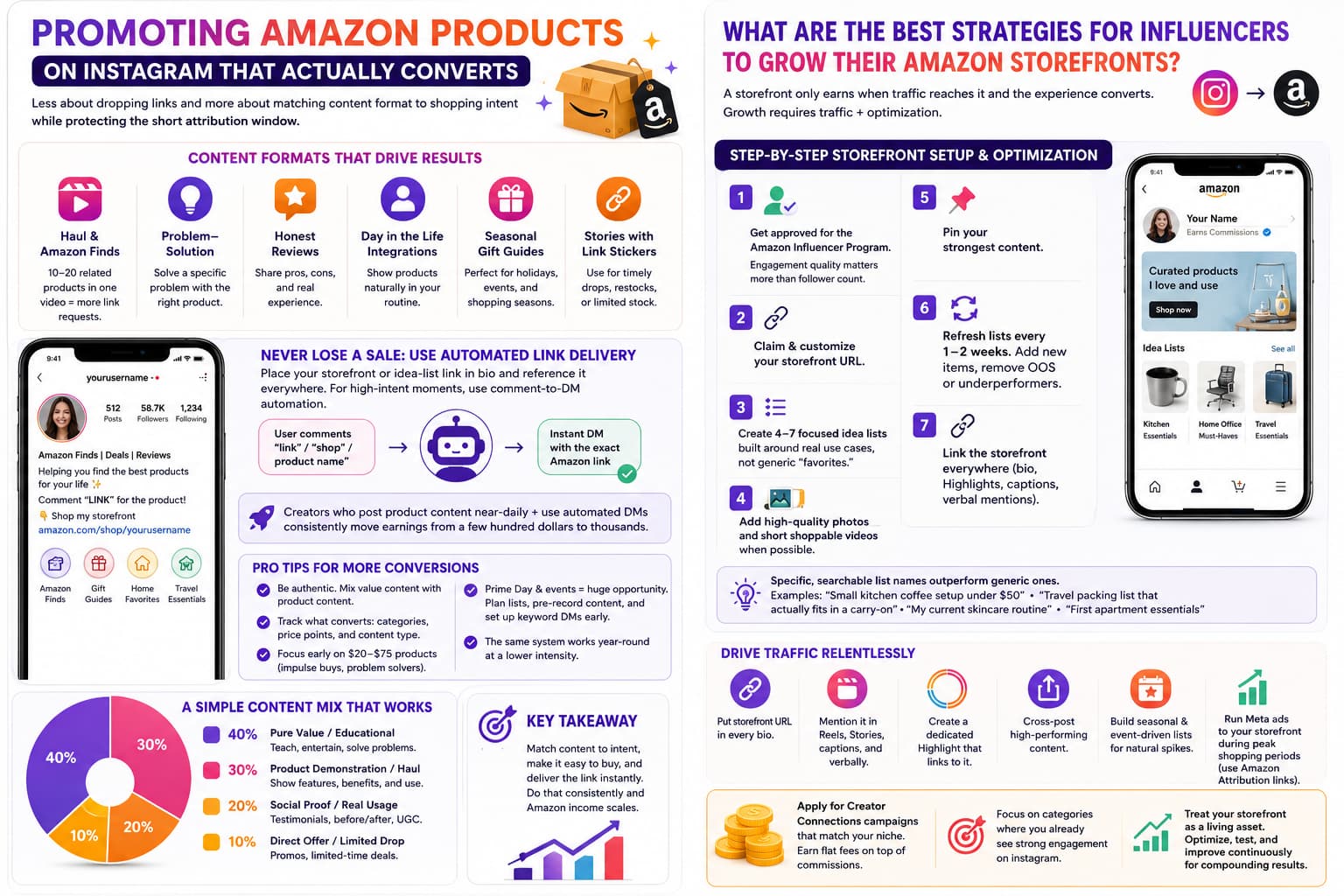
Promoting Amazon products successfully on Instagram is less about dropping links and more about matching content format to shopping intent while protecting the short attribution window.
Haul-style and “Amazon finds” Reels remain high-volume formats. Showing 10–20 related products in one video generates more link requests than single-product posts. Problem-solution videos, honest reviews that include drawbacks, “day in the life” integrations, and seasonal gift guides also convert well because they feel useful. Stories with link stickers work for timely drops or limited stock. Carousels and static posts still perform when the caption educates and the call-to-action is clear.
Always place the storefront or specific idea-list link in the bio and reference it verbally and in text. For high-intent moments, use comment-to-DM automation so that anyone who types a keyword (“link,” “shop,” a product name, or a category code) receives the exact link within seconds. This single tactic captures purchases that would otherwise be lost. Creators who scale Amazon income consistently report that near-daily product content plus automated link delivery is what moves earnings from a few hundred dollars a month into the thousands.
Authenticity still matters more than volume of links. Audiences notice when every post feels like a hard sell. Mix pure value content with product content. Track which categories and price points convert for your specific audience and double down on those. Many successful Amazon-focused creators focus on mid-priced impulse or problem-solving products in the $20–$75 range early on because the conversion friction is lower.
Event periods such as Prime Day amplify these tactics. Creators who prepare idea lists weeks ahead, pre-record content, and set up keyword-triggered DMs capture a disproportionate share of the surge. The same system works year-round at a lower intensity.
A simple content mix that works for many:
- 40% pure value / educational
- 30% product demonstration or haul
- 20% social proof / real usage
- 10% direct offer or limited drop
This keeps the feed feeling human while still generating consistent link requests.
What Are the Best Strategies for Influencers to Grow Their Amazon Storefronts?
A storefront only earns when traffic reaches it and the experience converts. Growth requires both continuous external traffic (primarily from Instagram and other platforms) and deliberate storefront architecture.
Step-by-Step Storefront Setup and Optimization
- Get approved for the Amazon Influencer Program (engagement quality matters more than pure follower count; many accounts get in with strong micro engagement).
- Claim and customize your storefront URL.
- Create 4–7 focused idea lists built around real use cases rather than generic “favorites.”
- Add high-quality photos and, when possible, short shoppable videos.
- Pin your strongest content.
- Refresh lists every 1–2 weeks (add new items, remove out-of-stock or underperforming ones).
- Link the storefront everywhere (bio, Highlights, captions, verbal mentions).
Specific, searchable list names outperform generic ones. Examples that convert well: “Small kitchen coffee setup under $50,” “Travel packing list that actually fits in a carry-on,” “My current skincare routine,” or “First apartment essentials.”
Drive traffic relentlessly. Put the storefront URL in every bio. Mention it in Reels, Stories, captions, and verbally. Create a dedicated Highlight that links to it. Cross-post high-performing content. Seasonal and event-driven lists create natural spikes. Some creators run light Meta ads to the storefront during peak shopping periods using Amazon Attribution links for tracking and the associated referral benefits where available.
On the Amazon side, apply for Creator Connections campaigns that match your niche. These can add flat fees on top of commissions. Focus on categories where you already have demonstrated engagement on Instagram. Creators who treat the storefront as a living asset rather than a set-it-and-forget-it page see compounding results over months.
What Tools Can Help Automate Recruiting on Instagram?
“Recruiting” on Instagram usually means one of two related activities: brands or agencies finding and reaching out to influencers, or creators and brands automating the qualification of high-intent conversations (commenters, DM inquiries, potential collaborators, or leads) so that human time is spent only on the most promising ones. Both benefit from automation, but safety is non-negotiable. Tools that rely on unofficial browser automation or aggressive bulk actions carry real account risk. Prefer solutions built on Meta’s official Graph API.
How We Evaluate the Tools
We assess tools against practical criteria rather than marketing claims:
- Safety and compliance: official Meta Graph API versus gray-hat methods that risk restrictions or bans.
- Pricing model: flat rate versus per-contact or message volume, and how costs scale with usage.
- Core capabilities relevant to recruiting or high-intent conversations: comment-to-DM triggers, keyword automation, AI or rule-based conversation handling, sequences, and basic qualification.
- Ease of setup and ongoing management for solo creators or small teams.
- Reliability under realistic volume and rate-limit handling.
- Transparency of limitations and support quality.
- Fit for different use cases (simple link delivery and affiliate conversion versus lead qualification and call booking versus pure influencer outreach).
Tools that score well combine safety with practical workflows and transparent pricing. No tool replaces relationship building; the best ones simply remove repetitive friction so you can focus on the conversations that matter.
Practical Tool Landscape in 2026
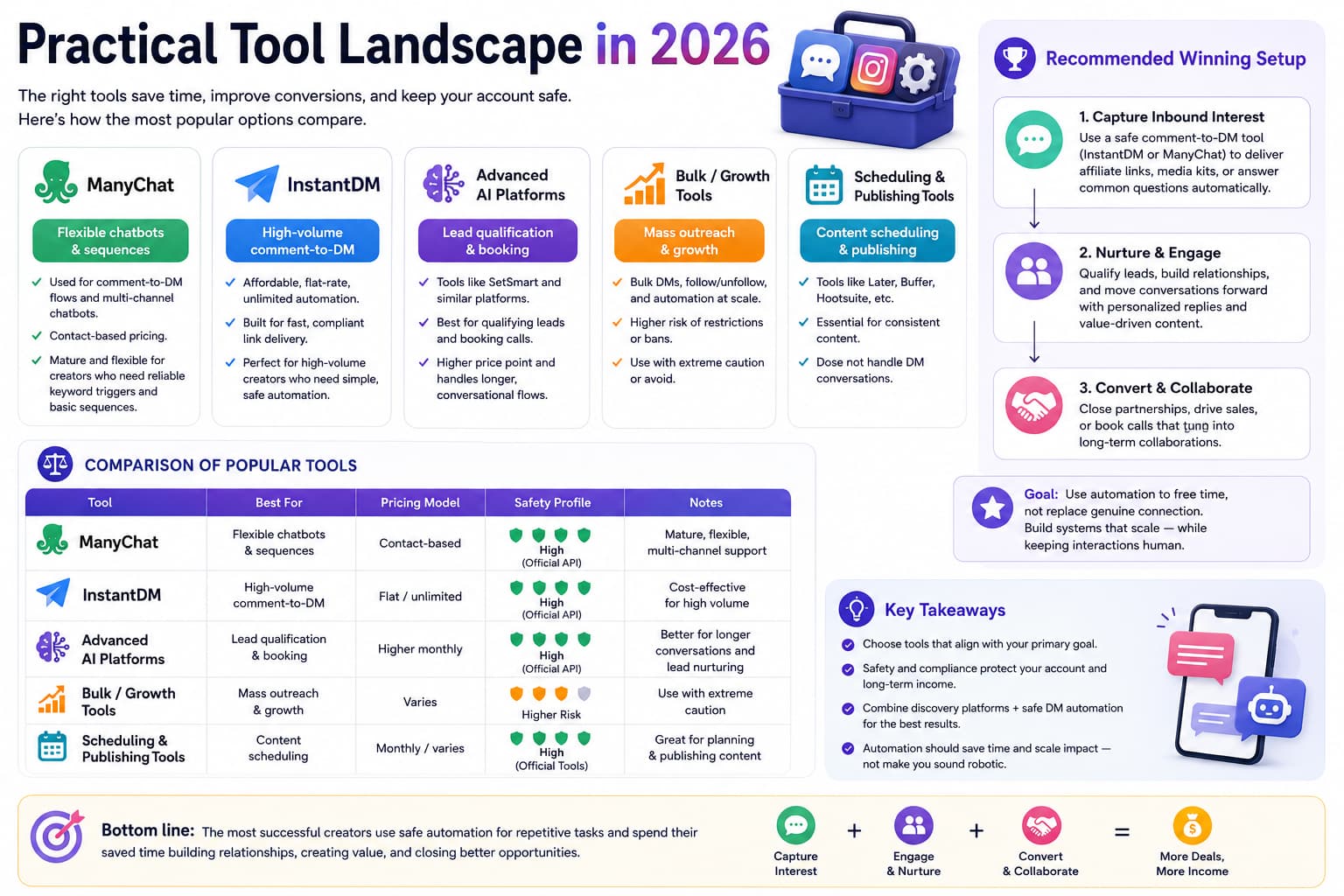
ManyChat remains widely used for comment-to-DM flows and multi-channel chatbots. Pricing is contact-based. It is mature and flexible for creators who need reliable keyword triggers and basic sequences.
InstantDM is frequently cited for affordable, flat-rate, unlimited comment-to-DM automation with attention to safety and rate limits. It suits high-volume creators who primarily need fast, compliant link delivery or simple recruiting sequences without complex AI overhead.
More advanced AI conversation platforms (such as SetSmart and similar tools) work better when the goal is qualifying leads and booking calls rather than pure link delivery. They sit at a higher price point and handle longer conversations.
Bulk-DM or growth-focused tools exist but carry higher risk profiles. Experienced users approach them cautiously or avoid them. Scheduling and publishing tools (Later, Buffer, and others) remain essential for consistent content that feeds the recruiting and conversion funnel, but they do not handle DM conversations themselves.
For pure influencer discovery and outreach at scale, dedicated influencer marketing platforms provide larger databases, audience analytics, and email or DM sequencing. Many teams combine a discovery platform with a safe Instagram DM automation tool for the actual conversation layer.
A simple comparison of the most commonly used options:
| Tool | Best For | Pricing Model | Safety Profile | Notes |
| ManyChat | Flexible chatbots & sequences | Contact-based | High (official API) | Mature, multi-channel |
| InstantDM | High-volume comment-to-DM | Flat / unlimited | High (official API) | Cost-effective for volume |
| Advanced AI platforms | Lead qualification & booking | Higher monthly | High | Better for longer conversations |
| Bulk / growth tools | Mass outreach | Varies | Higher risk | Use with extreme caution |
The practical winning setup for most people is a safe comment-to-DM tool for inbound interest (affiliate links, media kit requests, collaboration inquiries) plus a structured, personalized outreach process for outbound recruiting. Automation should free time, not replace genuine connection.
What Creators and Operators Actually Say on Reddit and in Real Discussions
Commercial guides tend to present clean frameworks. Real discussions are messier and more useful. Early Amazon Influencer participants often report modest first-month commissions while they experiment with content volume and storefront structure. Those who stick with focused categories, regular idea-list refreshes, and consistent external traffic from Instagram see meaningful growth over 6–12 months. Engagement quality and authentic product fit repeatedly beat follower vanity metrics for both program approval and sales.
On the Instagram side, creators who automate only the repetitive parts—link delivery, basic keyword responses, simple qualification—while staying present for real conversations avoid the robotic feel that kills conversion. Several threads emphasize that Amazon’s short cookie window rewards speed, which is why safe automation has moved from “nice to have” to table stakes for anyone serious about affiliate volume.
Common themes that keep appearing:
- Volume of content helps early, but structured, use-case-based storefronts win later.
- Engagement rate and comment quality matter more for approval and conversions than pure follower count.
- Creators who treat the storefront as a living catalog (regular refreshes) outperform those who set it and forget it.
- Speed of link delivery is repeatedly cited as a conversion multiplier.
- Over-automation that makes conversations feel robotic reduces both trust and sales.
The recurring advice is consistent: stack streams, stay compliant, treat both the storefront and the conversation layer as assets you actively manage, and measure what actually produces commissions or booked collaborations rather than vanity engagement. Volume helps early. Structure, relevance, and speed win later.
Common Mistakes That Quietly Kill Results
- Relying on a single revenue stream.
- Treating the Amazon storefront as a dump of random products instead of curated idea lists.
- Ignoring the short cookie window and responding to “link?” comments hours later.
- Using aggressive or non-API automation tools that put the account at risk.
- Chasing follower count at the expense of engagement quality.
- Posting only product content with no value mix (audiences burn out).
- Never refreshing idea lists or tracking which categories actually convert.
Avoiding these alone puts you ahead of a large percentage of creators who are technically “doing everything” but seeing little return.
Putting It Together: A Practical System Rather Than Isolated Tactics
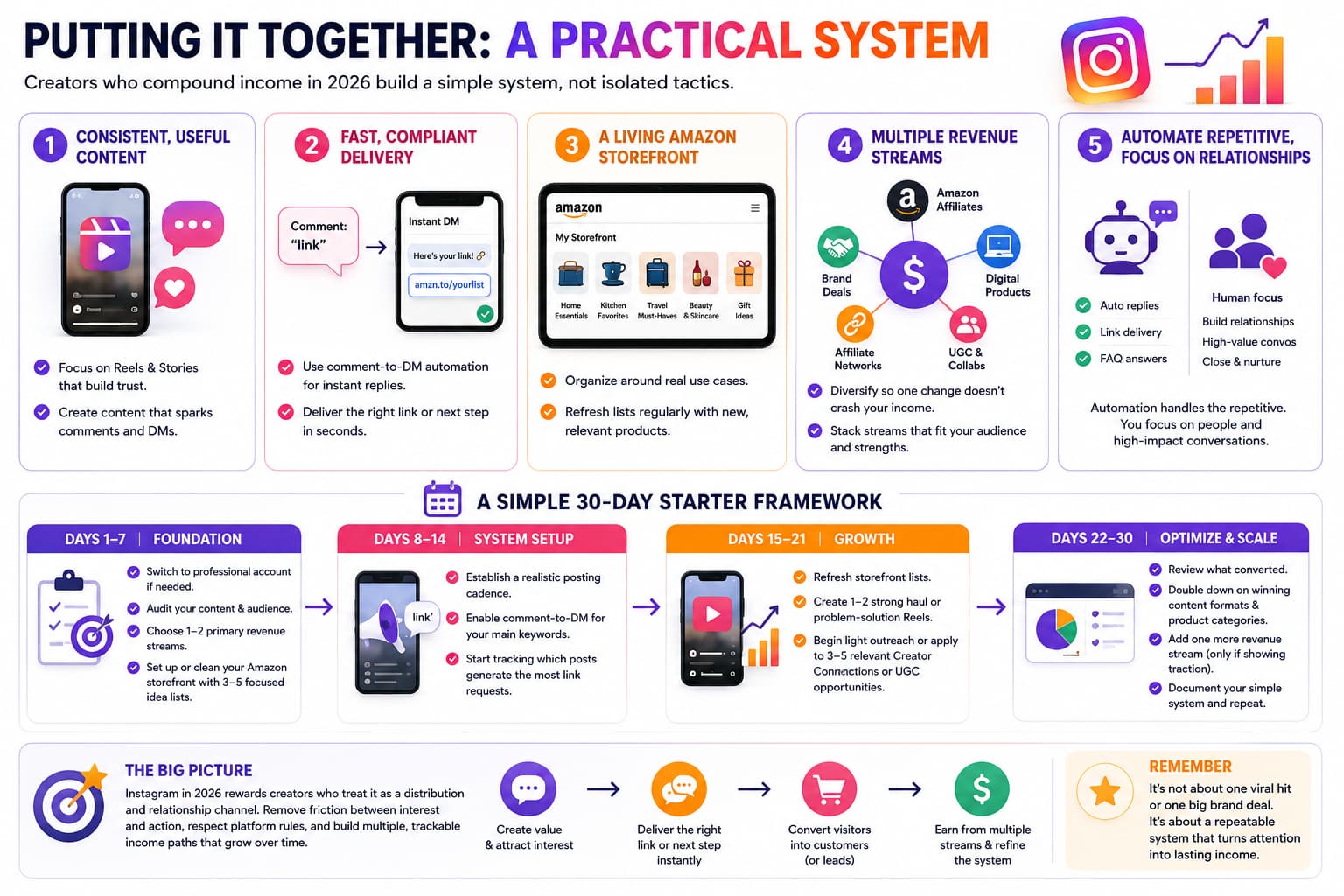
The creators who compound income in 2026 do not chase one perfect program or one viral Reel. They build a simple system:
- Consistent, useful content (especially Reels and Stories) that builds trust and generates comments or DMs.
- Fast, compliant delivery of the right link or next step (storefront, specific idea list, media kit, calendar link).
- A living Amazon storefront organized around real use cases and refreshed regularly.
- Multiple revenue streams so no single platform change or algorithm shift creates a crisis.
- Automation limited to the repetitive, high-volume tasks while human attention stays on relationships and high-value conversations.
A Simple 30-Day Starter Framework
Days 1–7: Switch to professional account if needed. Audit current content. Choose 1–2 primary revenue streams (e.g., Amazon Affiliates + one higher-margin network). Set up or clean your storefront with 3–5 focused idea lists.
Days 8–14: Establish a realistic posting cadence (aim for consistency over perfection). Enable basic comment-to-DM for your main keywords. Start tracking which posts generate the most link requests.
Days 15–21: Refresh storefront lists. Create one or two stronger haul or problem-solution Reels. Begin light outreach or apply to 3–5 relevant Creator Connections or UGC opportunities.
Days 22–30: Review what converted. Double down on the content formats and product categories that worked. Add one more revenue stream only if the first ones are showing early traction. Document your simple system so you can repeat it.
Start with one or two streams you can execute consistently. Add safe automation where it multiplies results. Expand the storefront and the owned offers as the audience and data justify it. Track what converts for your audience rather than copying someone else’s rates or product list.
Instagram in 2026 still rewards creators who treat it as a distribution and relationship channel rather than a pure content destination. The programs, Amazon strategies, and automation tools that work best are the ones that respect platform rules while removing friction between interest and action. The accounts that last are rarely the ones that land one oversized brand deal. They are the ones that systematically turn attention into multiple, trackable income paths and keep refining the system over time.
This approach is slower than the “get rich from Reels” promises, but it is far more durable.
Learn the best ways influencers earn on Instagram in 2026 — top programs, Amazon product strategies, storefront growth tips, and safe automation tools. Practical, up-to-date guide.
Sources
- Amazon Associates – Official Influencer Program & Associates Help
- Gigapay – The State of US Influencer Marketing Spend in 2026
- Influencer Marketing Hub – Industry rate benchmarks and creator earnings data (2025–2026 reports)
- Meta / Instagram – Partner Monetization Policies and professional account requirements
- Reddit communities – Real creator discussions on Amazon Influencer experiences and Instagram income (r/digital_marketing, r/InstagramMarketing, r/Amazon_Influencer)
- Public industry analyses on Instagram creator rates, affiliate performance, and automation safety practices (2025–2026)