Last updated: 31 October 2026
What is social media marketing for small business in 2026? It is using Instagram, Facebook, TikTok, LinkedIn, or YouTube to get found, show proof, and turn comments and messages into customers, without a 10-person social team.
You post where your buyers already scroll. You answer the people who raise a hand. You skip the six-app calendar that dies in week two.
That's the whole job. Not a content studio. Not a billboard you never check.
If you only remember one line: social media marketing for a small business is posting, listening, and converting conversations, not running a 10-person social team.
TL;DR
- Social media marketing for a small business is posting, listening, and converting conversations, not running a 10-person social team.
- It works when discovery, proof, and a reply sit on the same platform.
- One platform you can answer in 24 hours beats six platforms you ignore.
What does social media marketing actually include for a small shop?
Social media marketing for a small business is posting, listening, and converting conversations, not running a 10-person social team.
You make something a stranger can find (a Reel, a Facebook post, a TikTok, a LinkedIn note, a YouTube short). You listen when someone comments, DMs, or reviews you. You convert that moment into a booking, a visit, or a checkout link. Paid ads can sit on top of that. They are not the definition.
McKinsey's explainer on what social media is treats social as the place people talk and, increasingly, shop. For a bakery, a clinic, or a one-person consultancy, the useful version is narrower: one network, one offer, one way to answer.
At a glance (verified October 2026)
| Aspect | Details |
| What it is | Post + listen + convert on platforms your customers already open. |
| What it is not | Daily posts on six apps, a replacement for Google Business Profile, or your entire marketing mix. |
| Why it works | Discovery, proof, and a reply can happen in the same thread. |
| Staffing | One owner, 3 to 5 focused hours a week on one primary network, is a real starting point. I am describing a workload, not a lab study. |
| First pick | Go where you already get questions. Local services often start on Instagram or Facebook. B2B often starts on LinkedIn. |
Why does social media marketing work for small business?
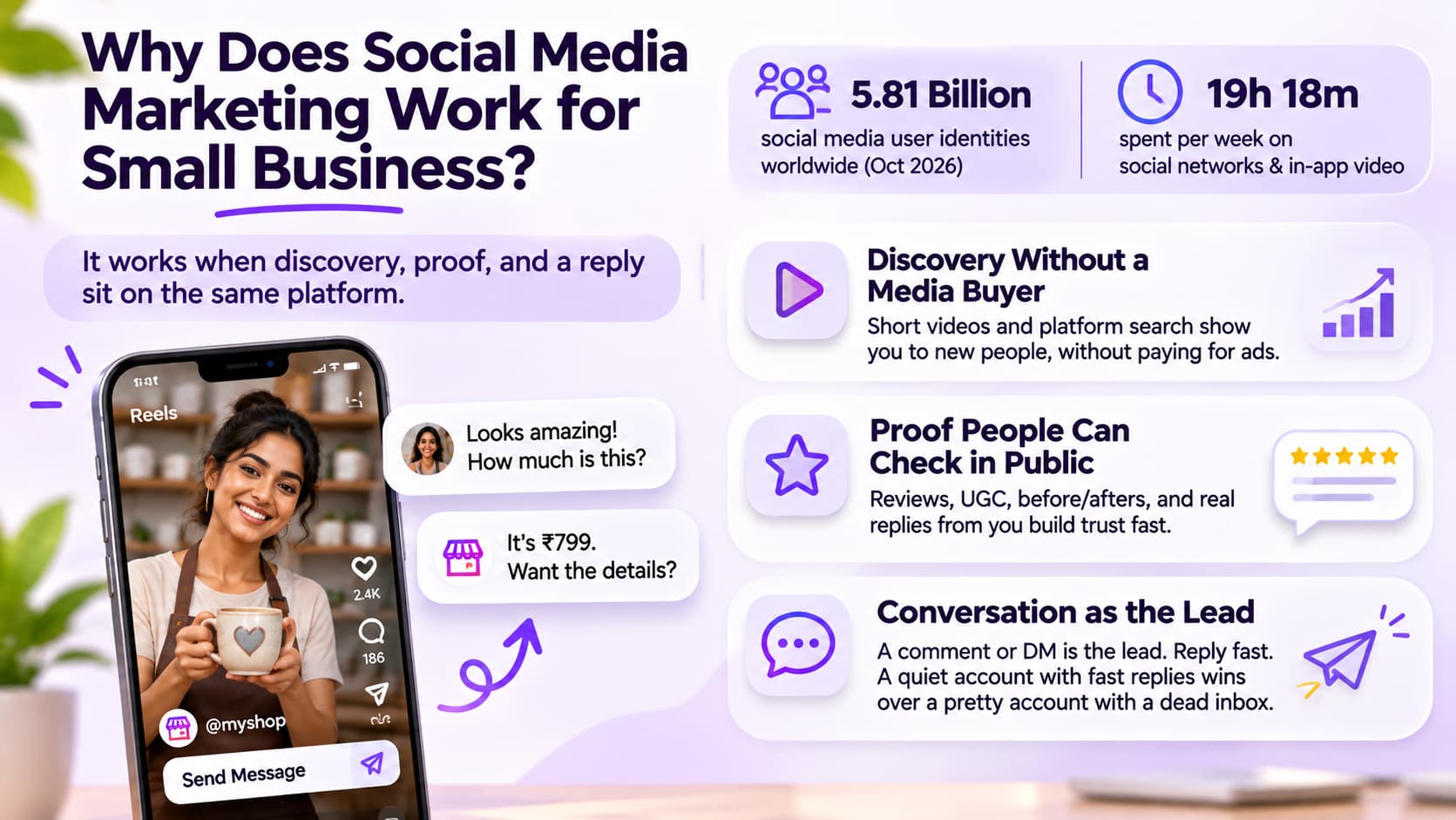
It works when discovery, proof, and a reply sit on the same platform.
A stranger can see a 20-second clip of your work, read three comments from people like them, and ask a price without leaving the app. A newspaper ad cannot do that loop. A website can't do it unless they already know your name.
DataReportal's October 2026 social media user counts put 5.81 billion social media user identities worldwide at the start of October 2026, close to 7 in 10 people on Earth. GWI data on that same page says a typical user visits about 6.66 platforms a month and spends 19 hours and 18 minutes a week on social networks and in-app video. Your buyers are already there. You do not have to invent the audience.
The mechanism for a small shop is three steps.
Discovery without a media buyer
Short video and local search on the platform show you to people who do not follow you yet. A Reel of a kitchen during rush, a TikTok of a before/after, a LinkedIn note about a client problem you just solved. You are borrowing the app's distribution. You are not buying a billboard.
Proof people can check in public
Reviews, UGC, before/afters, and owner-on-camera replies beat a polished brand kit you cannot maintain. A stranger trusts three comments from people in the same city more than your tagline.
Conversation as the lead
The comment or DM is the lead. If that message sits for two days, the post was entertainment, not marketing.
That is why a quiet account with fast replies beats a pretty account with a dead inbox.
What benefits does social media marketing give a small business?
The benefits of social media marketing for small business are reach you can start without a media buyer, trust you cannot buy with a stock photo, and a path from "I saw you" to "I asked you" that does not require a website first.
Reach on a lean budget. Organic posts are not free of time. They are free of a media insertion order. You can test a $5 to $20 a day boost later. Start by earning the view.
Trust in public. A reply under a skeptical comment does more than a slogan. People watch how you talk when something goes wrong.
Local path to a visit. "We have a table at 7" in the DMs is closer to revenue than a like.
Market notes you already paid for. Saves, shares, and the exact words people type in comments tell you what to post next week. You do not need a research firm for that.
Customer service in the open. A public "we replaced it same day" is marketing and operations in one thread.
None of those benefits show up if you publish and disappear. The benefit is the loop, not the logo on the grid.
Organic vs a small paid test
Organic is the test of whether anyone cares. Paid is volume on a post that already gets questions. If a $5 to $20 a day boost sends people to a dead inbox, you paid to annoy them. Run organic until you can name the question people ask, then boost that post, not a random carousel.
Local shop vs online-only
A salon, clinic, or cafe needs the post to produce a visit or a booking this week. An online seller needs the same loop, but the conversion is a checkout link or a DM with the product. The definition does not change. The last click does.
Does social media marketing work for small businesses?
Yes, social media marketing works for small businesses when you pick one platform, one offer, and a reply window you can keep. It fails when you copy a 30-day content calendar built for a team you do not have.
I don't have a universal conversion rate to quote, and I won't invent one. Public "social converts at X%" roundups mix ads, influencers, and enterprise budgets. That number is not your bakery.
What I will stand on:
- People spend a large slice of waking hours in these apps (19 hours 18 minutes a week for a typical user, DataReportal / GWI, October 2026).
- Small teams can show the work itself, which bigger brands often cannot do without legal review.
- The sale still happens off the like. A comment with no reply is not a lead.
If you have never gotten a customer from social, the usual leak is the last step: they asked, and nobody answered.
Does it replace Google Business Profile, email, or walk-in signage? No. Social is one channel. I keep the longer case on Why Social Media Should Not Be Your Entire Marketing Strategy.
Which social media platform is best for small businesses?
The best social media platform for a small business is the one your buyers already open and the one you can answer in 24 hours. There is no universal winner.
| Platform | Best when | Weak when |
| visual work, local services, product photos, Reels discovery | you refuse to shoot vertical video or answer DMs | |
| local groups, older buyers, events, a Facebook Page people already search | you only post links and never reply in comments | |
| TikTok | fast discovery with native video, younger buyers | you need private B2B conversations as the first click |
| consultants, B2B, hiring, founder-led expertise | you treat it like Instagram with stock photos | |
| YouTube | searchable how-tos that keep working for months | you cannot record even a simple phone explainer |
Verified as a fit table, October 2026. This is not a tools ranking.
One platform you can answer in 24 hours beats six platforms you ignore.
Instagram, if that is already where people ask
Instagram is a strong first network when your work is visual and the question arrives as a comment or DM. Reels can reach people who do not follow you. Stories keep the people who already do. Instagram's grow guide is the official starting map for Insights and Meta Business Suite, not a content calendar I wrote.
Stay on one handle. Switch it to a professional account so Insights exist. Post proof, not only promotions. Answer the comments the same day.
If the inbox is the bottleneck after the post works, that workflow lives on Instagram DM Automation for Small Brands (2026): What to Look For.
Facebook, TikTok, LinkedIn, YouTube
Facebook still wins a lot of local "is anyone open Saturday?" traffic in groups and on a Facebook Page. TikTok wins cold discovery if you will speak on camera. LinkedIn wins if your buyer is at a desk. YouTube wins if you can stand to explain the same job once and leave it up.
Pick the row that matches the buyer, not the app your nephew likes.
What is social media marketing not?
It is not posting every day on every app. It is not a replacement for a Google Business Profile, an email list, or a phone number on the door. It is not a 10-person "always-on newsroom."
It is also not an AI agent. Meta's owner-facing agent is a different product. I keep that definition on What Is Muse for Small Business? Meta's AI Agent Explained (2026). Drafting a reply is not the same as running your marketing.
If you are mixing "AI that talks in DMs" with "a chatbot on a website," start at Instagram AI Agents Explained: Automate DMs with ChatGPT and Chatbot Marketing Strategies for Small Businesses (2026). Those are adjacent jobs. They are not this definition.
How much time should a small business spend on social?
Spend enough time to publish one useful post and clear the replies. For most owners I talk to, that is a few hours on one network, not a second job.
A workable week on one platform:
- One proof post. A job you finished, a customer result, a myth you keep hearing.
- Two or three replies in public. People watch those more than the caption.
- Inbox zero on that app. Same-day if you can, 24 hours if you cannot.
- Fifteen minutes of notes. What people asked. That is next week's post.
Batching the filming helps. Automating the listening does not, if it means nobody is actually there. Scheduling tools belong on 8 Best Social Media Management Tools in 2026 (Real Pricing & Reviews). Use them to queue the post, not to hide from the comments.
If you can't protect those hours, don't open a second account. A dead second account trains people to ignore you.
What to post in week one
Don't start with a 30-day grid. Start with three proof posts and a bio that says who you help, where you are, and what to do next (comment, DM, call, or book).
Week one, on one app:
- Post a real job, plate, or result. Talk over it if you can stand the camera.
- Screenshot or restack a kind review (with permission).
- Answer every comment like a person, not a brochure.
- Put one instruction in the bio. Not five links.
If nobody asks a question after those three posts, change the subject, not the posting app. You are still on the definition of the channel: found, trusted, answered.
A cafe might show the morning pastry case. A plumber might show the flooded floor and the dry one. A consultant might show the exact question a client asked, with names removed. Proof is specific. Cute quotes are not. If you would not say it to a customer at the counter, don't post it.
How do you know if social media marketing is working?
You know it is working when you can name customers who found you there and you can see which posts they touched. Vanity metrics without a path to a message are a hobby.
Track, in this order:
- Messages and comments that ask for a price, a slot, or a link. That is demand.
- Profile visits and follows after a specific post. That is discovery.
- Site or booking sessions from social. Tag the links. Google's campaign URL builder is how you stop guessing whether Instagram or Facebook sent the visit.
- Saves and shares on proof posts. Those are quieter than likes and closer to intent.
Give a local business a 30-day window, not a 48-hour panic. A consultant with a longer sales cycle needs more than a month before you call it.
If the views are high and the inbox is empty, the post is entertainment. Change the last line to one instruction: comment PRICE, DM BOOK, call the number.
What mistakes kill small-business social media?
The mistakes are staffing, not creativity.
Six platforms, no replies. You look busy. Nobody gets an answer.
Only promotions. A grid of "10% off" with no proof of the work.
Buying followers. Cheap, visible, and useless when real buyers check the comments.
Posting and leaving town. The algorithm will show the post. A human still has to talk.
Measuring likes as revenue. A like is not a booking.
Copying a national brand's cadence. They have a team. You have Tuesday after close.
Treating every DM like a support ticket you can ignore overnight. For a small shop, that thread is the sales floor.
Fix those before you hire a freelancer to "take over social."
Hiring too early
A freelancer who posts and never shows you the inbox is a content vendor, not marketing. If you hire, hire for replies and proof, not for pretty templates. You can add scheduling later. You can't outsource caring whether someone asked a price.
How I checked this
I am not a social network. I compared public small-business social guides from Sprout Social, Lyfe Marketing, Business.com, and UniAthena in October 2026, then wrote the version a one-person shop can run.
I scored five things:
- Definition. Does it describe posting, listening, and converting, or only "being present"?
- Mechanism. Does "why it works" name discovery, proof, and reply, or only brand awareness?
- Platform fit. Can an owner pick one network without a 12-app matrix?
- Time honesty. Does the page admit ignored inboxes kill the channel?
- Measurement. Can you tell working from scrolling?
User counts above are from DataReportal, October 2026. I did not invent a conversion rate.
About the Author
Aravindh Kumar is an ecommerce and Instagram growth expert with 8+ years of experience in online selling. He has worked with 500+ brands, including Forbes-listed companies, helping them build profitable Instagram sales channels. He has helped 200+ Instagram businesses grow their online presence.