Quick answer
Last updated: 03 October 2026
WhatsApp API pricing in 2026 is not a subscription. WhatsApp Business API pricing and WhatsApp Cloud API pricing use the same Meta card: you pay per delivered template, by category and by the recipient’s country, as set out on Meta’s WhatsApp Business Platform pricing page. A marketing message is $0.0118 (₹0.8631) in India and $0.0250 in the US. Utility and authentication cost far less. Your inbox or BSP fee sits on top, and in India 18% GST applies on the provider invoice.
Monthly cost is that mix of volume × rate, plus the tool, plus tax. Ten thousand marketing messages to Indian numbers are about $118 / ₹8,631 in Meta fees before software.
Service replies are no longer free. From 1 October 2026, Meta charges them at the utility rate after 1,000 free delivered service messages per business phone number per month. Utility templates inside the 24-hour window are billable the same day. The 72-hour window from a Click-to-WhatsApp ad or Facebook Page button stays free. Courier’s October 2026 pricing note walks through the same cutover.
What the price actually is
Three different bills get called “the WhatsApp price.”
- Meta’s message fee. Charged when a template is delivered, not when you hit send. From 1 October 2026 the same rule covers service replies after the free tier.
- The software or BSP fee. An inbox, Cloud API wrapper, or Business Solution Provider — subscription, per-message markup, or both. If the job is still Instagram rather than WhatsApp, the cost shape is different: see what Instagram DM automation actually costs in 2026.
- Tax and extras. In India, 18% GST on the provider invoice. Wrong template categories, quality-rating drops, and international authentication are the quiet extras.
Meta’s platform access is free. The WhatsApp Business app on a phone is free. You pay when you automate, broadcast, or connect WhatsApp to a CRM through the API.
On 1 July 2025 Meta retired conversation-based pricing. A 24-hour “conversation” is no longer one charge. Each delivered template is its own line, which Meta’s developer pricing documentation still states as the current model. If a vendor still quotes “₹0.78 per conversation” or “first 1,000 conversations free” with no end date, those numbers are out of date.
Budget WhatsApp API cost as delivered volume × category × country + tool + tax. There is no single global per-message rate.
How Cloud API pricing works
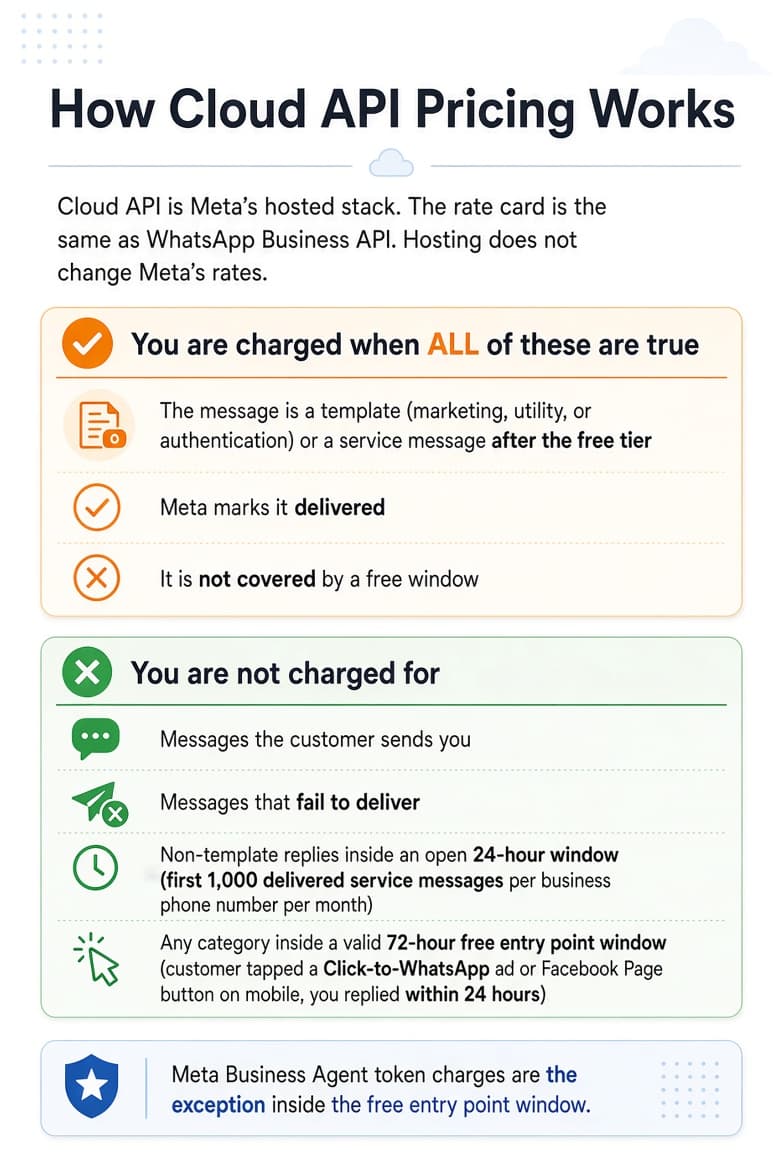
WhatsApp Cloud API pricing is not a second product. Cloud API is Meta’s hosted stack. The rate card is the same as WhatsApp Business API pricing. ChatMitra’s Cloud API pricing breakdown reaches the same split: hosting does not change Meta’s rate.
You are charged when all of these are true:
- The message is a template (marketing, utility, or authentication), or a service message after the free tier.
- Meta marks it delivered.
- It is not covered by a free window.
You are not charged for:
- Messages the customer sends you.
- Messages that fail to deliver.
- Non-template replies inside an open 24-hour window, only for the first 1,000 delivered service messages per business phone number per month.
- Any category inside a valid 72-hour free entry point window. The customer tapped a Click-to-WhatsApp ad or a Facebook Page button on mobile, you replied within 24 hours, then you get 72 hours of free outbound. Meta Business Agent token charges are the exception inside that window.
| Category | What it is | Until 30 Sep 2026 | From 1 Oct 2026 |
| Marketing | Offers, launches, re-engagement, most broadcasts | Always charged. No volume discount. | Always charged. No volume discount. |
| Utility | Order updates, shipping, reminders, receipts | Charged outside the 24-hour window. Free inside it. Volume tiers apply. | Charged inside and outside the window. |
| Authentication | OTPs, login codes, 2FA | Always charged. Volume tiers apply. A higher authentication-international rate can apply when the business is eligible and the recipient market is on that list. | Same. |
| Service | Free-form human or third-party AI replies inside the 24-hour window | Free. | Utility rate after 1,000 free per phone number per month. No volume tiers. No rollover. |
Marketing is the expensive category on purpose. An order confirmation approved as marketing can cost 5–10× the utility rate for the same text. Fix the category when you submit the template. That habit cuts more bill than switching providers. Teams comparing inbox tools rather than rate cards can start with Instagram DM automation tools tested in 2026.
Rates by country
Meta list rates in USD per delivered template, card effective 1 October 2026. France and Spain are exact. Mexico and UAE marketing rose on this card. India marketing did not.
| Market | Marketing | Utility | Authentication | Service from 1 Oct 2026 |
| India | $0.0118 | $0.0014 | $0.0014 | $0.0014 after 1,000 free |
| United States and Canada | $0.0250 | $0.0034 | $0.0034 | $0.0034 after 1,000 free |
| United Kingdom | $0.0635 | $0.0220 | $0.0220 | $0.0220 after 1,000 free |
| Germany | $0.1365 | $0.0550 | $0.0550 | $0.0550 after 1,000 free |
| France | $0.0859 | $0.0300 | $0.0300 | $0.0300 after 1,000 free |
| Spain | $0.0707 | $0.0200 | $0.0200 | $0.0200 after 1,000 free |
| Brazil | $0.0625 | $0.0068 | $0.0068 | $0.0068 after 1,000 free |
| Indonesia | $0.0411 | $0.0250 | $0.0250 | $0.0250 after 1,000 free |
| UAE | $0.0576 | $0.0157 | $0.0157 | $0.0157 after 1,000 free |
| Mexico | $0.0397 | $0.0085 | $0.0085 | $0.0085 after 1,000 free |
| Colombia | $0.0125 | $0.0008 | $0.0008 | $0.0008 after 1,000 free |
| Turkey | $0.0109 | $0.0009 | $0.0009 | $0.0009 after 1,000 free |
India marketing is roughly half of the US rate and about one-eleventh of Germany. A global blast priced off a US spreadsheet will look cheap on an Indian list and expensive on a German one. Ominiflow’s WhatsApp API cost guide is a useful second pass on the same country split. UAE marketing moved from $0.0499 to $0.0576. Mexico marketing moved from $0.0305 to $0.0397. India marketing stays $0.0118.
Pricing in India
Meta list rates, INR card effective 1 October 2026:
| Category | USD | INR |
| Marketing | $0.0118 | ₹0.8631 |
| Utility | $0.0014 | ₹0.1150 |
| Authentication (domestic) | $0.0014 | ₹0.1150 |
| Authentication-international | $0.0304 | ₹2.4971 |
| Service | $0.0014 after 1,000 free | ₹0.1150 after 1,000 free |
Authentication-international is the trap, and the direction matters. It is not “an India account sending an OTP abroad.” Meta charges the higher rate on authentication templates delivered to a user in a market that has an authentication-international rate. India is one of those markets, and only after the business is eligible. Eligibility is more than 750,000 messages outside customer-service windows in a moving 30-day period to users in those markets. An India business sending an OTP to an Indian number pays the domestic ₹0.1150. A business that has crossed the eligibility line and sends an OTP to an Indian number pays ₹2.4971, about 22× the domestic rate.
What dashboards show vs what Meta charges
Several Indian platforms list marketing at ₹1.09 and utility or authentication at ₹0.145. Those are not Meta list rates. The extra is usually BSP credit load, and sometimes GST presentation. Display rates below were read from vendor pages and comparisons current as of early October 2026. Recheck before you buy. Plans move faster than Meta’s card.
| Line | Marketing (India) | Utility / auth (India) | What the figure is |
| Meta list | ₹0.8631 | ₹0.1150 | Official card. No GST inside it. |
| AiSensy display | ₹1.09 | ₹0.145 | Credit rate, all plans. Service ₹0.145 after 1,000 free. |
| Interakt Growth display | ₹0.871 | ₹0.150 utility / ₹0.128 auth | Plan display, not Meta list. |
| Wati Growth display | ₹1.0357 | ₹0.1495 | INR rate card reported against the July card. Confirm on Wati. |
| Gupshup self-serve | Meta + about $0.001 | Meta + about $0.001 | Pass-through plus a small add-on, billed from a USD wallet. |
If a page says WhatsApp API pricing “starts at ₹1.09,” ask whether that is Meta, Meta plus markup, or Meta plus markup plus GST. The official price in India for a marketing template is still ₹0.8631 per delivery. MyOperator’s October pricing update is one of the India pages that separates the Meta line from the platform line.
GST at 18% applies on the BSP service invoice. Meta’s message fee is usually collected through the provider wallet. Ask for a GST invoice you can claim as input credit. Do not add 18% on top of ₹0.8631 and call the result Meta’s rate.
Three India examples
Coaching or course brand — 5,000 marketing messages to Indian numbers
- Meta: 5,000 × ₹0.8631 = ₹4,315.50
- AiSensy display: 5,000 × ₹1.09 = ₹5,450
- Interakt Growth display: 5,000 × ₹0.871 = ₹4,355
- Wati Growth display: 5,000 × ₹1.0357 = ₹5,179
- Gupshup-style: ₹4,315.50 + about $5 add-on
- Tool plan on top: ₹1,500–₹8,000, then 18% GST on that invoice
- All-in: often ₹7,000–₹14,000 a month if you are not also sending heavy utility traffic
D2C brand — 10,000 marketing + 15,000 utility + 2,000 auth
- Marketing, Meta: 10,000 × ₹0.8631 = ₹8,631
- Utility, Meta: 15,000 × ₹0.1150 = ₹1,725. From 1 October this is charged inside open windows too.
- Auth, Meta: 2,000 × ₹0.1150 = ₹230
- Meta subtotal = ₹10,586
- Same mix on AiSensy display: ₹10,900 + ₹2,175 + ₹290 = ₹13,365
- Same mix on Gupshup-style pass-through: ₹10,586 + about $27 add-on
- Then a BSP plan of ₹3,000–₹12,000 plus GST
SaaS — 100,000 domestic India OTPs
- Domestic Meta, Indian recipient, business not on the international rate: 100,000 × ₹0.1150 = ₹11,500 ($140 at $0.0014)
- Same 100,000 OTPs delivered to Indian numbers once authentication-international applies: 100,000 × ₹2.4971 = ₹2,49,710 ($3,040 at $0.0304)
- AiSensy display on domestic auth: 100,000 × ₹0.145 = ₹14,500
- SMS for the same volume is usually several times the domestic WhatsApp auth rate. WhatsApp wins on cost in India if the recipient stays on the domestic authentication rate.
What changed on 1 October 2026
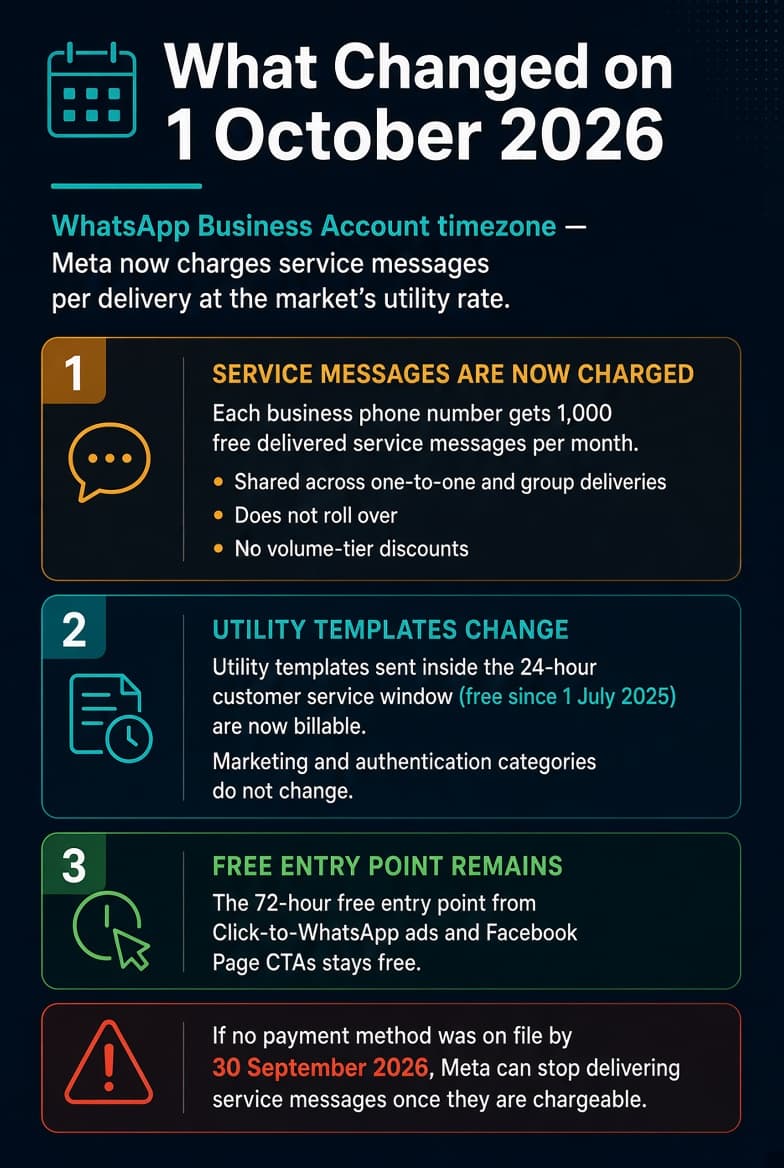
From 1 October 2026, in the WhatsApp Business Account timezone, Meta charges service messages per delivery at that market’s utility rate. 360dialog’s note on service-message charging and YCloud’s 1 October pricing update describe the same rule.
Each business phone number gets 1,000 free delivered service messages per month. The allowance is shared across one-to-one and group service deliveries. It does not roll over. Service messages do not get volume-tier discounts.
Utility templates sent inside the 24-hour customer service window, free since 1 July 2025, are now billable. Marketing and authentication do not change category. The 72-hour free entry point from Click-to-WhatsApp ads and Facebook Page CTAs stays free.
If no payment method was on file by 30 September 2026, Meta can stop delivering service messages once they are chargeable. The Times of India report on accounts without a payment method is the public warning on that cutoff.
| Message | Through 30 Sep 2026 | From 1 Oct 2026 |
| Marketing template | Charged | Charged |
| Utility template outside the 24h window | Charged | Charged |
| Authentication template | Charged | Charged |
| Utility template inside the 24h window | Free | Charged at the utility rate |
| Free-form service reply inside the 24h window | Free | Charged after 1,000 free per number per month |
| Customer inbound message | Free | Free |
| Anything inside a valid 72h ad or Page CTA window | Free | Free |
| Meta Business Agent reply | Token fee from 1 Aug 2026, about 4–5¢ typical | Same |
What this does to a support inbox
A UK number sending 100 marketing templates, 200 in-window utility templates, and 1,000 service replies:
- September: 100 × $0.0635 = $6.35. The rest was free.
- October: $6.35 + (200 × $0.0220) + (1,000 × $0.0220) = $32.75 at the free-tier cap. Send 8,000 service replies and the service line becomes 7,000 × $0.0220 = $154, plus the utility replies.
India is gentler because utility is $0.0014. Eight thousand service replies to Indian numbers after the free 1,000 = 7,000 × $0.0014 = $9.80 to Meta. The shock is in Europe, the UK and the Gulf. Plan by destination, not by where the company is registered. The same support thread on Instagram still depends on the DM automation features creators actually need, which is a different meter from this WhatsApp card.
Meta Business Agent
From 1 August 2026, Meta bills its own agent at $2.00 per 1 million tokens, covering input tokens, output tokens and delivery in one charge. A typical reply uses 20,000–25,000 tokens, so about 4–5 US cents per agent message. That is a different meter from service-message pricing. A third-party AI that sends free-form replies is a service message. Meta’s own agent is a token message. Do not mix them in one cell.
What is still free
- Customer-initiated inbound messages.
- Undelivered outbound messages.
- The first 1,000 service messages per business phone number per month.
- All categories for 72 hours after a qualifying Click-to-WhatsApp ad or Facebook Page CTA on mobile, if you opened the window correctly. Meta Business Agent token charges are the exception inside that window.
- User-initiated WhatsApp calls. Business-initiated Calling API uses a separate pulse-based card.
The 24-hour customer service window opens when the user messages you and resets on each new user message. It is not a daily bucket. If the thread goes quiet for 25 hours, the next business template is billable again at its category rate.
Volume tiers
Meta discounts utility and authentication as monthly delivered volume in a market–category pair climbs. Marketing never gets this discount. Service does not get it either.
Tiers accrue at the business portfolio level across every WhatsApp Business Account you own. They reset monthly at midnight in the WABA timezone. They apply marginally: crossing a band does not rebate messages already sent that month. Only charged messages count. Free-window messages do not help you reach a cheaper band.
UK utility bands on the October 2026 card:
| UK utility messages / month | Rate | vs list |
| 0–100,000 | $0.0220 | list |
| 100,001–1,000,000 | $0.0209 | −5% |
| 1,000,001–4,500,000 | $0.0198 | −10% |
| 4,500,001–40,000,000 | $0.0187 | −15% |
| 40,000,001–80,000,000 | $0.0176 | −20% |
| 80,000,001+ | $0.0165 | −25% |
120,000 UK utility messages cost (100,000 × $0.0220) + (20,000 × $0.0209) = $2,618, not 120,000 × $0.0209. If OTP traffic is split across two portfolios, you may never leave list rate. Keep authentication in one portfolio when the destination market is the same. India utility stays at ₹0.1150 until 25 million delivered messages in the month, so almost every Indian brand is on list rate.
How to calculate the cost
Meta fee = each country–category pair’s delivered volume × that pair’s list or tier rate.
All-in = Meta fee + BSP plan or markup + tax + any AI or calling.
Count only delivered templates. Split marketing, utility and auth. Split India, US and UK. Add max(0, service replies − 1,000) × utility rate per phone number.
- India coach, 5,000 marketing to India. Meta ₹4,315.50. Tool ₹2,000–₹8,000. All-in often ₹8,000–₹15,000. Marketing is the whole Meta line. AiSensy display on the same 5,000 is ₹5,450 before the plan.
- India D2C, 10,000 marketing + 15,000 utility + 2,000 auth. Meta ₹10,586. In-window utility that used to be free is on this bill. Plan a 10–25% Meta-line increase if order-update templates ride inside open chats.
- US ecommerce, 10,000 utility to US numbers. Meta 10,000 × $0.0034 = $34. A $0.005 per-message add-on takes it to about $84. A $99 flat tool plus $34 Meta is about $133. At this volume the tool, not Meta, is the bill.
- Support desk, 8,000 service replies to UK numbers, one phone number. Free tier 1,000. Billable 7,000 × $0.0220 = $154 Meta, with no tier relief.
- Agency with five client accounts in one portfolio. Utility and auth tiers pool. Service free tiers do not. They sit on each phone number. Five numbers do not give you 5,000 free service messages if traffic piles onto one main number. Brands that still run the customer conversation on Instagram rather than WhatsApp can compare ManyChat alternatives before they add a second WhatsApp number just to buy another 1,000 free service replies.
Meta fee vs what your provider charges
| Setup | What you pay the provider | What you pay Meta | Watch-out |
| Cloud API direct | Engineering time | List rate | Cheapest Meta line. You own templates, quality and inbox. |
| 360dialog-style host | Plan around €49+ per number | Usually pass-through | Confirm “no markup” in the contract. |
| Twilio-style pipe | About $0.005 per message on top of Meta | List rate | Fine at 2,000 messages. Painful at 200,000. |
| Shared inbox (Wati, Interakt and similar) | Monthly plan. US public tiers in 2026 sit roughly in the $69 / $149 / $349 band. India plans are in rupees. | Pass-through or bundled credits | You are buying software. Compare included limits. |
| India credit wallet (AiSensy-style) | Subscription + credits | Displayed as ₹1.09 / ₹0.145 | Credits are not Meta list. Ask for the split. |
| Gupshup-style India / SEA contract | Small per-message add-on plus platform | List + about $0.001 | Read the rate card, not the homepage. |
| Seat-priced inbox | Seats + platform | Meta separately | Right when the team needs a shared queue. Wrong when you only needed a pipe. |
At low volume, a flat inbox plus Meta pass-through beats a per-message markup. At high utility or auth volume, pass-through plus a cheap pipe wins. At high marketing volume, nothing saves you except sending fewer marketing templates or moving first contact into the 72-hour ad window. Marketing has no volume discount.
Live public anchors as of 3 October 2026. Check before you buy. These move.
- Twilio: Meta plus about $0.005 per message.
- Wati month-to-month US-geo snapshots: about $69 / $149 / $349. India Growth display about ₹1.0357 marketing and ₹0.1495 utility.
- AiSensy India credits: marketing ₹1.09, utility, auth and service ₹0.145 after the 1,000 free service messages.
- Interakt Growth display: marketing ₹0.871, utility ₹0.150, authentication ₹0.128.
- Several older India landing pages still mix conversation-era numbers. Use them as product pages, not as Meta’s card.
Business App vs Meta Verified vs API
| Business App | Meta Verified | Business Platform (API) | |
| Cost | Free | About $14.99–$349.99 a month by tier | Meta per message + tool |
| Who it is for | One phone, manual chat | Badge and extra support | Automation, CRM, broadcasts, multi-agent |
| Broadcasts and bots | Limited | Not a replacement for the API | Official path |
| Unofficial libraries | High ban risk if you outgrow the app with grey tools | — | Lowest risk on official Cloud API |
Some providers let the same number run the app and the API together. App-side manual replies can stay off the API meter depending on setup. Ask before you assume. Unofficial browser-automation stacks have no Meta message fee and a real ban cost. They do not belong in a pricing model.
Hidden costs the rate card does not print
- Wrong template category. A shipping update approved as marketing keeps the high rate until you resubmit.
- Template rejection loops. Meta does not bill a rejection. The delay is what you pay. Teams then reuse a broad marketing template for transactional jobs.
- Quality rating and messaging limits. A drop from High to Medium or Low throttles how many customers you can open. The cost is stalled revenue.
- Follow-ups outside the window. The first utility ping is cheap. A “just checking in” template three days later with no inbound is often marketing.
- Authentication-international. Domestic India OTP at ₹0.1150 versus ₹2.4971 on OTPs delivered to Indian numbers once the business is eligible. One eligibility crossing turns a ₹11,500 / 100k OTP month into ₹2,49,710.
- October support load. Free-form AI that “just replies” becomes a service line after 1,000 messages per number.
- Calling API. Separate card. Six-second pulses. User-initiated calls are free. Permission-request messages sit on the messaging card.
- No payment method on 30 September 2026. When charging started, missing billing can stop service delivery. That is an outage, not a fee.
WhatsApp OTP vs SMS
At Meta list rates, 100,000 authentication messages:
| Market | WhatsApp auth | SMS | Direction |
| India | $140 | Usually higher per delivered OTP | WhatsApp wins if reach is high |
| United States | $340 | SMS often cheaper for reach | Mixed. Install rate is the constraint. |
| United Kingdom | $2,200 | Varies by route | Model both |
| Germany | $5,500 | Can be close | Do not assume WhatsApp is cheaper |
| Blended global | about $1,130 | Often several times more | WhatsApp usually wins on cost, not on universal reach |
WhatsApp authentication is not exposed to classic SMS pumping the same way. It is exposed to bots hitting your send endpoint. Rate-limit the request that triggers the OTP. Volume tiers help only if auth traffic stays in one portfolio and one destination mix.
How to cut the bill
- Put every transactional ping in a utility template and challenge the category if Meta marks it marketing.
- Pull first contact into Click-to-WhatsApp ads so the opening 72 hours are free. Qualify in that window.
- Send fewer, denser support replies. Five chatty service messages cost five units. Flows can replace a four-message back-and-forth with one interaction.
- Keep OTP recipients on the domestic authentication rate. Authentication-international is a recipient-market rate, triggered by eligibility, not by where the company is incorporated.
- Pool utility and auth volume in one business portfolio.
- Add extra phone numbers only if you need extra 1,000-message service allowances. Do not add numbers just to look scaled.
- Choose pass-through Meta rates once utility volume is high. Choose a flat inbox when Meta’s line is small and the team needs a shared queue.
- Recheck the official card on 1 January 2027. Rates can move that morning. They will not move again before then.
How to spot outdated pricing pages
Do not paste a page into a budget if it:
- Still says Meta charges per conversation in 2026 with no end date.
- Says service messages are unlimited free with no October date.
- Quotes India marketing at ₹0.78 per conversation.
- Uses a calculator last updated in 2024, or still labelled in conversations.
- Gives one global “WhatsApp API price” with no country column.
- Will not split Meta list rate from the provider’s credit rate.
Meta’s public marketing page explains categories and the 72-hour window. For numbers, use the developer pricing document and the downloadable rate-card files linked above. If a figure here disagrees with Meta’s live CSV, the CSV wins. Recheck on 1 January 2027.
About the author
Aravindh Kumar is an ecommerce and Instagram growth expert with 8+ years of experience in online selling. He has worked with 500+ brands - including Forbes-listed companies - He has helped 200+ Instagram businesses grow their online presence.