
TL;DR — Quick Reference
| Best true free tier | InstantDM — 500 free automations/month, no credit card and no expiry; and LinkDM 1000 free contacts. |
| Best free tier | If you post a video about your InstantDM experience, it gives you one full year of free access with unlimited credits |
| Most generous free contact limit | LinkDM — 1000 contacts free, advanced features locked |
| Best for simplicity and speed | Inro — clean UI, fast setup, free plan with 200 DMs/mo |
| Best budget pick for comment replies | ReplyRush — flat $7/mo, comment-to-DM focused, no contact caps |
| Affordable paid plan | InstantDM — $9.99/mo, unlimited contacts, no caps |
| Most expensive at scale | ManyChat — $65+/mo at 25K contacts |
| Meta Business Partners | InstantDM, ManyChat, Chatfuel, LinkDM — direct Meta support, early API access, verified compliance |
| Meta Tech Providers | CreatorFlow, Inro, ReplyRush — API-compliant and safe, without the additional Business Partner tier |
| One to avoid | Any tool that asks for your Instagram password during setup |
What "Affordable" Actually Means in Instagram DM Automation
Price per month and cost per result are not the same number. A $0 plan that caps out mid-campaign and leaves 300 commenters unanswered will cost you leads. A $9.99 flat plan that runs unlimited DMs through a viral post costs you $9.99. Which one is cheaper depends on what you're measuring.
That framing matters because this market has three distinct pricing models, and none of them look the same at scale as they do on the pricing page.
The first pricing model is the flat rate, where you pay one fixed price per month—like $7.00, $9.99, or $19.00. However, the actual value you get depends heavily on the platform's usage caps.
With InstantDM, your flat rate includes genuinely unlimited credits. If your account triples in size over the next 90 days and your DM volume skyrockets, your bill stays exactly the same and your campaigns keep running. ReplyRush also operates on a flat rate at $7/mo, but focuses specifically on comment-to-DM flows — useful if that's your primary use case, but more limited in trigger variety than InstantDM. LinkDM, on the other hand, restricts you to limited credits. While they charge a flat monthly fee, a sudden viral post or spike in engagement will quickly drain your allowance, shutting down your automations exactly when you need them most.
The second is per-contact pricing. You pay based on how many unique people are in your automation system. At 500 contacts, it's inexpensive. At 5,000 contacts, it's meaningfully more. At 25,000 contacts — the kind of number a creator hits after a few months of consistent Reels — it's $65 a month or more. ManyChat and Chatfuel use this model. The risk isn't gradual growth; it's the single viral post that adds 3,000 contacts in 48 hours and jumps your bill $20 overnight with no warning.
The third is credit-based. You get a fixed number of credits per month — free or paid — and each automated interaction burns one credit. One DM sent, one credit used. One comment reply, one credit used. The cap resets monthly. InstantDM's free plan works this way: 500 credits per month, each credit equalling one automated interaction. Inro also uses a credit-style model on its free plan, capping out at 200 DMs per month. When the credits run out, automations pause until the reset. Understanding what counts as one credit per tool is the single most important thing to clarify before signing up, because "500 interactions" and "500 DMs" are not always the same thing.
Flat-rate pricing is the only model with no surprise billing. It's the only model where going viral is neutral from a cost perspective. The others — per-contact and credit-based — require you to actively manage the ceiling.

Safety Before Savings: The API Compliance Check
Before price, before features, before anything else: does this tool use the official Meta Graph API?
That question eliminates a significant portion of the tools in this market. Meta's Graph API is the only sanctioned way for third-party tools to interact with Instagram accounts programmatically. Tools built on it connect via Meta OAuth — you see a Meta-hosted authorisation screen, you approve permissions, and you're in. The tool never sees your password. Every action it takes is logged within Meta's infrastructure and operates inside Meta's published rate limits.
Grey-zone tools do something else entirely. They ask for your Instagram username and password and simulate a human logging in — a browser bot that behaves like a person scrolling through the app. Meta has been detecting this reliably since 2023, according to their platform integrity team's published updates. The detection triggers action blocks. Repeated detection escalates to shadowbans. Persistent use leads to permanent account suspension. You can restrict the account that took you two years to build within weeks of connecting a non-compliant tool.
The test lasts 30 seconds. During setup, if the tool redirects you to a Meta-hosted login page, it complies. If the tool's own website presents you with a field asking for your Instagram credentials, close the tab. That's it. No compliant tool in 2026 needs your password.
Every tool in this comparison uses the official Meta Graph API. Any tool that doesn't have it has been excluded deliberately — no amount of free credits justifies an account ban.
The Social Cat blog cover featuring the 7 best Instagram DM automation tools and hidden triggers for influencer marketing in 2026.
Affordable Instagram DM Automation Tools — Full Comparison (2026)
Here's the full picture before the individual reviews:
| Tool | Free Tier | DM/Credit Cap | Comment-to-DM | Key Triggers | Analytics | Follow-gating | Paid Plan From | Meta Status | API-Safe |
|---|---|---|---|---|---|---|---|---|---|
| InstantDM | ✅ 500 credits/mo + 7-day trial | 500/mo free, Unlimited paid | ✅ | ✅ | ✅ Paid | ✅ Paid | $9.99/mo | Business Partner | ✅ |
| Inro | ✅ 200 DMs/mo | 200 DMs/mo free | ✅ | ✅ Basic | ✅ Basic | ❌ Free | $15/mo | Tech Provider | ✅ |
| ReplyRush | ❌ No free tier | — | ✅ | ✅ | ✅ | ❌ | $7/mo | Tech Provider | ✅ |
| CreatorFlow | ✅ 500 DMs/mo forever | 500/mo free; 5K/mo Pro; 10K/mo Growth | ✅ | ✅ | ✅ Paid | ❌ | $15/mo (Pro) | Tech Provider | ✅ |
| ManyChat | ✅ 25 contacts | Contact-based | Limited | ❌ Advanced locked | ❌ | ❌ | $15/mo | Business Partner | ✅ |
| Chatfuel | ✅ 50 convos/mo | 50 convos/mo | Limited | Limited | ❌ | ❌ | $14.99/mo | Business Partner | ✅ |
| LinkDM | 7-day trial only | Trial only | ✅ | ✅ | ✅ | ✅ | $19/mo | Business Partner | ✅ |
1. InstantDM — Free Plan, 7-Day free Trial, and Affordable Price
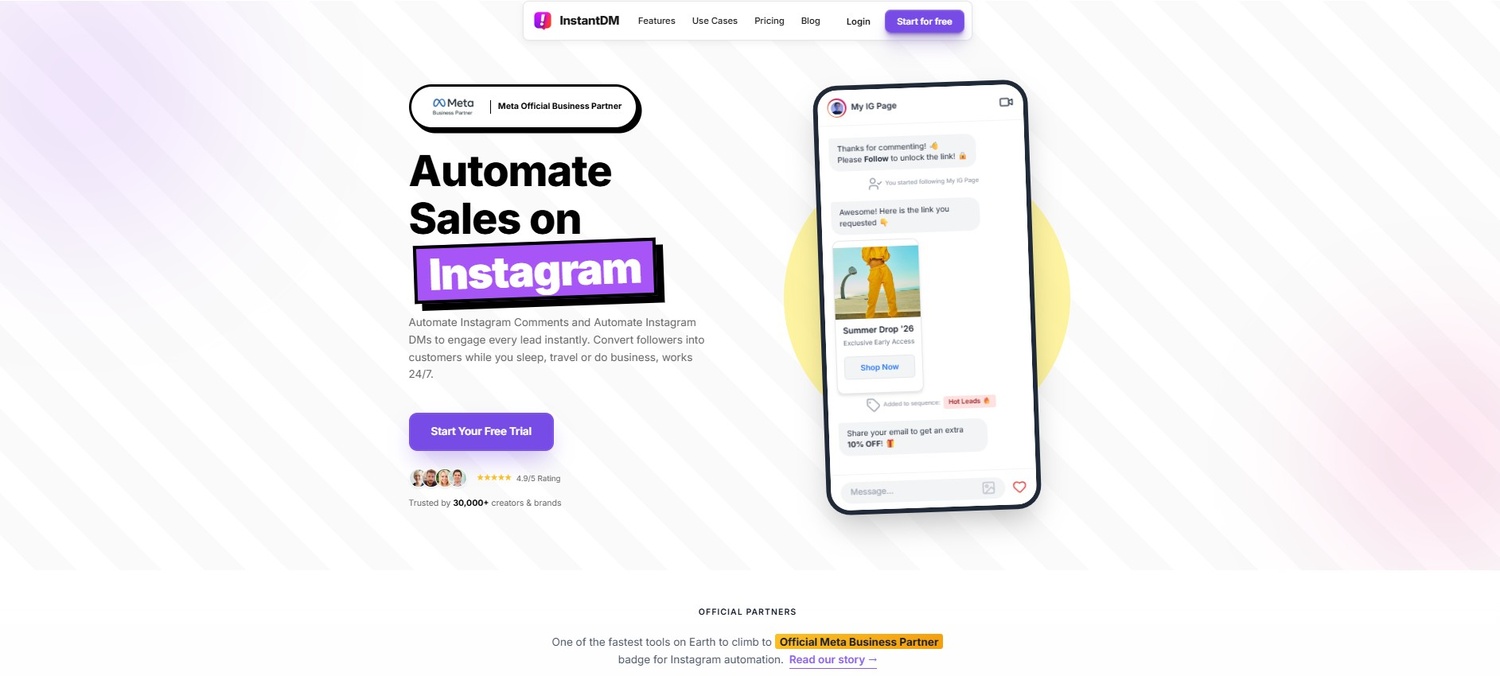
InstantDM is the only tool in this comparison that gives you three distinct ways to start for free before spending a single dollar. Most reviews get this wrong entirely. They either list it as paid-only or only mention the trial. All three options are real, and each one serves a different stage of where you are with automation.
The permanent free plan gives you 500 credits per month with no expiry and no credit card required. One credit equals one automated interaction: one comment-reply DM, one keyword-trigger DM, one story reply, and one new-follower welcome message. It doesn't matter what type of interaction it is — each one costs one credit. When you hit 500, automations pause until the calendar month resets. There's no notification when you're close to the limit and no grace period when you hit it. Campaigns stop mid-stream, silently.
In practical terms, 500 credits is enough to run one or two small campaigns on a post with modest engagement. A Reel that pulls 200 keyword comments burns 200 credits. A second post with 300 comments burns the remaining 300. You're out for the month after two posts. That's not a problem if your account gets limited engagement — it's a real constraint if you're posting consistently and driving comment volume.
The 7-day free trial is a different product altogether. It unlocks full access to the Legend Pro tier: unlimited automations, advanced DM flow builder, in-chat email collection, follow-gating, and priority support. No credit card is required to start and there's no auto-charge if you don't upgrade after the 7 days. You get the complete paid product with real campaign data — actual open rates from your actual audience — before committing to anything.
Here's where it gets genuinely interesting. If you post a video about your InstantDM experience after your 7-day trial, InstantDM gives you one full year of free access with unlimited credits. No monthly cap. No pausing mid-campaign. Full automation, completely free for 12 months. That's not a gimmick — it's a creator partnership model that makes sense for both sides. You get a year of unlimited automation worth hundreds of dollars. InstantDM gets an authentic creator review from someone who actually tested the product. One short video, one year free.
After the trial, if you don't post a video and prefer to just pay, paid plans start at $9.99/mo flat — unlimited contacts, unlimited DMs, and all features included. No per-contact pricing. No caps. No surprise billing when a post goes viral.
What InstantDM doesn't do: no native WhatsApp support and no permanent access to the full feature set on the base free plan. If multi-platform is a requirement, this isn't the right tool. If Instagram is your primary channel and you want the lowest flat rate in the market with a genuine path to a full year free, nothing else in this comparison comes close.
Best for: solo creators, coaches, and small e-commerce brands who are Instagram-first and want predictable costs at any scale, with a real option to get 12 months unlimited for the cost of one video.
2. Inro — Clean Interface, Beginner-Friendly, Free to Start
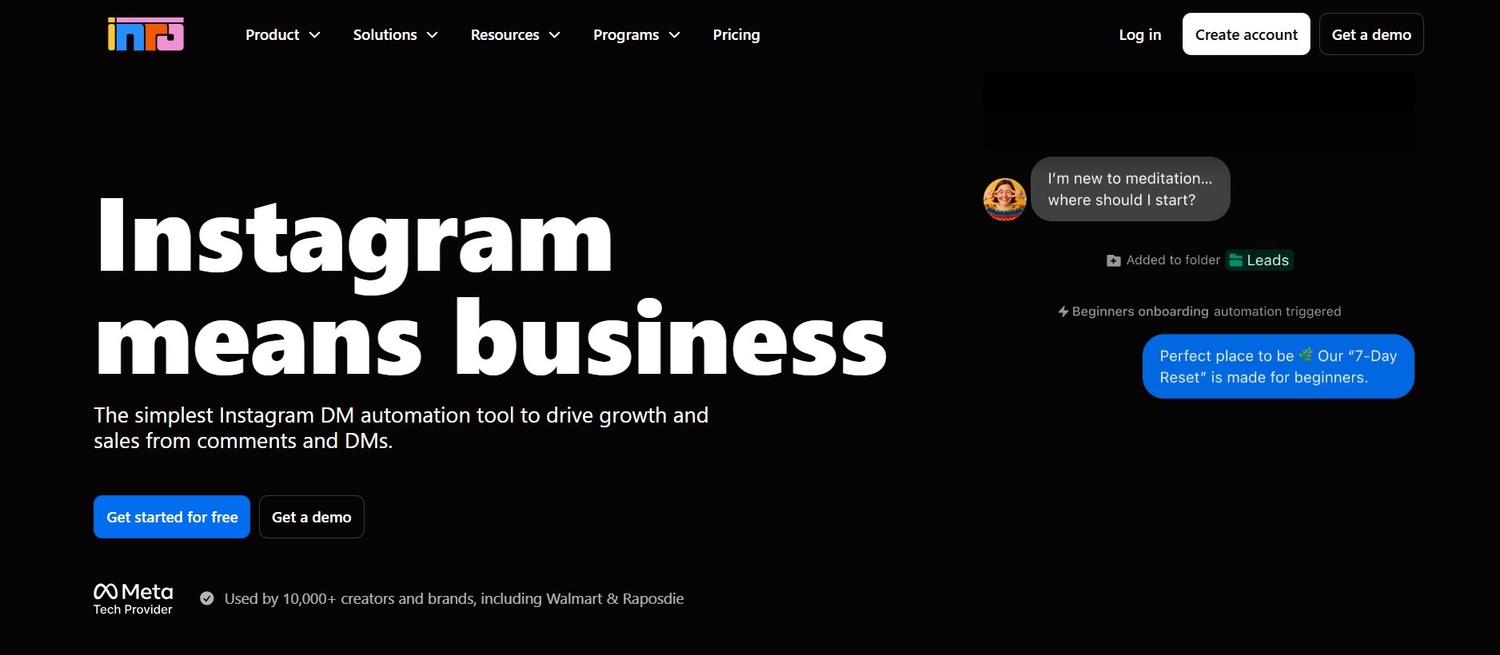
Inro is one of the newer entrants in the Instagram DM automation space and has built a reputation for a clean, minimal interface that gets first-time users running their first campaign faster than most competitors. If the barrier for you has been complexity — too many settings, too many menus, flows that feel like building a sitemap — Inro removes most of that friction.
The free plan gives you 200 DMs per month with no credit card required. One DM equals one message sent, which means a two-message flow reaches 100 people before the cap hits. For a first campaign, 200 messages is enough to verify the mechanic works and see some real open-rate data. It is not enough to run a sustained campaign at any meaningful scale. Treat the free tier as a genuine sandbox, not a growth tool.
The interface is where Inro earns its place in this comparison. The flow builder is drag-and-drop with visual previews of how a conversation appears on the recipient's end — a feature most tools don't include at this price point. For creators who think visually and want to see what their automation looks like before sending it to their audience, this matters.
At the paid level, Inro starts at $15/mo. That's $5.01 more per month than InstantDM for a comparable Instagram-only feature set. The gap is most visible on follow-gating and advanced analytics — both are included in InstantDM's paid plan from the first month, while Inro gates some advanced features to higher tiers. For basic comment-to-DM and keyword triggers, the two paid plans are broadly equivalent.
What Inro doesn't do well: it lacks the volume flexibility of InstantDM's flat unlimited model at the base paid tier, and the analytics depth at lower plan levels is limited to basic sent/received counts. If you need granular conversion data — how many DM opens resulted in link clicks, how far people progressed through a multi-step sequence — you'll need to upgrade or supplement with an external analytics tool.
Honest verdict: Inro is the best entry point for creators who find other platforms visually overwhelming. The free tier is genuinely functional for testing. At the paid level, InstantDM offers more for less, but Inro's UX advantage is real if ease of setup is the priority.
Best for: beginners running their first DM automation campaign who prioritise a clean, visual interface over advanced features or lowest price.
3. ReplyRush — Lowest Paid Price, Comment-to-DM Focused
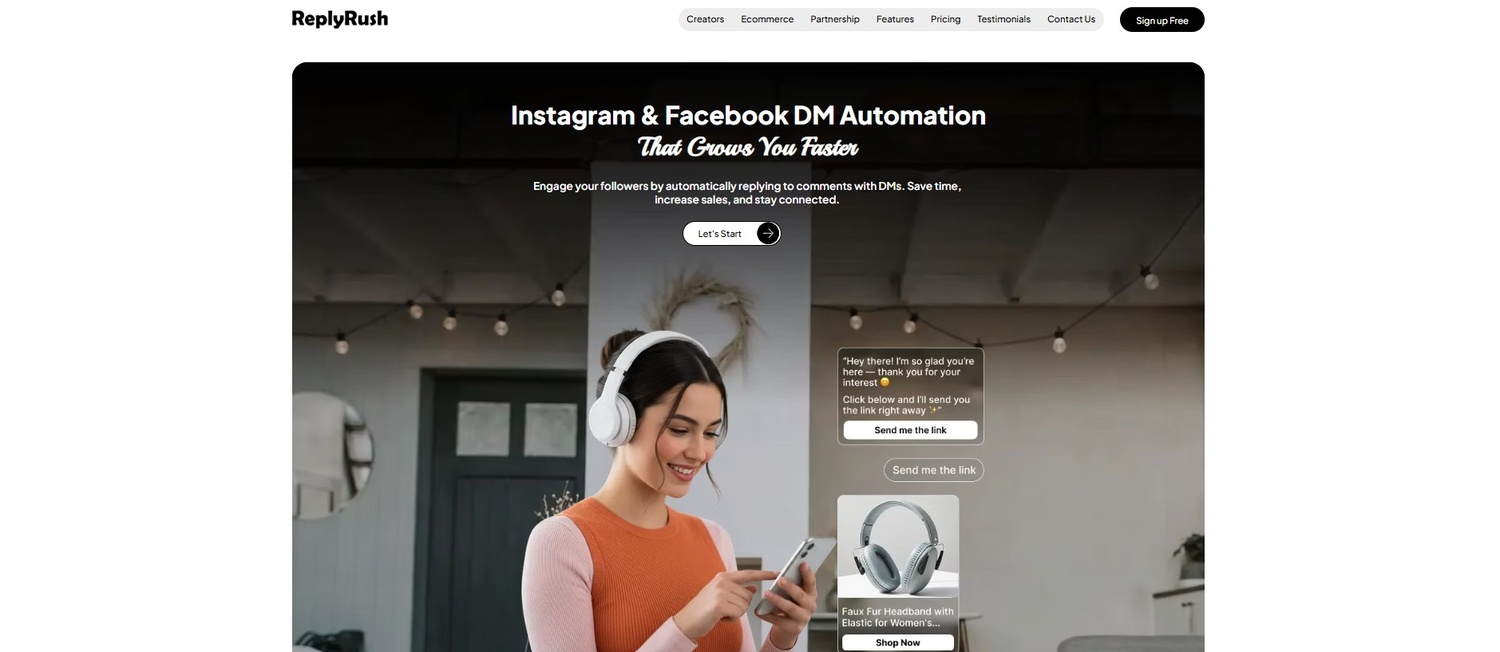
ReplyRush is the low paid option in this comparison at $7/mo flat. There is no free tier — the $7 is the entry point — but for a creator who already knows they want comment-to-DM automation and wants to start at the lowest possible monthly cost without credit-counting or per-contact billing, ReplyRush makes a reasonable case for itself.
The tool is deliberately narrow in scope. Comment-to-DM is the primary use case it was built around. Set a keyword, write the DM, attach to a post, go live. The setup takes minutes. There are no complex branching flows, no multi-platform integrations, no elaborate sequence builders. For creators who want one trigger and one automated reply — and nothing more complicated — that simplicity is a feature, not a limitation.
At $7/mo flat with no contact caps, ReplyRush sits $2.99 below InstantDM's $9.99. That difference matters more at very tight budgets than it does at moderate scale. What you give up for that $3 saving: story reply triggers are either absent or limited, follow-gating is not included, in-chat lead capture is not available, and analytics are basic. The tool does the one thing it promises and does it cleanly. It does not pretend to be a full marketing automation suite.
The risk with ReplyRush is outgrowing it quickly. If your first comment-to-DM campaign works — open rates above 60%, link clicks happening — you will almost immediately want to add a follow-up message, collect an email before delivering a freebie, or set up a story reply trigger for a different campaign. At that point, you are looking at a migration to a more capable tool. The $7/mo plan saves you money in month one and potentially costs you time in month three when you rebuild everything on a new platform.
Honest verdict: ReplyRush is the right call if your sole requirement is affordable comment-to-DM automation with no free-tier limitations and no contact-count billing. If you anticipate wanting follow-gating, story triggers, or lead capture within six months, start with InstantDM at $9.99 and avoid the migration cost.
Best for: creators who want the lowest flat monthly rate for comment-to-DM automation and have no immediate need for advanced features.
4. CreatorFlow — A Restricted Free Tier and Volume-Based Paid Plans
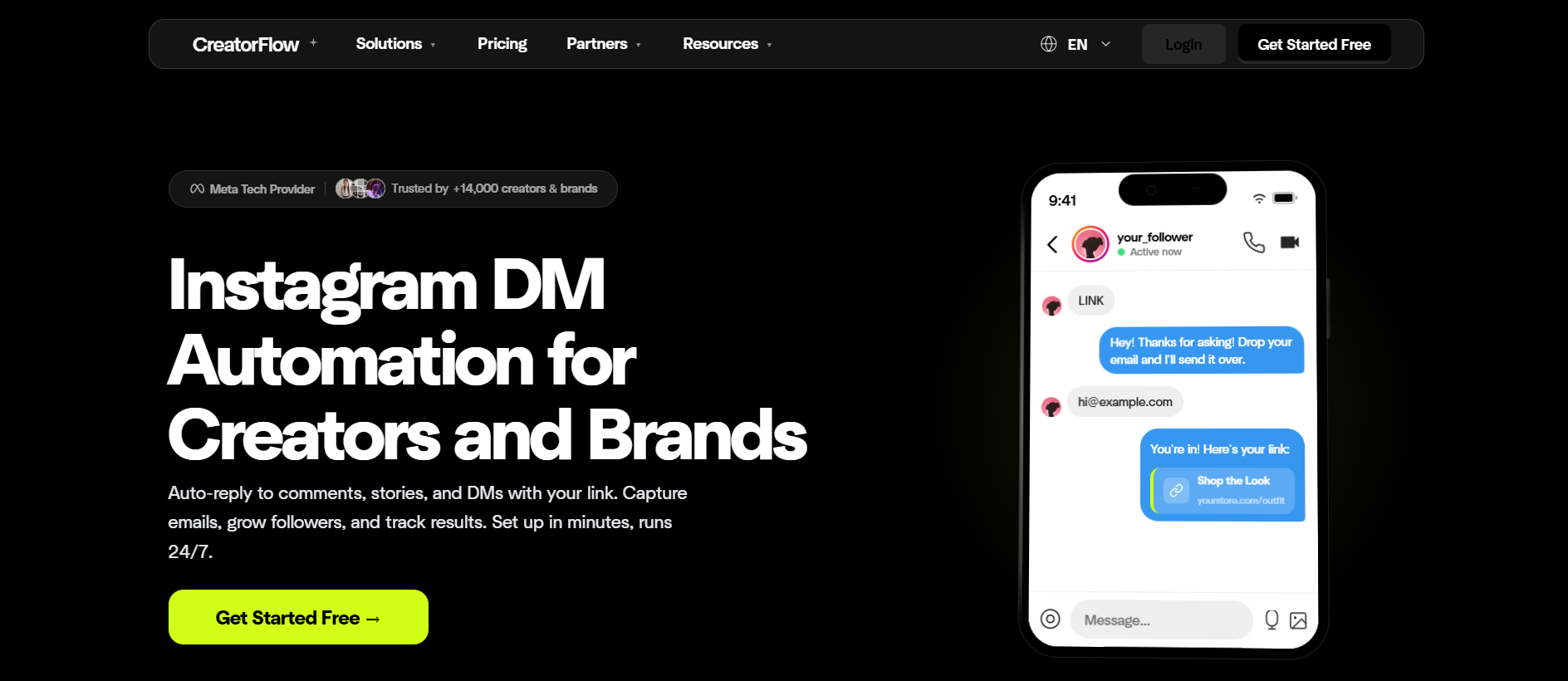
CreatorFlow connects via Meta OAuth and uses the official Instagram Graph API, which passes basic compliance. However, it is important to note that it is only a Meta Tech Provider; it lacks the higher-tier official Meta Business Partner designation.
The free plan offers 500 DMs per month without requiring a credit card, granting access to features like comment-to-DM, story replies, keyword triggers, and email collection. While this sounds generous at first glance, the catch lies in how those DMs are actively counted.
On CreatorFlow, every individual message sent counts as one unit. If you set up a standard two-message flow (an opener and a follow-up), you burn two DMs per person. In practice, that "500 DM" free plan only reaches 250 people. If a single post gets 300 keyword comments, a basic two-message sequence requires 600 DMs—meaning your automation will hit a hard ceiling and shut down mid-campaign. This is a critical limitation that the pricing page does not Make immediately obvious.
When you inevitably hit that wall and need to upgrade, the paid plans are strictly volume-based:
- Pro ($15/mo): 5,000 DMs per month, 2 workspaces, email collection, link tracking, unlimited automations.
- Growth ($29/mo): 10,000 DMs per month, 5 workspaces, priority support.
This pricing model might seem predictable at a very modest scale, but it becomes a significant financial liability the moment your account grows. If a piece of content goes viral and you suddenly need to send 30,000 DMs in a month, you would require multiple Growth plans, pushing the monthly cost to nearly $90. Ultimately, this volume-based pricing structure punishes your success in the exact same way per-contact pricing does—it just measures the restriction differently.
5. ManyChat — A 25-Contact Free Tier and a Massive Feature Wall
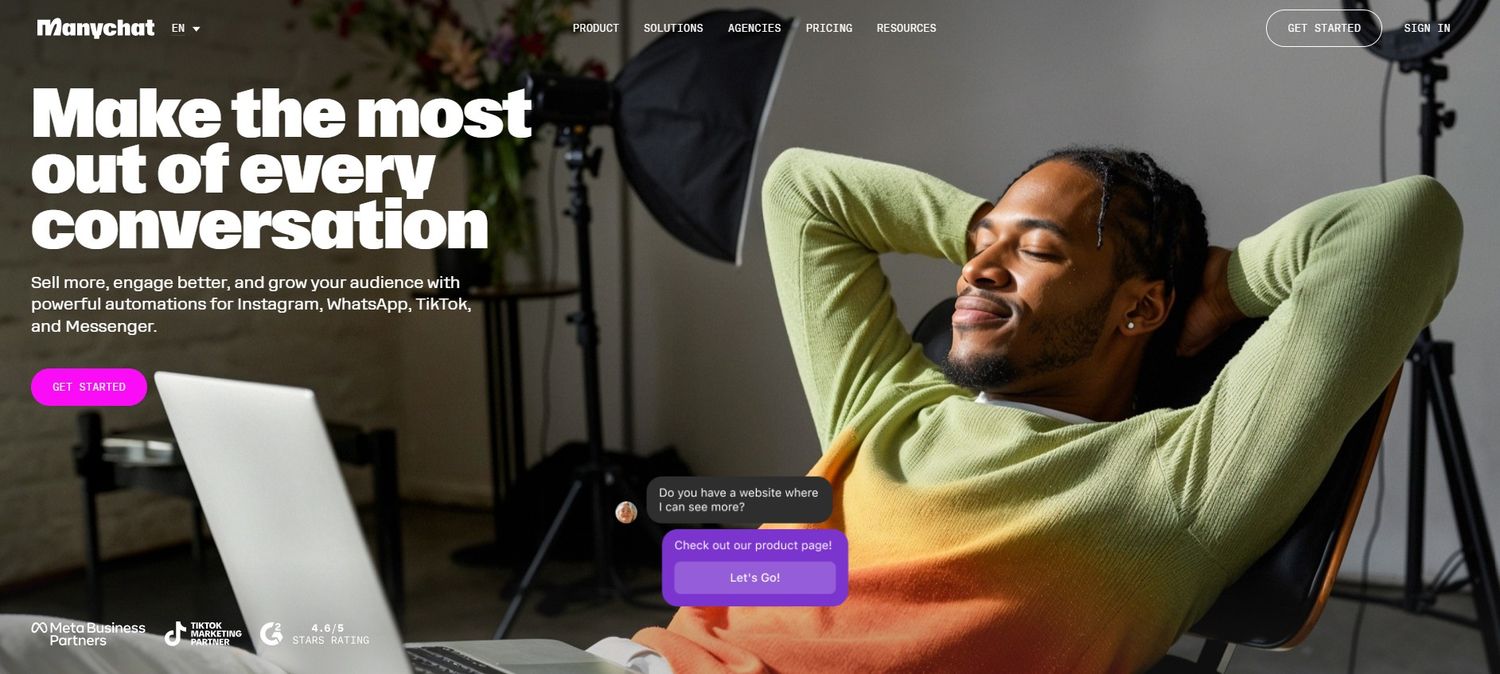
ManyChat frequently promotes its free tier, but the reality is shockingly restrictive: you are capped at just 25 contacts at no charge.
A contact is defined as a unique person who has interacted with your automation. In the context of Instagram marketing, 25 contacts is virtually nothing. A single post with even a modest amount of engagement will exhaust this limit in minutes. Once you hit that 25-person ceiling, your automations simply stop working for anyone new, effectively killing your campaign before it even starts.
The more significant issue is what is locked away on the free plan. The tools you actually need to drive revenue are entirely inaccessible. Advanced keyword triggers—the core feature that lets a specific word in a comment or DM fire a tailored sequence—require a paid plan. A/B testing is locked. Analytics beyond basic message counts are locked. Priority support does not exist. You are left with a heavily crippled builder that cannot run the conditional, keyword-triggered sequences required to genuinely convert leads.
The Pricing Trap: Once you hit that 25-contact limit and are forced to upgrade—which will happen almost immediately—ManyChat's per-contact pricing model compounds quickly and aggressively.
While it starts at $15 for 1,000 contacts, you are punished financially as your audience grows:
- 5,000 contacts: $25/month
- 10,000 contacts: $45/month
- 25,000 contacts: $65+/month
If one of your Reels lands on the Explore page and brings in 2,000 new contacts over a weekend, you aren't just rewarded with engagement; you are penalised with a massive, unexpected spike in your monthly billing.
Honest Verdict: ManyChat is built for large agencies or enterprise businesses that strictly require managing complex Facebook, WhatsApp, and Instagram campaigns simultaneously. However, if you are focused primarily on Instagram, their aggressively restrictive 25-contact free limit, locked features, and scaling per-contact pricing make it an incredibly poor and expensive choice for growing accounts.
 Klaviyo Into A Precision Profit Machine," specifically targeting Shopify brands. To the right, a "Deliverability score" dashboard shows a high score of 95 and detailed metrics like open and click rates, highlighting the platform's ability to boost revenue and guarantee a 4x ROI through optimized data performance.">
6. Chatfuel — 50 Conversations, Good for Learning, Nothing Else
Chatfuel gives you 50 conversations per month on the free plan. That is the hardest cap in this comparison and it's not close.
Fifty conversations means 50 unique interaction threads between your account and 50 different users. A comment-to-DM campaign on a post that gets 80 keyword comments burns through the cap before you've reached everyone who commented. On a post with any real traction, the free limit is gone within hours of publishing. This is not a tool you can grow on at the free tier. It's not even a tool you can properly test a campaign on at the free tier.
What Chatfuel's free plan is actually useful for: understanding how automation flow logic works. The visual flow builder is among the more intuitive in this market for building multi-step sequences with conditional branches. If you want to understand how triggers connect to responses, how logic splits work, and how a conversation sequence is structured — before touching your main account — 50 conversations is enough to experiment with the mechanics.
The paid plan starts at $14.99/mo and unlocks full conversation volume along with the complete feature set. The tool's strength at the paid tier is its flow builder for complex sequences. If your use case involves intricate multi-step conversations with conditional logic, Chatfuel is worth evaluating at the paid level. At the free level, treat it as a sandbox.
Honest verdict: use Chatfuel's free tier to learn how automation logic is built. Don't use it to run campaigns your audience will see.
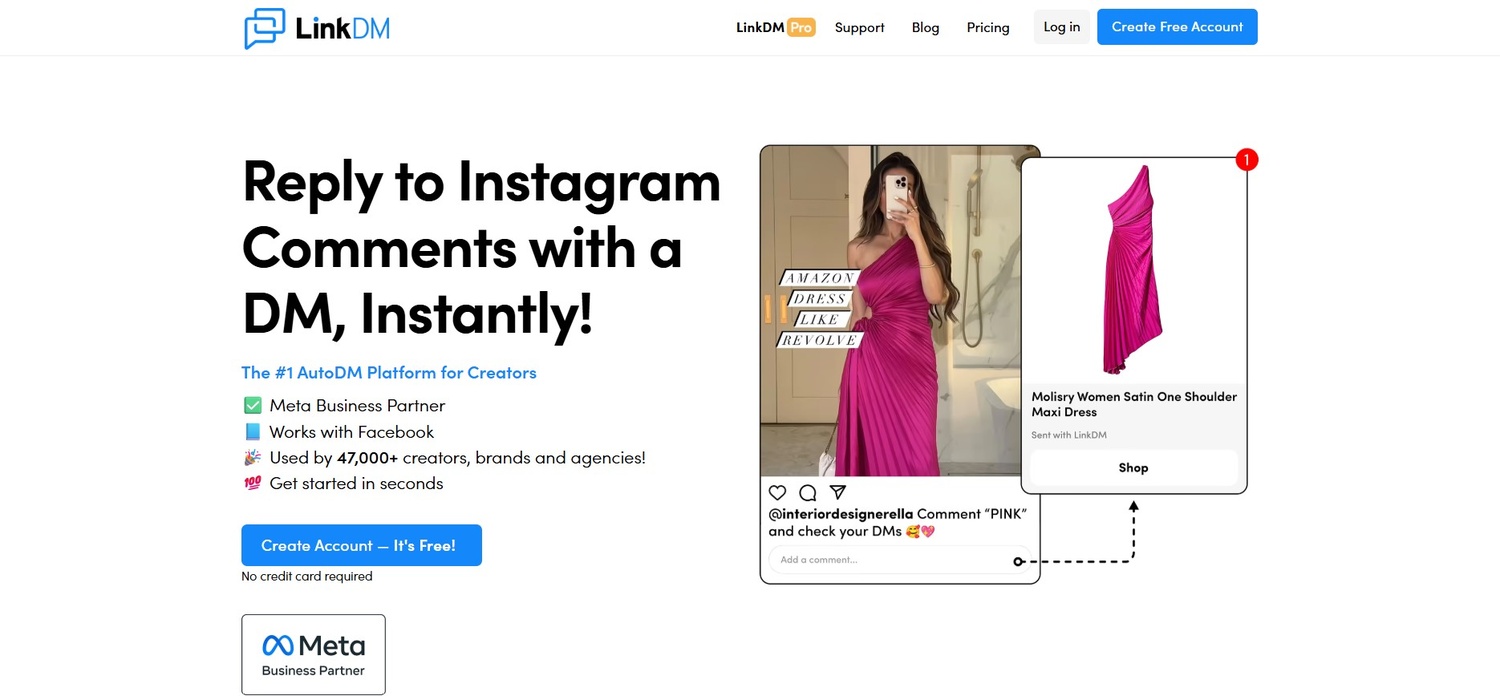
7. LinkDM — The 1,000 DM Trial Wall
LinkDM frequently leans on its legacy reputation, but its pricing structure leaves a lot to be desired for growing creators. They try to pull you in with a free trial that restricts you to just 1,000 DMs per month.
If you are just starting out, 1,000 messages might sound like plenty of runway. It isn't. If you run a standard two-message flow—an initial delivery plus a quick follow-up to capture a lead—that allowance only covers 500 people. A single Reel gaining even modest traction will completely devour those credits in a matter of hours, freezing your automations right when you need them to convert.
Once you crash into that invisible limit, LinkDM immediately forces you onto their $19/month paid tier.
While the platform is fully Meta-compliant and features a solid user community, the math simply does not add up for a solo creator or small brand. You get the exact same core features—comment-to-DM, story triggers, and follow-gating—with InstantDM for a flat $9.99 a month. Choosing LinkDM means you are voluntarily paying nearly double the price just to access an older tool with a slightly larger support forum.
Honest Verdict: LinkDM is an established, functional option if you do not mind overpaying. But the moment your content actually performs well, that restrictive 1,000 DM trial limit breaks your funnels and forces an immediate, overpriced upgrade.
The Real Cost of "Free" When the Cap Kills the Campaign
There are three moments where a free plan stops being a useful testing ground and starts actively costing you. None of them send you a notification.
The first is the viral post scenario. You set up a comment-to-DM campaign on a post promoting a free guide — your keyword is "GUIDE," your DM delivers the link instantly. The post gets picked up by Explore. By 11pm, 620 people have commented your keyword. InstantDM's free plan has fired 500 credits and gone silent. The next 120 commenters receive nothing. No DM. No link. No follow-up. You find out the next morning when you open the dashboard and see the drop-off. That window — the 20 to 40 minutes after someone engages with a trending post — is when DM delivery converts at its highest rate. Missing it doesn't mean those 120 people try again later. It means they scroll past and forget. The same scenario on Inro's free plan — capped at 200 DMs — would stall even earlier, after just the first wave of commenters.
The second is the growth milestone. Most accounts running consistent content hit 5,000 to 10,000 engaged followers within 6 to 12 months, based on Meta's 2025 creator growth benchmarks. At that level of engagement, a 500-credit monthly allowance covers roughly two comment-to-DM campaigns. One Reel every two weeks with automation — every other post runs manually, or doesn't run automation at all. That's not automation. That's a sample.
The third is the feature ceiling. Follow-gating — where a person has to follow your account before receiving a link — is locked on most free plans. In-chat lead capture, where your DM flow collects an email or phone number before delivering the freebie, is also locked on most tools. CreatorFlow is an exception — it unlocks email collection on its free tier — but follow-gating remains unavailable across all CreatorFlow plans. These are the features that convert DM opens into actual leads. ReplyRush and Inro share the follow-gating limitation too. The free tier shows you that automation works. It doesn't give you the tools to make automation profitable at the level that the paid tools do.
This is where the paid plan math starts making sense. At $9.99/mo flat with no caps, a single campaign reaching 200 people — converting at 5% on a $30 product — returns $30 in revenue on a $9.99 monthly spend. That's a positive return before the month ends. The free plan, capped at 500 credits and missing follow-gating, might reach the same 200 people but can't collect their email before delivering the link. The conversion rate on an uncaptured lead is substantially lower. The tool that costs money outperforms the free version not because it sends more messages, but because the messages it sends are set up to actually close.
How to Set Up Instagram DM Automation: Step by Step
None of the top-ranking posts on this keyword include a setup guide. Here's exactly how to run your first campaign, using InstantDM as the reference platform. The flow is structurally similar across meta-compliant tools — including Inro and ReplyRush, which both use Meta OAuth for the same authorisation step.
If you're looking to scale those campaigns into a full 24/7 sales engine, our guide to IG DM funnels walks through building multi-step sequences that convert followers into paying customers on autopilot.
Step 1: Connect your Instagram business or creator account via Meta OAuth. Go to the dashboard and click on "Connect Instagram." You'll be redirected to a Meta-hosted authorisation screen — not a form on the tool's own site asking for credentials. Log in through Meta, approve the requested permissions (comment management, messages, basic account data), and you're returned to the dashboard. The entire process takes under two minutes. Your password never touches InstantDM's servers.
Step 2: Choose your trigger type. The four options are comment keyword (someone comments a specific word on your post), story reply (someone replies directly to one of your stories), DM keyword (someone sends a specific word in a DM), and new follower (someone follows your account). For a first campaign, the comment keyword is the highest-volume trigger and the easiest to test against a single post. Pick one keyword that's specific enough to filter genuine interest — "GUIDE" or "LINK" or "FREEBIE" — not something generic that unrelated comments might accidentally trigger. Note: ReplyRush focuses on comment keywords only; Inro supports comment and DM keyword triggers at most plan levels but may limit story reply to paid tiers.
Step 3: Write your opening DM. Use the {{first_name}} personalisation token so the message opens with the person's name — this alone improves open-to-reply rates noticeably. Keep the first message under 160 characters. Long opening DMs have lower engagement because they read as automated. Write it the way you'd actually type it to someone you know: "Hey {{first_name}}! Here's the link you asked for 👇, consistently outperforms Dear [Name], Thank you for your interest in our content." The conversational version doesn't sound like it was written by a form letter.
Step 4: Build your follow-up sequence. Deliver the value first — the link, the freebie, the answer to the question your post raised. Then, optionally, ask for something in return: an email address, a phone number, or a "Reply YES if you want the full breakdown." Asking before delivering is the most common reason DM sequences stall at message one. People who haven't received what you promised aren't motivated to give you their contact details. Give first, ask second.
Step 5: Enable follow-gating if you're delivering a lead magnet. If your campaign gates the link behind a follow — meaning the person has to follow your account before receiving the link — activate this option in the campaign settings before going live. The tool checks follower status in real time and holds the link until the follow registers. Test this step specifically from your secondary account because follow-gate timing can lag on slower mobile connections, and a 60-second delay feels like a broken campaign to the person waiting. Follow-gating is available on InstantDM and LinkDM at paid tiers; it is not available on ReplyRush or Inro's entry plans.
Step 6: Test the entire flow from a secondary Instagram account. Before publishing the trigger post, run the complete sequence from a second account you control. Comment the keyword on your post; watch the DM arrive; open every message in the sequence; click through any links; check that personalisation tokens pull the correct name; and verify that links are formatted as clickable URLs rather than plain text. This step consistently catches the silent failures – token errors, link formatting issues, and follow-gate timing lags – before your audience finds them.
Step 7: Go live and monitor the first 48 hours closely. Publish the post, activate the automation, and keep the dashboard open for the first two days. The metrics that matter most early on are the open rate on the first DM (anything above 60% means your trigger is working and the opening message is landing); the drop-off point in the sequence (which message do people stop responding after?); and whether conversions — link clicks, email captures, consultation bookings — match the goal you set for the campaign. If your open rate is strong but your conversion is weak, the trigger is fine and the follow-up copy is the problem. Fix that one element before scaling.
For a deeper breakdown of comment-to-DM automation strategy and how to send automatic DMs when someone comments on specific post types, those guides go further into campaign-level optimisation beyond the setup basics.
The first week of data is the most actionable you'll collect. It tells you whether the trigger keyword is working, which message in the sequence is losing people, and whether the campaign goal is realistic given your audience size and engagement rate.
What These Trigger Types Actually Deliver — Benchmarks
A fitness coach with 28,000 Instagram followers started on ManyChat's free plan in early 2025. The contact limit was hit in the first month — a single coaching post drove 1,200 comments and pulled in 400 new contacts in one day, burning through a quarter of the free allowance immediately. They upgraded to ManyChat's £25/mo plan to handle the volume. Three months later, they switched to InstantDM's paid plan at $9.99/mo — same comment-to-DM features. same Meta API compliance, less than half the monthly cost. Over the following 45 days they ran comment triggers on coaching program posts, sending 3,100 DMs total. The open rate across those campaigns was 71%. Of the people who opened, 9.8% booked a free consultation call — 44 calls total from a $9.99/month spend. The tool paid for itself before the first consultation converted.
That's one account. The benchmark data below is aggregated from campaign performance across Meta-compliant Instagram automation tools, sourced from platform-level reporting through 2025:
| Trigger Type | Average Open Rate | Average Conversion |
|---|---|---|
| Comment-to-DM (keyword) | 65–80% | 8–18% |
| Story reply trigger | 70–85% | High intent |
| DM keyword trigger | 60–75% | 6–14% |
| Welcome DM (new follow) | 55–65% | 3–8% |
| Broadcast (opted-in) | 60–75% | 5–12% |
DMs outperform email at every stage of the funnel — Mailchimp's 2025 email benchmarks put average open rates at 20–35%, against 65–85% for triggered Instagram DMs on the same audience segments.
Pricing at Scale — What You Pay as Your Account Grows
Flat rate and per-contact pricing look identical at 500 contacts. They are not the same at 10,000, and they are very different at 25,000.
The table most pricing pages don't show you the following:
| Tool | Free Tier | 1K contacts | 5K contacts | 10K contacts | 25K contacts | Meta Status |
|---|---|---|---|---|---|---|
| InstantDM | 500 credits/mo | $9.99 | $9.99 | $9.99 | $9.99 | Business Partner |
| Inro | 200 DMs/mo | $15 | $15 | $15+ | $15+ | Tech Provider |
| ReplyRush | None | $7 | $7 | $7 | $7 | Tech Provider |
| CreatorFlow | 500 DMs/mo | $15 (5K DMs) | $15 (5K DMs) | $29 (10K DMs) | $29+ × plans | Tech Provider |
| ManyChat | 25 contacts | $15 | $25 | $45 | $65+ | Business Partner |
| Chatfuel | 50 convos | $14.99 | $24.99 | $49+ | — | Business Partner |
| LinkDM | 7-day trial | $19 | $19 | $19 | $19 | Business Partner |
The viral billing risk is specific, and it's real. A creator on ManyChat's $15/mo plan who gets a Reel to Explore — pulling in 3,000 new contacts over 72 hours — wakes up to a contact count that triggers a tier jump. The bill increases from $15 to $25 overnight with no advance warning and no cap they set themselves. CreatorFlow handles this differently — it pauses automations when the DM volume cap is hit rather than auto-upgrading — but a creator needing 30,000 DMs after a viral post would still need multiple plans at $29 each. There's no "pause billing when viral" option on volume-based tools either. Flat-rate pricing has no equivalent risk.
Flat-rate pricing has no equivalent risk. Whether you add 10 contacts this month or 10,000, the bill is identical. ReplyRush at $7/mo and InstantDM at $9.99/mo both carry this predictability — the difference is feature depth. CreatorFlow at $15/mo is flat too, but its DM volume cap means a viral post that exhausts 5,000 DMs still pauses your campaigns until the next billing cycle. That predictability has real value when you're making content decisions — you don't have to calculate whether a campaign will trigger a billing upgrade.
The pricing crossover point — where flat rate becomes cheaper than per-contact — is roughly 2,000 to 3,000 contacts for most per-contact tools. Below that threshold, per-contact plans and flat-rate plans are similar in cost. Above it, the gap compounds. At 10,000 contacts, ManyChat costs $45/mo against InstantDM's $9.99 and ReplyRush's $7. At 25,000, it's $65+ more than single digits. The delta at scale is not marginal.
5 Mistakes People Make With Affordable Instagram Automation Tools
Mistake 1: Signing up for a tool without checking its API compliance. This happens because the low price point removes the scrutiny that a $99/mo tool would get. People sign up, connect their account, and only notice the tool asked for their Instagram password after the fact. At that point, the account may already be flagged. The fix is the 30-second test: look for a Meta OAuth redirect during setup. If it's a credential field on the tool's own website, stop. Don't proceed past that screen. All tools in this comparison — including Inro and ReplyRush — pass this test.
Mistake 2: Going viral on a capped plan with no upgrade plan ready. You run a test campaign, open rates are 70%, you post a bigger piece of content to take advantage of the automation — and the cap kills the campaign on your best-performing post to date. The fix is not to panic-upgrade after the fact; it's to check your remaining credit balance before publishing any post you plan to promote or boost. If you're within 200 credits of the cap and you have a post going live that week, either upgrade first or accept that the campaign will be cut short. Inro's 200 DM free cap makes this risk arrive faster than any other tool in this comparison.
Mistake 3: Choosing a tool based on price, then spending five hours learning a platform you'll outgrow in six weeks. Free doesn't mean costless — your time is a cost. If you're going to hit Chatfuel's 50-conversation cap and move on within a month, the five hours you spent learning its flow builder are five hours that could have gone toward the tool you'll actually use at scale. The same logic applies to ReplyRush: if you know you'll need follow-gating or story triggers within three months, learning ReplyRush's comment-only system and then migrating is a time cost that outweighs the $2.99/mo saving over InstantDM. Match the tool to your actual growth trajectory.
Mistake 4: Not testing flows from a secondary account before going live. The things that break silently are the ones you don't think to check. Personalisation tokens that pull an empty field because the user's first name isn't set. Links that render as plain text in DMs because of formatting issues. Follow-gate timing that takes 90 seconds — long enough for an engaged user to assume the automation is broken and give up. None of these failures show up in a dashboard test. They only appear when a real person on a real device tries to go through your flow. Run the complete sequence from a secondary account before any post goes live. It takes 10 minutes and it's the single highest-use quality check you can do.
Mistake 5: Staying on a free tier out of inertia when the math has already flipped. The open rates are good. The campaigns are working. But every month, the cap cuts off two or three campaigns early. Upgrading feels like a commitment, so it keeps getting deferred. Run the arithmetic once: one sale from an automated DM campaign — at a $30 product price and 5% conversion rate from 200 DM opens — returns $30 in revenue. That's three months of InstantDM at $9.99/mo paid for by a single conversion from a single campaign. Or more than four months of ReplyRush at $7/mo if comment-to-DM is your only need. Staying on the free tier after that point isn't caution. It's leaving money in the campaign you're already running.
Meta Business Partner vs. Meta Tech Provider — Why the Difference Matters for Your Account
Every tool in this comparison uses the official Meta Graph API. That's the baseline — the minimum requirement for API compliance — and it means none of them put your account at risk of a ban from simulated logins. But API compliance is not the same as Meta partnership status, and that distinction has practical consequences you should understand before choosing a tool.
Meta Tech Provider is the foundational tier. A tool earns this status by registering with Meta as a developer, passing the app review process, and operating within Meta's published API terms. It confirms the tool is a legitimate, registered third party that accesses Instagram through approved channels. CreatorFlow, Inro, and ReplyRush hold Tech Provider status.
**Meta Business Partner** is a higher, separately vetted tier. Meta evaluates companies for this status based on performance metrics, client outcomes, platform expertise, compliance track record, and technical capability. It is not automatic — it requires a formal application, review, and ongoing performance standards. InstantDM, ManyChat, Chatfuel, and LinkDM have achieved Business Partner status in this comparison.
Here's why that distinction is practically relevant to you as a creator or brand:
Priority support from Meta. When a Business Partner tool encounters an API-level issue — a permissions error, a delivery failure during a high-volume campaign, an account flag that needs investigation — they have a direct channel to Meta's technical team. A Tech Provider does not have the same access. For a campaign running during a viral post, the speed of that support path is not theoretical.
Early access to new API features. Meta rolls new features — new trigger types, updated messaging capabilities, enhanced analytics endpoints — to Business Partners before general availability. Business Partner tools are often already supporting new capabilities when they ship publicly. Tech Provider tools add them later, on a timeline they don't control.
Verified compliance track record. The Business Partner badge is not a one-time approval. It requires maintaining Meta's standards on an ongoing basis. Tools that hold it have a documented history of operating within Meta's terms at scale, not just at signup. For a small account, this may feel abstract. For a brand managing an account with 500,000 followers running automated campaigns on every post, the compliance track record of the tool you connect is a real risk consideration.
Accountability and trust signals. Meta Business Partners are listed in Meta's official partner directory. Their status is publicly verifiable. When a brand evaluates which DM automation tool to connect to their main business account, the ability to verify Business Partner status in Meta's own directory is a meaningful trust signal that Tech Provider status alone doesn't provide.
What Tech Provider status does guarantee: API compliance. The tool connects via Meta OAuth, not a password scrape. Your account is safe from the category of risk that non-compliant tools create. For a solo creator running moderate campaigns, a well-built Tech Provider tool is sufficient. The risk profile is low, the account is protected, and the day-to-day feature set is functionally equivalent.
Where Business Partner status starts to matter: as your account grows, as your campaigns increase in volume, and as the stakes of a delivery failure or account flag increase. At 5,000 followers running occasional automations, the difference is minor. At 100,000 followers running daily campaigns for a product launch, the support access, compliance depth, and early feature availability of a Business Partner tool carry real weight.
In practical terms: InstantDM, ManyChat, Chatfuel, and LinkDM operate with the additional layer of accountability, direct Meta support access, and feature pipeline access that comes with Business Partner status. CreatorFlow, Inro, and ReplyRush are compliant and safe, but operate without those additional protections. For most readers of this comparison, that's a secondary factor — API compliance is the critical threshold. But it's worth knowing before you make a decision at scale.
Which Tool Should You Actually Use?
You want zero budget, no time limit, and no credit card: Start with either InstantDM's free plan (500 credits/mo) or CreatorFlow's free plan (500 DMs/mo). Inro also offers a free tier at 200 DMs/mo — lower volume but a cleaner interface if that matters at the testing stage. For single-message campaigns, InstantDM and CreatorFlow are equivalent. Inro hits the cap faster but gives a better visual experience for first-timers.
You want the absolute lowest paid price for comment-to-DM only: ReplyRush at $7/mo flat. No contact caps, no free tier, no advanced features. If your workflow is post content – trigger comment keyword – deliver DM – done, ReplyRush is the cheapest way to run it reliably. The moment you need follow-gating, story replies, or email capture, move to InstantDM.
You want to test the full product before paying anything: InstantDM's 7-day trial gives you Legend Pro access – unlimited automations, follow-gating, email collection, and full analytics – with no credit card and no auto-charge. Seven days is enough to run a real campaign, pull real open-rate data, and make a fully informed decision about whether the paid plan is worth $9.99/mo for your account.
You're a beginner who finds automation tools overwhelming: try Inro at the free tier first. The interface is the most visually approachable in this comparison — drag-and-drop, real conversation previews, and minimal settings to navigate. Use it to understand what a DM automation looks like from the recipient's perspective, then graduate to InstantDM when you're ready for full feature access at a lower price.
You need Instagram, Facebook, and WhatsApp in one place. ManyChat is the only tool in this comparison with genuine multi-platform coverage. The free tier covers 25 contacts across channels. The paid plan starts at $15/mo and scales with contact count. If multi-platform is the requirement, ManyChat is the right tool — with full awareness that the per-contact pricing model will cost more as your audience grows.
You want an established platform with a large user community and documentation: LinkDM at $19/mo flat. It has been in the market longer than most tools here; the user community is larger, and the documentation is more extensive. The 7-day trial gives you full access before paying. If community resources and peer case studies are how you learn, the $9 premium over InstantDM's flat rate may be worth it.
You just want to understand how flows work before touching your main account: Chatfuel's 50-conversation free tier. You won't be reaching your audience at scale, but the visual flow builder is intuitive and 50 conversations is enough to understand how triggers, branches, and sequences connect. Use it as a sandbox, not a campaign tool.
For anyone with more than 5,000 followers posting at least twice a week, the free tier maths stops making sense within 60 to 90 days. At that scale, with that posting frequency, you will hit the cap. You will have campaigns cut short. The features you actually need — follow-gating, lead capture, and full analytics — will be locked. At that point, InstantDM at $9.99/mo flat is the low-price option in this market that gives you unlimited volume, all features, Meta Business Partner status for direct support access, and no billing surprises when a post goes viral. If your needs are narrower — comment-to-DM only, no lead capture — ReplyRush at $7/mo is worth the look first.
The Paid Plan Decision Makes Itself
Free is the right place to start. There's no argument for paying $9.99/mo to prove to yourself that DM automation drives real open rates. Start on the free plan. Run one comment-to-DM campaign on a real post. Check what percentage of people who commented your keyword actually opened the DM.
When you've seen a 70% open rate on your own account — with your own audience, on your own post — you'll understand what the tool is doing. And when you've had one campaign hit the 500-credit cap on a post that was gaining traction, with comments still coming in and the automation sitting silent, the paid plan decision is already made.
InstantDM's 7-day trial is where that next step starts. No credit card. One trigger. One post. See what the full product does before you pay for it.
Watch: Instagram DM Automation Pricing in 2026
See what affordable DM automation actually looks like in 2026:
- Instagram DM Automation Tools Compared: What Actually Works
- How Much Does Instagram DM Automation Cost in 2026?
- Best Budget Instagram DM Automation Tools
- Instagram DM Automation vs Manual: Cost Comparison
Related: Best Insta DM App & Instagram DM Automation Tools (2026): Th
Related: How to Reply to Instagram DMs Faster (Manual + Auto-Reply Se
Related: The Best Automation Tools for OnlyFans Creators to Scale Inc
Related: Mastering IG DM Funnels: Guide to Auto DM Sales
Avoiding Instagram Bans for OnlyFans Creators: 2026 Guide
How Spiritual Creators Build Loyal Communities Through Instagram DMs
Why Social Media Should Not Be Your Entire Marketing Strategy
Instagram Is Disabling Accounts Without Warning. Here's How to Protect Yours.
How to Automate Your Instagram DMs with Claude AI
How to Send a Link When Someone Comments on your Instagram
Best Insta DM App & Instagram DM Automation Tools (2026): The Complete Guide
The Best Instagram Tools for Creators to Scale Fast in 2026
The Best Automation Tools for OnlyFans Creators to Scale Income
Mastering Instagram Insights 2026: The Ultimate AI Strategy Guide
The Best AI-Generated Images & Stock Photos for Your Brand
Instagram Just Added AI Reply Suggestions in DMs - Here's What It Means for You
Messaging With Instagram Marketing Strategy Actually Works
How to Reply to Instagram DMs Faster (Manual + Auto-Reply Setup)
2026 E-Commerce FAQ Templates: How to Turn DMs into Sales
How to Delete or Deactivate Instagram in 2026 (With Data Backup)
How Photographers Automate Booking Inquiries Through Instagram DMs
Automate, Engage, Convert: The AI Agent Playbook for Instagram DM Marketing in 2026
9 DM Campaign Ideas That Generated 10x More Leads Than Email
Quick Guide - How Do You Direct Message Someone on Instagram
Connect Facebook to Instagram in 2 Minutes (Required for DM Automation)
Instagram Lead Generation on Autopilot: The Complete DM System
How to Set Up Auto DM on Instagram - Step By Step 2026 Guide
How to optimize my Instagram profile to stop losing sales?
How to Turn Your Instagram Scroll Into $1,000+ in Daily Income
Ultimate DM Templates for Comment-to-Lead Instagram Auto DM
How to Manage Instagram Direct Messages & Boost Sales
Instagram vs TikTok 2026: Which Platform Wins?
The 2026 Guide: Using Instagram Auto DMs Without Getting Banned
Instagram API Rate Limits Explained (2026 Developer Guide)
Instagram DM Limits & Rules 2026: The Ultimate Account Safety Guide
Gary Vee's Instagram Rules + AI Prompts = Digital Product Sales on Autopilot
Amazon Influencers Are Sending Storefront Links on Autopilot — Here's How
Course Creators Are Using AI DM Agents to Fill Programs on Autopilot
The LTK Affiliate Program (2026): Commission Rates, Secret Approval Requirements, & How to Scale
8 DM Tips That Boost Reply Rates by 40% (Tested on 50K Messages)
30 Things You Need to Know Before Starting on Instagram in 2026
How to Check Instagram Messages: DMs, Requests, and Hidden Inbox (2026)
How to Organize Instagram DMs: Labels, Filters, and Inbox Zero
Instagram Navigation Metrics: What They Mean and How to Use Them for Sales
Data Encryption at Rest: Why Your DMs are Safer with InstantDM