TL;DR
In 2026, Instagram is no longer just an app for sharing photos in order; it is a very advanced semantic search engine. Using only a block of thirty hashtags is an old-fashioned way to get your content seen. To get noticed these days, you need to know how to use Instagram keywords. This means putting high-intent phrases in your name field on purpose, naturally weaving them into your captions, using hidden alt text, and even saying them out loud in your Reels so that the algorithm can index your audio.
But the challenge doesn't end with finding it. You need a way to turn all the traffic your SEO strategy brings to your profile into money once it starts working. This is where keywords come in handy: they help people find your site and they help you Make sales by using trigger keywords like "LINK" in comments. By adding InstantDM, an official Meta Business Partner, you can instantly turn those keyword comments into automated private messages. This will send products straight to your audience's inbox and close the conversion gap completely. Read on to learn everything there is to know about the 2026 plan.
Introduction: The New Era of Instagram Discovery
Let's face it: the growth tactics you employed in 2023 are now outdated. If your current Instagram strategy consists of posting an aesthetic photo, writing a two-word caption, and pasting a wall of generic hashtags like #love and #instagood in the first comment, you are actively sabotaging your organic reach.
Welcome to the year 2026. The platform, the people who use it, and the machine-learning algorithms that power it have all changed a lot. Instagram is now officially a search engine for pictures. People are no longer just mindlessly scrolling through their feeds; they are actively using the search bar and the explore page to find local businesses, solutions to problems, aesthetic inspiration, and educational content. People now use Instagram to look for "marathon training tips" or "NYC coffee shop reviews", just like they used to use Google to look for "best running shoes".
This change has created a huge chance for brands and creators who are willing to change. To get the most out of this new algorithmic landscape, you need to know how to use Instagram keywords. It's not about fooling the system anymore; it's about giving the algorithm clear, relevant data so it knows who to show your content to.
Stop guessing what your audience wants and start relying on actual search data to drive your content calendar. By using a step-by-step guide on how to find SEO keywords for Instagram, you can learn how to use free tools like AnswerThePublic and TubeBuddy to uncover the exact long-tail phrases your ideal clients are actively typing into the search bar.
Part 1: Understanding the Search Landscape in 2026
1. How Instagram Search Has Changed: From Hashtags to Semantic SEO
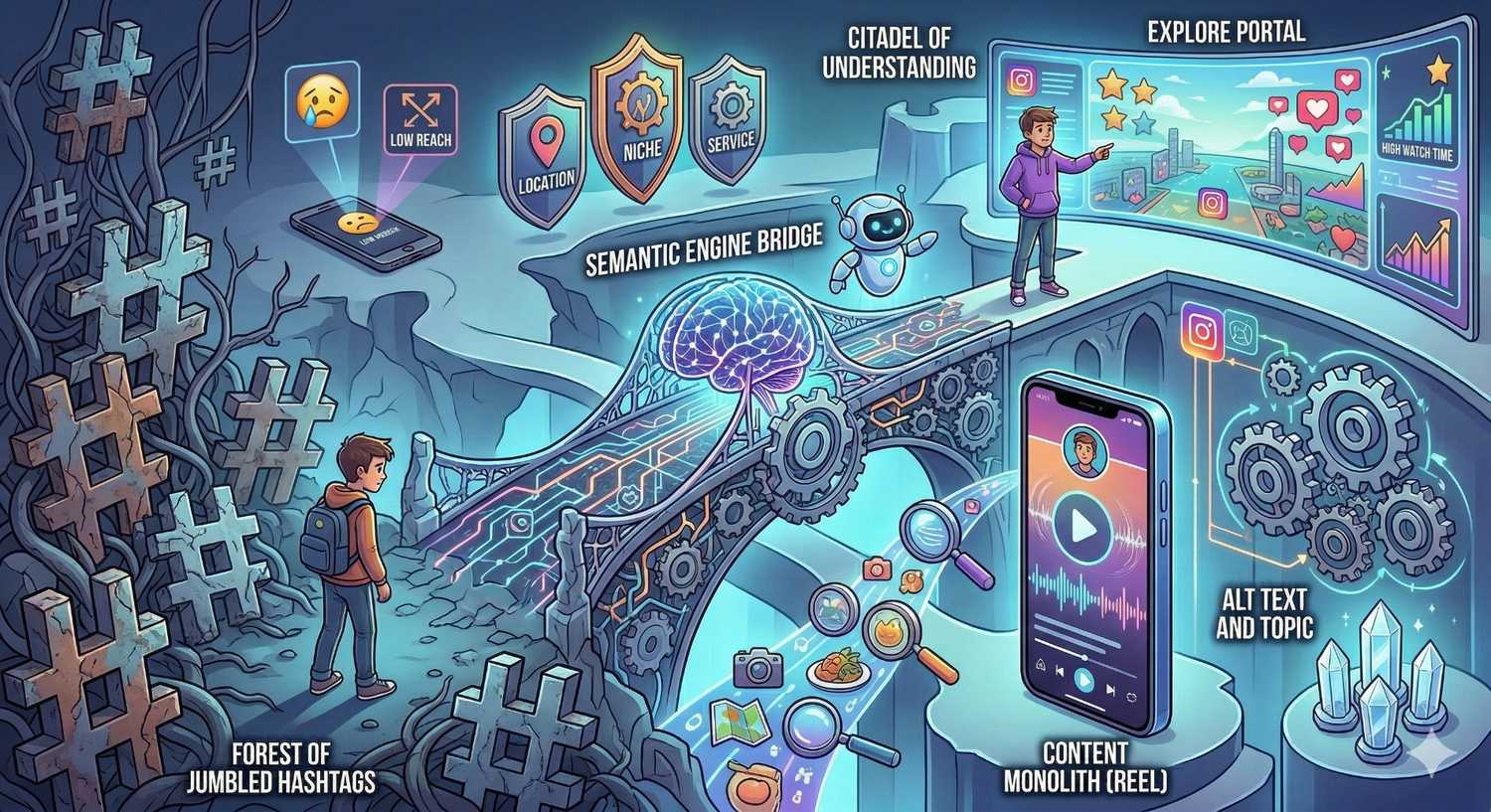
To understand where we are, you have to understand where we came from. For years, Instagram's search functionality was incredibly rigid. If you searched for "vegan baking", the algorithm would strictly look for posts that included the exact tag #veganbaking. If you wrote a brilliant, 500-word caption about baking a vegan cake but forgot the hashtag, your post was invisible to the search engine.
Today, that infrastructure is dead. Instagram now employs semantic SEO (search engine optimisation). This means the artificial intelligence powering the platform doesn't just scan for literal tags; it attempts to understand the meaning and context of your entire post. It analyses the visual elements within your video, the text written in your caption, the relationships between the words you use, and even the historical data about what your account typically posts.
Hashtags are now just one small data point among dozens. The algorithm is smart enough to know that if your video shows a dumbbell, your caption mentions "hypertrophy", and your on-screen text says "build muscle", the post is about fitness—even if you never used a single hashtag.
Stop guessing what your audience wants to see and start optimizing your profile for discoverability. Mastering the 3 ways to use Instagram keyword search to grow your business on social media is the ultimate secret to boosting your organic reach without spending a dime on ads.
2. What Exactly Are Instagram Keywords? (A 2026 Definition)
In 2026, when we say "keywords," we don't mean a random list of words at the end of a post.
An Instagram keyword is a word, phrase, or piece of information that tells the algorithm what your content is about and who it should be shown to. There are keywords in several different dimensions because the platform can handle text, images, and audio.
- Textual Keywords: The actual words typed into your bio, your post captions, and your name field.
- Visual keywords: the objects, colours, and settings the AI recognises within your actual photo or video frame (e.g., a laptop and coffee cup signal a "workspace" or "entrepreneur" vibe).
- Audio Transcripts: The spoken words in your Reels and Stories that Instagram's auto-captioning software processes and indexes.
- Action Keywords: Specific trigger words that you ask your audience to comment (e.g., "Comment GUIDE") to initiate an automated direct message via platforms like Instant DM.
Keywords are the bridge between what your target audience is searching for and the content you are providing.

3. The Algorithm Explained: How Instagram Sorts Search Results
So, how does Instagram decide which of the millions of posts to show first when someone types "minimalist living room ideas" into the search bar? The ranking algorithm considers three main signals, listed in order of importance:
- Relevance to the Search Query: This is the point at which your SEO work pays off. The algorithm looks to see if the exact words (or very similar synonyms) are in your bio, caption, or alt text. You get a lot of points here if your post talks about minimalist furniture in a clear way.
- User Activity and History: The algorithm favours accounts that the person doing the search has already interacted with. You get a higher ranking if people have liked your posts in the past or if they regularly interact with accounts like yours.
- Information About the Post and Account: The engagement score is the measure of popularity. If two posts are equally relevant, the algorithm will put the one with more likes, shares, saves, and comments at the top of the search results page.
Part 2: Applying Keywords to Your Content
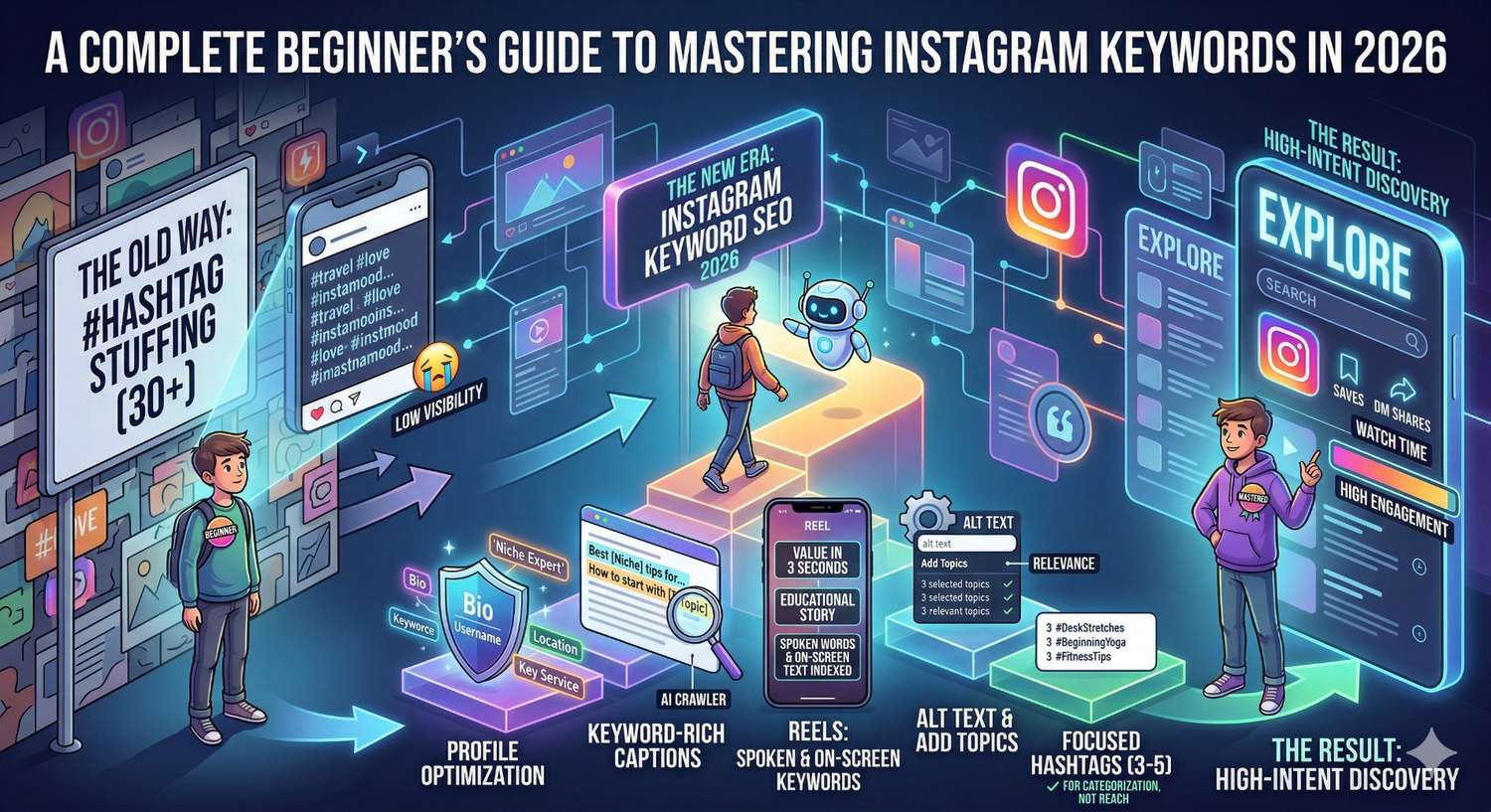
4. Profile Optimization: Embedding Keywords in Your Bio and Name Field
Your SEO journey starts before you ever publish a post; it starts on your profile. The single most important, yet frequently wasted, piece of SEO real estate on Instagram is your Name Field.
Do not confuse your username (@janesmith) with your name. Your Name field is bolded at the top of your bio, and it is entirely searchable. If your username is @janesmith and your Name field just says "Jane Smith", you are missing out on thousands of searches. No one is going to Instagram and searching for "Jane Smith" unless they already know you personally.
Instead, you need to embed your primary industry keyword here. Change your name field to 'Jane Smith | NYC Wedding Photographer' or 'Jane | Holistic Nutrition Coach'. When someone in New York searches for a wedding photographer, your profile will instantly populate in the "Accounts" tab of the search results.
Next, optimise your bio. You have 150 characters to tell the algorithm exactly what you do. Instead of using cute quotes or confusing emojis, use secondary keywords. For example: "Helping busy moms with meal prep, quick recipes, and macro tracking."
5. Caption SEO: Writing Contextual Keywords Naturally
Gone are the days of writing a single emoji as a caption. If you want to rank on the search page, your captions need to act like mini blog posts. The algorithm crawls your captions to understand the context of your media.
However, you cannot just "keyword stuff". Writing a caption that says, "Buy my shoes. Best shoes. Running shoes. "Fast shoes" will trigger spam filters and ruin your reach. You must weave primary and secondary keywords into a natural, engaging story.
Let’s say you are a real estate agent. Instead of just posting a picture of a house, write a caption like "Looking for the perfect first-time buyer home in Austin, Texas? This mid-century modern property features an open-concept kitchen and is located right in the heart of the South Congress neighborhood." By writing naturally, you hit multiple long-tail keywords (Austin Texas, mid-century modern, first-time buyer) without sounding like a robot. You can then end this caption with a call to action, telling them to comment a specific keyword to trigger your real estate flow, seamlessly blending your SEO strategy with your sales funnel.
Instead of stuffing your captions with spammy hashtag blocks that can trigger a shadowban, you need to adapt to the platform's modern search engine. Learning how to use keywords on Instagram allows you to naturally integrate searchable terms into your profile and content without looking like a bot.

6. Alt Text Secrets: The Hidden Layer of Instagram Discoverability
Most creators don't even know this feature exists, which makes it your secret weapon. "Alt Text" (Alternative Text) was originally designed for accessibility, allowing screen readers to describe images to visually impaired users. However, Instagram’s search algorithm also reads this text to understand exactly what is in your photo.
If you don't write your own alt text, Instagram's AI will guess what the image is, and it's usually very generic (e.g., "Image may contain: one person, standing, outdoors").
Take control of this data. Before you hit publish on a static post or carousel, scroll down to "Advanced Settings", select "Write Alt Text", and describe the image using your target keywords.
- Bad Alt Text: "Me at the gym."
- Good Alt Text: "A female personal trainer doing a barbell deadlift in a commercial gym, demonstrating proper glute workout form."
You are literally spoon-feeding the algorithm the exact search terms you want to rank for.
7. Video SEO: Speaking Your Keywords in Reels and Stories
Short-form video is the king of Instagram reach, but how does an algorithm "read" a video? It listens to it.
Instagram's audio processing software is incredibly advanced. When you speak in a Reel or a Story, the platform automatically generates a transcript in the backend. It indexes the words coming from your mouth to categorise your content.
If you want your Reel about "skincare routines for acne" to rank on the search page, you need to physically say the words "skincare routine for acne" within the first three seconds of the video. Furthermore, use the native text editor to put those keywords on the screen. The AI reads the on-screen text overlays just like it reads your caption.
This audio indexing is also very important for your backend sales systems. When you say, "Comment the word GLOW below and I'll send you my favourite serum," you're giving a verbal command that works perfectly with a backend automation tool like InstantDM. This makes it easy to get leads while the SEO metadata spreads your video to a wider audience.
In 2025, the game changed when Google began indexing Instagram posts directly in its search results, meaning your content's lifespan just extended from 48 hours to several months. To take advantage of this massive shift, you need a FAST strategy for Instagram SEO and Keywords to get found, starting with switching to a public professional account and toggling on the Google indexing setting.
Instagram SEO and Keywords: How to Get Found in 2025 (FAST Strategy)
Part 3: Strategy & Measurement
8. Keyword Research Tactics: Finding High-Intent Phrases for Your Niche
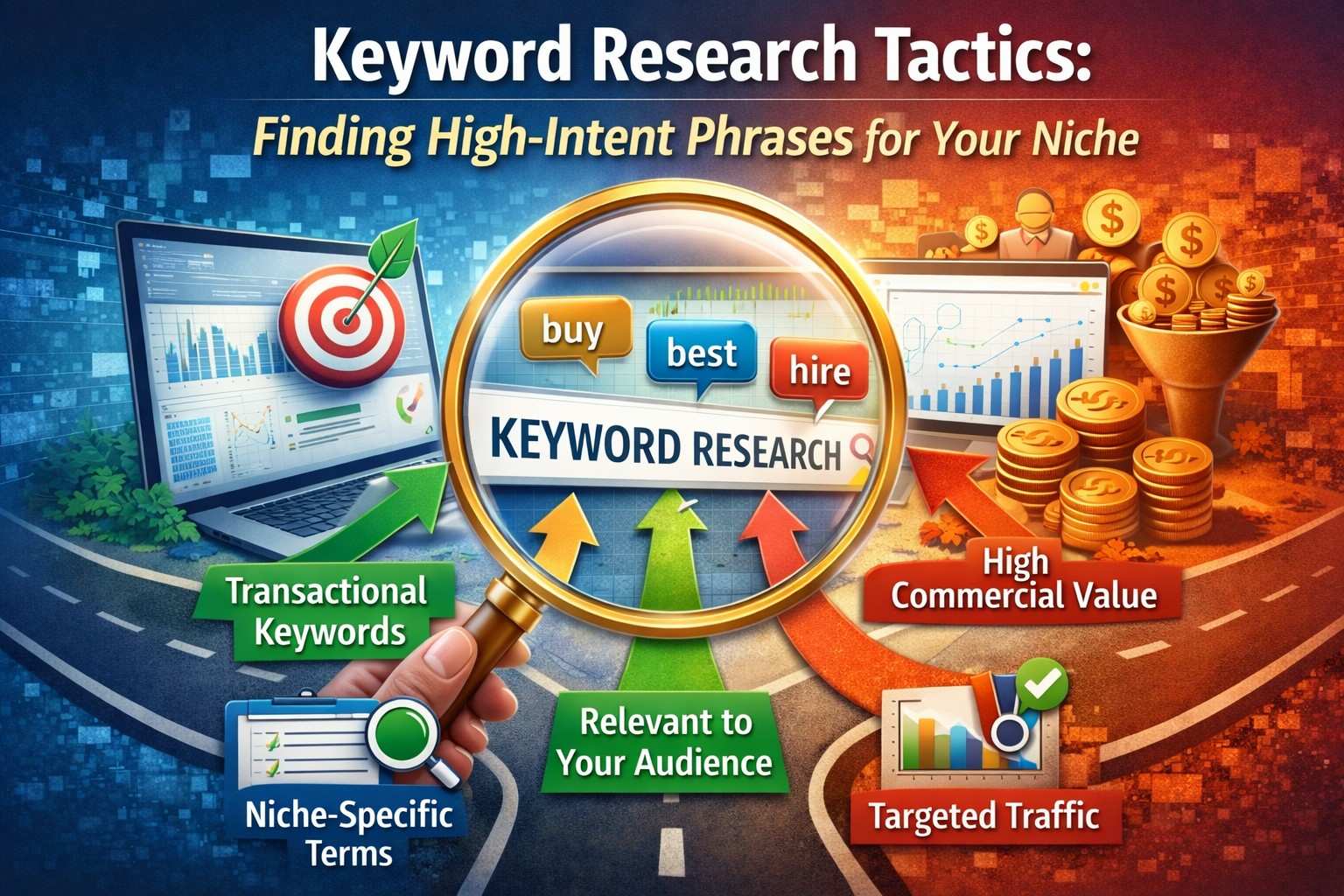
You can't optimise your content if you don't know what your audience is actually searching for. Unlike Google, Instagram does not have a native "Keyword Planner" tool that shows you exact search volumes. However, you can use intuitive tactics to uncover high-intent phrases.
- The Predictive Search Method: Open the Instagram app, go to the search bar, and type in your broad niche (e.g., "dog training"). Do not hit enter. Look at the predictive drop-down list. Instagram will auto-suggest terms like "dog training tips," "dog training puppy", or "dog training leash pulling". These suggestions are generated based on what millions of other users are actively searching for right now. These are your target keywords.
- Competitor Auditing: Go to the top three largest accounts in your niche. Look at their most viral posts from the last 90 days. What specific phrases do they use repeatedly in the first line of their captions? What text do they put on their Reel covers?
- Platform Crossover: Use TikTok's search bar or Google Trends. The questions people ask on TikTok and Google are exactly the same questions they are looking for on Instagram.
9. Hashtags vs. Keywords: Striking the Perfect Balance in 2026
A common question beginners ask is, "If keywords are so important, should I just stop using hashtags entirely?"
The answer is no, but your strategy needs to shift. Hashtags are no longer the primary driver of reach, but they are still a supplementary categorisation tool. Think of your caption and on-screen text as the main course, and hashtags as the seasoning.
In 2026, the optimal strategy is to use 3 to 5 highly specific, niche hashtags, rather than 30 broad ones.
If you are a local bakery, using #food or #yummy is a waste of time. Your post will be buried in milliseconds. Instead, use your caption to write a keyword-rich story about your sourdough process, and then use hashtags like #AustinBakery, #TexasSourdough, and #AustinFoodies. This perfect balance tells the algorithm exactly what you are doing (through semantic keywords) and exactly where you are located (through targeted hashtags).
10. Tracking Your SEO Success: Native Insights and Metric Benchmarks
SEO is not a guessing game; it is a data-driven science. If you implement these keyword strategies, you need to know if they are actually working.
Please consider switching your Instagram account to a professional or creator account if you haven't done so already. After you publish a fully optimised post, wait 48 hours, then tap "View Insights." Scroll down to the "Reach" breakdown.
You are looking for specific metrics: impressions from Explore and impressions from Search.
If your "From Search" metric is steadily climbing month over month, your keyword strategy is working. People are actively typing phrases into the search bar and finding your content. If the majority of your impressions are only coming from "Home" (your existing followers), you need to refine your keywords and make your captions more descriptive, as the algorithm hasn't quite figured out how to index you for non-followers yet.
Part 4: Conversion & Automation
11. The Dual Power of Keywords: Search SEO vs. DM Triggers
Up to this point, we have focused entirely on search keywords—the words you use to get found by the algorithm. But getting a million views doesn't pay your rent. If you have a massive audience but zero sales, you don't have a business; you just have an audience.
In 2026, the most successful creators use a dual-keyword strategy. They use SEO keywords to drive organic traffic, and they use action keywords (or trigger keywords) to convert that traffic into revenue.
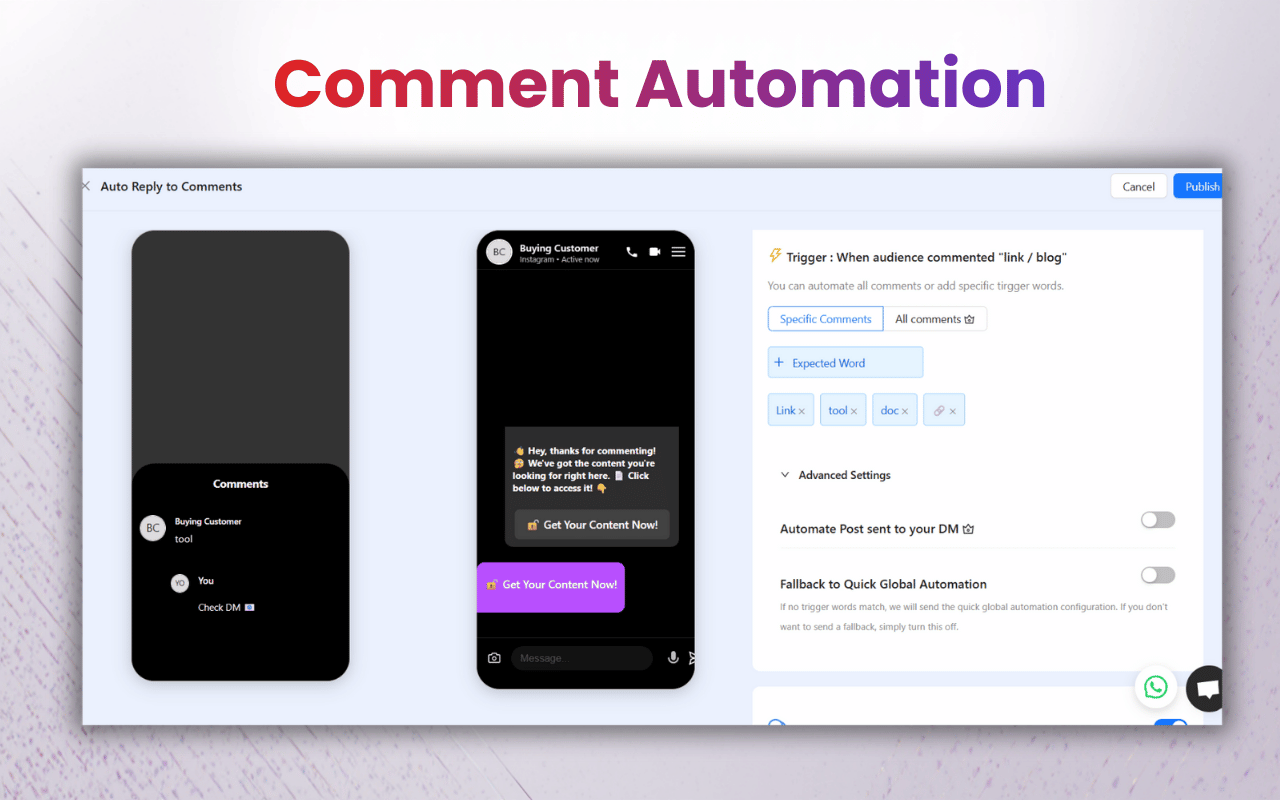
An action keyword is a specific, simple word that you instruct your viewer to type in the comments section. For example: "Comment the word MASTERCLASS to get my free training." This transition moves the user from a state of passive consumption (reading your optimised caption) into active engagement. But handling hundreds of these comments manually is physically impossible, which brings us to the most critical software integration of 2026.
12. Closing the Conversion Gap: Why You Need to Add InstantDM Software
The traditional method of converting Instagram traffic is fundamentally broken. For years, creators relied on the dreaded "Link in Bio" strategy. A user watches your reel, reads your keyword-rich caption, gets excited about your product, and then has to back out of the video, go to your profile, click a Linktree, find the right button, and wait for an external website to load.
This process is riddled with friction. Data shows that up to 60% of users will abandon the process if it requires too many steps. This is the "conversion gap"—the space where high-intent buyers fall off before giving you their money.
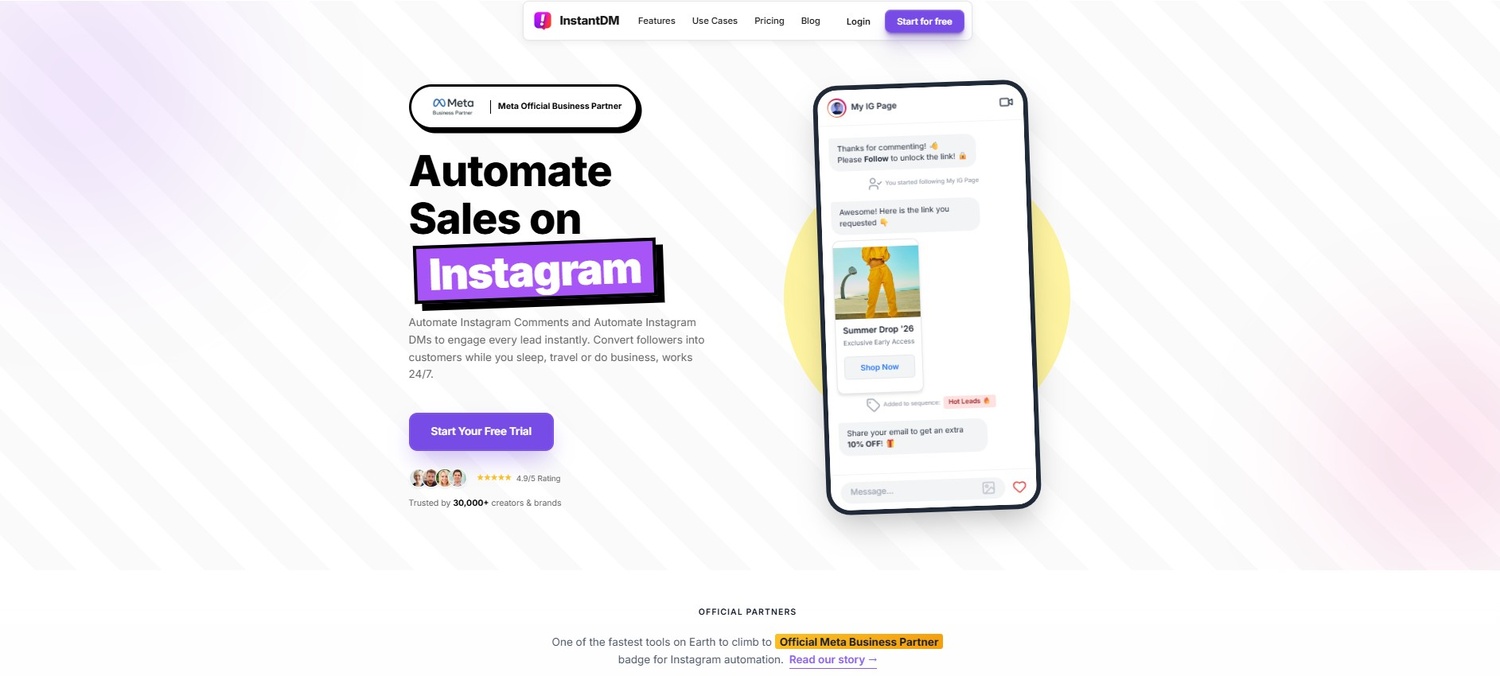
To close this gap, you must add InstantDM software to your marketing stack. InstantDM is an official, verified Meta Business Partner that acts as your 24/7 automated sales assistant. Instead of sending people on a scavenger hunt to your bio, you simply tell them to comment on your action keyword. The second they type it, InstantDM automatically likes their comment, replies to them publicly, and instantly sends the exact product link or resource directly into their private Direct Messages. You eliminate friction, capture the lead while their intent is highest, and turn your comment section into a highly profitable checkout lane.
To ensure your automated content actually reaches the right people, you need to stop relying on random hashtags and start treating the platform like a true search engine. Learning the fundamentals of Instagram keyword research will help you find the exact phrases your target audience is typing into the search bar.
13. Setting Up Universal Keyword Triggers for Seamless Conversations
Creators often hesitate to use automation due to their fear of its complexity. They picture needing a computer science degree to set up coding logic. However, modern platforms have democratised this technology.
An intuitive, drag-and-drop visual flow builder that makes setting up these conversion funnels easier than editing a photo. Even better, they offer a feature called Universal Triggers.
In the past, you had to set up a different automation rule for a Reel, a different one for a Story, and another for a regular post. With Universal Triggers, you configure one single keyword—let's say, "EBOOK"—and it works across all your channels simultaneously. If someone replies to your story with "EBOOK", comments on a reel with "EBOOK", or even sends you a cold DM with the word "EBOOK", the InstantDM system seamlessly recognises it and delivers your sequence.
This is incredibly powerful for live events as well. InstantDM’s Live Comment Auto-DM feature allows you to host an Instagram Live, teach your audience, and say, "Type 'VIP' in the chat right now for a discount." The software will instantly send the DM to viewers in real-time, allowing you to monetize a live broadcast without ever pausing your presentation.
14. The Future of Instagram SEO: AI Search and Predictive Discovery
As we look toward the remainder of 2026 and into the future, the integration of artificial intelligence into social media search is only going to deepen. Instagram is heavily testing predictive discovery—meaning the algorithm is trying to serve users the exact products or content they need before they even type a full keyword into the search bar.
To survive in this predictive landscape, your content must be deeply categorised by semantic SEO, and your backend must be fully automated. When a piece of your content inevitably hits the algorithmic lottery and goes viral, a manual workflow will collapse. Trying to hand-type DMs to 10,000 new commenters will result in your account getting action-blocked by Instagram for spam-like behaviour.
By integrating tools like InstantDM, you are protected by their Safety Queue feature, which intelligently paces out messages during a viral surge to keep your account 100% compliant while securing every single lead. Early adoption of this combined strategy—ruthless keyword optimisation on the front end and smart DM automation on the back end—is the only sustainable blueprint for massive organic growth.
Conclusion: Stop Guessing, Start Converting
In 2026, social media managers will need to know how to use Instagram keywords to stay alive. Anyone who wants to build a brand online will need to know how to do this. The time of the chronological feed and stuffing hashtags is over for good. Today, your success depends on how well you can communicate with the algorithm through optimised profile names, semantic storytelling in your captions, descriptive alt text, and clear audio transcripts.
But remember, traffic without conversion is just vanity. Building an impeccable SEO strategy that brings thousands of eyes to your profile is useless if those users bounce because of a clunky "link in bio" funnel. By identifying your high-intent audience through search keywords and seamlessly transitioning them into private conversations using the automated triggers of InstantDM, you create a frictionless, scalable business. Take an hour today to audit your profile, research your niche phrases, set up your first Universal Trigger, and watch your organic reach transform into tangible, automated sales.
Related: The Best AI-Generated Images & Stock Photos for Your Brand
Related: Instagram Just Added AI Reply Suggestions in DMs - Here's Wh
10 AI Instagram Post Generators Tested: Which One Actually Saves Time?
How to Monetize TikTok Content: The Complete 2026 Playbook for Creators
5 Things to Do Right After Posting on Instagram to Grow Your Account