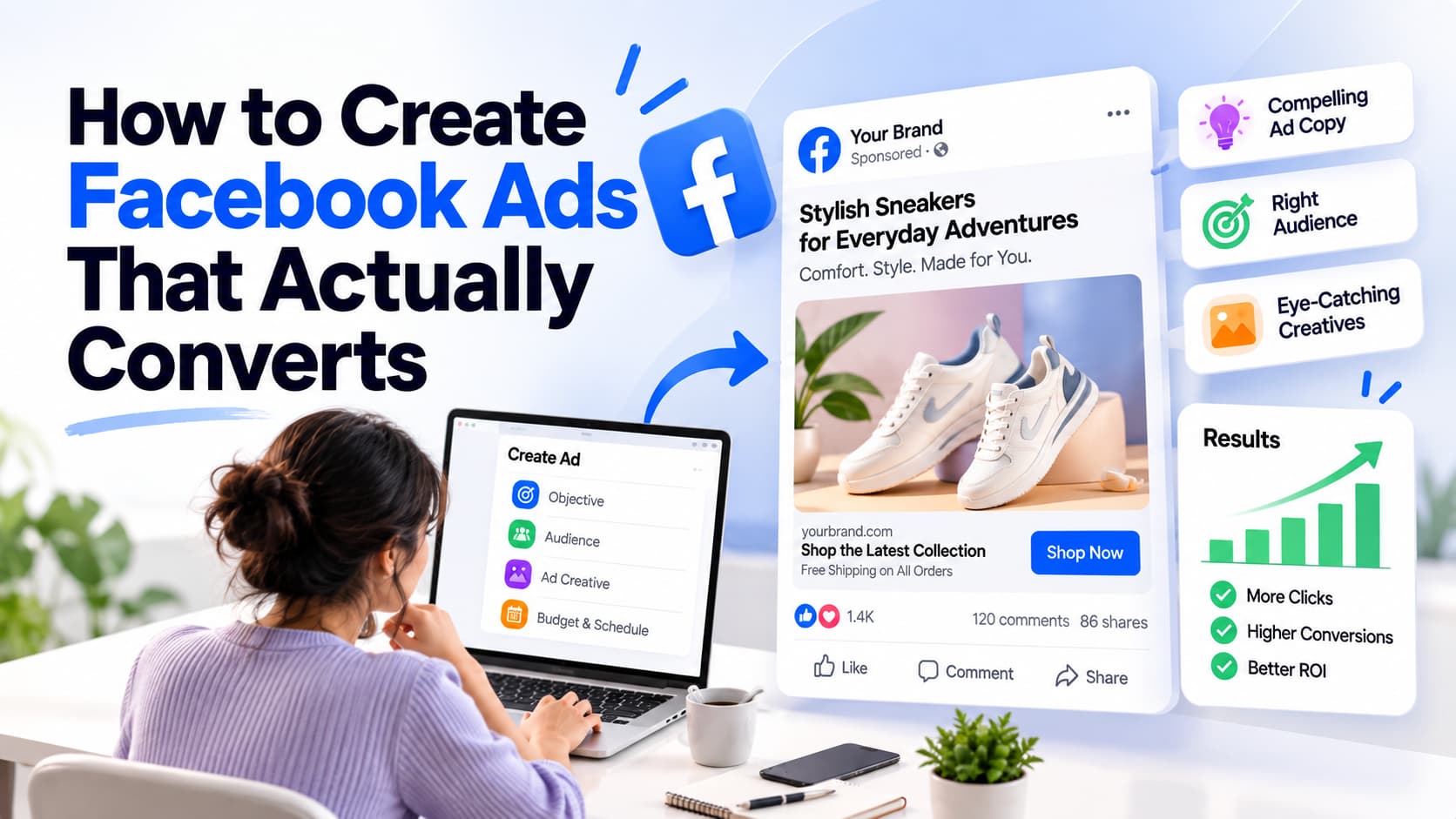
Facebook ads that convert are campaigns that optimize for a real business event, a purchase, a lead, a booked call, not a cheap click. In 2026 that means you pick the Sales or Leads objective in Ads Manager, you send those events back with the Meta Pixel and the Conversions API, and you match the ad to a page that can finish the job. Traffic campaigns can look busy. They rarely pay the bills.
Facebook ads that convert optimize for a purchase or a lead, not a click.
TL;DR
- Pick Sales or Leads. Traffic is for clicks. Conversion ads are for outcomes.
- Install the Meta Pixel and the Conversions API before you scale spend.
- Match the offer and the landing page to the ad, then let Advantage+ find people.
What are Facebook ads that convert?
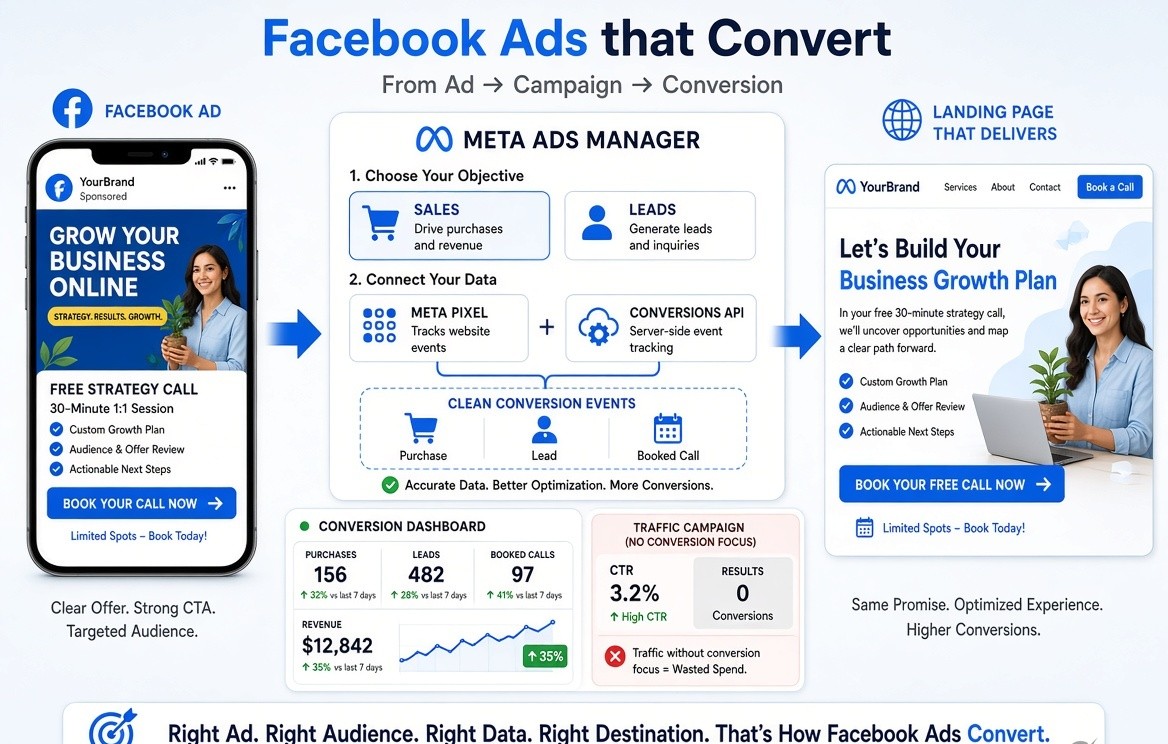
Facebook ads that convert are paid placements across Facebook, Instagram, Messenger, and Audience Network that get someone to complete a defined action you can measure. That action is the conversion. A sale. A form fill. A trial start. A booked appointment. A click is not a conversion unless you decided the click is the only thing you sell, which almost nobody does.
I still see accounts where the campaign name says "conversions" and the objective is Traffic. I'm not guessing here. Meta then hunts for people who click. It doesn't hunt for people who buy. That gap is why a lot of "good" CTR screenshots sit next to empty Stripe dashboards.
Facebook conversion ads are the same idea with a more specific meaning. In Ads Manager, conversion ads are the ones that use Sales or Leads (or App promotion if the event lives in an app) and optimize delivery toward an event you fire from the Pixel, the Conversions API, an instant form, or an app SDK. If you can't name the event, you don't have Facebook conversion ads. You have a boost with extra steps.
I treat three sentences as the whole job:
- The ad makes a promise a stranger can understand in one second on a phone.
- The destination keeps that promise without a new story.
- Meta gets a clean event every time the promise is kept.
Miss any one of those and the auction starts charging you to teach the algorithm the wrong lesson.
What is the difference between Facebook conversion ads and traffic ads?
Facebook conversion ads tell Meta: find people likely to complete this event. Traffic ads tell Meta: find people likely to click or land on the page. Both can use the same image. They don't buy the same people.
I use this split when I open a new campaign:
| Objective | What Meta optimizes | When I use it | What usually breaks |
| Sales | A website or catalog event such as Purchase, AddToCart, or InitiateCheckout | Ecommerce, paid products, anything with a Pixel purchase event | Not enough purchase events to exit learning |
| Leads | Instant form submits, website Lead events, calls, or messages | Coaches, local services, B2B, waitlists | Cheap leads that never pick up |
| Traffic | Clicks or landing page views | Content, blog traffic, cheap tests of a URL | High CTR, no revenue |
| Engagement | Likes, comments, views, page activity | Warming a page or a post, not revenue | Vanity metrics |
| Awareness | Reach or impressions among people likely to recall the ad | Brand lift, not a first conversion campaign | You cannot "optimize" your way to a sale from here |
| App promotion | App installs or in-app events | Apps only | Using it for a website offer |
Verified October 2026 against Meta's six ODAX objectives: Awareness, Traffic, Engagement, Leads, App promotion, and Sales. The old "Conversions" label is gone. Sales replaced it, and catalog sales sit inside Sales.
I only use Traffic when I am paying for a page view on purpose, like a blog post or a comparison page, and I already know I will retarget those visitors later with a conversion campaign.
If the outcome you want is a chat rather than a website sale, that is a Messages destination, not a website Sales campaign: Facebook Messenger advertising and chat setup. Same Ads Manager. Different event. Don't mix them in one ad set and hope Meta sorts it out.
How did I evaluate Facebook ads that convert in 2026?
I didn't run a 50-brand lab for this piece. I pulled the public 2026 WordStream / LocaliQ industry benchmarks, Meta's current Ads Manager objective list, Meta's learning-phase threshold, and the Pixel plus Conversions API docs.
I scored a conversion setup on five things:
- Objective fit. Does the campaign optimize for the event that makes money?
- Event quality. Does the Pixel plus Conversions API fire the right event, once, with value when there is a sale?
- Offer match. Does the ad promise the same thing the page delivers?
- Creative volume. Are there enough distinct angles for Meta to pick a winner in 2026 delivery?
- Learning math. Can this budget hit about 50 optimization events a week?
Last updated: October 2026.
That's the bar I used for every section below. If a tactic fails those five, I don't care how pretty the ad looks in Ads Manager.
What do you need before you spend?
You can publish an ad with a Page and a card. You can't create Facebook ads that convert without tracking and an offer someone would take even if the ad disappeared.
A Facebook Page and a real Ads Manager account
Ads run from a Facebook Page, not a personal profile. I still watch people try to launch from a profile, hit a wall, and blame Meta. Create the Page, add a profile photo, a cover, a short About section, and a way to contact you. Then open Ads Manager at adsmanager.facebook.com. If you have a team, put the Page and the ad account inside Business Manager so one person leaving does not take the Pixel with them.
If the Page is not linked to Instagram yet and you want placements there, connect them first. I wrote the click-path here: How to connect your Facebook Page to Instagram.
Meta Pixel
The Meta Pixel is a browser snippet on your site. It sends PageView and standard events (ViewContent, AddToCart, Lead, Purchase, and the rest) back to Events Manager. Without it, Sales campaigns have nothing to optimize toward on the website. Install it with the official helper or through your site tool (Shopify, GTM, WordPress plugin). Then verify with Meta Pixel Helper. I don't launch conversion ads on a Pixel I haven't watched fire on a test purchase or a test form.
Conversions API
The Conversions API (CAPI) sends the same events from your server. Browser Pixel data got thinner after iOS tracking changes. In 2026 I treat Pixel-only as a starter, not a conversion stack. CAPI is how you recover events the browser drops, and it's how Meta keeps a usable purchase signal. Deduplicate events with an event ID so Pixel and CAPI don't double-count. Docs: Meta Conversions API. If Event Match Quality in Events Manager is sitting in the red, fix names, emails, and phone hashing before you scale.
Facebook ads that convert optimize for a purchase or a lead, not a click. That sentence is useless if the event never arrives.
A real offer
I've burned budget on "learn more" ads for products with no price, no proof, and no next step. Conversion ads need a reason to act today: a clear product, a lead magnet that's actually useful, a trial, a booking slot, a discount with an end date. If I wouldn't click it as a stranger on the bus, I don't run it.
How do you create a Facebook conversion campaign step by step?
Here is the path I use inside Ads Manager when I want conversions, not a traffic report.
Campaign
Click Create. Choose Sales if the money event is on your website or catalog. Choose Leads if the money event is a form, a call, or a qualified inquiry. Set the conversion location to Website for website conversion ads. Turn on Advantage campaign budget unless you have a hard reason to split budgets by ad set. Name the campaign with the event and the offer, not "Campaign 3." Future you will thank you.
Ad set
Pick the Pixel and the event. Purchase for ecommerce. Lead or CompleteRegistration for forms. If your daily budget can't produce about 50 of those events a week, pick a higher-funnel event only as a temporary crutch (InitiateCheckout, ViewContent) and plan to switch back once volume exists. I hate that crutch. I still use it on tiny catalogs rather than sit in learning forever.
Audience: start with Advantage+ audience. Location, age minimum if you legally need it, and exclusions (buyers, employees, junk traffic). I don't stack eight interests in 2026. That used to feel like control. Now it starves delivery.
Placements: Advantage+ placements for new conversion campaigns. Manual placements only when I already know a placement wastes money (Audience Network on a lead form is a frequent one) or when the creative only works in 9:16.
Schedule: start continuous. Daily budget, not a two-day lifetime burst.
Ad
This is where most "how to make Facebook ads that convert" posts get vague. I upload more than one creative on day one. A talking-head video, a static with the offer in the first line, a carousel if I have more than one proof point. Primary text states the promise and the next step. Headline restates the offer, not the brand slogan. CTA matches the event: Shop Now for Purchase, Sign Up or Get Quote for Lead, Learn More only when the page is the product.
Use the 2026 flexible / Advantage+ creative setup so Meta can mix images, videos, and text. I still write the first text variant myself. I don't let the system invent the offer.
Review: Pixel event, URL UTM, mobile preview, and the landing page on a phone. Publish. Approval is usually minutes. First-time accounts can wait longer.
That's the account-level setup. What follows is why it still fails after you hit Publish.
Who should you target in 2026?
In 2026 I start broader than I did in 2019. Interest stacking fought the delivery system. Advantage+ works when the event is clean and the creative is specific. The targeting is the creative.
Broad Advantage+ targeting
Location. Age floor if needed. Language if the ad is not in the local language. That's the cold campaign. Meta finds buyers from the event and the creative. This feels wrong if you grew up on detailed targeting. It is how facebook ads that convert get cheaper once you have 50 events a week.
Custom audiences
I still build these, because they are the one targeting layer first-party data still owns:
- Purchasers, 180 days, excluded from prospecting, included in retention
- AddToCart no purchase, 7 to 14 days
- Site visitors, 7 to 30 days, broken out if volume allows
- Customer list upload (email and phone), hashed
- Video viewers at 50% or 75% if organic or paid video is doing real work
- Engaged with Page or Instagram, used for cheap warm tests, not as the only conversion audience
Retargeting still converts better than cold. WordStream doesn't publish a universal retargeting CVR in the 2026 set I used, so I won't invent one. In accounts I watch, warm traffic is the first place a thin budget should go, then cold once the Pixel has buyers to learn from.
Lookalikes
Lookalikes of purchasers or qualified leads, 1% first. I don't seed a lookalike from every site visitor. Garbage in, lookalike out. Refresh when the source audience changes. If Advantage+ already overlaps the lookalike, I don't run both in the same campaign and let them bid against each other.
Post scheduling and ads-account rules are a different job from conversion setup: Facebook automation tools for posts, ads, and marketing.
Which Facebook ad formats convert in 2026?
Format does not save a weak offer. Format does decide whether someone stops. I pick format from the job, not from a trend thread.
| Format | Best for | Spec I actually use | Weak when |
| UGC / talking-head video, 15 to 30 seconds | Proof, demos, founder story, most cold conversion ads | 9:16 and 1:1, captions on, hook in the first 3 seconds | The first 3 seconds are a logo sting |
| Single image | Offers, price, a single product, fast tests | 1:1 or 4:5 in feed, 9:16 in Stories/Reels, readable on a phone | Tiny text, stock handshake photos |
| Carousel | Multiple products, steps, before/after, proof cards | First two cards do the selling | Card 1 is a brand film and the offer is on card 5 |
| Collection / catalog | Ecommerce with a product feed | Advantage+ catalog / Sales with catalog | Feed is dirty, prices wrong, missing images |
| Instant Experience | Full-screen mobile story | Only if the page is slow and you can rebuild the offer inside Meta | You duplicate a slow site inside Meta and nobody checks out |
Verified October 2026. Meta still serves the same core formats. The ranking change is volume and native feel. Ads that look like a polished TV spot lose to ads that look like a person on their phone.
Video is not automatically better for conversion rate. Video wins when it shows the product working or a person I trust. Static wins when the offer is the ad (price, deadline, "book Tuesday"). I test both. I don't pick a format because a podcast said "video is king."
What can you steal from ads that actually convert?
I don't have a vault of other people's ROAS screenshots, and I won't fake ten case studies. I do steal patterns that keep showing up in accounts that make money.
- The offer is in the first line and on the image. "30-minute audit, free this week" beats a mood film with "Learn more."
- UGC that names a specific result. "I stopped leaking cart sessions after we put CAPI on checkout" is a better ad than "We help brands grow."
- Native comments as social proof. People screenshot reviews into the creative. It is ugly. It converts.
- A retargeting ad that only talks about the objection. Shipping. Fit. "Is this a scam." Price. Cold ads can't do this well. Warm ads can.
- One CTA. Shop Now or Get the PDF. Not four links and a brand manifesto.
If you want Instagram-specific click-to-chat creative, that is a different playbook: Instagram Click-to-DM ads for ecommerce. Don't copy a DM ad onto a website Purchase campaign. The click goes to the wrong place and the event never fires.
Why do Facebook ads fail after the click?
Most "my ads don't convert" tickets I see are landing page tickets.
The ad promised a $29 template. The page is a homepage with a 12-link nav and a 4MB hero video. The ad was 9:16. The page is a desktop layout with a tiny "Buy" under the fold. The ad said "book a call." The page is a blog post.
Congruence is the word agencies use. I use "does the next screen keep the sentence I just paid for."
Checklist I run on a phone before I scale:
- The headline on the page repeats the ad promise in the first screen.
- The primary button is the conversion. Not "Our story."
- Load is fast enough that I don't wait on LTE. If I wait, the Pixel records a view and no Lead.
- Checkout or form is short. Every extra field is a tax on CVR.
- Price, shipping, and refund are visible if you are asking for a card.
- No pop-up that covers the button on mobile.
- Thank-you page fires Purchase or Lead, not only PageView.
I've cut CPA by changing nothing in Ads Manager except the first screen of the page. That's why "how to optimize facebook ads for conversions" is half creative and half website. Meta can't convert a visitor you bounce in two seconds.
Facebook ads that convert optimize for a purchase or a lead, not a click. The page is where the purchase or the lead happens.
What conversion rate should you expect in 2026?
Use public numbers, then ignore them if your offer is weird.
WordStream and LocaliQ's 2026 Facebook advertising benchmarks (US, broken out by objective) are the cleanest set I trust for this page:
Traffic campaigns, all industries
- Average CTR: 1.93% (up from 1.71% in 2025)
- Average CPC: $0.60 (down from $0.70)
Leads campaigns, all industries
- Average CTR: 2.70% (up from 2.59%)
- Average CPC: $1.80 (down from $1.92)
- Average conversion rate: 8.54% (up from 7.72%)
Highest lead CVRs in that set: Education and Instruction 15.87%, Arts and Entertainment 15.31%. Health and Fitness sat at 7.98%. Lowest: Automotive for sale 4.15%, Industrial and Commercial 4.50%, Home and Home Improvement 5.32%.
Source: WordStream Facebook Ads Benchmarks 2026 and the LocaliQ 2026 Facebook advertising benchmarks. Verified October 2026.
The 2026 average Facebook lead-campaign conversion rate is 8.54 percent, according to WordStream and LocaliQ.
Read that number correctly. It is leads-objective CVR (leads divided by clicks), not Shopify purchase CVR. WordStream did not publish a single all-industry purchase conversion rate in that 2026 traffic/leads split, so I won't invent a "9% of people who click will buy" line. Ecommerce purchase CVR is usually lower than lead CVR because a card is harder than an email.
What I treat as a practical band:
- Lead ads / instant forms: if you are near 8.54%, you are average, not a genius. Above 12% I look at lead quality, because cheap form fills can fake a pretty CVR.
- Website leads: often lower than instant forms because the person left Facebook.
- Purchases: judge against your AOV and margin, not against a lead benchmark.
CTR without CVR is a vanity sandwich. A 3% CTR into a 1% purchase rate can beat a 1% CTR into a 10% purchase rate, or not, depending on CPC. I watch cost per result and revenue. I glance at CTR to see if the creative is dead.
The 2026 average Facebook lead-campaign conversion rate is 8.54 percent, according to WordStream and LocaliQ. If you are at 3% on a lead campaign, the problem is usually the offer, the form, or the audience, not "the algorithm hate me."
How do you exit the learning phase without burning budget?
Meta needs about 50 optimization events per week before an ad set exits the learning phase. That threshold is still the one advertisers hit in 2026. Until you get there, delivery is jumpy and CPA lies to you.
Meta needs about 50 optimization events per week before an ad set exits the learning phase.
Rough daily budget math I write on a notepad before I launch:
| Target CPA | 50 events per week | Daily budget to feed learning |
| $10 | $500/week | about $71/day |
| $20 | $1,000/week | about $143/day |
| $40 | $2,000/week | about $286/day |
| $80 | $4,000/week | about $571/day |
If that daily number is more than you can spend, you have three honest options:
- Optimize for a more common event (Lead instead of Purchase) until volume exists, knowing the buyers you get will be sloppier.
- Tighten the offer so CPA falls and 50 events become cheaper.
- Stay small, accept learning-limited, and don't "scale" a $15/day Purchase campaign. You will just reset it every time you poke it.
I don't change creative, audience, and budget on day two. Each significant edit can restart learning. I wait through 3 to 4 days unless the ad is broken (wrong URL, Pixel missing, CPA 5x target with no chance). Then I kill or I leave it. I don't nibble.
Scaling I trust: 20% to 30% budget bumps every few days on a stable ad set, or duplicate into a new campaign rather than doubling overnight. Horizontal scale (new creative, new lookalike, new geo) beats slamming one ad set.
Meta needs about 50 optimization events per week before an ad set exits the learning phase. Write it on the campaign. It saves arguments later.
What mistakes kill Facebook ads that convert?
I keep a short list because the long lists are how people avoid fixing the Pixel.
Optimizing for the wrong event. Traffic when you wanted sales. Landing page views when you wanted purchases. Engagement campaigns "to warm the audience" that never get a conversion campaign behind them.
Starving learning. $10/day on Purchase with a $60 CPA. You will never see 50 events. The ad set lives in learning limited and you call Meta broken.
Editing every morning. New headline, new interest, new budget. The algorithm is always a beginner.
Creative that looks like an ad template. Gradient, three bullets, stock smile. In 2026 the feed is full of that. UGC and ugly native screenshots still stop the thumb.
Offer buried. 40 seconds of brand film, price at the end, no captions, sound off. People never hear the offer.
Pixel and CAPI ignored. Duplicate events, missing Purchase value, Event Match Quality in the dirt, then "why is attribution weird."
Excluding nobody. You keep paying to show prospecting ads to people who bought yesterday.
No mobile page test. You preview the desktop site in Chrome and launch.
One ad. Creative fatigue is not a myth. Frequency climbs, CTR falls, CPA follows. I rotate a new angle before the old one is fully dead.
Buying cheap leads you won't call. Instant forms can print emails. If nobody in your company follows up in an hour, you didn't get a conversion. You got a CSV.
For comment-to-inbox follow-up on Facebook itself, that is inbox automation, not Ads Manager: Facebook DM automation. Different layer. Don't confuse a comment reply with a Purchase event.
When should you use Sales vs Leads vs Traffic?
I pick the objective from the action I can complete in one session.
Use Sales when the person can pay or start checkout on the site. Product page. Shopify cart. Stripe payment link. Course checkout. If the Pixel can fire Purchase with value, Sales is the conversion ad.
Use Leads when the conversion is contact info or a booking request, not a card. Local services. Coaching applications. B2B demos. Instant forms convert higher on average (that 8.54% figure lives here) and the quality is the follow-up problem. Website lead forms convert lower and the people who finish them are often warmer. I test both when the budget allows.
Use Traffic when the click is the product: a blog post, a tool page, a YouTube view through your site. Then retarget with Sales or Leads. I don't run Traffic and then act shocked that nobody bought.
Awareness and Engagement are not conversion ads. They can support conversion ads. They are not a substitute.
A UGC video on Sales to a product page. An instant form on Leads with the offer in the first line. A carousel on Sales with catalog cards. Format follows objective.
What do Reddit advertisers keep repeating?
I read r/FacebookAds more than I quote it. The threads that keep coming back in 2025 and 2026 are not secret bid tricks.
Creative is the targeting. People who still win talk about UGC, hooks, and testing angles, not about finding the perfect interest.
Don't look like an ad. Native, phone-shot, captions, a person. The polished brand kit is for the website.
Stop rebuilding the account every week. Diversify campaign types (cold, retargeting, a backup) instead of one golden ad set.
Measure past CTR. Time on page, checkout starts, actual revenue. A high CTR ad that dumps bounce traffic is a tax.
Learning phase math. The 50-events number shows up in Reddit for the same reason it shows up here. People underfund Purchase campaigns and then post "Meta is dead."
I agree with most of that. I disagree with "turn the Pixel off and go full Andromeda vibes" as a strategy. You still need an event. Facebook ads that convert optimize for a purchase or a lead, not a click. Reddit can't repeal that.
About the Author
Aravindh Kumar is an ecommerce and Instagram growth specialist with 8+ years in online selling. He has worked with 500+ brands, including Forbes-listed companies, on paid social and on-platform sales channels, and has helped 200+ Instagram businesses grow their online presence.