last Updated: 09 November 2026
To hook an Instagram Reels ad in the first 3 seconds, open on motion, put a buyer-specific claim in both the spoken line and the on-screen text, and do not open with a prize. A Reels ad hook is the first three seconds of a paid Reel: the first frame, the first spoken line, and the first text overlay, working together so a cold viewer stays past three seconds. A giveaway open can raise comments and still train the ad set on people who wanted the prize, not the product.
The body of the ad, the offer, and the comment ask only matter if this window holds. Meta describes a hook as the text, visual, and audio that grab attention in the first few seconds of a Reel, and names three text patterns: a value promise, a statement of intent, and a question or invitation, in The Science of the Hook. Campaigns with music or voiceover in Reels have been reported by Meta to deliver up to 13% higher incremental conversions. The opening is not a slogan. It is a selection device. Whatever you put in second one is the audience Meta will try to find more of.
Question | Verdict |
How do you hook a Reels ad in the first 3 seconds? | Motion in frame 1, one buyer claim spoken and written, no prize. |
What is a good hook rate? | About 30%+ on Reels. Under 15% is a broken first frame. |
What should the first 3 seconds show? | A moving face or result, 3–7 words on screen, the same claim out loud. |
Do giveaway hooks work on Reels ads? | No, not as a default. They train delivery on freebie-seekers. |
Best hooks that are not giveaways? | Pain call-out, contrarian, result first, a number, demo first, named person. |
What an Instagram Reels ad hook actually is
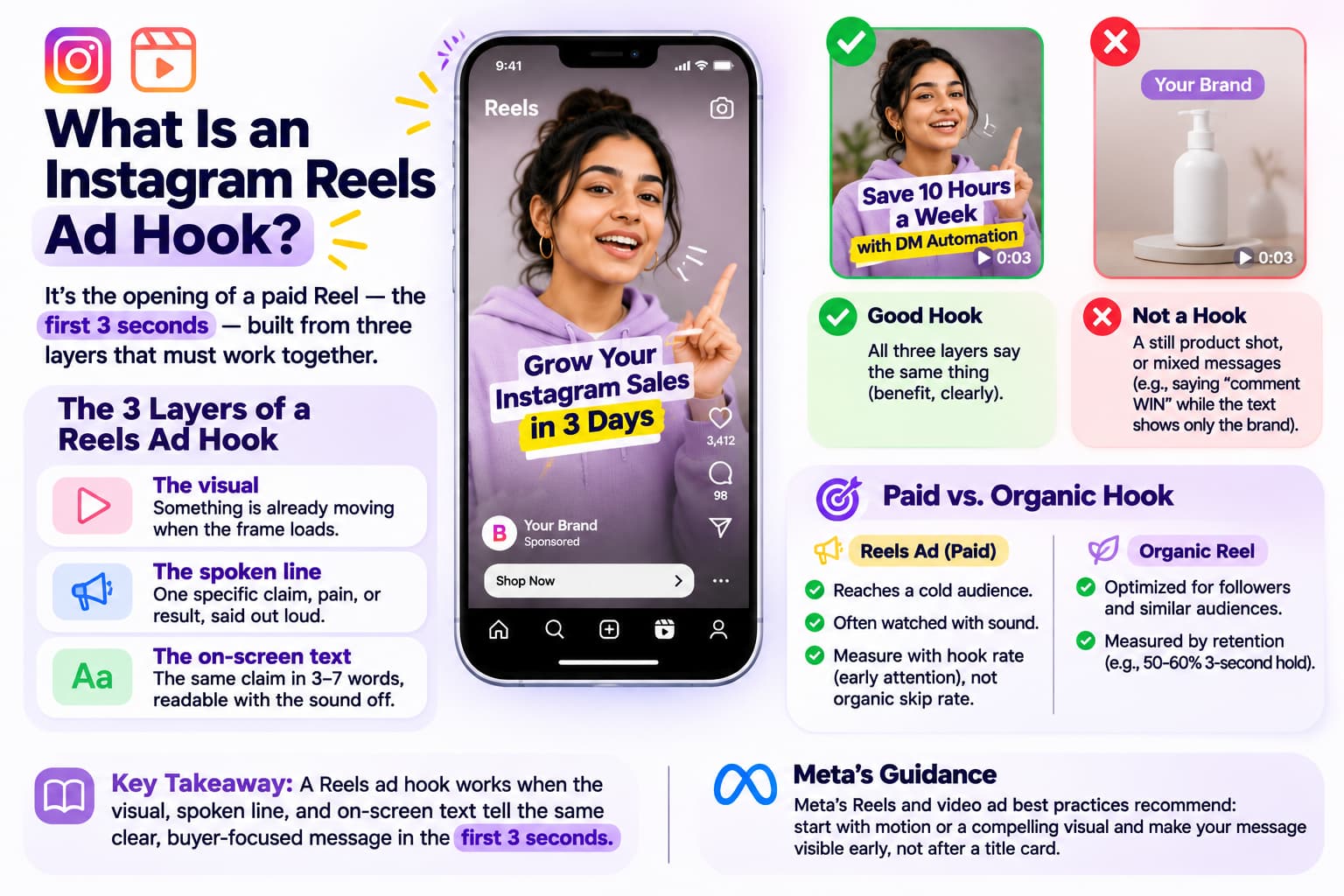
An Instagram Reels ad hook is the opening of a paid Reel, measured to the three-second mark, built from three layers that have to agree:
- The visual: something is already moving when the frame loads.
- The spoken line: one specific claim, pain, or result, said out loud.
- The on-screen text: the same claim, in three to seven words, readable if the sound is off.
If any one of those layers is doing a different job, the hook fails. A face saying “comment WIN” while the text says the brand name is three hooks, and none of them is about the buyer. A still product shot with a great line in the caption is not a hook, because the caption is not the first frame.
Meta’s published Reels guidance treats the hook as those three components together, not as a clever sentence written after the edit. Most advertisers write the line, then film a logo sting in front of it. Meta’s Instagram video ad best practices put the same requirement on the first frame: motion or a compelling visual, with the message visible early, not after a title card.
A paid hook is not the same object as an organic Reel hook. Organic distribution cares about retention inside a seed audience of followers and people similar to engagers. A Reels ad is bought against a cold audience, often sound-on, often in a placement where the viewer did not ask to see the account. The same sentence can work in both places. The scoreboard does not. A 50% or 60% three-second hold is an organic retention target. Using it to judge a paid Reel will make you kill ads that are fine and keep ads that only look fine. On unpaid Reels, that early leave is what InstantDM covers as skip rate in the first 3 seconds. Score a paid Reel on hook rate, not on that organic skip.
What is a good hook rate for an Instagram Reels ad?
A good hook rate for an Instagram Reels ad is about 30% or higher. Treat 25% as the line where the opening is usable, under 15% as a broken first frame, and 30–35% or better as the band worth scaling. Hook rate is 3-second video plays divided by impressions. Pair it with hold rate, or a high hook rate is just a bait open.
Hook rate = 3-second video plays ÷ impressions.
Ads Manager does not always label that column “hook rate.” Build it from three-second video plays and impressions, and only compare it inside the same placement. A Reels number and a Facebook Feed number are not the same score. The 3-second video play count behind that formula is the same retention field described in Meta’s video insights. Across Meta placements, a solid hook rate sits around 20–25%, and top performers clear 30%. Reels and Stories usually run higher than Feed for the same creative, often by about 5 to 8 points, because the swipe is faster in both directions: people leave faster, and they also stop faster when the first frame breaks the rhythm. On Reels specifically, 30–35% is a reasonable strong read. Above that, check hold before you add budget.
Hold rate is the companion, not a second vanity number. A practical definition used by media buyers is ThruPlays divided by 3-second views. It tells you whether the video kept the attention the hook just earned. A 40–50% hold is a common working target. Strong creative sits above 50%. A 40% hook rate with a 15% hold means the open overpromised. An 18% hook rate with a decent hold means almost nobody met the body, so the body does not matter yet. Meta has also reported that about 65% of people who watch the first 3 seconds continue to 10 seconds, which is why a held open is worth more than a pretty first frame that dies at second four. That figure is in Meta’s note on updated video ad features.
Hook rate on Reels | What it usually means | What to do |
Under 15% | Frame 1 is not registering | Rebuild the open. Do not tweak the landing page. |
15–25% | Below a usable paid open | Change the first 1.5 seconds: motion, text, or line. |
25–30% | Usable | Keep the body. Test a second open against it. |
30–35% | Strong for Reels | Scale carefully. Watch hold and cost per result. |
Above 35% | Excellent, or a bait open | Check hold rate and lead quality before spending more. |
Two traps sit under the formula.
The first is the denominator. Impressions, not clicks, not link clicks, not ThruPlays. A small audience with a high click-through can still have a weak hook if most impressions never reached second three. HubSpot’s Instagram video notes treat a Reel view as roughly that same 3-second mark, which is why a “view” is not proof the hook worked on a paid placement.
The second is the business outcome. An improved hook rate can sit next to a worse cost per lead. That is the giveaway pattern, and it is why hook rate is the first filter, not the last. Read hook rate, then hold, then cost per qualified conversation. If the only number that moved is comments containing the word “WIN,” the open selected the wrong person.
What should the first 3 seconds of a Reels ad show?
The first 3 seconds of a Reels ad should show motion in frame 1, a buyer-specific claim on screen in three to seven words, and the same claim spoken out loud. No logo sting, no “hey guys,” no prize, no brand name as the first word. The viewer should know who the ad is for and what is at stake before second three. You have roughly three seconds to give them a reason not to swipe, the same window InstantDM uses in how to increase Instagram engagement.
Split the window. The two halves do different work.
0.0–1.0 seconds: stop the thumb. This is the pattern break. A face already mid-sentence. A hand entering the frame. A result already on screen, not a promise that a result is coming. A zoom that has started before the cut. Meta has noted that younger audiences move through Reels faster than older ones, which is the practical version of this: the decision is underway before your second sentence exists. Static first frames get read as “this ended” or “this is an ad.” Either read is a swipe. Meta’s video advertising guide puts the grab in the first three to five seconds, and tells you to design for sound-off with captions and a bold claim or visual up front.
1.0–3.0 seconds: state the stake. The spoken line and the on-screen text land the same idea. Not a paragraph. One claim. “Your Reels ads get comments and no buyers.” “This ₹2,400 set sold out without a giveaway.” “If you are a coach stuck at views, this is the open.” The text is large, high contrast, and inside the safe zone. Reels ads are often sound-on, and Meta has reported that music or voiceover can lift incremental conversions by up to 13%. Plenty of impressions are still watched muted, in a loud room, or with the sound decision made after the swipe instinct. If the claim lives only in the audio, you lose those impressions before the voiceover starts. HubSpot’s Instagram for business guide makes the same opening demand for the organic side: a strong hook inside the first 3 seconds, because watch-past-3-seconds is what the distribution system can see.
Buyer-specific means a person, a situation, and a cost. “Creators” is not specific. “Shopify stores under ₹5 lakh a month whose Reels ads get saves and no checkout” is specific. Specificity is the filter. A vague open stops more thumbs and qualifies fewer buyers. On a paid placement, the second of those is the one you are buying.
The first frame also has to match the rest of the ad. If second one shows a finished room and second eight shows an unrelated talking head in a car, hold collapses and the hook rate was borrowed. The open is a promise the next ten seconds must pay.
A shot list for the opening of a 15-second Reels ad:
- Frame 1 is already in motion. Cut the pause at the top of the file in the edit. Most wasted opens are a half-second of nothing before the line.
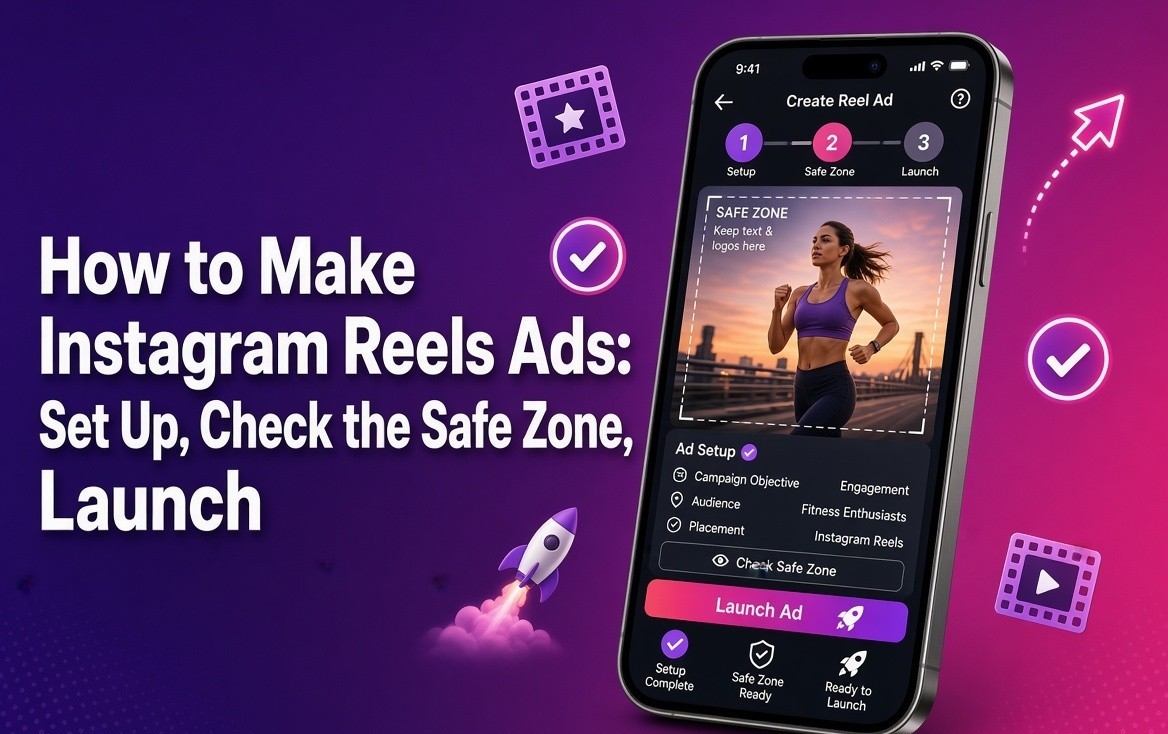
- Face or result is in the safe zone, not behind the interface icons. Reels ad files are 9:16, and Meta’s Reels ad creative specs keep the bottom 35% clear of text and logos so the claim is not sitting under the buttons.
- On-screen text is the claim, not the brand, and it is readable at arm’s length on a phone.
- The spoken line fits in under three seconds. If it needs a second sentence to make sense, it is a script, not a hook.
- The brand name, the offer stack, and the comment instruction wait until after second three.
The hook’s only duty is to make the right person still be watching when the ask arrives.
Do giveaway hooks work on Reels ads?
No. A giveaway hook is a bad default for an Instagram Reels ad. “Comment WIN,” “free for 10 people,” and a prize in frame 1 can raise the hook rate and the comment count, then train delivery on freebie-seekers. Cost per qualified lead usually gets worse, not better. Use a giveaway open only if the prize is the product and you can afford the audience it selects.
A Reels ad hook does not only stop a thumb. It tells the delivery system who stopped. Meta finds more people like the people who watched, clicked, and commented. If the people who comment are there for a hamper, the next thousand impressions look more like hamper-seekers. The hook rate chart in Ads Manager will look healthy. The inbox will not.
Organic Reel advice often recommends a freebie comment because the distribution goal is reach, and the cost of a low-intent commenter is a crowded comment box. On a paid Reel the cost is the budget.
A giveaway open fails in four ways.
It selects the wrong person in second one. The viewer who stays for “win a free order” is not the viewer who stays for “this is why your ads get likes and no DMs.” You cannot fix that with a better landing page, because the landing page never meets most of them.
It inflates the early metric you are using as a quality signal. Hook rate and comments move together. If you optimize the ad set toward comments, a prize open will win the test against a buyer open and then lose on cost per purchase. The test was scored on the wrong event.
It exhausts frequency on a junk audience. You pay to re-show the prize to people who already did not buy. Refreshing the creative with a new prize does not fix the audience. It repeats the selection.
It collides with the later ask. If the first three seconds promised a winner and second twelve asks for a price keyword, the people who comment are still answering the prize. The reply can send. The lead is still wrong. Fix the open, not the reply. The first message they get has to match the ad they just watched, which is the same rule InstantDM uses for Messenger ad chat setup.
A prize-shaped open is legitimate only when the product is the prize, the giveaway is the offer, and you can tell a buyer from a hunter after the comment. A store that gives away the product it sells, to people who already buy that category, is running an offer. A coach who opens every ad with “tag two friends to win a call” is buying reach with a media budget. Those are different campaigns. Do not mix them and then blame the hook rate.
Replace the prize with a cost the buyer already feels. Lost sales. A fee. A room that does not photograph. A Reel that gets views and no bookings. The open should name that cost. The prize can live in an email later, if you still want one. It does not belong in frame 1 of a cold Reels ad.
What are the best Instagram Reels ad hooks that are not giveaways?
The best Instagram Reels ad hooks without a giveaway are a pain call-out, a contrarian line, a result shown first, a specific number, a demo in frame 1, and a named-person open. Each one qualifies a buyer in under three seconds. None of them needs a prize to earn the watch.
Meta’s three text types sit underneath these. A value promise puts the gain in the first line. A statement of intent says what the viewer is about to see. A question or invitation asks them to recognize their own situation. Meta has published a statement-of-intent example from a Castlery partnership Reel, reported at a 78% lower cost per purchase and a 47% lower cost per add to cart against its comparison. The useful part is the pattern: say what is about to happen, show it starting, and skip the brand intro.
Six opens cover most Reels ad jobs. Use one per variant. Do not stack three of them into the first three seconds.
Pain call-out. Name the situation they are already annoyed by. “Your Reels ads get saves and no checkout.” Best when the buyer knows the problem and is tired of tips. Weak when the problem is one they do not believe they have.
Contrarian. Reject the default move. “Stop opening your Reels ads with a giveaway.” Best when the category is full of the same advice. Weak when you cannot pay the claim off in the next line. A contrarian open with no mechanism is a comment-bait line.
Result first. Show the outcome, then the cause can wait. The finished room. The booked calendar. The sold-out size. Best for visual products. Weak if the result is a fake mockup the viewer has already seen a thousand times.
Specific number. A price, a count, a time. “14 bookings from one Reel ad, no freebie.” Numbers stop the thumb because they are checkable. They also fail if you cannot stand behind them. Do not invent a result for the open.
Demo first. The product is already doing the job at second zero. A cleaner picking up a visible mess. A pattern piece cut on camera. No “let me show you.” Best for anything with a visible action. Weak for a service that has no object.
Named person. “If you are a [who] and [situation].” This is the tightest qualifier and often the lowest hook rate of the six, because it tells the wrong people to leave. That is a feature on a paid placement. A lower hook rate on a tighter audience can beat a higher hook rate on everyone.
A working open usually combines two, not six. Named person plus pain. Result first plus a number. Demo first plus a value promise in the text. The test is whether a stranger, sound off, can repeat the claim after one second.
Lines that are not hooks, even if they feel like content:
- “Wait for it.”
- “You won’t believe this.”
- “Comment WIN to enter.”
- The brand name as the first word.
- A trending sound with no claim on screen.
- “Link in bio,” which is not a first-frame idea and is a weak ask on a paid Reel anyway.
What not to open a Reels ad with
Open | Why it loses the first 3 seconds |
Logo sting or brand title card | The viewer has not been given a reason to care whose logo it is. |
“Hey guys, welcome back” | Selects followers. A cold Reels impression is mostly not followers. |
Prize in frame 1 | Selects hunters. Raises comments, contaminates delivery. |
Product beauty shot, no motion, no claim | Reads as an ad that already ended. |
Trend audio, no on-screen claim | Borrows attention you do not keep once the sound is familiar. |
Three claims at once | Nothing is readable by second three. |
A question the buyer does not have | “Want to grow?” stops nobody who is already being sold growth. |
Cut these in the edit, not in a note after launch. If the exported file starts with a half-second of slate, that half-second is the hook, and it is empty.
Six opens, written as first-three-second scripts
Each pair is a giveaway-shaped open and a buyer open for the same niche. Film the buyer line. The ask that follows comes after second three, once.
Coach or consultant
- Weak: “Comment FREE and I’ll send a gift to 20 of you.”
- Buyer open: on-screen text “Views, no calls.” Spoken: “If you are a coach and your Reels ads get views and no booked calls, the open is the problem.”
Fashion or ecommerce
- Weak: “Win this set, tag two friends.”
- Buyer open: text “Sold out in the DM.” Spoken: “This set sold without a giveaway. The first frame was the outfit, not the prize.”
Real estate
- Weak: “Comment WIN for a free consult.”
- Buyer open: text “3 site visits, one Reel.” Spoken: “If you list homes and your Reels ads get likes from other agents, this open is for the buyer, not the trade.”
DIY or maker
- Weak: “Free pattern if you comment GIFT.”
- Buyer open: text “Watch the seam.” Spoken: “The hook is the cut, not a freebie. If you sell the pattern, show the finished piece in frame one.”
Film the buyer line as the whole first three seconds. The body can prove it. The open should not also deliver the tutorial, the price stack, and the keyword. That compression is why so many Reels ads feel like a caption read aloud.
How to test the hook without rebuilding the ad
Change only the first three seconds. Keep the body, the offer, and the ask identical. Three opens are enough. Read hook rate first, hold second, and cost per qualified result third. Kill a variant that loses the placement baseline. Do not wait for a perfect cost-per-result read on an open that nobody watched.
If you change the hook, the offer, and the edit in the same upload, you did not test the hook.
- Pick one body. Same demo, same proof, same length, same caption ask.
- Cut three opens from the six types above. Make them different ideas, not three wordings of the same idea. “Stop wasting money” and “you are wasting money” is one variant.
- Export three files. Check that each file is in motion on frame 1 and that the text is inside the safe zone.
- Run them in the same placement, against the same audience, with enough budget that each can leave learning. Comparing a Reels open to a Feed open wastes the test.
- After delivery has settled, sort by hook rate. Anything under 15% is a broken frame. Anything under your account’s Reels baseline gets a new open, not a new landing page.
- On the winners, read hold and the quality of the result. A winner that fills the comments with prize words is not a winner if the campaign is trying to sell.
Meta’s Reels guidance says small changes to the opening can move results, and that advertisers should iterate rather than protect the first cut. The first open is a hypothesis. The second open is the test.
Do not vary, in the same test, the audience, the bid, the offer, the length of the body, or the comment word. Those are real tests. They are not this test.
When hook rate is high and the result is bad, the open is selecting the wrong person, or the body breaks the promise. Watch the retention curve. A cliff at second four means the hook overpromised. A flat curve and a bad cost per result means the people who stayed are the wrong people. The giveaway open is the second pattern. Fix the claim, not the editor.
Where the hook sits in the rest of the Reel
A 15 to 25 second Reels ad has four beats. Only the first beat is the hook.
- Seconds 0–3: hook. Motion, claim, text. No prize.
- Seconds 3–8: proof of the claim. The room, the booking, the seam, the number you are willing to stand behind.
- Seconds 8–15: one mechanism. Why that result happened. No brand history.
- Final seconds: one next step.
The next step on a Reel you want conversations from is usually a single comment word, said once, after the proof. The DM that follows has to arrive while they are still on the phone, which is the timing InstantDM covers in Instagram DM marketing. If that comment should open the DM on its own, the keyword wiring is the comment-to-DM setup, not part of the open. Use it after the hook is earning a 3-second view from a buyer. Automating a giveaway open only scales the wrong conversation.
A check before you export
- Frame 1 is in motion. The pause at the head of the clip is gone.
- The spoken line and the on-screen text make the same claim.
- The claim names a person or a situation, not “everyone who wants to grow.”
- No prize, no “WIN,” no “tag a friend” in the first three seconds.
- No logo, no welcome, no brand name as the first word.
- Text is three to seven words, high contrast, in the safe zone.
- The line fits in under three seconds without a second sentence.
- Two other opens of the same body are ready, not two color grades of the same open.
- You know the hook-rate band you will kill under, before you spend.
- The ask, if there is one, starts after the hook.
If a file fails the first four, do not upload it to learn. You already know what it will do.