TL;DR
Are people looking at your Instagram Stories but not interacting with them? You probably have the "zombie scroll". To fix this, you need to stop asking for big commitments, like leaving the app through a link in your bio, and start using small triggers. You can wake up your audience by using native features like polls and sliders along with the Hook-Story-Offer framework. What is the end goal? Use keyword triggers to get them to message you directly. DMs are the new algorithm goldmine, so starting direct conversations is sure to get you more attention. And when the volume gets too high, tools like InstantDM can automate the follow-up, making sure you never miss a lead while you sleep, travel, or work on making more content.
Let's be frank for a moment. You spend twenty minutes designing the perfect Instagram Story. You pick the right font, find the trending audio, and strategically place your stickers. You publish the content, allow a few hours to pass, and then review the analytics.
You’ve got hundreds, maybe thousands, of views. But how many clicks? How many replies? Crickets.
Most creators and brand owners think they have a traffic problem. The reality is much harsher: you have a conversion gap. Your audience is watching, but you haven't given them a compelling, frictionless reason to take action.
In this guide, we are going to tear down exactly why your current story strategy might be falling flat and how to implement "story triggers"—specific psychological and technical levers that turn passive viewers into active, engaged leads.
1. Why Your Story Views Aren't Translating to Action
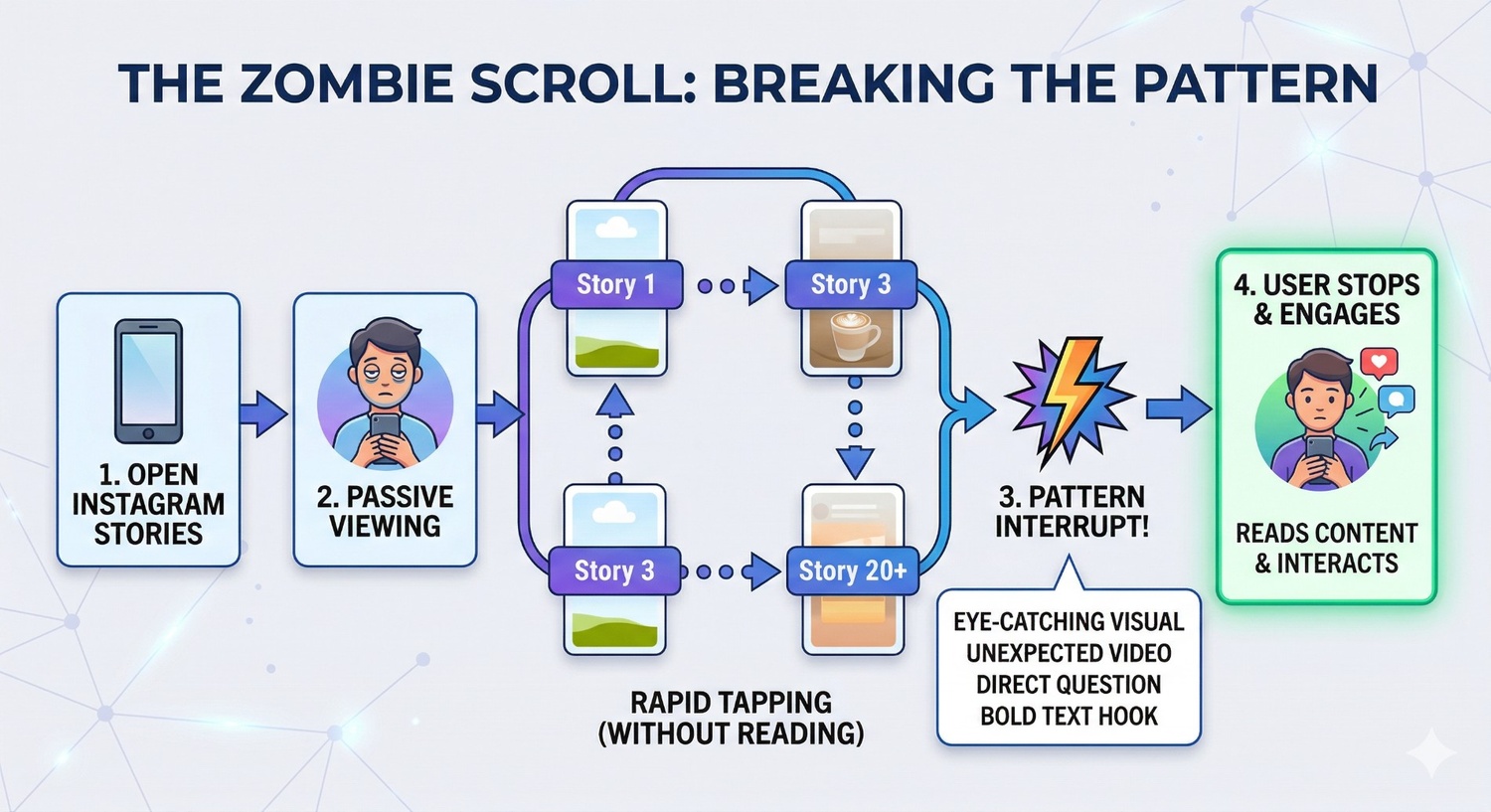
To understand why people aren't engaging with your Stories, you have to understand how people consume them. Think about your own behaviour on the app. When you open Stories, you aren't usually looking for a deep, intellectual dive. You're looking for quick hits of dopamine. You tap the right side of your screen rapidly—tap, tap, tap—blurring past dozens of posts in seconds.
This is the gap between a passive "swipe right" and an active tap.
When you ask someone to "Click the link in my bio," you are asking them to do an incredible amount of work. They have to stop the story, click your profile picture, read your bio, find the link, wait for the browser to load, and navigate a new website. In the social media world, that is a marathon.
Why training your audience to engage requires smaller, low-friction asks before pitching anything is the secret sauce to retention. You cannot ask for a marriage proposal on the first date. If your audience is used to just watching your content without ever interacting, you have to train them to touch the screen.
You start with the lowest friction possible: a tap on a slider. Then, a tap on a poll. Then, a quick reply to a question box. Only after they have proven they are willing to interact do you drop the big trigger. If your views aren't translating to action, it's because you are skipping the foreplay.
If you want to master these features, check out thiscomprehensive guide to every Stories engagement sticker on Instagram before planning your next post.
2. The Hook, Story, Offer Method (Retention First) [NEW]
One of the biggest mistakes brands Make is treating their Stories like a billboard. They throw up a graphic of their new product with a "Buy Now" sticker on the very first slide.
Why dropping a link on the first slide ruins your reach comes down to how the Instagram algorithm calculates retention. If people see an ad on slide one and immediately exit your Stories, Instagram takes that as a massive negative signal. The algorithm says, "Wow, people hate this content," and it stops showing your subsequent Stories to the rest of your audience.
Instead, you need to use the Hook, Story, Offer method. This means building a 3 to 4-part Story sequence that actually keeps people watching until the end.
- Slide 1: The Hook. This is your pattern interrupt. It shouldn't look like an ad. It should be a bold claim, a controversial opinion, or a relatable struggle. (e.g., "I wasted $2,000 on Facebook ads last month because I made this one stupid mistake.")
- Slide 2: The Story (Context). Here is where you explain the hook. You provide value. You show the behind-the-scenes. (e.g., "I realized my landing page was converting at 1% because the load time was too slow. Here is what I changed...")
- Slide 3/4: The Offer. Now that you have retained their attention and proven your value, you make the ask.
Setting up the "pain point" before introducing your trigger is vital. If you sell a skincare product, don't just post the bottle. Post a raw, unfiltered photo of an acne breakout (The Hook). Talk about how frustrating it is to try 10 different serums that don't work (The Story/Pain Point). Then, offer the solution (the offer/trigger).
All the DM automation in the world will not help your digital marketing agency if nobody is actually watching or engaging with your daily content in the first place. Many business owners struggle with a sudden drop in reach, unknowingly making critical mistakes—like simply resharing static feed posts—that actively hurt their algorithmic distribution. If you want to feed your new automated sales funnel with a massive surge of warm prospects, you need a strategy designed to capture attention and provoke instant direct messages. Discover the exact frameworks to instantly boost your reach by checking out this breakdown on Get 10X More Views on Your Instagram Stories in 5 Minutes. Mastering these quick, intentional story tactics ensures your content actually gets seen, allowing your automation software to do the heavy lifting of converting viewers into high-paying clients.
3. Getting More Mileage Out of Native Features
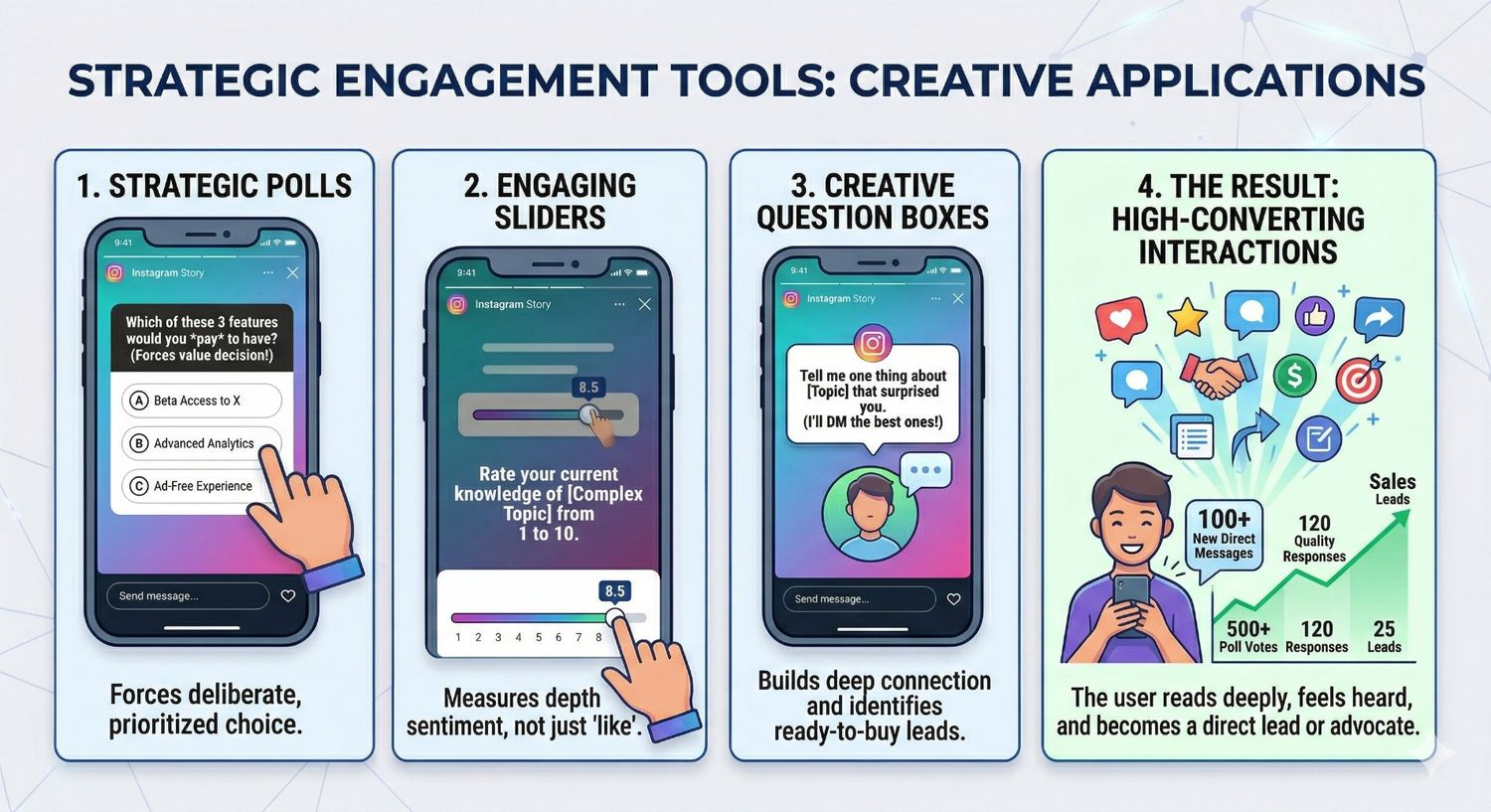
Instagram literally gives you the tools to boost your engagement natively, but most people use them entirely wrong. Native stickers are not just cute decorations; they are behavioural psychology tools.
Polls & Sliders: Stop using them just for fun. How to use them for quiet market research and segmenting your buyers is a meaningful upgrade. Instead of asking, "Do you like coffee or tea?", ask a question that qualifies a lead. If you are a fitness coach, your poll should be "What's your biggest struggle right now? [Dieting] or [consistency in the gym]." When someone votes "Dieting," – they have just handed you a massive piece of data. You now know exactly what their pain point is. You can follow up with them directly, knowing exactly what to pitch. Sliders are similar. "How overwhelmed are you feeling about Q4 taxes?" Let them slide it all the way to 100%. You are getting them to admit they have a problem.
Question Boxes: Why "Ask me anything" fails. We’ve all seen it. A creator posts "Ask me anything!" and gets zero responses. It's too broad. It puts the cognitive load on the audience to think of a good question. The specific prompts that actually get responses are highly targeted and offer immense, immediate value. Try this instead: "I have 20 minutes before my next meeting. Drop your website URL below and I'll give you a brutally honest 1-sentence critique on your homepage. "You will be flooded with responses because the value proposition is clear and specific.
The "Add Yours" Sticker: Tapping into community-driven virality. This sticker is a cheat code for reach. It creates a chain reaction. If you can create a prompt that allows your audience to show off a little bit, they will use it. If you are a local real estate agent, create an "Add Yours" sticker that says, "Show me your favourite hidden gem coffee shop in [City Name]." As people reply and add their own photos, your original handle is attached to that sticker, spreading your brand visibility far beyond your own follower list.
To see how your current metrics stack up against your competitors, take a look at the latestInstagram Stories Benchmark Report.
4. Gamifying Your Stories to Force Engagement [NEW]
If you want to bypass the "Zombie Scroll," you have to make your stories feel like games. Gamification interrupts the normal pattern of consumption and forces the user to physically interact with the screen in new ways.
Use the quiz sticker not just for trivia but to highlight a problem that your product solves. Don't use the quiz sticker to ask, "What's my favourite colour?" Use it to educate and agitate. If you are a financial advisor, post a quiz: "What percentage of Americans have zero retirement savings?" Options: A) 10%, B) 25%, C) 50%. When they click and get the answer wrong, you have created a knowledge gap. They are now highly receptive to the next slide, where you explain why that statistic is scary and how your consultation services can keep them out of that percentage.
"Tap and hold to read" design tricks that artificially boost your story retention metrics.Instagram’s algorithm measures how long someone stays on your Story. A standard photo stays up for five seconds. But what if you put a large block of highly valuable text on a slide and make the font just small enough that they can't read it in 5 seconds? They are forced to place their thumb on the screen to pause the story. By holding their thumb there for 15-20 seconds to read the text, they are sending massive retention signals to the algorithm.
Creating highly shareable "this or that" templates that encourage screenshotting and tagging. Create a branded graphic with two columns of choices (e.g., "Morning Routine: Coffee vs Matcha, Read vs Meditate, Gym vs Run"). Tell your audience to take a screenshot, circle their choices, post it to their Stories, and tag you. This forces engagement on multiple levels: the screenshot, the upload, and the tag, bringing their entire audience back to your page.
5. The 'Reply with a Keyword' Playbook
This is where we transition from casual engagement to actual business. Driving traffic away from Instagram is notoriously difficult because Instagram hates it when users leave their app.
Why telling people to click the "link in bio" is dead and friction-heavy is simple: you are relying on the user to do the heavy lifting. Furthermore, links in your bio are not trackable to a specific post. If you get a sale today, was it from yesterday's reel, today's story, or a post from three weeks ago?
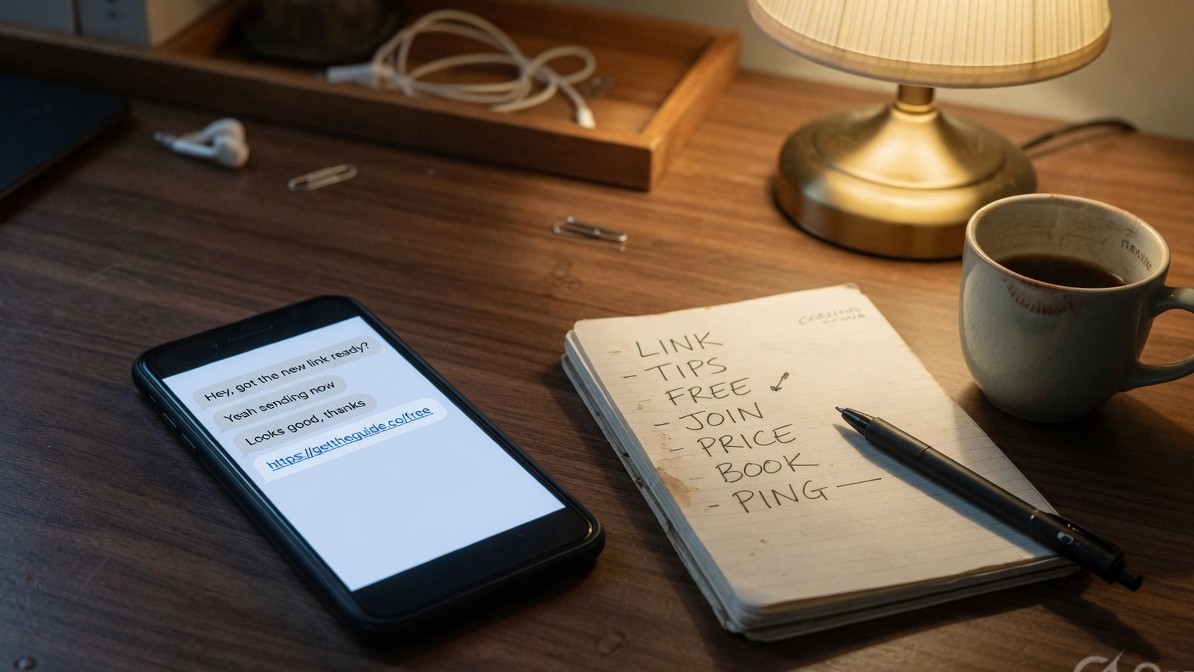
The solution is the keyword trigger. Crafting a compelling tease on your Story that encourages people to message you a specific word (e.g., "Reply SECRETS to get the guide") changes the entire dynamic.
You post a piece of valuable content and say, "I put together a full PDF breaking down exactly how I achieved this result. Reply to this story with the word BLUEPRINT and I'll send it directly to your inbox."
Moving the interaction from public view to a private, 1-on-1 space does three things:
- It feels highly personal and exclusive.
- It requires minimal effort from the user (typing one word).
- It opens a direct line of communication where you can actually sell to them without the noise of the feed.
6. The "Close Friends" VIP Trigger [NEW]
The "Close Friends" feature (the green circle) is vastly underused by marketers. Most people use it for posting memes to their real-life buddies. Smart marketers use it to build a hyper-responsive VIP list.
Using exclusivity to drive massive action and urgency taps into basic human psychology. People want to feel like insiders. They want access to things the general public doesn't have.
The strategy is simple but deadly effective: post on your public story saying, "Reply with 🍏 to be added to my Close Friends list for tomorrow's flash sale. The public gets 10% off, but my close friends are getting 40% off and early access."
Your Direct Messages will suddenly overflow with positive messages. You manually (or automatically) add these people to your Close Friends list.
Why smaller, highly engaged segments consistently convert better than your entire follower list is because you have pre-qualified them. They have already given a micro-yes by raising their hand and requesting to be added to the list. When you launch that exclusive story the next day, the conversion rate will be astronomically higher than a standard public post because you are speaking directly to a warm, validated audience.
One of the most effective ways to initiate an automated conversation is through Instagram Stories. Prompting your audience to reply with a specific keyword allows you to instantly deliver lead magnets, links, or booking calendars straight to their DMs. However, if your native privacy settings are misconfigured, viewers won't even have the text box to type a response, completely breaking your lead generation funnel before it starts. Whether you are running complex sequences through tools like InstantDM or just starting out with basic triggers, verifying your platform permissions is a mandatory first step. To ensure your profile is fully set up to capture these interactions, check out this How to Enable Story Reply in Instagram – Detailed Tutorial [2025]. Getting this simple setting right guarantees your audience can seamlessly engage with your daily content.
7. The Algorithm Shift: Why DMs are the New Likes
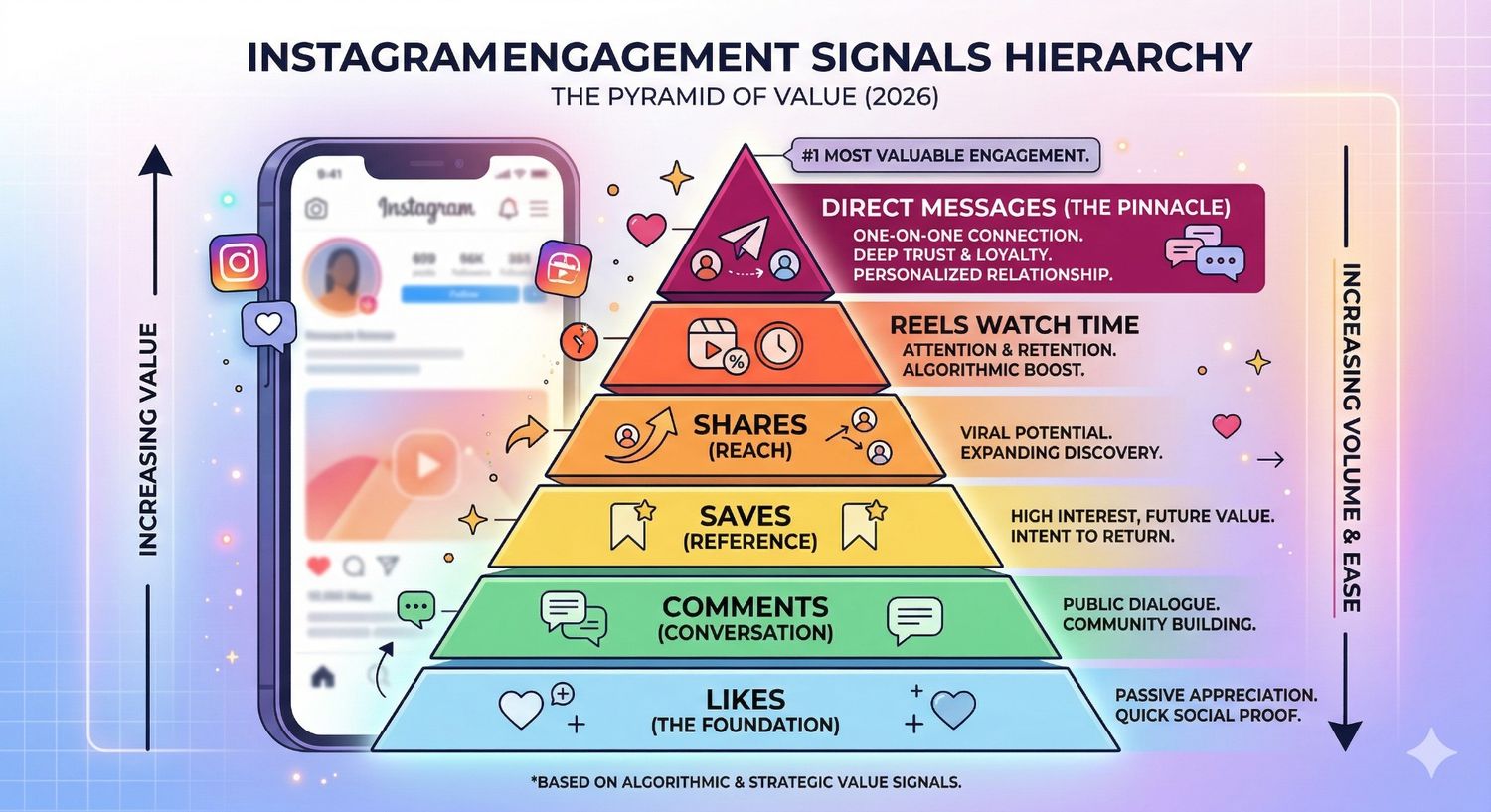
If you haven't noticed, the way Instagram ranks content has fundamentally shifted. Likes and comments are nice, but they are public, surface-level metrics. Instagram wants to foster deep connections.
How Instagram’s algorithm heavily favours accounts you message directly is no secret among top-tier creators. The algorithm tracks relationships. If you DM someone, Instagram assumes you have a close, personal relationship with them.
Pushing conversations into the inbox practically guarantees that your profile will stay at the front of their Story queue tomorrow, and this is all about relationship weighting. Once a user sends you a keyword in their DMs, Instagram prioritises your content in their feed. The next time you post a Story, your little bubble will be the first one they see when they open the app. By forcing the DM trigger today, you are buying guaranteed organic reach for tomorrow. It is a compounding effect that builds massive momentum over time.
8. The Bottleneck: When Your Triggers Actually Work
So, you’ve implemented the Hook-Story-Offer. You used a keyword trigger. You promised a free guide. And suddenly... it works. It works too well.
What happens when 200 people reply to your story at the exact same time? At first, it's a rush of dopamine. You feel like a marketing genius. Then, the panic sets in. You are sitting on your couch, manually copy-pasting the same link 200 times. You hit action blocks. Your thumbs cramp. You miss messages because they get buried in the 'Requests' folder.
This incident underscores the harsh reality of the 5-minute rule: if you fail to respond promptly with a link, the lead typically loses interest and navigates away. "Studies—such as the landmark Lead Response Management Study published in the Harvard Business Review—show that you are exponentially more likely to qualify a lead if you respond within 5 minutes." After 30 minutes, they have completely forgotten about you, moved on to a competitor's page, or closed the app.
If you ask people to DM you, but you take 12 hours to send the link, you have broken their trust and wasted the trigger. Manual replies simply do not scale.
9. Scaling the Conversation (Without Living on Your Phone)
If you are treating your Instagram page like a business, you cannot afford to be the bottleneck in your own sales process. You need to handle the sudden influx of Story replies and mentions without manually typing the same response all day.
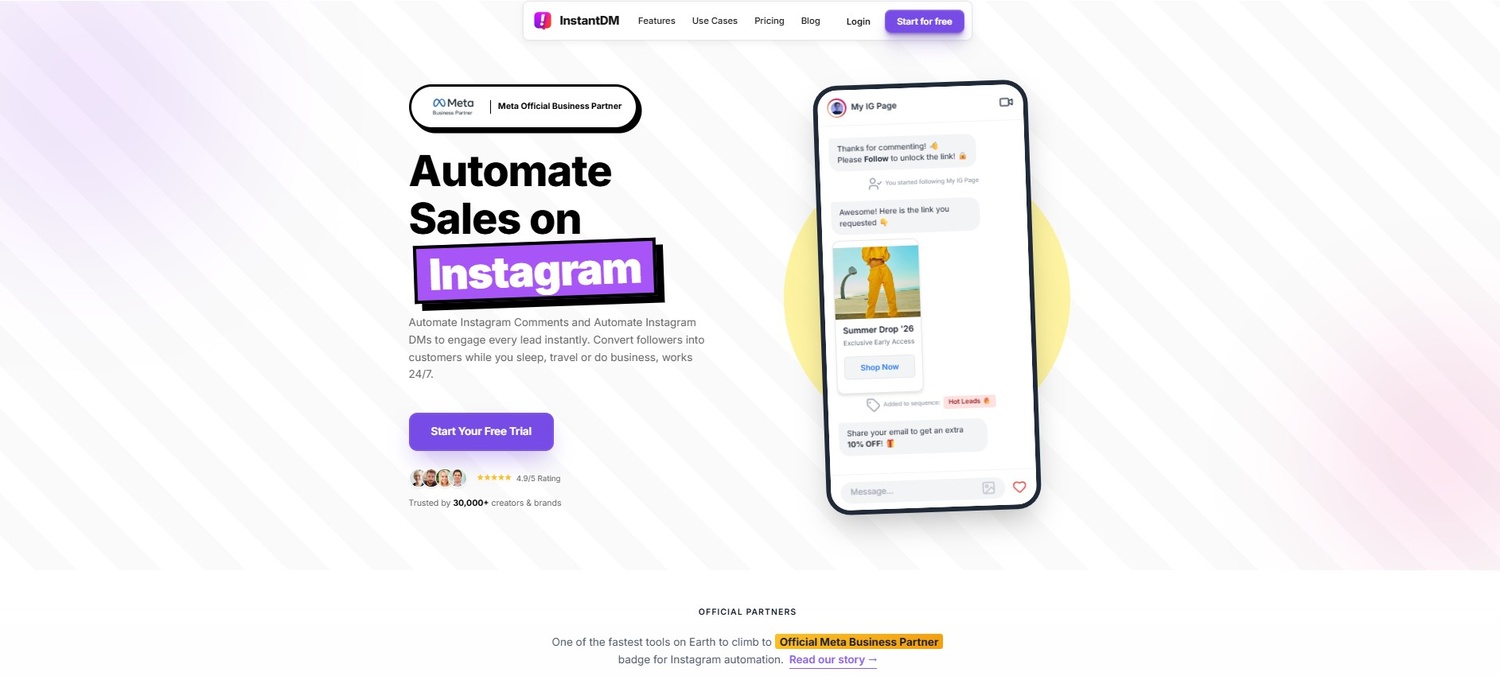
The Setup: This stage is where using a platform likeInstantDM makes perfect sense. As a verified Meta Business Partner, it allows you to safely delegate the busywork to software that offers unlimited automations and operates 24/7.
With InstantDM, you can set up Universal Triggers. This means you configure a single keyword (like "GROWTH"), and whether someone comments on a reel, replies to a story, or It sends the message straight to your inbox, and the system instantly recognises it, firing off the correct response in 0.5 seconds. Every single time.
But it goes much deeper than just firing off a link. You can build entire automated sales funnels directly inside the Instagram inbox. For example:
- The Follow for Link feature: What if someone who doesn't follow you sees your story because someone else shared it? They answer with the word that sets them off. Make sure they really follow you. The bot gently says, "Hey!" if they don't. I'd love to send you this guide, but you have to follow the page first to get it! The link goes away as soon as they tap follow. You are getting a lead while also growing your audience.
- Lead Gen on Autopilot: You can get their information right in the chat instead of sending them to a clunky landing page to enter their email. The automation says, "Great! What's the best email address to send the PDF to?" They type it in, check it, and then it automatically syncs with your Google Sheets or CRM.
- Safety Queue: Advanced safety mode kicks in when a story goes viral and you get 5,000 replies in an hour. It automatically finds the spike and spaces out the DMs at safe intervals for people, so your account won't get flagged or shadowbanned.
The moment someone replies to your story with your keyword, the system does the heavy lifting. You can even set up automated follow-up sequences. If they didn't click the link after 3 hours, the system sends a gentle reminder. This operation is all happening instantly in the background while you focus on creating more content, taking a vacation, or getting a full night's sleep.
10. Your 24-Hour Action Plan
While theoretical knowledge is valuable, it's the execution that truly matters. Here is a simple, ready-to-use story sequence that you can post today to test your first automated trigger.
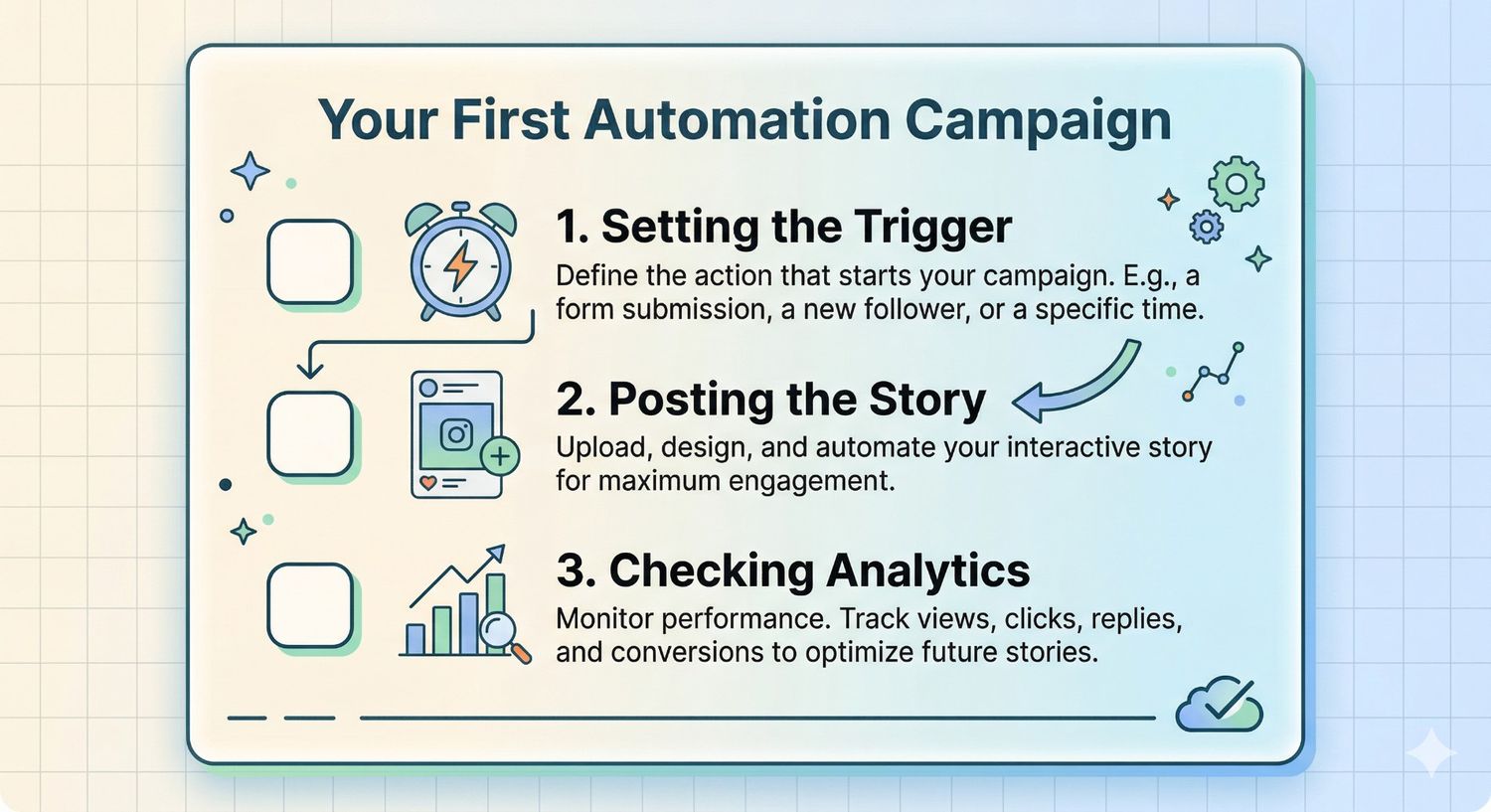
Step 1: The Setup (10 minutes) Determine what you are giving away. It could be a discount code, a free PDF, a link to a YouTube video, or a calendar booking link. Choose a short, easy-to-spell keyword (e.g., "VIDEO", "TIPS", "SALE"). If you are using an automation tool, set the trigger up so the response fires immediately.
Step 2: The Hook Story (Morning) Post a story highlighting a major pain point your audience faces. Keep it relatable and text-heavy to force them to tap and hold. Example text: "So many people DM me, asking how I organise my entire week in Notion without getting overwhelmed. " It used to take me hours until I built this specific template..."
Step 3: The Offer Story (2 hours later) Post a follow-up. A story showing a visual of the solution (a screenshot of the template, a sneak peek of the video). Add large text: "I'm giving away the exact framework I use for free today. Reply to this story with the word "TEMPLATE", and I’ll instantly DM you the link."
Step 4: Monitor and Engage (Afternoon) Watch the replies roll in. If you are doing it manually, please set aside some time in the next few hours to reply promptly. If you have automated it, sit back, review your click-through rates, and spend your time engaging with the people who ask follow-up questions in the DMs.
Conclusion: The Inbox is Where the Magic Happens
Stop settling for passive Story views. Every tap, poll vote, and keyword reply is a micro-commitment that brings your audience one step closer to becoming a customer. By utilising the Hook-Story-Offer method and leveraging native stickers, you train your followers to stop scrolling and start engaging. And when you finally drop that keyword trigger, the DMs will follow.
But remember, generating the lead is only half the battle; responding in seconds is how you close it. You don't have to live on your phone to scale your business. By integrating a verified automation platform likeInstantDM, you can instantly deliver links, capture emails, and qualify leads 24/7. Turn your Instagram Stories into an automated sales engine today, and let your inbox do the heavy lifting.