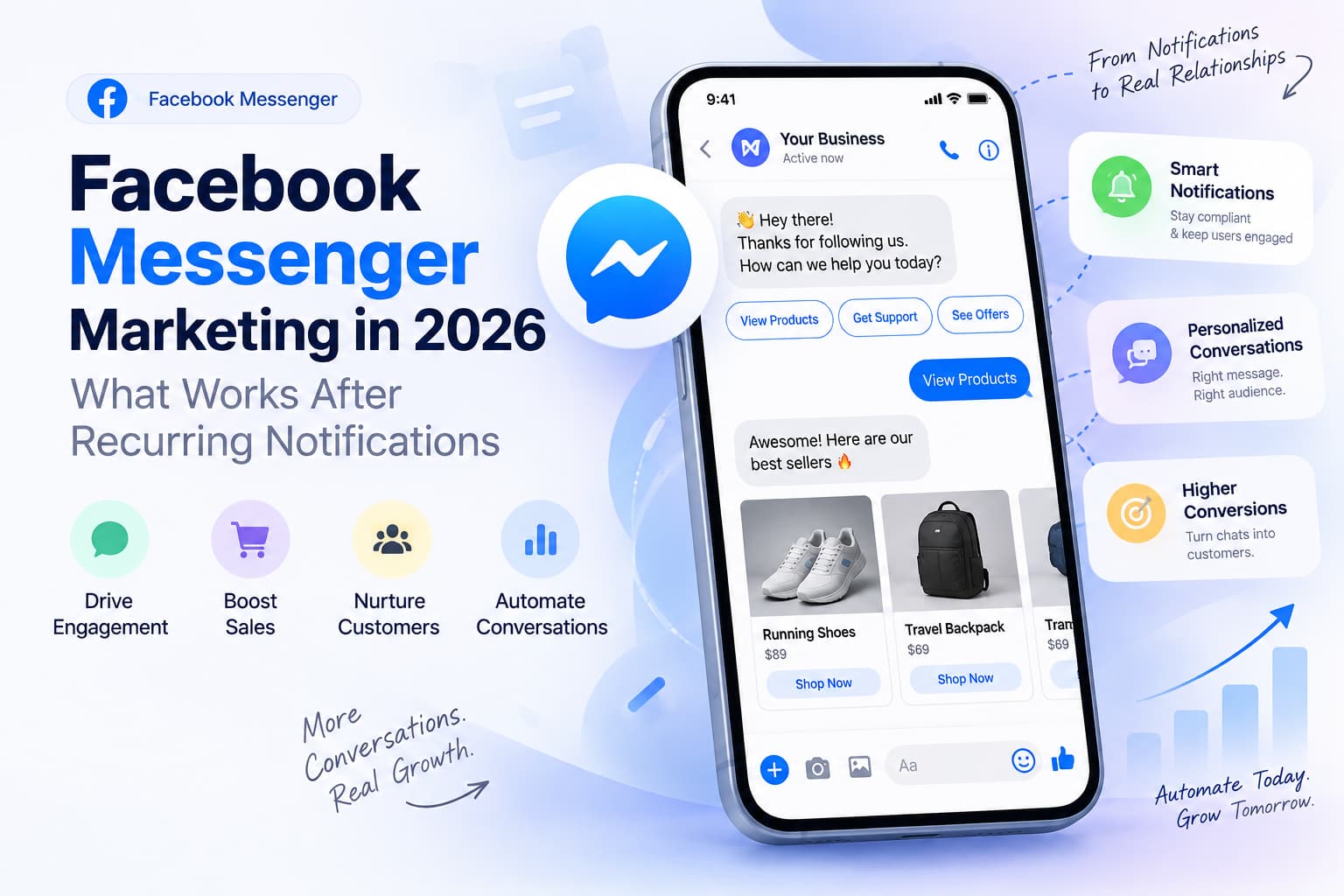
Facebook Messenger marketing is still worth it in 2026 if you run conversations, not broadcasts. Recurring Notifications are going away. The work that still converts is comment-to-chat, Click-to-Messenger ads, and replies inside the 24-hour window.
| Question | Verdict |
| Still worth it in 2026? | Yes, as a conversation channel |
| Free weekly broadcasts? | No. Recurring Notifications are being removed |
| What still works? | Comments, ads, and inbound messages inside 24 hours |
| After the window? | Tags, human agent, Sponsored Messages, or opted-in Marketing Messages |
| Native AI on the Page? | Meta Business Agent can answer; it does not replace comment-to-chat or ad staffing |
A conversation starts when someone comments, taps an ad, or messages the Page. You do not cold-message strangers. Promotional replies are free inside the 24-hour window. Meta Business Suite is enough at low volume. A platform is for speed, flows, Instagram plus Facebook on one bill, and ads that cannot sit unanswered.
What is Facebook Messenger marketing?
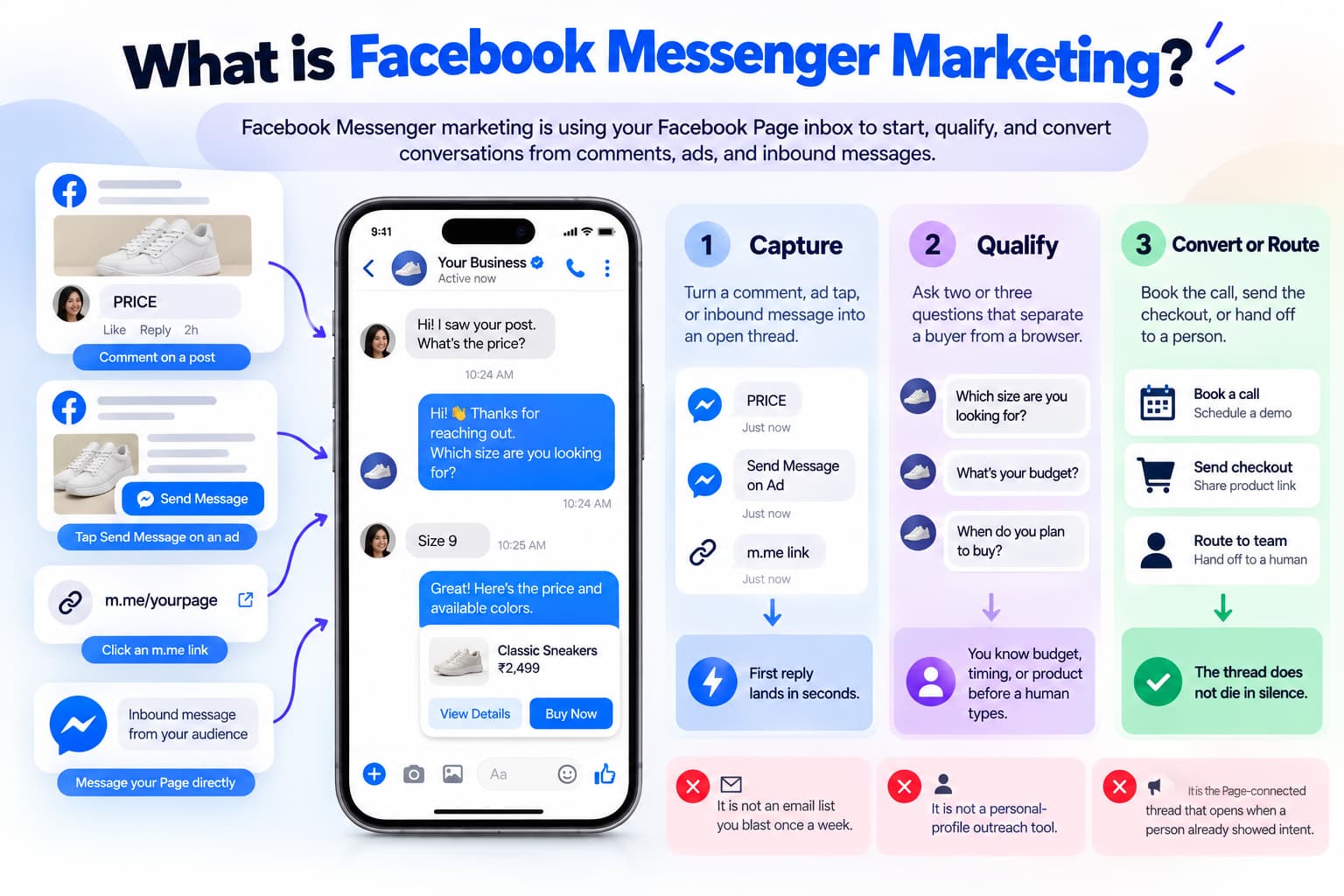
Facebook Messenger marketing is using your Facebook Page inbox to start, qualify, and convert conversations from comments, ads, and inbound messages.
It is not an email list you blast once a week. It is not a personal-profile outreach tool. It is the Page-connected thread that opens when a person already showed intent: they commented PRICE, they tapped Send Message on an ad, they hit an m.me link, or they wrote the Page themselves.
Three jobs sit under that definition.
| Job | What it means | What “good” looks like |
| Capture | Turn a comment, ad tap, or inbound message into an open thread | The first reply lands in seconds |
| Qualify | Ask two or three questions that separate a buyer from a browser | You know budget, timing, or product before a human types |
| Convert or route | Book the call, send the checkout, or hand off to a person | The thread does not die in silence |
Everything else — chatbots, autoresponders, ads, comment keywords — is a way to do one of those three jobs without missing the window.
Is Facebook Messenger marketing still worth it in 2026?
Yes — if you treat it as conversations inside the 24-hour window, not as a free broadcast list. Recurring Notifications are being removed. Marketing Messages and Sponsored Messages are the paid re-engagement paths. Comment-to-chat and Click-to-Messenger still work because the user starts the thread.
The old pitch was: collect opt-ins, then drip a daily tip or a weekly sale to thousands of subscribers. That model depended on Recurring Notifications. Meta is sunsetting that product and moving re-engagement onto Marketing Messages, which are opt-in, partner-constrained, and billed closer to ads than to a free inbox blast.
What did not die:
- A comment on your post or Reel can still open a Private Reply in Messenger.
- A Click-to-Messenger ad can still start a thread from Facebook or Instagram.
- An inbound message still gives you 24 hours of promotional room.
- A fast first line still beats a lead form.
What did die:
- Building a “Messenger list” and treating it like email.
- Messaging anyone who ever talked to the Page, forever, for free.
- 2019 chatbot blast blueprints copied onto a 2026 Page.
If your buyers already live on Facebook, Messenger is still a short path from attention to a qualified chat. If the plan is “upload a CSV and broadcast,” use email. Messenger does not work that way anymore.
What changed in Facebook Messenger marketing in 2026
Recurring Notifications are going away. Marketing Messages replace that re-engagement path. The free work moves into the live thread.
Recurring Notifications are being removed
Recurring Notifications let a Page collect an opt-in and send promotional updates on a daily, weekly, or monthly cadence after the 24-hour window closed. That was the broadcast era of Facebook Messenger marketing.
Meta put the product on a deprecation path through early 2026: no new integrations, tighter send cooldowns, then discontinuation on the Messenger API for most regions. Dates in public docs vary slightly by region. Do not build a new campaign on Recurring Notifications. Treat them as gone.
Meta put Recurring Notifications on a deprecation path through early 2026 (Recurring Notifications on Messenger will go away in 2026).
The replacement path is Meta’s Marketing Message API for Messenger.
What Marketing Messages replace
Marketing Messages are the 2026 re-engagement format. The person must subscribe. They can opt out. Sends run through Meta’s marketing stack, not a free “notify my fans” switch. Access is limited by region and partner. Budget sits closer to an ad account than to a free inbox toggle.
Re-engagement is still possible. It is no longer the free center of the strategy.
Can you still send broadcasts on Messenger?
Not the old free Recurring Notifications blast. Use Marketing Messages for opted-in promo, or Sponsored Messages to pay your way back into an existing thread. Most conversion work should still happen inside the live 24-hour window.
| Method | Promotional? | Cost | When to use |
| Standard reply inside the 24-hour window | Yes | Free | Default play. Qualify, send the offer, book. |
| Private Reply to a comment | First message only | Free | Comment-to-chat on your own posts and Reels |
| Message tags | No | Free | Order updates, account notices, confirmed events |
| Human agent tag | Support, not promo | Free | A person continuing a request |
| Sponsored Messages | Yes | Paid ad | Re-open a thread that already exists |
| Marketing Messages | Yes, opted-in | Paid / partner | Recurring promo after explicit subscribe |
What Meta Business Agent changes in 2026
Meta Business Agent is Meta’s own AI on Messenger, WhatsApp, and Instagram. It can answer Page questions, recommend catalog products, book, qualify a lead, and hand off to a person. Setup lives in Meta Business Suite. You do not need a developer for the basic version.
Treat it as a native first-line, not as a Messenger marketing system.
| Job | Agent can do it? | Still your job |
| First reply on an inbound | Yes | Tone, offer, and when a human takes it |
| Catalog / FAQ answers | Yes, if the Page and site are current | Wrong or stale content still ships |
| Comment-to-chat on a Reel | No — that is Private Reply + a trigger | Keyword, public reply, first DM |
| Click-to-Messenger staffing | Partial — only if you turn Agent on | Same first DM as the ad |
| Broadcast after the window | No | Marketing Messages or Sponsored |
| Instagram + Facebook flows | Only inside Meta’s Agent | Shared automation still needs a tool |
Use Agent when the Page is quiet, FAQs are stable, and you want a free-or-native answer while you sleep. Leave Agent — or sit InstantDM in front of the same Page — when you need a keyword on a specific post, a public reply plus one Private Reply, the same first DM on organic and ads, or Instagram and Facebook on one flat bill.
Agent does not bring Recurring Notifications back. It does not let you message people who never talked to the Page. The 24-hour window and Private Reply limits still apply to promotional follow-ups you send yourself.
If Agent is on, audit the first 20 transcripts in week one. If it greets like a helpdesk and your ad promised a price list, turn it off for that entry point and use the first DM you already wrote.
Why Facebook Messenger marketing still works
It still works because the person is already in a chat, not on a landing page they can bounce from.
A feed post fights the algorithm. An email fights the promotions tab. A lead form asks for a phone number before they have asked a question. A Messenger thread starts after a tap or a comment. The next line can be a question, a price, a calendar link, or a human.
Treat old “80 percent open rate” claims as direction, not a guarantee.
| Messenger thread | Lead form ad | ||
| Attention | High if the first line is useful | Low | Medium |
| Time to first reply | Seconds | Hours | None — they submitted and left |
| Promotion rules | Tight | Loose | The form is the capture |
| Best use | Qualify and book | Nurture a list you already own | Cheap capture when chat support is weak |
Messenger loses when you treat it like a form. A 12-step flow, a generic “Thanks for messaging us!”, or a three-hour first reply wastes the only advantage the channel has: speed inside a private thread.
The three ways a Messenger conversation starts
Every Facebook Messenger marketing system is three front doors and one inbox.
A comment on your post or Reel
Someone comments a keyword — or any comment — on a Page post or Reel. You post a short public reply (“Sent you the link”) and send one Private Reply in Messenger with the thing they asked for.
This is the cleanest organic opt-in left in 2026. The person raised a hand in public. The useful part moves to private chat. You get one Private Reply per comment, within seven days. If they reply to that message, the 24-hour window opens and you can continue.
How to set the public reply and the Private Reply: Facebook comment automation.
Post CTA:
Comment PRICE and I’ll send the one-page breakdown in Messenger.
First DM:
Got it — here’s the one-pager. Are you looking at this for yourself or for a client?
A Click-to-Messenger ad
The ad looks like any Facebook or Instagram unit. The CTA is Send Message. The destination is a conversation with the Page, not a landing page.
You pay for capture. Qualification is still your problem. If the first line is “Hi! How can I help you today?”, you paid for a tap and then sounded like every other Page.
Ads Manager buys the conversation. A tool or a person staffs it.
An inbound message, m.me link, or Send Message button
The person writes the Page, taps Send Message on the profile, or follows an m.me link from a site, email, or bio. Instant Reply and Away Message cover the first line. Keywords cover PRICE, HOURS, BOOK. A flow covers the rest.
The rules that govern every Messenger campaign
The window, tags, and promotional limits sit in Meta’s Messenger Platform policy overview.
The 24-hour messaging window is the period after someone messages your Page when you may send promotional replies for free. After it closes, you need a tag, a human-agent reply, a Sponsored Message, or an opted-in Marketing Message.
- The person acts first. A comment, a message, an ad tap, a plugin, or an m.me link. You do not scrape profiles and start threads. Cold Messenger outreach is how Pages get restricted.
- One Private Reply per comment, within seven days. That is the comment-to-chat door. It is not an unlimited drip from a comment.
- Promotional content is allowed inside the 24-hour window. The window opens when they message you, tap your CTA, reply, or otherwise act. Use it.
- After the window, use the methods table above. Tags are not a loophole for sales copy. Human agent is for humans. Sponsored Messages cost money. Marketing Messages need a subscribe.
- Official Page, official API. Tools that comment on other people’s posts, or pretend to be you in a personal inbox, are a different risk.
What you may send after the first line, including tags and the window clock: Facebook DM automation.
Organic Facebook Messenger marketing plays that still work
Organic means you do not buy the first tap. You still need a trigger, a first line, and a next step for a qualified person.
Comment-to-Messenger on one pinned post
Pick one offer. Pin one post or Reel. One keyword. One first DM.
Weak: “Comment YES for more info.”
Stronger: “Comment KIT for the size guide and the checkout link.”
Keep the public reply short. Put the link and one qualifying question in the DM. If they go quiet, wait for a reply before you use the rest of the window. Do not send six follow-ups they did not ask for.
Keyword replies in the inbox
HOURS, MENU, BOOK, PRICE, DEMO. Native Suite gives you a handful of keywords with a delay. That is enough for a quiet Page. It is not enough when comments and ads arrive together.
Thanks for writing — if you want the price list, reply PRICE. If you want a time this week, reply BOOK.
Chat links on the site, bio, and email
Put an m.me link on the contact page, in the email footer, and on the thank-you screen. The person who clicks already decided to talk. Do not send them through a form first.
When to use ads in a Messenger marketing system
Click-to-Messenger and inbox placements are covered in Meta’s Messenger ads overview.
Use ads when organic comment volume cannot feed the inbox you already know how to run.
Click-to-Messenger is for new conversations. You pay for people who never talked to the Page. The creative should look like a chat invite.
Sponsored Messages are for people who already messaged you. You pay to land back in that inbox after the window closed. That is remarketing, not prospecting.
Two mistakes kill paid Messenger.
- Buying conversations you cannot answer. Staff the thread before you raise budget.
- Watching only cost per conversation start. That is the ad metric. Cost per qualified lead and cost per booking are the business metrics.
Campaign setup and the reply layer: Facebook Messenger advertising: tools and chat setup.
Use the same first DM on the ad and on the organic keyword. If the ad says “Get the 2026 price list” and the bot says “Welcome to our Page!”, you paid to confuse them.
Autoresponder, chatbot, and comment-to-chat are not the same job
They are three jobs, not one product.
| Job | What it does | When you need it |
| Autoresponder | Instant Reply, Away Message, a few keywords | A first line after hours |
| Chatbot / flow | Branching conversation after the first message | Questions, buttons, a bookable next step |
| Comment-to-chat | Public reply plus one Private Reply from a post or Reel | Your content is the opt-in |
Native first line and keywords: Messenger autoresponder for Facebook.
You can run Facebook Messenger marketing with only an autoresponder if volume is low and a human sits in the inbox. Add a flow when the same questions repeat all day. Add comment-to-chat when people already talk under the post.
A chatbot is not a requirement. A first line inside a minute is.
Comment-to-Messenger is allowed on your own Page posts and Reels: one Private Reply per comment, within seven days, through official tools. Not on other people’s posts. Not from a personal profile.
Scripts you can paste
Rewrite the offer. Keep the structure.
Comment CTA
Comment KIT — I’ll send the checklist in Messenger.
Public reply
Sent you the checklist.
First DM after a comment
Here’s the checklist. Are you setting this up for one Page or for clients?
First DM after a Click-to-Messenger ad
You tapped through for the 2026 price list. Want the one-pager, or do you want times that are open this week?
Qualifier — pick two, not five
- Is this for you or for a team?
- Are you trying to start this month or just researching?
- Budget ballpark: under $50/month, or you already run ads?
Handoff
A person on our side will take this from here. If you want a time on the calendar instead, say BOOK.
After-hours
We’re offline. Reply PRICE or BOOK and this thread will pick it up when we’re back — or leave the one question you care about.
One bump inside the window
Still want the one-pager, or should I close this out?
Metrics that matter for Messenger marketing
If you only count messages sent, you will prefer the tactic that talks the most and sells the least.
| Metric | What it is | Why it matters |
| Conversation start rate | Threads opened ÷ people who saw the CTA or ad | Did the invite work? |
| First reply under 60 seconds | Share of new threads that got a useful first line in a minute | The channel’s real advantage |
| Qualified-lead rate | Threads that answered the two qualifier questions | Chat volume vs pipeline |
| Booking or purchase from thread | Calls booked or checkouts from that conversation | The point |
| Cost per conversation | Ad spend ÷ threads started | Paid only |
| 24-hour window used / wasted | Qualified threads that got a next step before the window closed | Tells you if replies are too slow |
| Marketing Messages opt-in rate | Subscribes ÷ people who were asked | Only if you use that product |
Creator campaigns can add DM start rate (DMs ÷ reach) and in-thread click rate. Those help. They still are not “we sent 10,000 broadcasts.”
A Page that answers in 12 seconds and books 8 percent of qualified threads will beat a Page with a 40-message flow nobody finishes.
Facebook Messenger vs WhatsApp vs Instagram DMs
Pick the inbox your buyer already opens.
| Facebook Messenger | Instagram DMs | ||
| Who lives there | Page fans, mixed-age markets, some local services | Creators, ecommerce, younger discovery | Daily default in India, LATAM, much of APAC |
| Cleanest organic trigger | Comment on Page posts and Reels | Comment on posts, Reels, Stories | Click-to-WhatsApp, catalog, status |
| Ads | Click-to-Messenger, Sponsored Messages | Click-to-Instagram-DM | Click-to-WhatsApp |
| Rules | 24-hour promo window, Private Reply limits | Similar Meta messaging rules | Separate Business API categories |
| When it wins | The audience already talks to the Facebook Page | Content is the funnel | The market already texts on WhatsApp |
Many India-first businesses close on WhatsApp and discover on Instagram or Facebook. That is a two-inbox plan, not a reason to ignore Messenger if the Page already gets comments.
Is Facebook Messenger marketing right for you?
Yes if all three are true:
- Your buyers already use Facebook enough to comment or tap an ad.
- You can answer, or automate an answer, inside a minute during the hours you claim to be open.
- You have one offer clear enough to put in a first DM.
It fits local services, coaches, ecommerce brands already running Meta ads, real-estate teams tired of cold lead forms, creators who already use comment keywords on Instagram, and agencies with a real reply SLA on client Pages.
Skip it if you want a Monday-morning blast list, if nobody can touch the inbox for six hours, if you planned to message people who never talked to the Page, or if Facebook is a dead Page and email already holds the relationship.
Teams that have outgrown Suite and need a shared inbox plus ad attribution are a different buyer. Most Pages still need one trigger, one first line, and an inbox that does not go silent overnight.
When Meta Business Suite is enough — and when it is not
Suite is free and it is the right first inbox: Instant Reply, Away Message, a few keywords, a basic comment-to-message template. If you post twice a week and answer by hand, stay there.
Leave Suite when comments stack faster than a person can type, when you need a public reply and a Private Reply on the same post including Reels, when Instagram and Facebook should share one automation, when Click-to-Messenger ads start conversations at midnight, or when you need buttons and a two-step qualifier instead of a delayed keyword.
| Situation | Start here |
| Low volume, business hours, no ads | Meta Business Suite |
| Comment + inbox + Instagram on one flat bill | InstantDM |
| WhatsApp and SMS in the same flow | ManyChat |
| Shared team inbox, mid-market B2C, heavy CAPI | Respond.io |
Shortlist of reply tools: 7 best Facebook auto reply tools.
InstantDM is a Meta Business Partner. Organic comment-to-Messenger is testable on the free plan. Ads automation is on Trendsetter.
A 30-day Facebook Messenger marketing plan
Week 1 — Trigger
One post or Reel. One keyword. One first DM. Turn Instant Reply on. Count how many comments become threads.
Week 2 — Qualify
Two questions and a human handoff. Cut extra buttons. If the flow has more than five decision points, shorten it.
Week 3 — Optional paid
Only if weeks 1 and 2 produce replies you can staff. Small Click-to-Messenger test. Same first DM as the organic keyword. Do not scale yet.
Week 4 — Keep one flow
Delete the weak keyword. Keep the offer that earned replies. Write down conversation start rate, reply speed, and bookings. Decide Suite vs a platform using the table above.
At the end of 30 days you should have one working front door.
Start with one conversation, not a broadcast list
Facebook Messenger marketing in 2026 is a conversation system under Meta’s rules. Capture the thread. Answer while the window is open. Qualify. Route. Pay for re-engagement only when that system already works.