TL;DR
Post three to five times a week to the feed, counting Reels, carousels and photos together, and add Stories on the days you have something to show. Instagram gives no official number. Its head, Adam Mosseri, said in March 2025 that "there's no perfect number", and the one public study that tests frequency against results points to three to five a week.
- Buffer's August 2025 study (2.1 million posts, 102,000 accounts) found the biggest jump when accounts went from one or two posts a week to three to five. Returns kept rising after that, more slowly.
- Posting more than once a day carries no penalty. Mosseri has said a second Reel "should not affect" the reach of one that's taking off.
- Weeks with no posts are the costly ones. In Buffer's data they fell below the account's own normal growth.
- A long break can lower reach when you return. Mosseri has said that is a side effect of the ranking system having little recent data, and that it isn't deliberate.
- Nothing here guarantees growth. A cadence only decides how many chances you get each week.
We have no dataset of our own on this. Everything below comes from what Instagram has said in public and from studies that state their sample size and date, checked in October 2026.
What has Instagram itself said about how often to post?
Instagram has never published a required posting frequency. What you get instead is a handful of remarks from Adam Mosseri and the @creators account, plus one line in its creator FAQ. Over five years the remarks have drifted from a specific suggestion to "it depends".
The number most guides still quote is from 2021. On June 10, 2021, during Creator Week, creator Karen X Cheng interviewed Mosseri for the @creators account. The advice reported from that session was a couple of feed posts a week and a couple of Stories a day. Nearly every "Instagram recommends 2 posts a week" line you'll read traces back to that one interview. It predates Reels taking over the feed, and we'd stop quoting it.
His recent answers are looser. Mosseri takes creator questions most Fridays in his Stories on his profile. Stories expire, so those answers have no permanent link. The quotes below are from the dated transcripts that consultant Luan Wise publishes each week. From March 2025:
- March 29: "There's no perfect number, unfortunately." He added that posting more generally gives you more chances to reach people.
- March 22: "I know people who post five reels a day and it does well for them." In the same session: "I know people who post once a month and it does well."
- March 15: frequency is not the most important factor, and he tries to post "at least a couple of things a week" himself.
He has been blunter about formats. In a January 28, 2025 video on how Stories are ranked, he said that for the vast majority of creators, posting to the feed is the best way to reach as many people as possible, and that Stories are for reaching "your most passionate audience with behind-the-scenes, timely content."
Two official pages get overlooked. Instagram's creator FAQ answers "What is the optimal number of reels I should share to grow?" by saying frequency is "just one factor of many". It then adds that the creators with the highest net follower growth "post 10 or more reels per month" on average. That is the only number Instagram prints. It describes what fast-growing creators do, it isn't a requirement, and it works out to two or three Reels a week.
The other is the Best Practices section Meta added to the professional dashboard in October 2024. Its Creation category promises "insights on how often to post", so check what it shows for your own account.
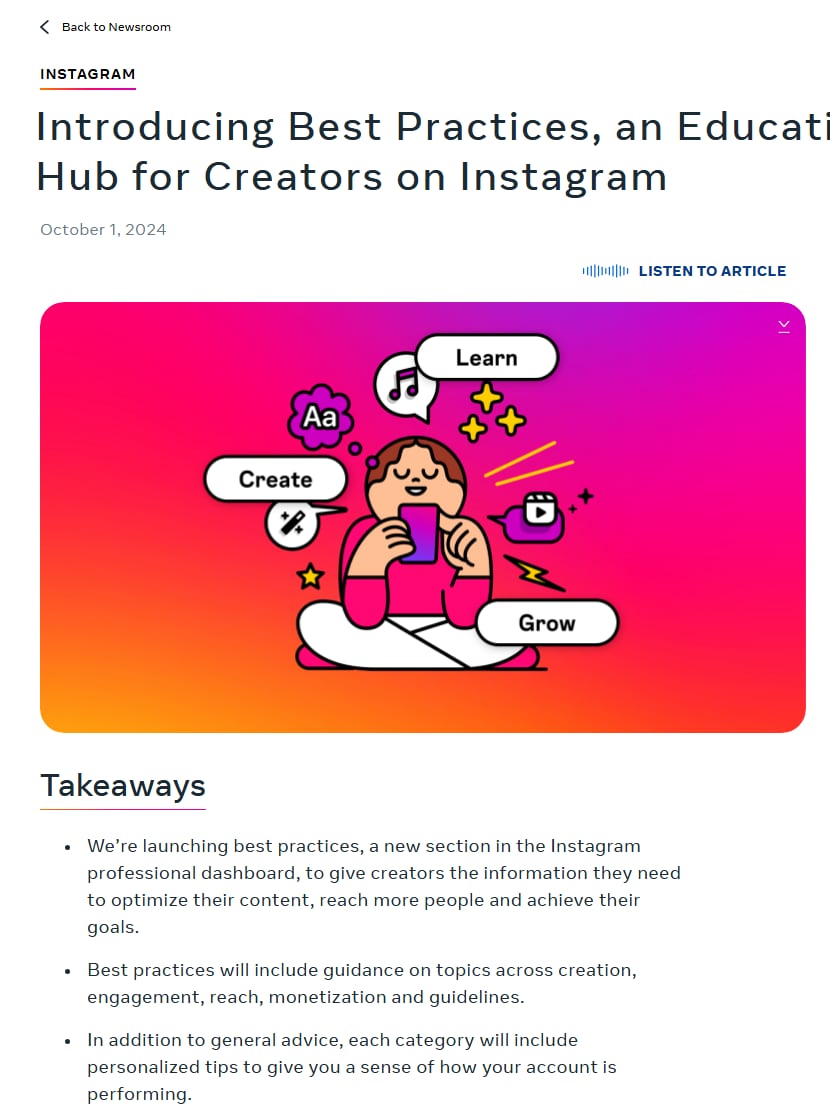
Meta's announcement of the Best practices hub in the professional dashboard. Screenshot of about.fb.com taken October 9, 2026.
What do the published studies say?
Five studies state their sample and date clearly enough to use. Buffer's is the only one that follows the same accounts through weeks when they posted more and weeks when they posted less. Dash Social's compares engagement across brands. The other three record how often accounts post, which tells you what is normal and nothing about what works.
| Source | Published | Sample | What it reports |
|---|---|---|---|
| Buffer | August 13, 2025 | 2.1 million feed posts from 102,000 accounts (Stories excluded) | Reach per post about 12% higher at 3 to 5 posts a week than at 1 to 2; 18% higher at 6 to 9; 24% higher at 10 or more |
| Later | March 2025 (data from January to October 2023) | 19 million feed posts and 32,000 Stories published through Later | Accounts under 10,000 followers averaged 2 feed posts a week; 10,000 to 100,000 averaged 3; 100,000 to 500,000 averaged 5 |
| Rival IQ | February 25, 2025 | 150 brands from each of 14 industries | Median brand posts about 4.5 times a week; frequency fell slightly for the first time in three years |
| Socialinsider | June 26, 2025 | 161,180 brand Stories (January to May, 2024 and 2025) | Brands with 10,000 to 50,000 followers averaged 35 Stories a month; 1,000 to 5,000 averaged 12 |
| Dash Social | August 25, 2026 (data from July 2025 to June 2026) | 3.3 million feed posts, Reels and Stories from more than 3,000 brands on its platform | Recommends 2 to 3 feed posts a week on engagement rate; brands posting 30 or more Story frames a week had the highest completion rates |
Buffer's study is the one to read closely, because it compares each account with itself. Its model estimated a lift in follower growth rate of 0.12% at 1 to 2 posts a week, 0.26% at 3 to 5, 0.44% at 6 to 9 and 0.66% at 10 or more. The step from one or two posts to three to five roughly doubles it. Weeks with no posts landed below the account's usual growth, which Buffer's data scientist called a "no-post penalty".
Those percentages are small. Buffer's own illustration, for an account with 5,000 followers and flat growth, works out to about 6 extra followers a week at 1 to 2 posts, 13 at 3 to 5, 22 at 6 to 9 and 33 at 10 or more.
Dash Social's analysis is the newest of the five and the only one with data from 2026. Its sample is brands that pay for a social media management platform, so it describes companies with a marketing team.
The other three are a reality check. Later's numbers show that twice a week is ordinary for a small account. Rival IQ's 2025 benchmark report shows that brands with teams sit around four or five posts a week. Socialinsider's Stories benchmarks show that even mid-sized brands average about one Story a day.
Why don't the numbers agree?
They answer different questions. "A couple a week" from 2021, "3 to 5" from Buffer, "2 to 3" from Dash Social and "4.5" from Rival IQ only look like a disagreement.
- Mosseri's 2021 remark was a floor for staying present with followers, given before Reels and recommendations carried most reach.
- Buffer measured association. Accounts tended to grow faster in weeks when they posted more. That isn't proof that posting more caused it, and Buffer says content quality probably matters most.
- Dash Social scored posts on engagement rate. Buffer scored reach and follower growth. A brand can get its best engagement rate at two posts a week and still reach more people in total at five, so both results can be true.
- Later and Rival IQ report what accounts do. Nobody tested whether the average was a good choice.
- Buffer, Later and Dash Social drew their samples from their own customers. Those accounts are more organised than the typical one, and all three companies sell scheduling.
That leaves a range of two to five feed posts a week. We lean toward the upper half, provided the quality holds.
How often should you post each format?
The table below is our recommendation, built from the sources above. Apart from the 10 Reels a month in its creator FAQ, Instagram hasn't published a number for any row. Reels, carousels and photos all count toward one weekly feed total. Stories don't, because they vanish after 24 hours and mostly reach people who already follow you.
| Format | Reasonable cadence | Lowest that still works | Why |
|---|---|---|---|
| All feed posts together | 3 to 5 a week | 1 a week, with no empty weeks | Buffer's largest step up is from 1 to 2 posts to 3 to 5 |
| Reels | 2 to 3 a week | 1 a week | Instagram can recommend them to people who don't follow you; its fastest-growing creators average 10 or more a month |
| Carousels | 1 to 2 a week | 2 a month | Slower to make; they suit followers who skip video |
| Single photos | 0 to 1 a week | None | Optional; fine for announcements |
| Stories | 1 to 5 frames on most days | A few days a week | They reach existing followers and do little for discovery |
| Trial Reels | 1 to 3 a week, if you have them | None | They go to non-followers first |
If the second column looks like too much, use the third.
How often should you post for your follower count?
Smaller accounts post less, and that's fine. No study shows that a small account needs a big account's schedule to grow. Later's figures, from posts its customers published in 2023, show how often accounts of each size post.
| Followers | Average feed posts a week | Average Stories |
|---|---|---|
| Under 10,000 | 2 | 3 a week |
| 10,000 to 100,000 | 3 | 4 a week |
| 100,000 to 500,000 | 5 | 15 a week |
These are averages, and the accounts in each row had different amounts of help. Later says its own account, with more than 520,000 followers, posts about 12 times a week with a team of three. The Stories column rests on only 32,000 Stories, so treat it as rough.
Under 10,000 followers, then, two feed posts a week puts you level with your peers and three puts you ahead. Add a post when you have the hours for it.
Industry matters more than size. In Dash Social's 2026 table, brands in most consumer categories (beauty, food and drink, home, travel, wellness) average about five feed posts a week, fashion and retail seven or eight, and sports, media and publishing 26 to 32. A newsroom has something new every hour and a candle shop doesn't.
How many Reels should you post a week?
Two or three is a sound target for one person. There's no official quota, and the one figure Instagram does print, 10 or more Reels a month among its fastest-growing creators, comes to about the same pace. Buffer counted Reels, photos and carousels as one group, so its three to five a week isn't a Reels number.
The closest thing to a Reels-only figure comes from Dash Social, which pulled about 700,000 brand Reels out of its 2026 dataset and landed on one to three a week, judged by engagement rate.
The same FAQ says Instagram recommends videos to people who don't follow you only when they are three minutes or less. If your Reels all open with the same weak first two seconds, a fourth and fifth each week won't fix that. Our breakdown of the six metrics the Instagram algorithm weighs covers the numbers to fix first.
Trial Reels exist for the case where you want more attempts without filling your followers' feeds. Instagram's December 2024 announcement says a trial is shown to people who don't follow you and stays off your grid unless you share it with everyone. Mosseri said in March 2025 that trials are open to public accounts with at least 1,000 followers. The setup is in how Instagram Trial Reels work.
How many Stories a day is too many?
There is no cap, and the old warning that more than a few Stories "kills your views" is out of date. Through early 2025 creators complained that posting several Stories in a day cut their reach. Mosseri acknowledged it in his March 29, 2025 Q&A ("if you post a lot of stories, you can get less reach") and said it wasn't on purpose.
In September 2025 he posted a video saying Instagram had fixed it. Tech press at the time quoted him calling the drop "not at all the intended behavior". We couldn't find a permanent link to that video, so treat the wording as reported.
Dash Social's 2026 analysis found that brands posting 30 or more Story frames a week, about four or five a day, had the highest average completion rates. Those brands have content teams, so don't read it as a target.
What's left is how long viewers keep tapping. Every extra frame is another place to leave, so frame ten is always seen by fewer people than frame one. One to five frames is plenty for most accounts. If Stories are where your sales conversations start, our guide to Instagram Story engagement goes deeper on stickers and reply prompts.
Does posting more than once a day hurt your reach?
No. Instagram doesn't penalise an account for posting twice in a day. The only daily ceiling it documents is a technical one. Meta's content publishing documentation limits an account to 100 posts published through the API in any 24 hours, which you'd only meet if a scheduling tool were posting for you all day.
Mosseri addressed the fear on March 7, 2025: posting another Reel while one is taking off "should not affect that reach", particularly if the second doesn't go up immediately after. He added that people are often too cautious about how often they share.
Your posts do compete with each other for attention, though. In an April 2024 Threads post, Mosseri explained why nobody reaches all their followers: many don't open the app that day, and those who do have more posts waiting than they have time for. Your second post of the day joins that same queue.
The risk he does name is annoying people. On March 15, 2025 he said that if you post "like nine things in a day" you may frustrate followers, and he suggested trials for the extra attempts. Two posts on a launch day is fine. A daily habit of several needs the unfollow check further down.
How long should you wait between Instagram posts?
Instagram has published no minimum gap. The only official hint is Mosseri's March 7 remark above, that a second Reel is safest when it doesn't go up immediately after the first.
Some guides state a rule of one feed post a day at most, or a set number of hours between posts. None of them cite Instagram for it, and we couldn't find a source either.
We spread the week's posts across different days and leave a few hours between two on the same day. That's a preference with no data behind it.
Should you post on Instagram every day?
Only if you can do it for months without the posts getting worse. Daily posting isn't required, and Instagram has never said it is.
Seven feed posts a week lands in Buffer's 6 to 9 band, where the estimated lift in growth rate was 0.44% against 0.26% at 3 to 5. Buffer still labels that band "treat with caution", because the gain disappears if quality slips or you burn out and stop.
If you're starting out, don't begin at seven. Begin at two or three, hold it for a month, then add one post a week and check whether average views per post held up.
How often should a new account, a creator with a job, a small business or an agency post?
Match the cadence to the hours you have. Time yourself making one Reel and one carousel from idea to published, then divide the hours you get in a busy week by those figures and round down. If a Reel takes you an hour and a carousel two, four hours buys two Reels and a carousel. A cadence you can't staff ends in empty weeks, and those cost the most.
New account under 1,000 followers
Aim for three feed posts a week and make at least two of them Reels. With few followers, almost all your reach has to come from people who don't follow you yet, and Reels are built to be recommended to them.
Trial Reels probably aren't available to you yet. Stories also matter less than you'd expect at this size, because they go mostly to followers you don't have. One or two a week is enough for now.
For what to post, start with a system for your first 1,000 followers.
Solo creator with a full-time job
Two to three feed posts a week. Film and edit in one weekend block, schedule the posts for weekday evenings, and post Stories only when something happens. If a week goes badly, publish one post anyway.
Small business
Three feed posts a week and Stories on the days you're open. Give each post a job. One shows the product, one answers a question customers keep asking, and one shows a person. Stories carry the daily material such as stock and opening hours.
Agency-run brand
Four to seven feed posts a week, with Stories daily. Rival IQ's median brand sits around 4.5, so five is ordinary. Approvals usually set the ceiling. If the client takes four days to sign off, plan for four posts and don't promise seven.
Is consistency more important than volume?
For most accounts, yes. In the public data the worst weeks are the ones with nothing posted.
Buffer found that weeks with zero posts fell about 0.08 standard deviations below an account's typical growth, while each step up in volume added a smaller gain than the one before.
Consistency doesn't have to mean the same hour every day, and nothing Instagram has said rewards a fixed slot. For timing, our guide to the best time to post on Instagram in 2026 covers how to find your own hours.
Does taking a break from Instagram hurt your reach?
A short break doesn't. A long one can lower reach for a while when you return, and Instagram says that isn't a punishment.
Mosseri explained the mechanism on March 15, 2025: when you haven't posted for a long time, the ranking system has less recent information about who responds to your posts, so your first posts back can travel less far. He described it as unintentional. He gave no number of days. The "30 days" threshold you may see quoted is somebody's guess.
If you're coming back after months away:
- Post something you're confident in first. An "I'm back" announcement gives followers nothing to watch.
- Keep to two or three posts a week for a month before you judge the numbers.
- Compare against your own figures from before the break.
- Follower counts often dip when a quiet account posts again, because people are reminded they follow you. That's normal, and why you lose followers on Instagram covers the other causes.
Does deleting or archiving posts hurt your account?
Instagram has published nothing that says so. No documented penalty exists for deleting or archiving, and the idea that removing posts lands you in "Instagram jail" is creator folklore.
We couldn't find a statement from Mosseri himself to link. The creator Brock Johnson, who interviewed him in 2025, wrote in July 2026 that Mosseri confirmed reach isn't punished when you archive or delete. That's a secondhand report.
Two things are documented:
- Archiving hides a post from your profile and keeps its likes and comments. You can put it back later and it returns to its original position, according to Instagram's Help Center page on archiving.
- Deleted posts and Reels go to Recently Deleted and are removed for good after 30 days, per Instagram's announcement of the feature. The menu has moved since then; search your settings for "Recently deleted".
Deleting does cost you something. A Reel can keep collecting views for weeks, and removing it after a slow first day throws those away. We'd archive anything we only want off the grid.
How do you tell from Insights that you're posting too much or too little?
Compare four weeks at one cadence with four weeks at another, and look at three numbers. You need a professional account (creator or business) to see them.
- Open your profile and tap Professional dashboard. If you don't see it, tap the menu, then Insights. Instagram describes the screens in About Instagram insights.
- Set the date range to the last 30 days. Note the total under Views, and the split between followers and non-followers.
- Open Content you shared and sort by Views. Write down the views on each post so you can work out an average per post. If one post ran far ahead of the rest, use the middle value so it doesn't skew the comparison.
- Go back and open the followers section. Under Growth you'll see follows and unfollows by day. This section appears once you have 100 followers.
- Change your cadence, wait four weeks, and take the same readings. Keep the formats, topics and posting times the same as before, so the number of posts is the only thing that changed.
Instagram renames these screens often, so your app may word them slightly differently.
Signs you are posting too much:
- Average views per post fall and total Views for the month stay flat, which means more work for the same result.
- Unfollows cluster on the days you post two or three times.
Signs you are posting too little:
- One post accounts for most of the month's Views.
- There are weeks with nothing in Content you shared.
- Follows only arrive in the two days after each post and stop in between.
A made-up example of the arithmetic. At three posts a week you average 1,800 views each, 5,400 a week. You move to six a week and the average drops to 1,300. That is 7,800 a week, 44% more, and worth it if you have the hours. If the average had dropped to 800, six posts would bring 4,800, less than you had before for twice the work.
Why did your reach drop after you started posting more?
Usually because each post got less of your attention, and sometimes because of the calendar. Check these in order:
- Compare totals as well as per-post numbers. Per-post reach often dips when you post more, while total reach rises. That's the trade Buffer's data describes, and it isn't a penalty.
- Look at what you cut to make room. If the hooks or the edits got thinner, that explains the drop. Our pre-posting checklist is a quick way to hold the standard.
- Check the calendar. In an April 2025 interview, Mosseri said that when reach swings sharply "it's probably more likely the world changed" than the algorithm, pointing to holidays and school breaks.
- Give it four weeks. One slow week tells you very little.
What does a realistic week look like?
This plan is for an invented account: a home bakery in Pune run by one person, with 2,400 followers. Orders come in by DM, and she has about four hours a week for Instagram.
Target: four feed posts (two Reels, one carousel, one photo), Stories on five days, one Trial Reel.
| Day | Feed | Stories | Time |
|---|---|---|---|
| Sunday | None. Film two Reels and shoot the carousel photos; schedule the week | None | 2 hours |
| Monday | Reel: icing a cake, start to finish | This week's order slots | 15 minutes |
| Tuesday | None | 2 frames from the kitchen | 10 minutes |
| Wednesday | Carousel: five birthday cakes with prices | Poll on next week's flavour | 15 minutes |
| Thursday | Trial Reel: Monday's Reel with a different opening shot | None | 10 minutes |
| Friday | Reel: packing a weekend order | Poll result, last slots | 15 minutes |
| Saturday | Photo: a customer's cake, with permission | 3 frames of deliveries | 15 minutes |
That comes to three hours and twenty minutes, and the rest goes to replies. The few minutes after each post goes live are covered in five things to do right after posting.
On a bad week she drops Saturday's photo and Thursday's trial, which still leaves three posts. After four weeks she checks her Insights and decides whether the fourth post is earning its place.
Does scheduling posts hurt reach?
No. Mosseri answered this on March 29, 2025: "if you use something like scheduled posts, it will not affect your reach one way or the other."
For one person, scheduling is what makes three to five posts a week survivable, because you can make the whole week in one sitting. You can schedule posts and Reels inside the Instagram app: write the post, tap More options, turn on Schedule this post (or Schedule this reel), pick a date and time, then tap Schedule. Instagram's Help Center page on scheduled posts, as we read it on October 10, 2026, says you need a public account and gives the limits as 25 scheduled posts a day, up to 30 days in advance. Product tags, collab posts, sponsored posts and fundraisers can't be added to a scheduled post. Some guides quote 75 days. The Help Center page doesn't. Meta's free desktop scheduler is in Meta Business Suite, and our walkthrough is in how to schedule Instagram posts. If you post the same Reel to TikTok, YouTube and LinkedIn, a multi-platform scheduler saves the repeated uploads. Our sister product Social by InstantDM does that from one calendar.
Can the link go out automatically when a scheduled post gets comments?
Yes. Instagram's official API lets a professional account send a private reply to a person who comments on its post. A tool connected through that API watches for a word you choose, say MENU, and sends your message with the link to each person who comments it. The person has to comment first, and Instagram's own rate limits still apply.
InstantDM is one tool that does this. It's an official Meta Business Partner with quick automations and a flow builder in one tool, plus phone apps, and it connects through Instagram or Facebook login without asking for your password. You can schedule an Instagram post with the auto-DM attached so the reply is ready the moment the post goes live.
The bakery's Wednesday carousel could ask people to comment MENU. She schedules it on Sunday, and on Wednesday afternoon the menu goes out while she's baking.
Pick a cadence you can hold, then get the replies handled
Choose a cadence that fits your hours and hold it for four weeks before you open Insights again. If the numbers improved and you have the time, add one post a week and run the check again.
If answering comments and DMs is what keeps you from posting on schedule, InstantDM can take the repetitive replies on the official Instagram API. Create an InstantDM account and connect it with your Instagram login. Plans are on the pricing page.