
Last updated: October 25, 2026
Muse vs ChatGPT for small business is a stack pick, not a “who is smarter” pick. If your shop already lives in Instagram, Facebook, Shopify and Meta ads and you can sign up in the US or Canada, Muse is the one that already knows those surfaces. ChatGPT is the one I reach for when the job is research plus a finished doc, sheet or deck. Gemini wins when the work is already in Gmail, Drive and Calendar. Claude wins when the files sit on your computer and you want the agent on that machine.
I checked Meta’s Muse for Small Business page and the September 29 Newsroom post on October 25, 2026. I also checked Claude’s pricing page and Google’s Gemini subscription page. For ChatGPT, use the price in your own account. Other blogs disagree, and I won't copy their numbers.
TL;DR
- Muse fits a US or Canada owner whose shop data already sits in Meta and Shopify. Nothing publishes, sends or spends until you approve it.
- ChatGPT fits project work: research, documents, slides, the messy “finish this” jobs.
- Gemini fits Google Workspace. Paying for Google AI Pro does not magically unlock every agent feature in every country.
- Claude Pro is $20/month, or $17/month if you pay $200 up front for the year. Max starts from $100/month. Claude is the one that runs on your computer.
How did I compare Muse, ChatGPT, Claude and Gemini?
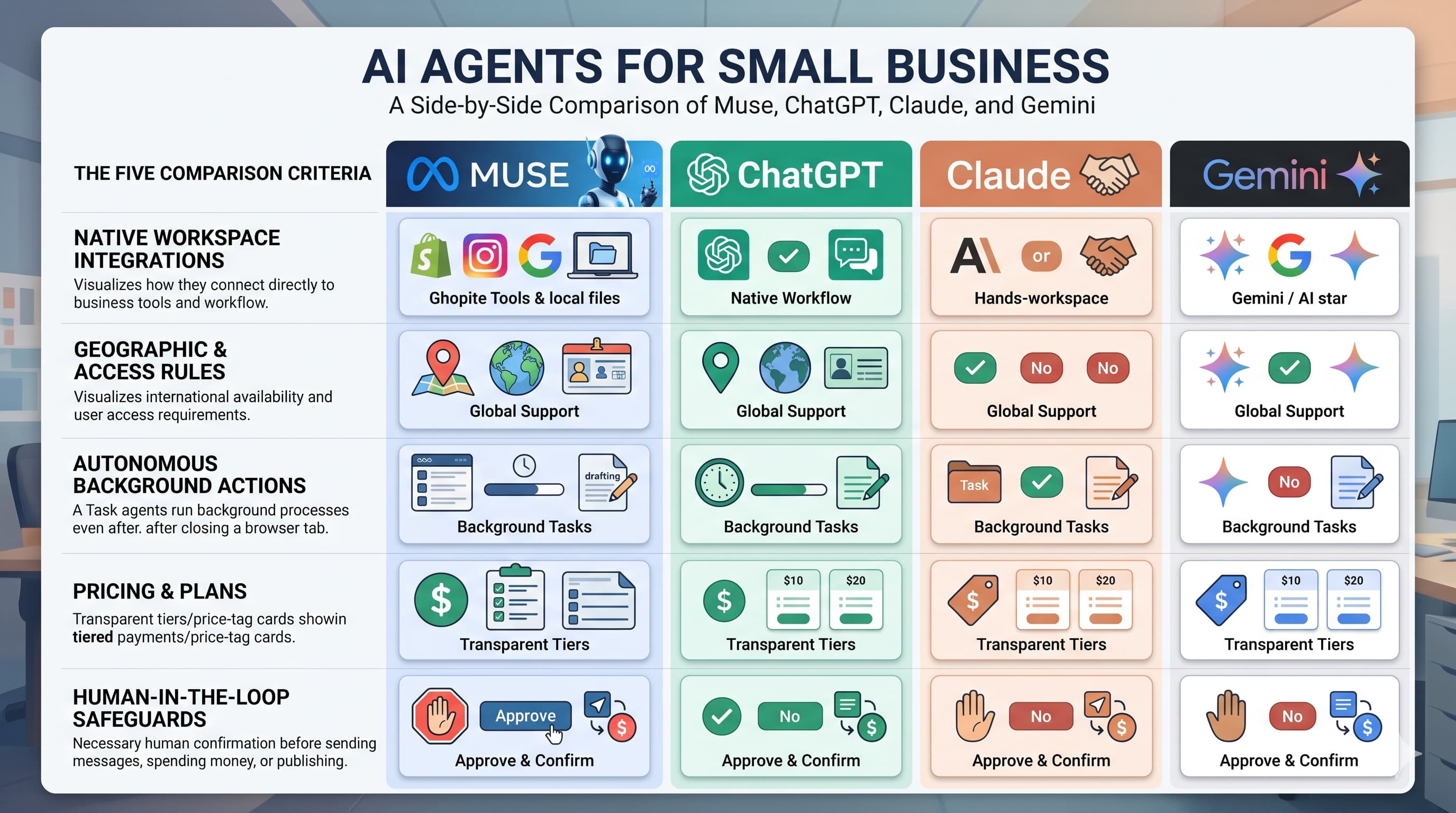
I compared them as agents a shop owner might actually hand work to, not as chatbots you paste a prompt into.
Five things decided the ranking in my notes:
- Where the work already lives: Instagram and Shopify vs Google Workspace vs files on a laptop vs a ChatGPT project.
- Whether I can even open it: Muse is US and Canada, 18 and over. The others are not locked to that map the same way.
- What it can do after I close the tab: draft, queue, research, touch local files, or just chat.
- Cost I can verify: a named plan glued to a dollar on the vendor page. If the vendor did not print it, I left the cell blank.
- What still needs a human: publish, spend, send a customer message.
I didn't run all four on a live bakery for 30 days. I compared vendor copy with independent write-ups, then I threw out numbers those pages could not show on a pricing URL.
Verified October 25, 2026.
Which AI agent is best for a small business?
The best AI agent for a small business in 2026 is the one that sits on top of the tools you already pay for, in a country that will let you in.
That is a boring sentence. It is also the one that saves you a month of “I subscribed to the wrong brain.”
At a glance
- Muse: Best when Instagram, Facebook, ads and Shopify are the shop. US and Canada, 18+. Meta says it is free for most of what people need, with unnamed subscription plans if you want more.
- ChatGPT: Best for research and finished documents. The old “agent mode” name is gone in current product copy. Work is the project-shaped path. Dots is the always-on path. Confirm Plus, Pro and Dots prices in ChatGPT before you pay.
- Gemini: Best inside Gmail, Docs, Drive and Calendar. Google AI Plus is $4.99/month. Google AI Pro is $19.99/month. Spark-style agent features still follow Google’s eligibility rules.
- Claude: Best when the source files are local. Pro is $20/month, or $17/month billed $200 up front. Max starts from $100/month.
Three Meta names get mixed in search. I am splitting them here so you do not pick the image tool when you wanted the shop agent.
- Muse: Meta’s personal AI agent, launched September 8, 2026. Use it for everyday errands for a person.
- Muse for Small Business: Skills and connectors added September 29, 2026. Use it for owner work across shop tools.
- Instagram Muse Image AI: In-app image generator. Use it for pictures, not a shop agent.
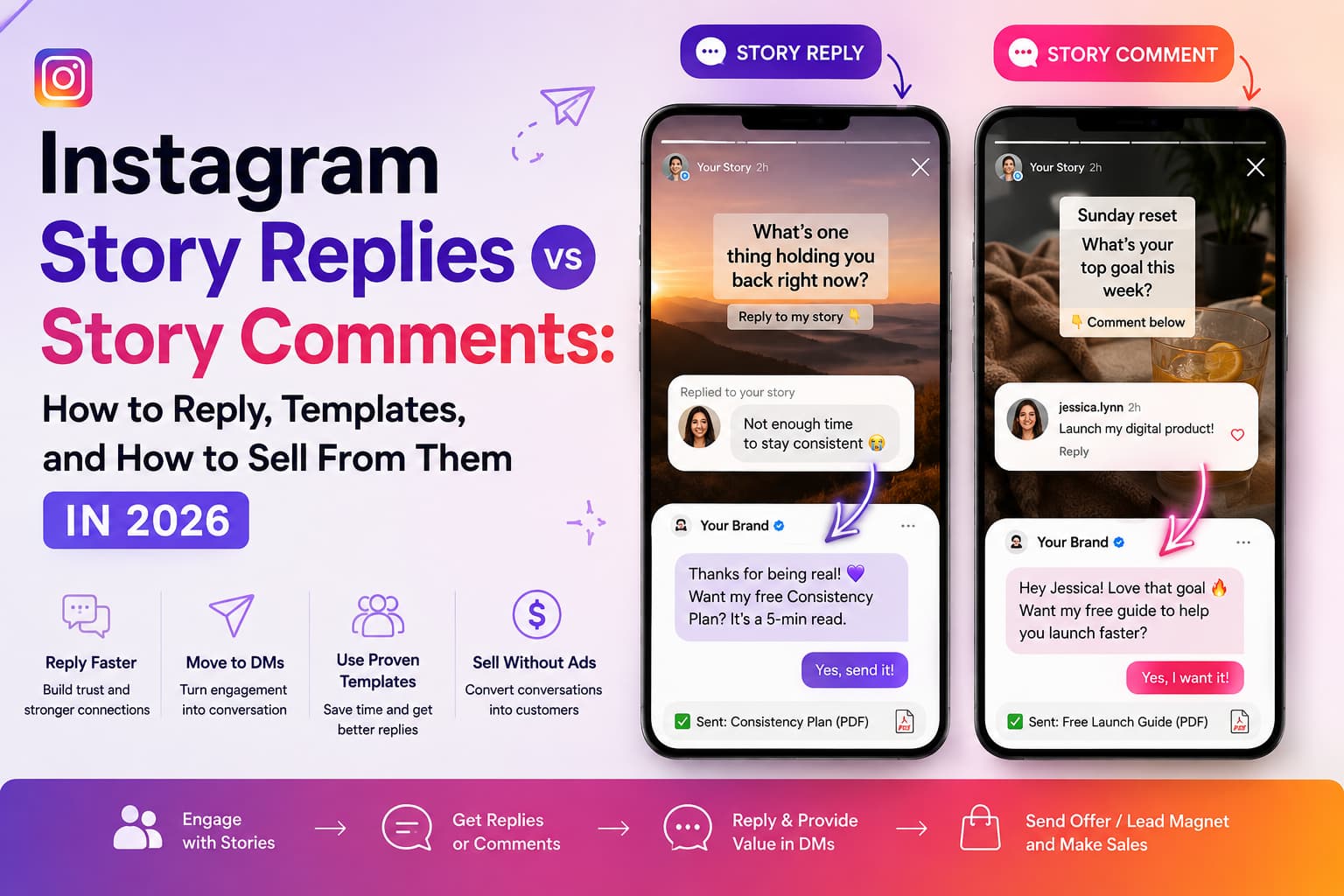
If you landed here because of the image tool, read Instagram's Muse Image AI: What Are the Real Privacy Risks?. That page covers the generator. This one compares agents.
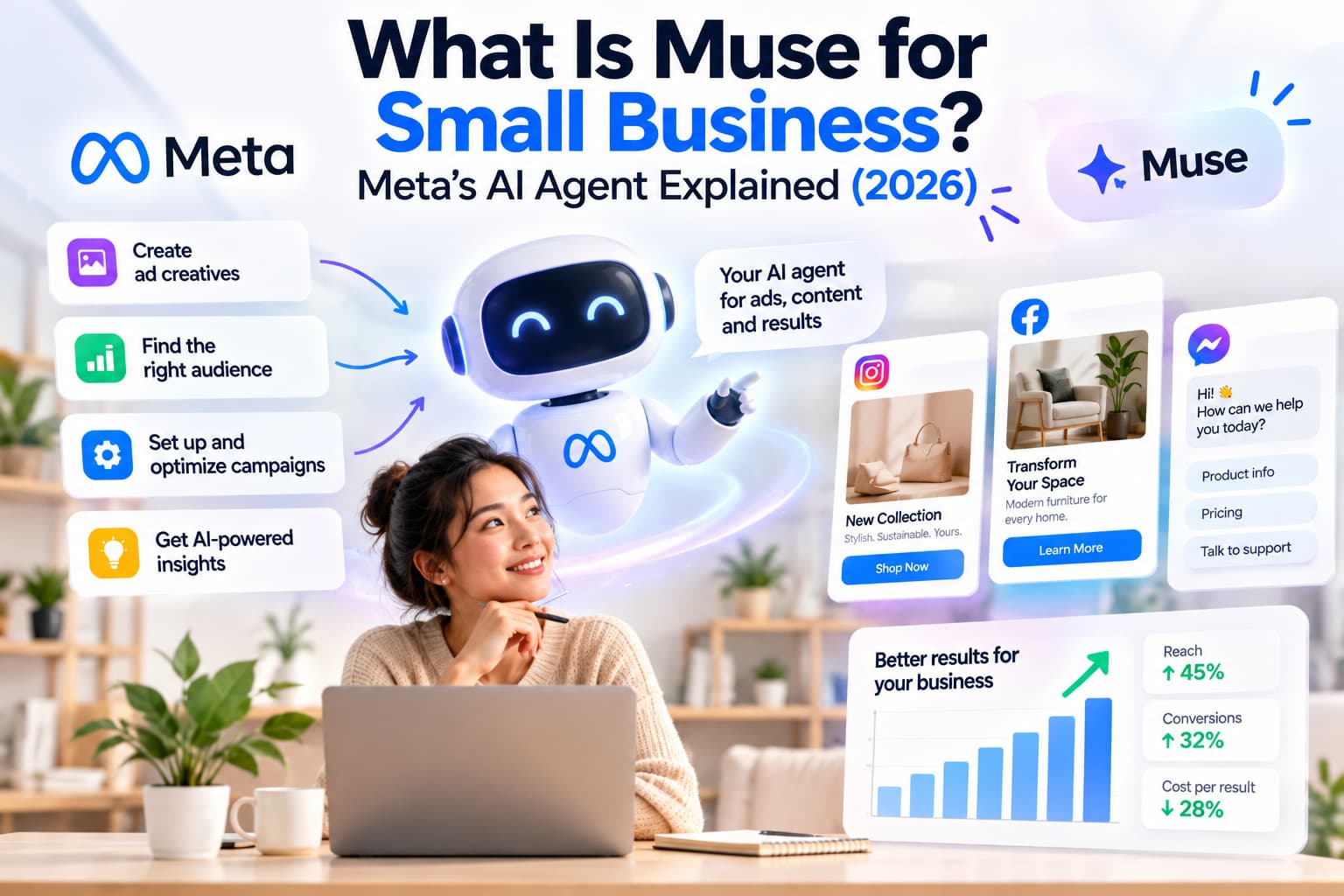
If you only needed the definition, read What Is Muse for Small Business? Meta's AI Agent Explained (2026).
A chatbot answers the question you typed. An agent owns the next step, then waits. If you want that split in full, read AI Agent vs Chatbot: Key Differences, Benefits & Which One Should You Choose?.
| Best for | Pick | Why |
| Instagram, Facebook, Meta Ads, Shopify | Muse | Native Meta/commerce connectors; US/Canada, 18+ |
| Research, documents, decks, spreadsheets | ChatGPT | Strong artifact-production workflow |
| Gmail, Drive, Docs, Calendar | Gemini | Native Google Workspace fit |
| Local files and desktop work | Claude | Best when source files are on the computer |
How do Muse and ChatGPT differ once you have a shop to run?
Muse reads the Meta and commerce tools you connect, then drafts the work and waits. ChatGPT is stronger when the output is a document, a table, a deck or a long research thread that does not have to live inside Instagram.
For muse vs chatgpt for small business, I stopped scoring “smarter” after the first afternoon. Muse already knows what a Facebook Page, a Meta ad account and a Shopify store are. ChatGPT is better at turning a messy brief into something a client can open.
Muse, on Meta’s own page
- Connects Asana, Box, Canva, Dropbox, Figma, Granola, HighLevel, Intuit QuickBooks, Klaviyo, Lovable, Notion, Shopify, Slack, Stripe, Zoom, plus Facebook, Instagram and Meta ads.
- Learns the voice, looks at what is working, and helps you improve ads and content.
- Can plan a month of content, draft a reply, a pitch or a product page.
- Does not publish, send or spend until you approve it. You can undo it.
ChatGPT, as a shop tool
- Wins on writing that has to leave the chat: proposals, SOPs, email sequences you will paste somewhere else, competitive notes.
- The current product split in independent write-ups is Work for a bounded project and Dots for something that keeps going. Confirm that split in ChatGPT before you buy a plan around a blog screenshot.
- It does not wake up already knowing your Instagram professional analytics. You paste, you connect what OpenAI offers, or you live with a gap.
Muse pros
- The shop stack is native: Instagram, Facebook, ads, Shopify, Stripe, QuickBooks.
- Free entry according to Meta, if the weekly cap does not cut you off.
- Approval before publish, send or spend.
Muse cons
- US and Canada only, 18+.
- Meta does not print a named paid plan next to a dollar on the public business page.
- Drafting a customer reply is not the same as sending it in Instagram.
ChatGPT pros
- Best “finish the artifact” agent of the four, in my use.
- Works as a thinking room when the data is not inside Meta.
- Useful when you sell services and the deliverable is a file.
ChatGPT cons
- You will babysit context that Muse would have pulled from Instagram or Shopify.
- Easy to confuse with a custom Instagram inbox bot. It is not one.
I would not run ads spend through either of them on day one. I would let Muse draft the campaign and a human tap yes. I would let ChatGPT write the brief and the landing-page outline.
Where do Claude and Gemini beat both of them?
Muse vs Claude vs Gemini is the comparison I run after the Meta vs OpenAI argument gets loud. Claude wins on local files. Gemini wins on Google Workspace. Muse still wins if the shop is Instagram-first and you can sign up.
Claude
Claude Pro costs $20/month, or $17/month if you pay $200 up front for the year. Max starts from $100/month. Those numbers are on Claude’s pricing page, October 25, 2026.
Claude’s agent path is the one that sits on your computer. The useful fact for a shop: it can see local files and desktop apps in a way Muse, living in Meta’s cloud, does not. Names for that path keep changing (Cowork, computer use, Duet). The local-files part is what matters.
That is the win if your “business” is a folder of invoices, a Numbers sheet, a pile of PDFs, and a human who hates uploading all of that into a new SaaS.
Claude cons: it does not arrive already wired to Instagram insights or Meta ads. You still approve anything that leaves the machine. Max at $100/month is a lot for a one-person shop that only needed a week of file cleanup.
Gemini
Google AI Plus costs $4.99/month. Google AI Pro costs $19.99/month. Both are on Google’s Gemini subscription page, October 25, 2026. Google lists higher tiers. I only quote Plus and Pro, which sit next to a dollar on that page.
Gemini is the obvious pick if your company already lives in Gmail, Calendar, Docs, Sheets and Drive. Spark-style “coworker” features are not the same thing as “I pay for Google One, so I get every agent.” Eligibility is the first gate. Paying Pro does not punch through a country or waitlist rule.
Gemini cons: weak if your customers live on Instagram and your catalog lives on Shopify, and you were hoping the agent would just know that. It knows Google. It does not know your ad account unless you build that bridge.
When I would skip Muse even if I like Meta
- You are outside the US and Canada.
- The real work is in Gmail and Docs, not in Instagram.
- The real work is a folder on a Mac.
- You need a finished 20-page report more than you need a drafted Reel caption.
Is Muse free for small business?
Yes, according to Meta: Muse is free for most of what people need, and there are subscription plans if you want more.
That is the official price sentence on the business page. It does not print $20, $100, Power, Maximum or a weekly token cap. A lot of blogs list those. I left them out of the verified row.
| Tool | Verified (October 25, 2026) | Common blog numbers I could not verify |
| Muse | Free for most of what people need, plus unnamed subscription plans. Same app, not a separate shop SKU. | Power $20, Maximum $100, 100M/500M/3B tokens |
| ChatGPT | Product split: Work for projects, Dots for ongoing help, on paid ChatGPT. | Plus $20, Pro $100, any Dots allowance |
| Gemini | Free. Google AI Plus $4.99/month. Google AI Pro $19.99/month. | “Spark is included with Pro everywhere” |
| Claude | Free. Pro $20/month or $17/month annual ($200 up front). Max from $100/month. | A shop-specific Claude SKU |
Verified October 25, 2026 on Meta’s business page, Claude’s pricing page and Google’s Gemini subscriptions page. Confirm ChatGPT inside your own account.
If Muse’s free week starts refusing jobs, open the paywall in the app. Do not trust a screenshot from early October. Free caps move.
A $20 Claude Pro month is a cleaner number to budget than “Muse has plans.” You can see Claude’s dollar. You cannot see Muse’s on the public business page.
Can you even get Muse, ChatGPT, Claude or Gemini where you live?
Muse is available today to people in the US and Canada who are 18 and over. Meta says it is working on more markets, taking a measured approach, and it has no extra timing to share.
If you run the shop from India, the UK or the EU, Muse is not a live option today. Comparing it with ChatGPT on features is a fantasy exercise. Pick Claude, Gemini or ChatGPT, then stop refreshing Muse waitlist threads.
ChatGPT, Claude and Gemini sell in far more countries. They still have their own waitlists and “not in your region” agent flags. Gemini Spark is the one I see owners trip on: they paid Google AI Pro and still could not get the agent feature the blog described.
Do not make a US Apple ID to “get Muse for the client.” That is a policy mess. It also mixes the client’s shop data into an account that is not theirs.
Age gate: 18+. If you are helping a student side hustle, read that line twice.
What should you let an agent touch?
Let it draft. Make a human tap publish, send and spend.
Meta’s product FAQ is the cleanest version of that rule I found: nothing publishes, sends or spends without your approval, and you can undo it. You also get an audit trail. Conversations are not shared with Meta’s ad systems, according to that same page.
I would still not hand over:
- The only inbox customers use
- The ad account with the open credit line
- A shared team Gmail with no audit
- Card details “so it can buy the domain for me”
Start with read-only work. Instagram insights, a Shopify sales recap, a Drive folder of old proposals. Then one draft. Then one approved send in a thread that is not your main customer line.
Prompt injection is the unsexy risk. If an agent can open email or a web page, someone can hide instructions in that page. Independent roundups beat this drum. They are right. Keep purchase and send behind a tap.
Muse is not “trust it with your life.” It is “trust it to draft next week’s ads, then look.”
How do you pick by the tools you already pay for?
You pick by the stack, then by country, then by price you can actually see.
If the shop is Instagram + Facebook + Shopify
Muse, if you are in the US or Canada. Connect Instagram, the Page, ads and Shopify first. Run one Meta-style prompt: look at this year’s sales and campaigns, then draft a growth plan. Read the plan. Do not auto-publish it.
For muse vs chatgpt for small business on this stack, ChatGPT is the backup writer, not the system of record. Paste the Muse draft into ChatGPT if you need it turned into a client PDF. Do not expect ChatGPT to notice that Reel 4 outperformed Reel 12 unless you give it the numbers.
If the company is Gmail, Docs, Calendar, Drive
Gemini. Plus at $4.99/month is the cheap test. Pro at $19.99/month is the one I would try if Plus feels cramped. Confirm Spark eligibility before you promise a client “the agent will live in our inbox.”
If the work is files on a laptop
Claude Pro at $20/month. Max from $100/month only if you are in it all day and Pro keeps hitting a wall.
If the deliverable is a document and the research is the job
ChatGPT. Pay whatever OpenAI is charging you today after you look at the live paywall.
If you want a directory of agent platforms, not these four consumer agents
That list lives on 10 Best AI Agent Platforms in 2026: Features, Pricing, Pros & Cons.
Where do these agents stop?
They stop at the Instagram inbox, at live spend, and at anything that has to fire when you are asleep without a tap.
Muse can draft a customer reply. It does not replace comment-to-DM. A comment that should get a product link in the private message still needs a Meta-compliant Instagram tool. InstantDM is one option on Legend Pro at $9.99/month billed yearly. It sends the link. It is not a Muse alternative, and it does not host the shop.
If the actual job is automating Instagram DMs with a model in the loop, start with Instagram AI Agents Explained: Automate DMs with ChatGPT.
They also stop at:
- Logging into Ads Manager for you as a permissions puzzle
- Replacing QuickBooks or Shopify admin
- Being Instagram’s image generator
- Running while you pretend you did not need a human in the loop
I keep seeing owners buy four subscriptions because a roundup scored “intelligence.” One agent on the stack you already have beats four agents you babysit.
Common mistakes I still see
Treating Muse Image AI as the shop agent. Different product. Pictures vs owner work.
Printing $20 / $100 as Meta’s price. Those figures show up in blogs. They did not show up on the public business page I checked.
Comparing Muse from India as if the waitlist were a feature list. You cannot log in. The comparison is over.
Handing the ad account to any of them on day one. Draft, then approve.
Using ChatGPT as an Instagram bot. ChatGPT will talk. Instagram will still need a proper messaging setup.
Paying Google AI Pro and assuming Spark showed up. Eligibility first.
Buying Claude Max because Max sounds like “business.” Max is usage. Pro is the shop starting point.
About the Author
Aravindh Kumar is an ecommerce and Instagram growth expert with 8+ years of experience in online selling. He has worked with 500+ brands, including Forbes-listed companies, helping them build profitable Instagram sales channels. He has helped 200+ Instagram businesses grow their online presence.